Success story · Video Q&A for public figures · USA
AskOnCamThree people launched a US video Q&A service on its own streaming in six weeks, where others staff whole teams
AskOnCam lets an audience ask questions on camera, vote on them and hear the top ten answered live. I am its fractional CTO and I own the technical side end to end: the architecture, the streaming infrastructure, the team of two engineers and every new hire. The MVP launched six weeks after the start, and its streaming runs with under a second of latency. The company got a full technology leader and a media stack of its own without paying for a full-time executive or a large engineering department.
- Client
- AskOnCam
- Product
- Audio and video Q&A for public figures
- Market
- USA
- Launch
- MVP in 6 weeks
- Streaming latency
- Under 1 second
- My role
- Fractional CTO, the whole technical side
- Team
- 2 engineers and me
- Website
- askoncam.com
In numbers
- from start to a launched MVP, with two engineers and me
- 6 weeks
- streaming latency on a stack the company owns instead of renting
- <1 s
- per video question, captured and played back on the stack I built
- 60 s
- questions the audience picks, and the creator answers them live
- Top 10
- two engineers and me cover what usually takes a media tech department
- 2 + 1
The product
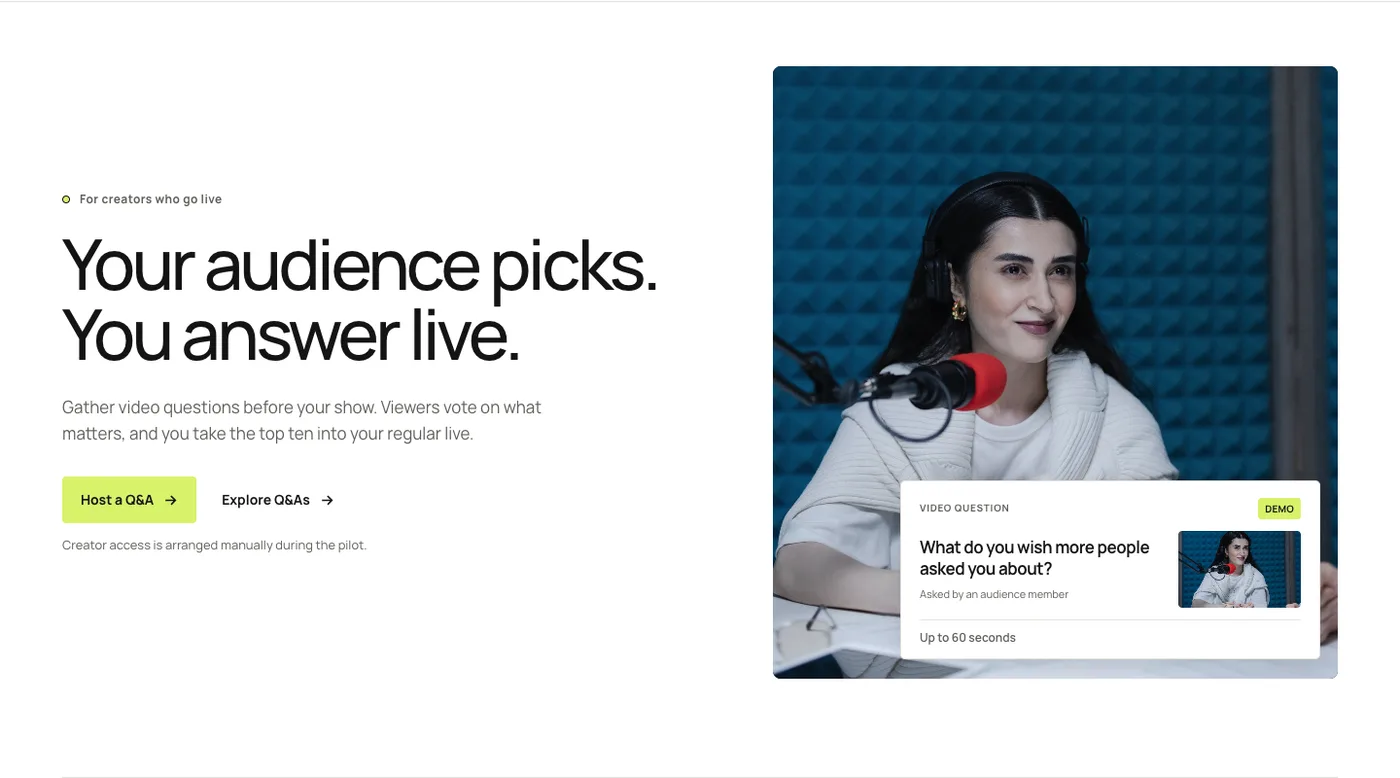
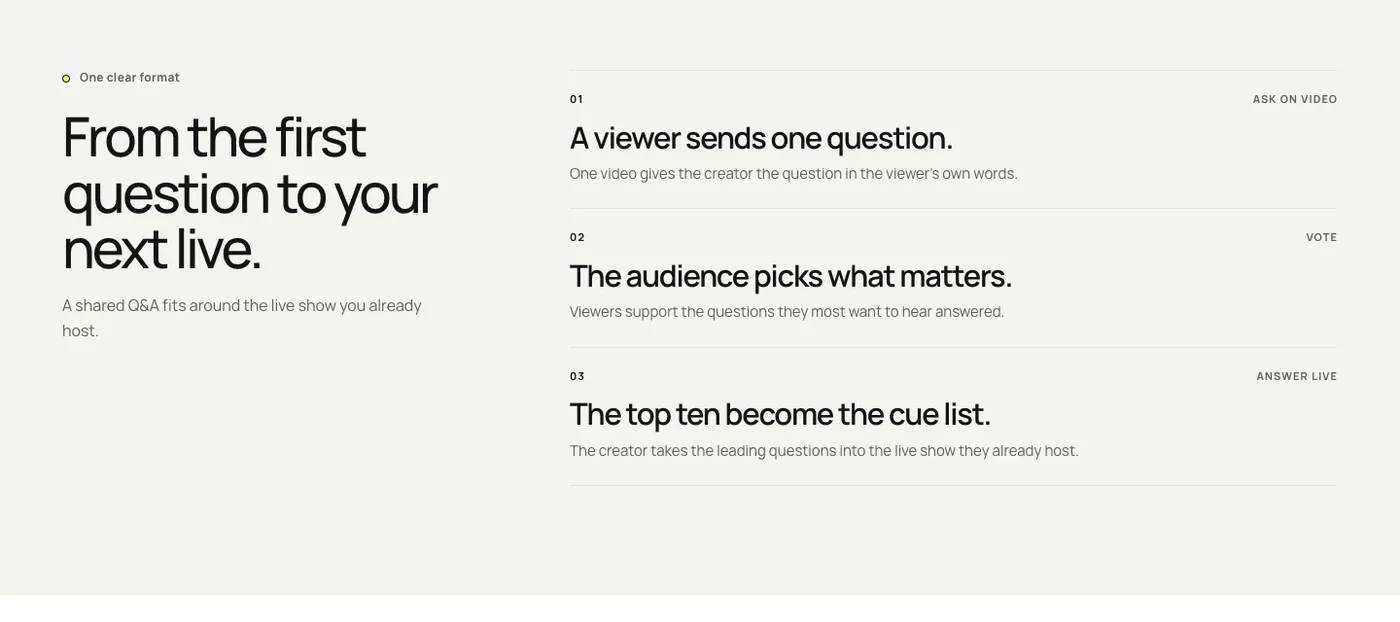
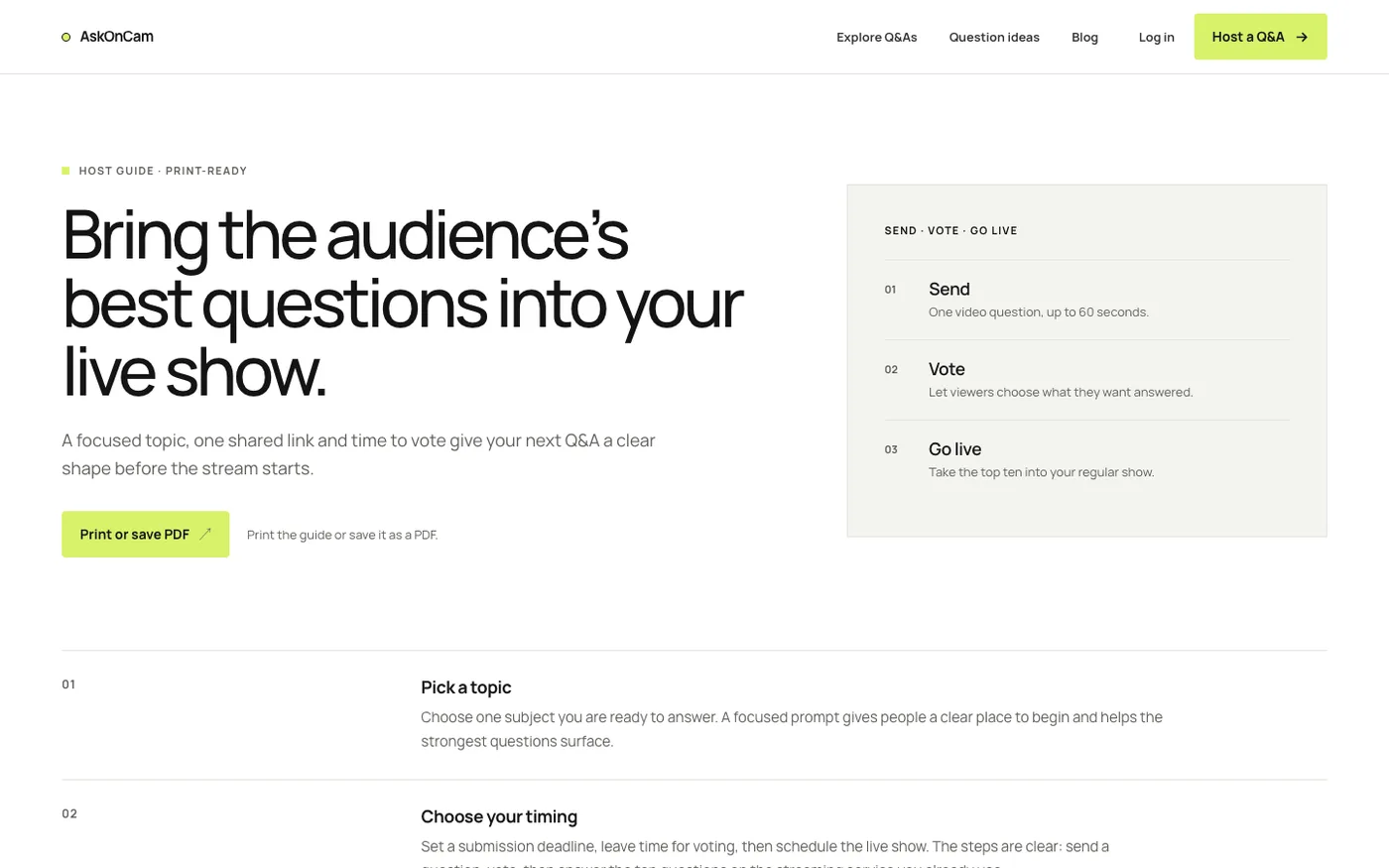
A viewer asks on camera, the audience votes, and the creator answers the top ten live. Pictures from askoncam.com.
The starting point
Public figures who go live get far more questions than they can answer, and a thoughtful question scrolls away in a fast chat. AskOnCam gives every question a place to land before the stream: a viewer asks on camera, the audience votes, and the creator takes the top ten into the live show.
The service is built for the US market and runs on audio and video from the first question to the answer. So it needed media infrastructure from day one, and a technical lead who could design it, build it and grow the team around it, without the cost of a full-time executive.
What we did
One architecture for the whole service, with one owner
I designed the architecture of the whole service: audio and video questions, voting, the creator's cue list and the public Q&A pages. With one person owning the design, there are no gaps between parts built to different plans.
Sub-second streaming the company owns instead of rents
I built the streaming infrastructure. It takes a viewer's question on camera, stores it and plays it back to the audience and to the creator, with under a second of latency. The company owns the core of its product instead of renting it from a video vendor, which keeps both the cost and the control in its own hands.
Infrastructure tuned for the US audience
I built the infrastructure the service runs on and set it up for its target market, the United States, so viewers and creators there get the fast playback a live format depends on.
An MVP in six weeks from a team of two engineers
I run the technical team: two engineers, the plan they work to and the engineering standards they keep. With clear priorities and firm standards, the team launched the MVP six weeks after the start and keeps shipping what companies usually hire a much larger team for.
Hiring only as fast as the product needs
I hire every new person who joins the team, so the team grows as the product does, payroll never runs ahead of the roadmap, and every hire meets the same bar.
A format that plugs into the creator's own show
A viewer records one question of up to 60 seconds, the audience votes, and the top ten become the cue list for the live show the creator already hosts, so creators adopt it without changing how they work.
The result
AskOnCam's MVP launched six weeks after the start, and the service now works in its creator pilot on streaming infrastructure it owns, with under a second of latency. One fractional CTO covered the whole technical side, from architecture to hiring, at a fraction of what a full-time executive and a larger team would cost.
Full case · PDF
AskOnCam
Three people launched a US video Q&A service on its own streaming in six weeks, where others staff whole teams
- 01The service architecture
- 02The streaming infrastructure the company owns
- 03How a video question travels from the viewer to the show
- 04Voting and the creator's cue list
- 05Infrastructure for the US market
- 06The team and the hiring plan: how three people carry the product
The full AskOnCam case
The public story stops here. The PDF has the rest: the architecture before and after, the migration plan, how the team works with AI agents, what it all costs to run and where the savings came from.
More stories
All stories
Want the next story to be about your company?
In a 30-minute call we pick the first task to hand to AI and estimate what it will save you.