Give your AI plans a clear owner
I lead your AI priorities, budget and rollout. Your team gets a practical plan and someone responsible for seeing it through.
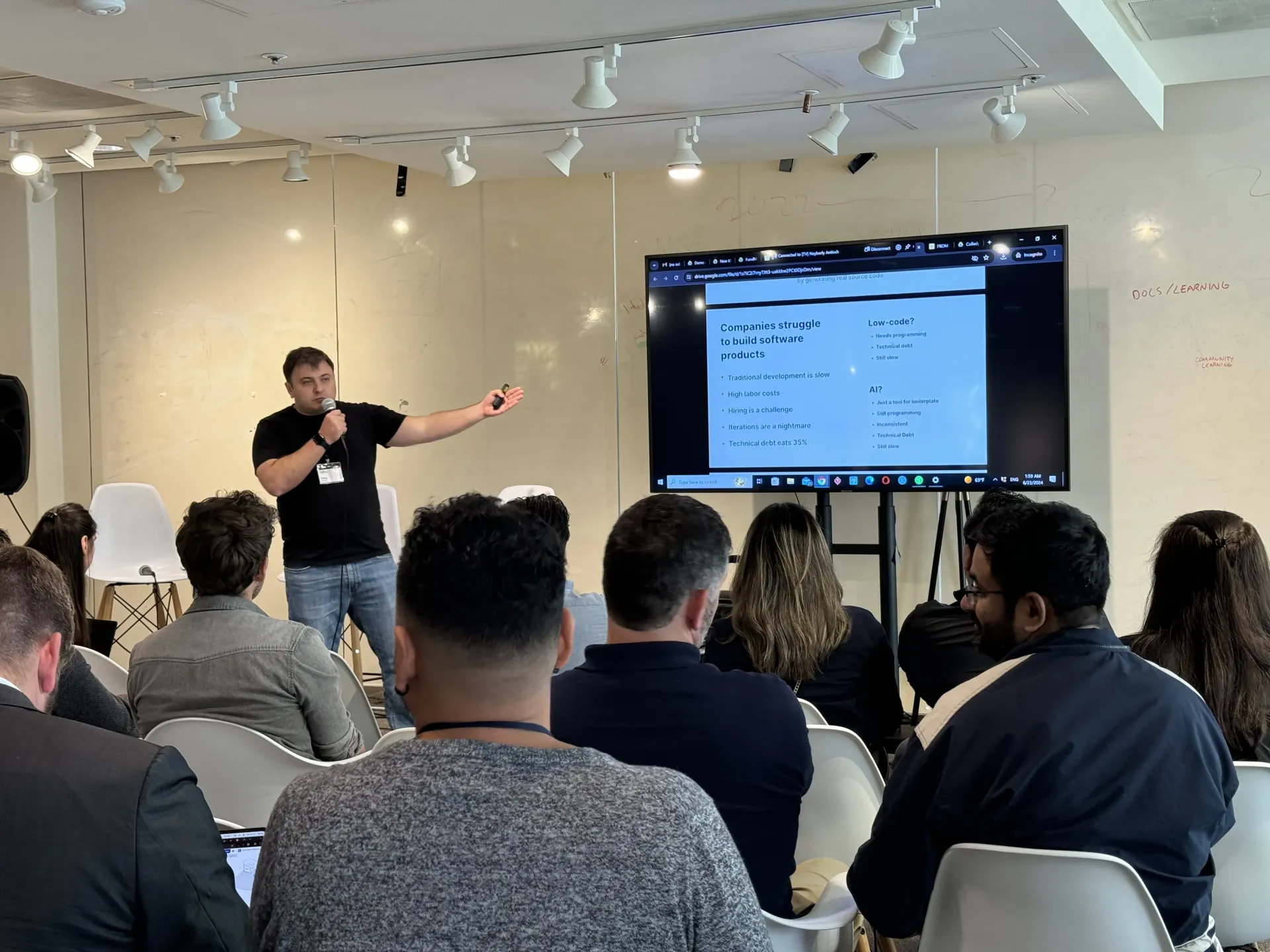
A fractional Chief AI Officer is a part-time executive who owns a company's AI strategy, governance, model and vendor choices, spend, and adoption — the same accountability as a full-time CAIO, at a fraction of the time and cost. Oleg Sotnikov holds that role for mid-size companies that need the function but not the headcount: he sets the AI roadmap, writes the policy, controls LLM spend, and reports progress to the board. He ran the same transformation inside his own company first, taking AppMaster from 25 people to 2 while production moved 11B+ tokens a month.
What the Role Covers
Six responsibilities that usually sit unclaimed between the CTO, the CFO, and legal.
AI strategy and roadmap
A ranked list of where AI changes your unit economics, with an owner, a date, and a number attached to each item. The board gets something it can hold a person to.
Governance, policy, and risk
Written rules for what data may reach which model, who approves a new tool, and how output gets reviewed before a customer sees it. Where certification matters, I run the ISO/IEC 42001 readiness work.
Model and vendor selection
Which models, which vendors, what stays in-house, and what you sign. I re-examine those choices on a schedule, because the frontier moves faster than procurement cycles.
LLM spend oversight
Token spend becomes a serious line item well before finance notices. I set per-team budgets, routing rules per workload, and dashboards that show cost per feature instead of one number at month end.
Team enablement
Engineers on Claude Code and Codex, analysts on agents, support on retrieval over your own documentation. I measure adoption: who uses what, on which work, and what it does to throughput.
Board and investor reporting
One page a month — what shipped, what it cost, what moved in the numbers, which risks are still open. Written for people who will never read a model evaluation.
How the Engagement Runs
Assess
Two to three weeks across your products, data, team, and current AI spend. You get a short, direct answer on where AI pays off in this business and where it would only look good in a deck.
Operating plan
Roadmap, usage policy, budget, and decision rights, all written down. Everyone knows who approves what before the first tool goes in.
Embedded rhythm
A fixed weekly cadence with your leads, monthly reporting for the board, and adoption metrics you can read without asking me. Month-to-month, end at month-end.
Why Me
- I ran this transformation on my own company first — AppMaster went from 25 people to 2, with 11B+ tokens a month in production
- Forbes Technology Council member, which is mostly practice at explaining technical bets to the people who fund them
- 25+ years of engineering leadership and 7 patents, so the roadmap survives contact with your architecture
Frequently Asked Questions
What does a chief AI officer do?
A chief AI officer owns how a company uses AI end to end: the strategy and roadmap, the policy for what data goes where, the choice of models and vendors, the budget, and adoption inside the teams. The role exists because those decisions otherwise get split between the CTO, the CFO, and legal, leaving nobody accountable for the result. In a fractional arrangement the same responsibilities are held part-time by someone who has done the work before.
Do we need a CAIO or an AI consultant?
Consulting fits a defined project. A fractional CAIO fits an ongoing need for part-time AI leadership. Both formats can include implementation; the difference is the scope of responsibility and duration.
How does the fractional model work?
A part-time Chief AI Officer works embedded: a fixed cadence with your leads, presence in the channels where decisions actually get made, and a monthly written report for the board. Most companies need one to two days a week — heavier at the start while the plan and policy get built, lighter once the operating rhythm holds. Engagements run month-to-month with the option to end at month-end.
What does a fractional CAIO cost?
It is scoped per engagement, because the work depends on how many teams, products, and regulators are involved. My fractional and advisory retainer ranges are published on the pricing page, and a CAIO engagement is quoted the same way: one monthly number agreed in writing before anything starts, month-to-month, end at month-end. The intro call is free and usually enough to tell whether this shape fits your situation.
How do you handle AI risk and governance?
Governance comes first, because the policy decides what the roadmap is allowed to do. I write the data-handling rules, the approval path for new tools, the human-review requirement for anything customer-facing, and the procedure for when a model produces something it should not have. When a customer or a regulator asks for a certificate, that same material becomes the base for ISO/IEC 42001 readiness.
Put Someone in the AI Chair
Thirty minutes on where your AI spend, risk, and roadmap sit today, and whether a fractional CAIO is the right shape for the next year.
Month-to-month work. You can end the engagement at the close of a month.
Let’s discuss your project
A free 30-minute call with Oleg to discuss your situation and choose a practical first step. No commitment.
A couple of sentences is enough: what does your company do, and what do you want to improve?
Related reading
AI strategy, governance, and what running an AI-first company actually costs.


