Find out whether your AI idea works
Test the idea on your own data before committing to a larger build. In two weeks, you get a working prototype and a clear next decision.
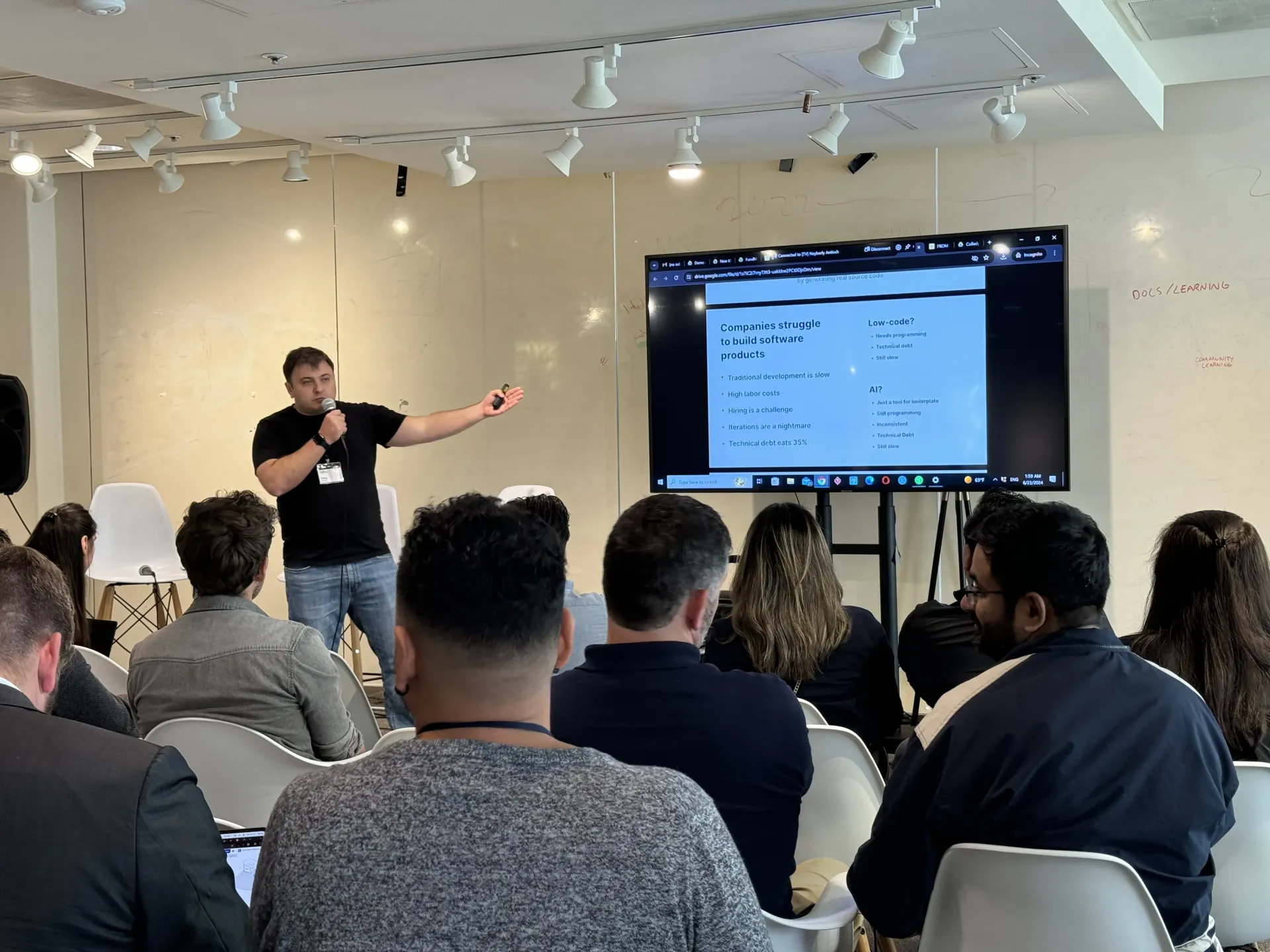
An AI proof of concept is a short, fixed-price build that tests one product hypothesis against real data and real integrations before you commit an engineering budget to it. Oleg Sotnikov delivers these in two weeks: the work is agent-built with Claude Code, Codex, and agent pipelines, which is what makes that timeline realistic. Success criteria are written down before anything is built, so demo day ends in a decision rather than a debate — kill the idea cheaply, iterate on it, or take it to an MVP.
What Makes Two Weeks Enough
Six choices that turn a short build into evidence you can decide on.
One hypothesis, not a roadmap
We cut the idea down to the single claim that decides whether the product is worth building — the one that costs the most to get wrong. Everything else waits for the MVP.
Agent-built delivery
The build runs on coding agents: Claude Code, Codex, and the pipelines I maintain for my own products. That is the reason two weeks produces a working flow instead of a clickable mock.
Real integrations
Your API keys, your database, your CRM or payment provider. A PoC running on fixture data proves the demo works; it says nothing about whether the product does.
Eval-first quality bar
Before anyone writes code we define how we'll measure that the AI actually works: the test cases, the accuracy and latency thresholds, and what counts as a failure. The eval set is a deliverable, and it outlives the PoC.
Token economics checked
I measure what the feature costs to run per request and project it at your expected volume. Better to find out in week two that it only works at a loss than after launch.
A path to production
The PoC is built so the parts worth keeping — data model, integrations, prompts, eval sets — carry into the MVP. I tell you plainly which parts are scaffolding meant to be thrown away.
How It Works
Scoping call
We go through the idea, the data you already have, and the systems it has to touch, then narrow it to one hypothesis a two-week build can settle.
Fixed quote and success criteria
You get a fixed price, a written scope, and the criteria the PoC will be judged against, including how we'll measure that the AI works. Nothing starts until you approve all of it.
Two-week build, then demo
I build, you see progress as it lands, and at the end we run the demo against the criteria. Three outcomes are all fine: kill it cheaply, iterate on what we learned, or move to the MVP with me as your fractional CTO if you want that continuity.
Why Me
- 1,000+ projects built over 25+ years — I've seen which prototypes turn into products and which ones stall
- Agentic delivery is my daily work: AppMaster runs on it and processes 11B+ tokens a month
- I introduce AI into AppMaster’s own workflows and bring that experience to testing new ideas.
Frequently Asked Questions
How much does an AI proof of concept cost?
Scope and commercial terms are agreed at the scoping call, before any work begins. The key inputs are the number of integrations, access to real data, and the quality bar. If the PoC becomes ongoing work, we agree the next engagement before it starts.
What can you actually build in two weeks?
One core flow, end to end, running on your real data and live integrations, measured against the criteria we agreed. What you don't get is a product: no admin panel, no billing, no multi-tenant setup, and only the edge cases that matter to the hypothesis. If two weeks can't settle your question, I say so at scoping instead of selling you a build.
What happens after the proof of concept?
Demo day ends in one of three decisions: stop, because the evidence says no; iterate, because the idea holds but the approach needs another pass; or go to production, where we build the MVP with AI agents on the same eval harness. On the production path I can stay on as your fractional CTO, or hand the work to your team with the eval sets and documentation needed to run it.
Who owns the code and the deliverables?
You do. Code, prompts, eval sets, infrastructure configs, and documentation are yours from day one, in your repositories and your accounts. There is no license to renew and nothing you have to buy from me later to keep using what was built.
What if the PoC shows the idea doesn't work?
If the test does not support the idea, you get the results and reasons. Use them to change the approach or stop before committing to a larger build.
Keep the PoC honest in production
A proof of concept that ships needs tracing, eval sets, and drift alerts behind it. AI observability is what keeps the demo's quality intact once real users arrive.
See AI observability & evalsTest the Idea Before You Fund It
One hypothesis, two weeks, a fixed price agreed up front. At the end you know whether it's worth building.
You keep everything the PoC produces — code, prompts, eval sets, and infrastructure.
Let’s discuss your project
A free 30-minute call with Oleg to discuss your situation and choose a practical first step. No commitment.
A couple of sentences is enough: what does your company do, and what do you want to improve?
Related reading
Building with coding agents, measuring AI quality, and what makes a prototype survive to production.


