Case study · Rescuing AI-built code · Worldwide
FixMyMess100+ broken AI-built apps rescued in 48 hours on average, 5 to 10 times cheaper than a rewrite from scratch
FixMyMess takes apps that founders built with AI and shipped to production before finding them broken, and makes them work: diagnosis, repair, refactoring, security and shipping. A rescue like that usually means weeks of agency work or a rewrite from scratch. We turn one around in 48 hours on average for 5 to 10 times less than a rewrite would cost. The rescue succeeds in 99% of cases, and the founder keeps the product and the users. I was hired as fractional CTO specifically to build this team and run it. Four engineers have fixed more than 2 million lines of AI-written code and closed more than 1,000 vulnerabilities for clients in more than 20 countries, on the architecture, the pipeline and the quality bar I set.
- Client
- FixMyMess
- Service
- Fixing AI-built apps that fail in production
- Market
- Worldwide, clients in 20+ countries
- My role
- Fractional CTO, hired to build and lead the team
- Team
- 4 engineers, 100+ rescues, 99% of them successful
- Security
- 1,000+ vulnerabilities closed
- Website
- fixmymess.ai
In numbers
- cheaper than rewriting the app from scratch
- 5–10×
- of rescues succeed, and the founder keeps the product and users
- 99%
- average turnaround, where rescues usually take weeks
- 48 h
- of the hardest rescues worldwide, done by a team of four
- 100+
- lines of AI-written code fixed by four engineers
- 2M+
- vulnerabilities closed before the code went back to production
- 1,000+
The service
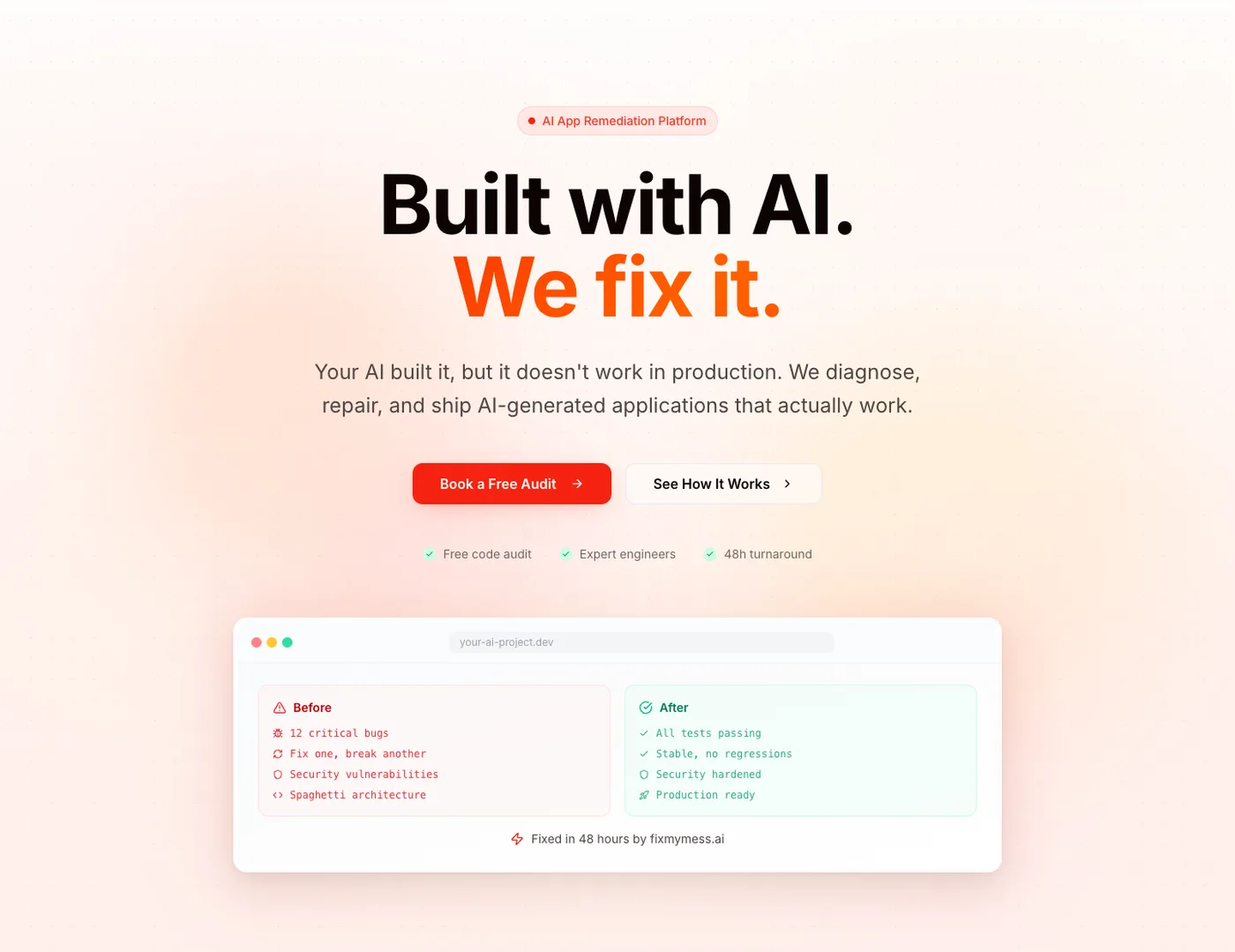
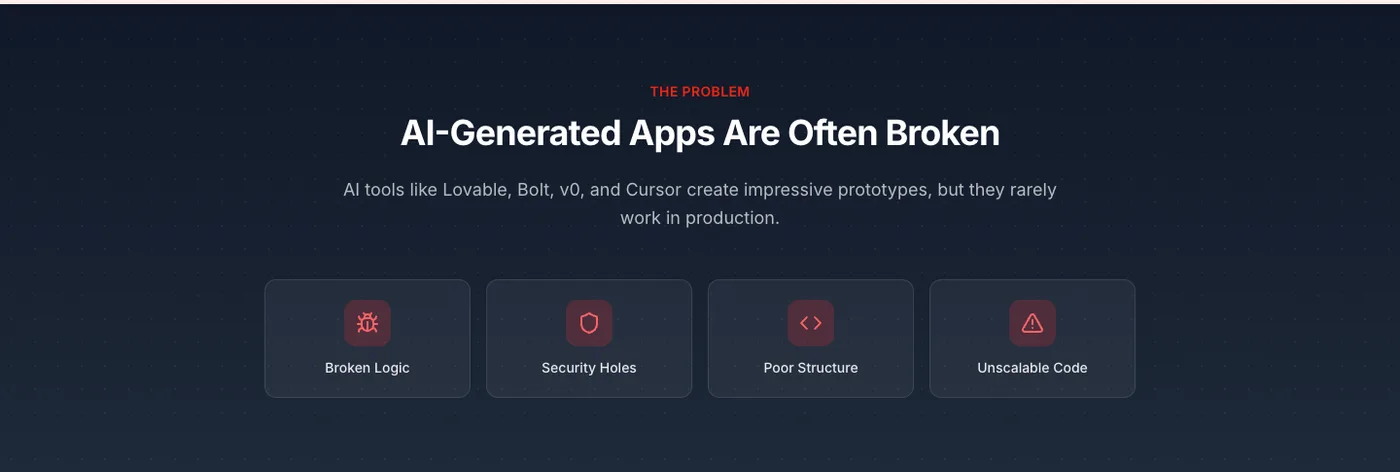
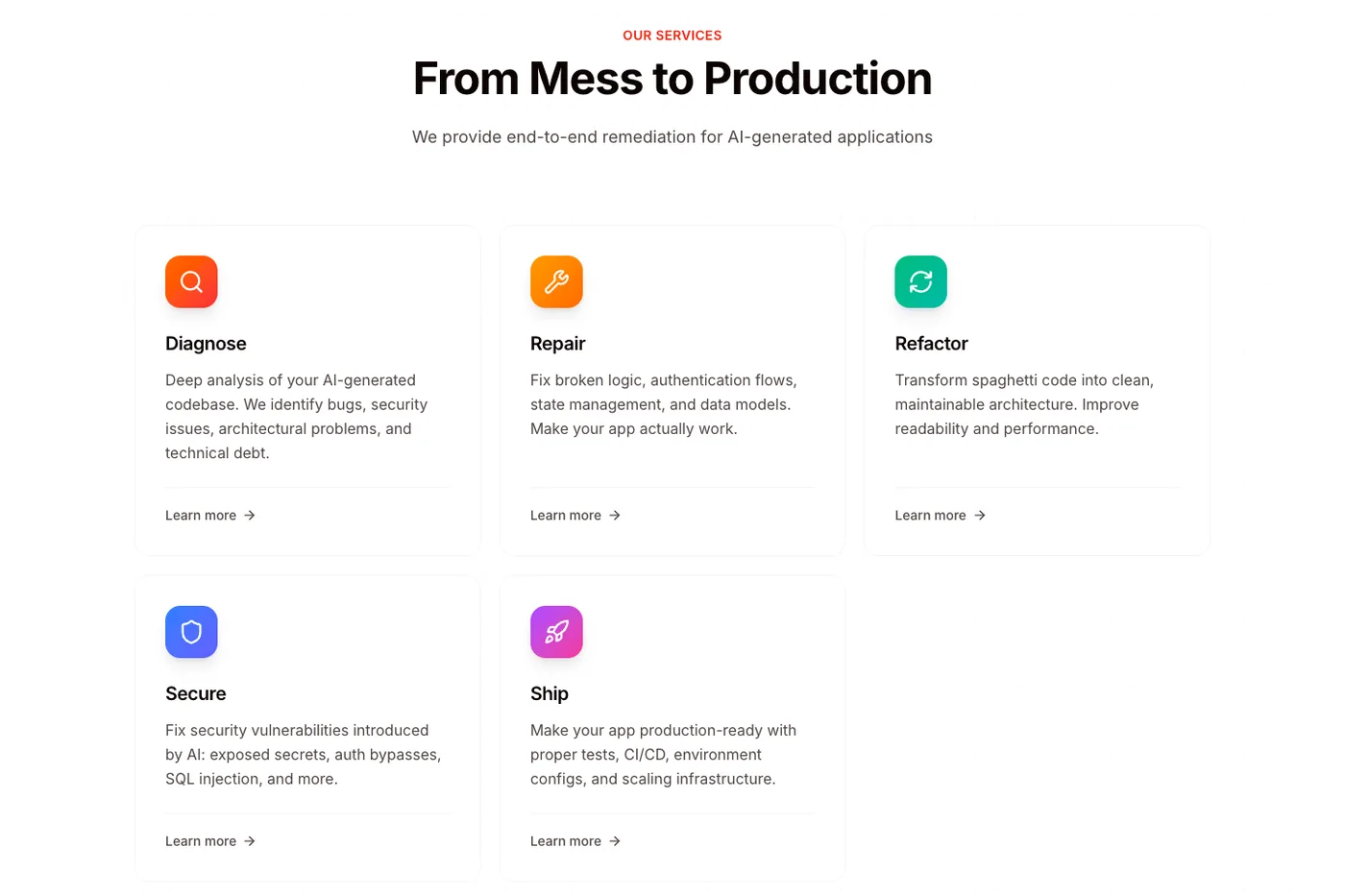
Built with AI, shipped by professionals: the last 10% an AI-built app cannot reach, the wall it stops at, and the playbook that gets it to production. Pictures from fixmymess.ai.
The starting point
AI tools like Lovable, Bolt, v0 and Cursor let founders build fast. Many of them find out too late that it is going wrong: the app is already in production with real users, and every fix breaks something else.
These are the hardest cases in software. The code came from a machine, nobody on the team wrote or understands it, and it is live in production. The usual answer is a rewrite from scratch, which costs months and puts the users at risk. FixMyMess needed a team that could take such cases on professionally and fast, and a CTO to build that team.
What we did
I built a team for the hardest cases
I was brought in specifically to build this team and run it: four engineers who clean up and fix AI-built codebases that have hit a dead end. Four people handle a caseload that would keep a much larger agency busy.
Rescued code the business can grow on
I own the architecture, case by case. Every codebase we rescue leaves with a structure that can carry the product forward, instead of a patched version of the mess, so the founder never pays for the same rescue twice and pays 5 to 10 times less than a rewrite from scratch would cost.
One pipeline that makes every rescue fast
Every project runs through the pipeline I set up: diagnose, repair, refactor, secure and ship. AI-assisted tooling does the heavy lifting at each step, and a person verifies the result. That is how four engineers turn a project around in 48 hours on average.
Production quality without a QA department
I oversee the work so that everything leaving the team is clean: the tests pass, there are no regressions, the security holes are closed and the code is ready for production. We have closed more than 1,000 vulnerabilities this way, and the founder gets that result without hiring a QA department.
100+ rescues in 20+ countries
The team has fixed more than 100 of the hardest cases and more than 2 million lines of AI-written code for clients in more than 20 countries, and 99% of our rescues succeed. Our clients are founders and owners who started building on their own, shipped to production and then needed professional help.
Any AI builder, 48 hours on average
We take apps built with Lovable, Bolt, v0, Cursor, Replit and ChatGPT and turn them around in 48 hours on average. Most agencies do not offer that turnaround even on code their own people wrote.
The result
Four engineers I hired and lead have rescued more than 100 of the hardest AI-built codebases for clients in more than 20 countries, in 48 hours on average and 5 to 10 times cheaper than a rewrite, and 99% of those rescues succeed. Founders keep their product and their users.
Full case · PDF
FixMyMess
100+ broken AI-built apps rescued in 48 hours on average, 5 to 10 times cheaper than a rewrite from scratch
- 01How I built a team of four for the hardest cases
- 02The rescue pipeline behind a 48-hour turnaround
- 03Architecture patterns for rescued codebases
- 04The security holes AI leaves behind
- 05Three rescues, anonymised
- 06The quality bar every fix must meet
The full FixMyMess case
The public story stops here. The PDF has the rest: the architecture before and after, the migration plan, how the team works with AI agents, what it all costs to run and where the savings came from.
More case studies
All case studiesWant the next case study to be about your company?
In a 30-minute call we pick the first task to hand to AI and estimate what it will save you.