Case study · Cloud machines for AI coding agents · USA and worldwide
detachboxA founder, a fractional CTO and one engineer took detachbox from an idea to a commercial product in three weeks
detachbox gives Claude Code, Codex and other CLI agents an always-on Linux box: the developer closes the laptop and the agent keeps working, on the Claude or Codex subscription the developer already pays for. We built it as founder → fractional CTO → engineer, with no team in between, and it went from the founder's idea to paid plans in three weeks. I own the architecture, the infrastructure, the code review and the technical direction, and we keep developing it. No subscription token or API key ever lands in a box, which makes detachbox one of the safest ways to run remote agents on your own subscription.
- Client
- detachbox
- Product
- Always-on boxes for AI coding agents
- Model
- Your own Claude or Codex subscription
- Main market
- USA, plus the rest of the world
- My role
- Fractional CTO and startup advisor
- Team
- Founder, 1 engineer and me
- Website
- detachbox.com
In numbers
- from the founder's idea to a commercial product with paid plans
- 3 weeks
- subscription refresh tokens or API keys inside a box, even with sudo
- 0
- agents preinstalled: Claude Code, Codex, OpenCode and Gemini CLI
- 4
- to roll a box back to a snapshot
- 2–6 s
- a month for a box that never sleeps, where Codespaces left on costs about $135
- $19
- for the limits and reset times of every Claude and Codex subscription
- 1 screen
The product
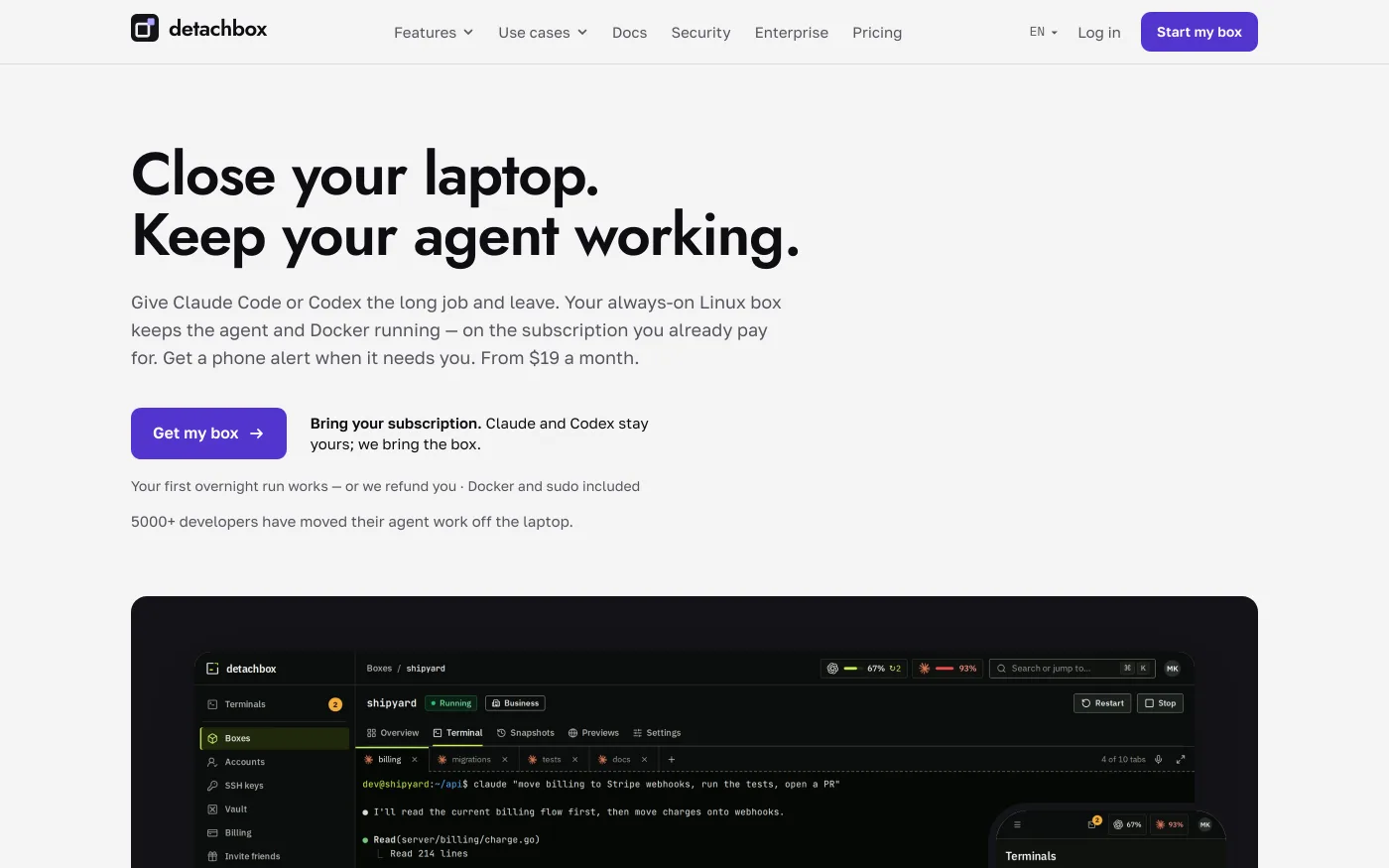
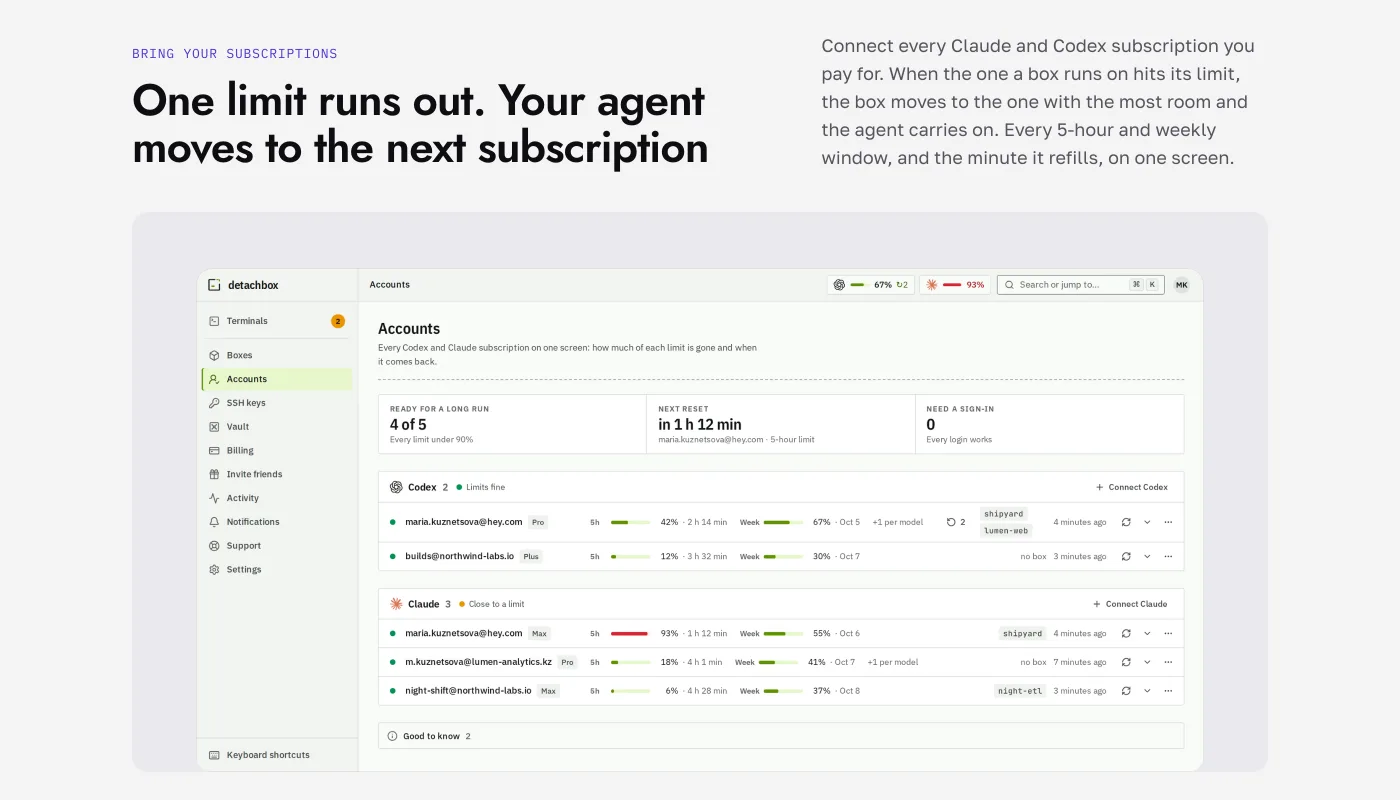
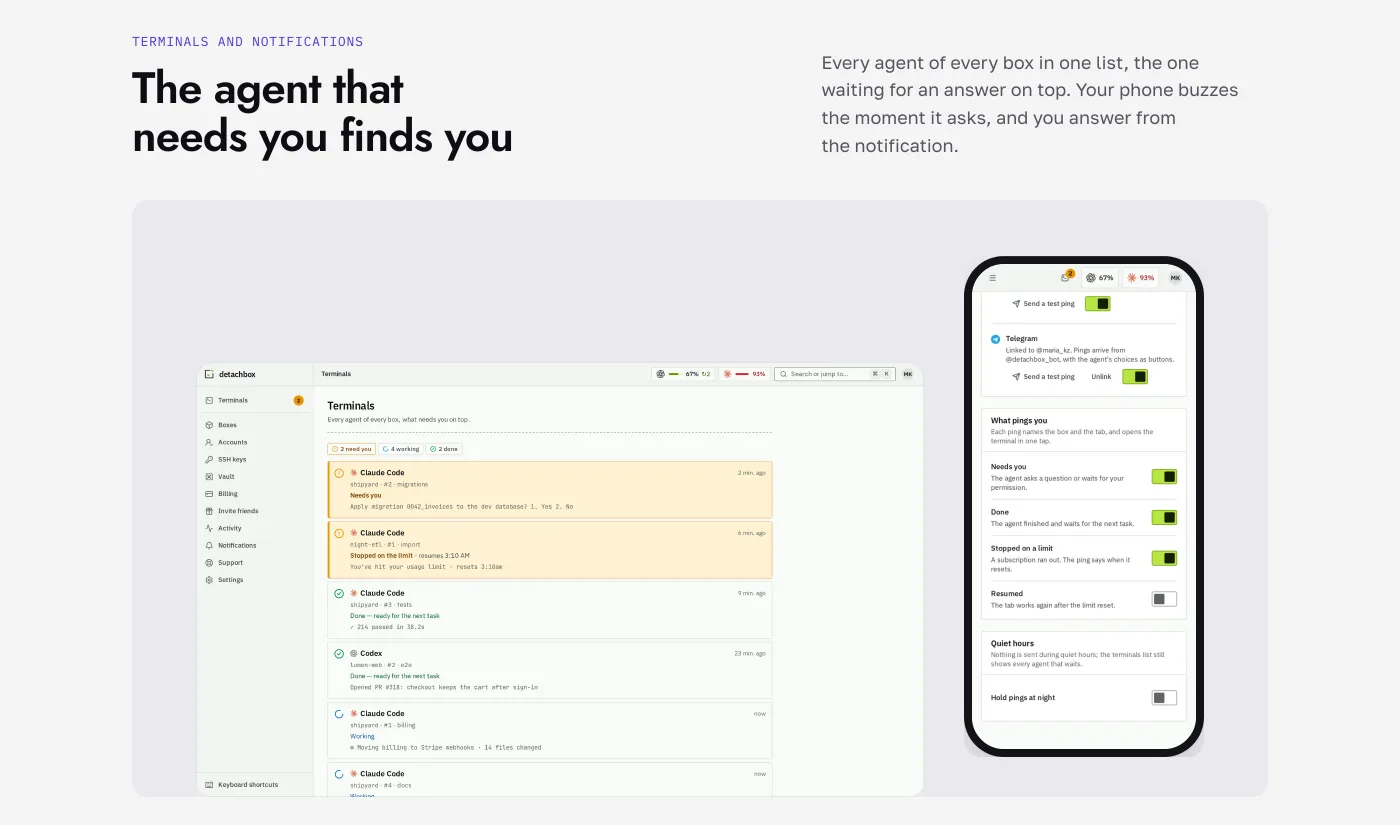
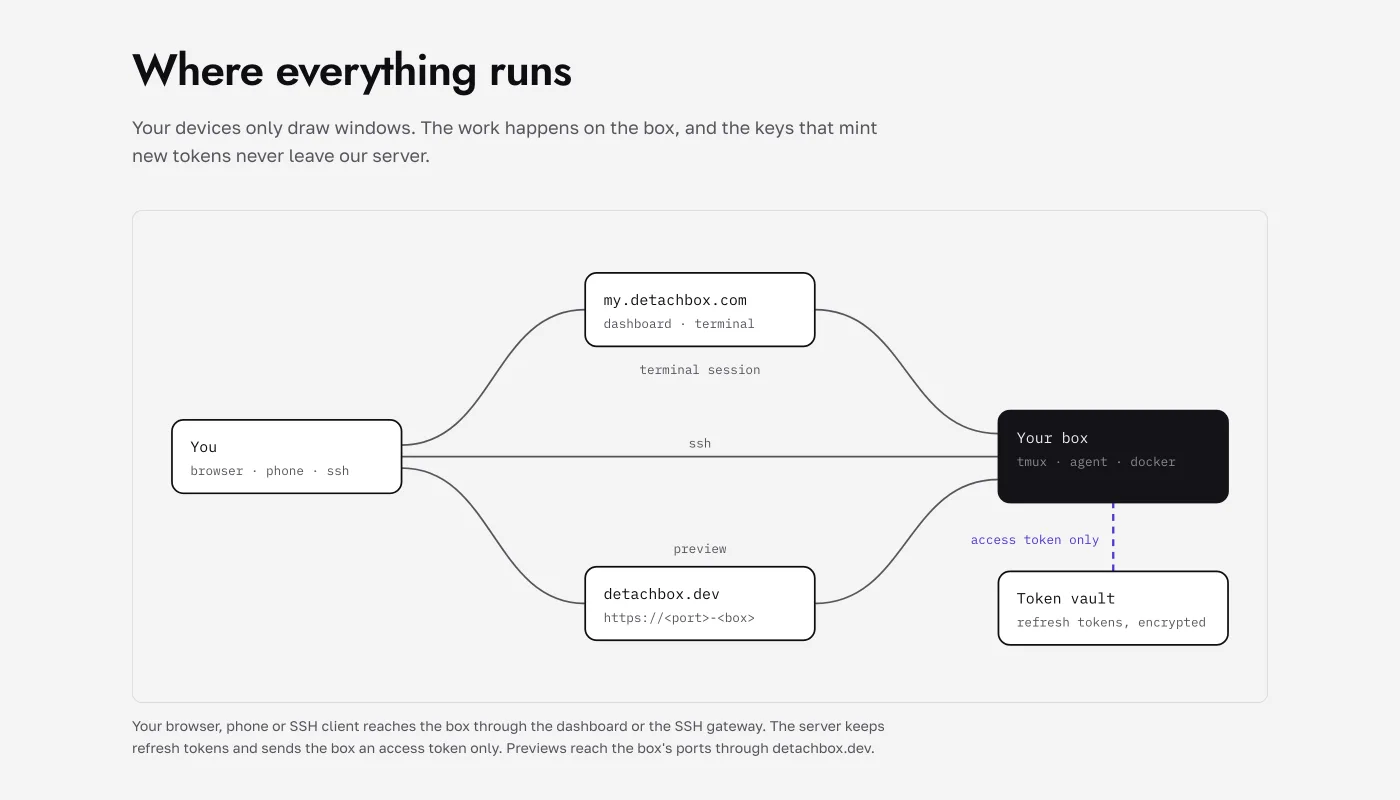
The public site: the always-on box with Claude Code at work, the limits board across subscriptions, every agent tab with the ones that need an answer on top, and where everything runs. The product screens use sample data.
The starting point
Coding agents now run for hours, but on a laptop they stop the moment the lid closes, and a bare server means a day of setup and keys left on its disk. detachbox gives every developer an always-on Linux box, ready at login, with the agents preinstalled and the developer's own Claude or Codex subscription connected. The founder needed a commercial product, not a prototype, and needed it fast.
We built it as founder → fractional CTO → engineer. The founder owns the product and the market; I own the architecture, the infrastructure, the review and the technical direction; one engineer builds. There is no product team, no QA department and no ops staff between us.
What we did
Three weeks from the idea to a product on sale
The founder brought the idea, I turned it into an architecture and a plan one engineer could build, and I reviewed the work as it landed. Three weeks later detachbox was a commercial product with three paid plans, Stripe billing and a refund promise on the first overnight run. A team hired the usual way spends that long just staffing up.
The subscription the developer already pays for
Each box comes with Claude Code, Codex, OpenCode, Gemini CLI, Docker and a full developer toolchain preinstalled. The developer connects the Claude or Codex subscription they already have, so they pay detachbox for the machine and not a second time for the model, and model traffic goes straight to Anthropic or OpenAI without passing through detachbox.
Keys never enter the box
I designed the security model around one rule: an agent running with sudo must hold nothing worth stealing. Subscription refresh tokens stay on detachbox's servers, encrypted with AES-256-GCM, and a box receives only a short-lived access token renewed on schedule. API keys for other services stay in a vault built on Sallyport Cloud, a credential gateway for agents I also architect, so the agent makes the call and never sees the key. Disconnecting an account deletes its tokens from the server and from every box that used it.
Boxes walled off from each other and from the platform
Each box is an unprivileged system container with its own user ID range, capped CPU, memory, disk and process count, and Docker running inside it. Private networks, neighbouring boxes, detachbox's own servers and outbound mail are blocked. Previews run on a separate domain, so a dev server inside a box can never read the dashboard's cookies. SSH takes keys only, and sign-in uses passkeys.
Infrastructure that grows node by node
I run the infrastructure. Boxes live on detachbox's own hardware, and capacity grows by adding nodes, not by redesigning anything. A box's files and Docker volumes survive a node reboot, the kernel is patched weekly, and a snapshot rolls a box back in 2 to 6 seconds. Owning the hardware is what keeps an always-on box at $19 a month, where GitHub Codespaces left on around the clock costs about $135.
Built for agents that run all day, not for watching them
Every agent tab across every box shows whether it is working, needs the developer or is done, and a push, Telegram or email notification arrives when an agent needs an answer, which can be given from a phone. One limits board shows every Claude and Codex subscription's usage and reset time, and when one runs out, the box moves to the subscription with the most room left. Every port of a box gets its own private HTTPS address for previews.
The result
A founder, one engineer and a fractional CTO took detachbox from an idea to a commercial product in three weeks, and it keeps growing on the same scheme. A developer closes the laptop and the agents keep working, on the developer's own subscription, in a box where no long-lived token or API key ever lands. That security model, on infrastructure that scales node by node, makes detachbox one of the safest ways to run remote AI agents today.
What comes next
We keep developing detachbox the same way: the founder sets the product priorities, I keep the architecture, the infrastructure and the review, and the engineer ships. Business plans already add snapshots, priority support and company invoices, and Enterprise adds dedicated nodes and an SLA.
Full case · PDF
detachbox
A founder, a fractional CTO and one engineer took detachbox from an idea to a commercial product in three weeks
- 01The architecture and the three-week plan, week by week
- 02The security model: tokens, the vault and box isolation
- 03How bring-your-own-subscription works and where the tokens live
- 04The infrastructure: nodes, snapshots and how capacity grows
- 05How the founder, the fractional CTO and the engineer split the work
- 06What we would do the same way again
The full detachbox case
The public story stops here. The PDF has the rest: the architecture before and after, the migration plan, how the team works with AI agents, what it all costs to run and where the savings came from.
More case studies
All case studies
Want the next case study to be about your company?
In a 30-minute call we pick the first task to hand to AI and estimate what it will save you.