Case study · AI call centers and telephony · Worldwide
CallbrainAn AI operator closes 92% of calls without a human, in 57 languages, and costs 3 to 5 times less a minute
Callbrain's AI operator answers and makes calls on a company's own number, works in its CRM or 1C during the call and closes 92% of calls without a human, handing the rest to people. It replies in under a second and lets the caller cut in mid-sentence, and a minute of it costs 3 to 5 times less than a minute of a human operator, which brings call center costs down by 50 to 80%. I designed the service end to end, from the PBX to the realtime voice models, and built it with one engineer, where a product like this usually takes a telecom company and a large team.
- Client
- Callbrain
- Product
- AI call center and AI PBX
- Market
- Every market, 57 languages
- Volume
- 100,000+ minutes of conversation a month
- My role
- Fractional CTO
- Team
- 1 engineer and me
- Price
- $0.16 per minute of conversation
- Website
- callbrain.app
In numbers
- of calls closed by the AI operator, with no human on the line
- 92%
- cheaper a minute than a human operator, at $0.16 billed per second
- 3–5×
- voice latency, and a caller can cut in mid-sentence
- <1 s
- languages at one price, without hiring a speaker for each
- 57
- minutes of conversation a month, with no cap on calls at once
- 100,000+
- to set up, where a call center rollout usually takes months
- 3 min
The product
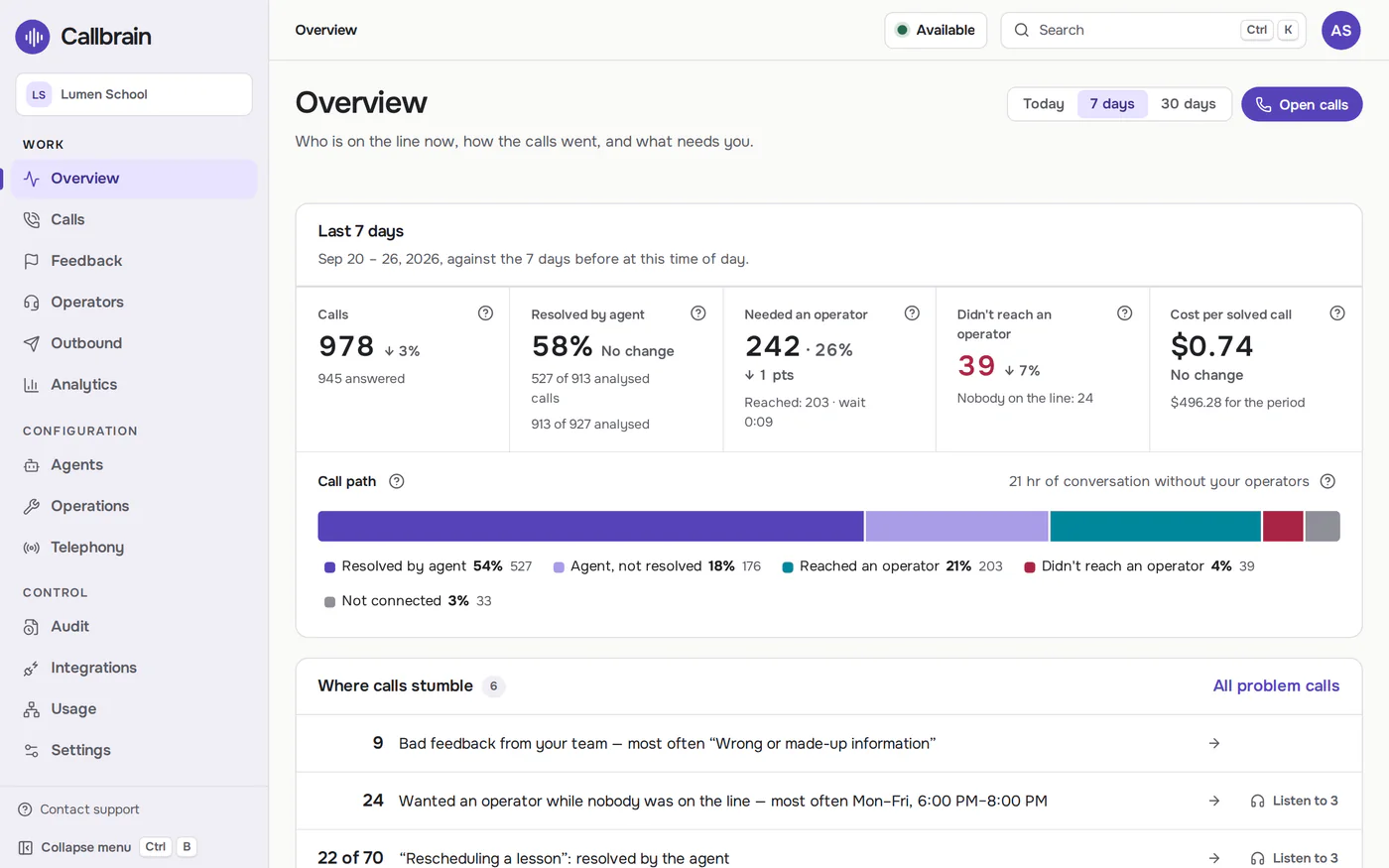
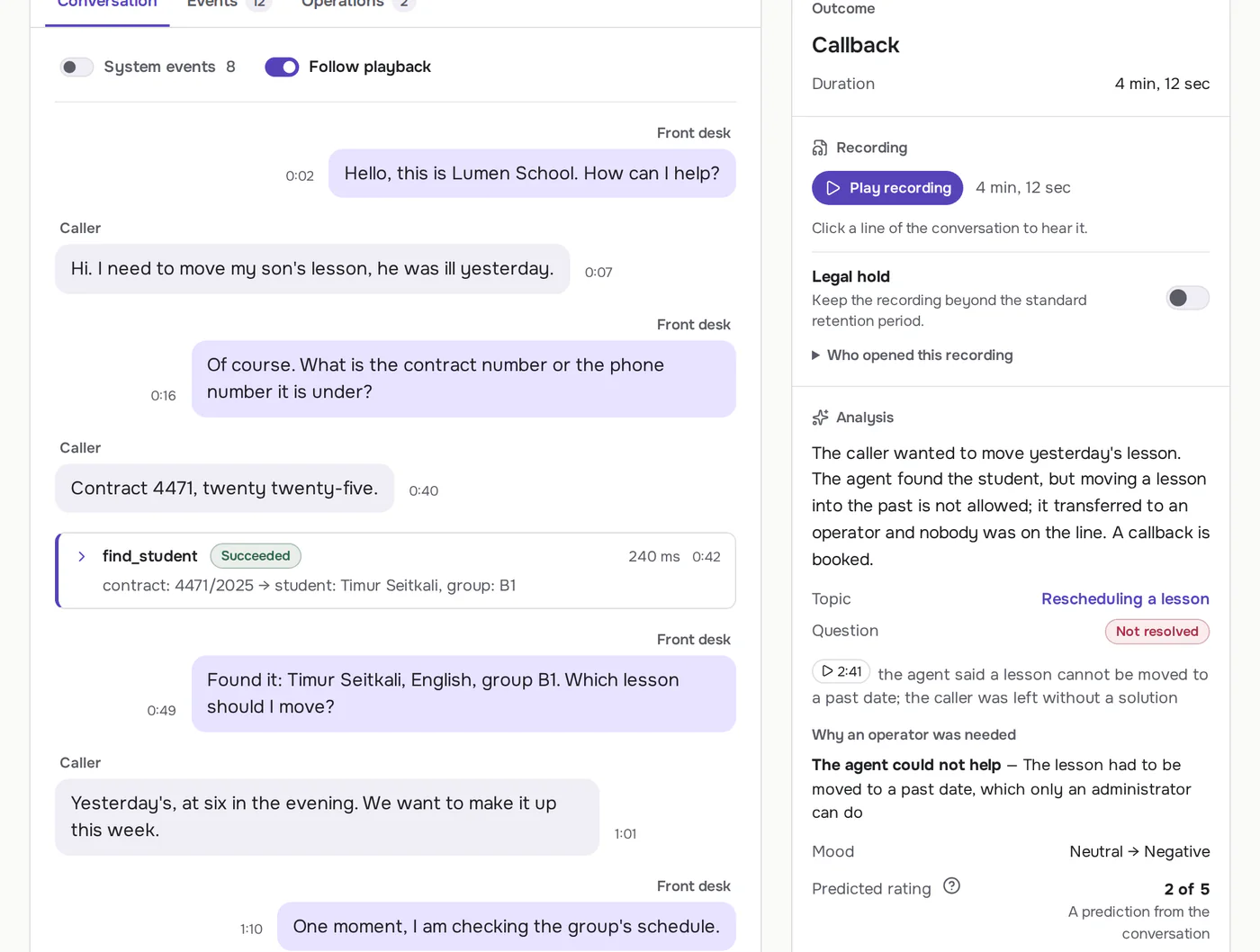
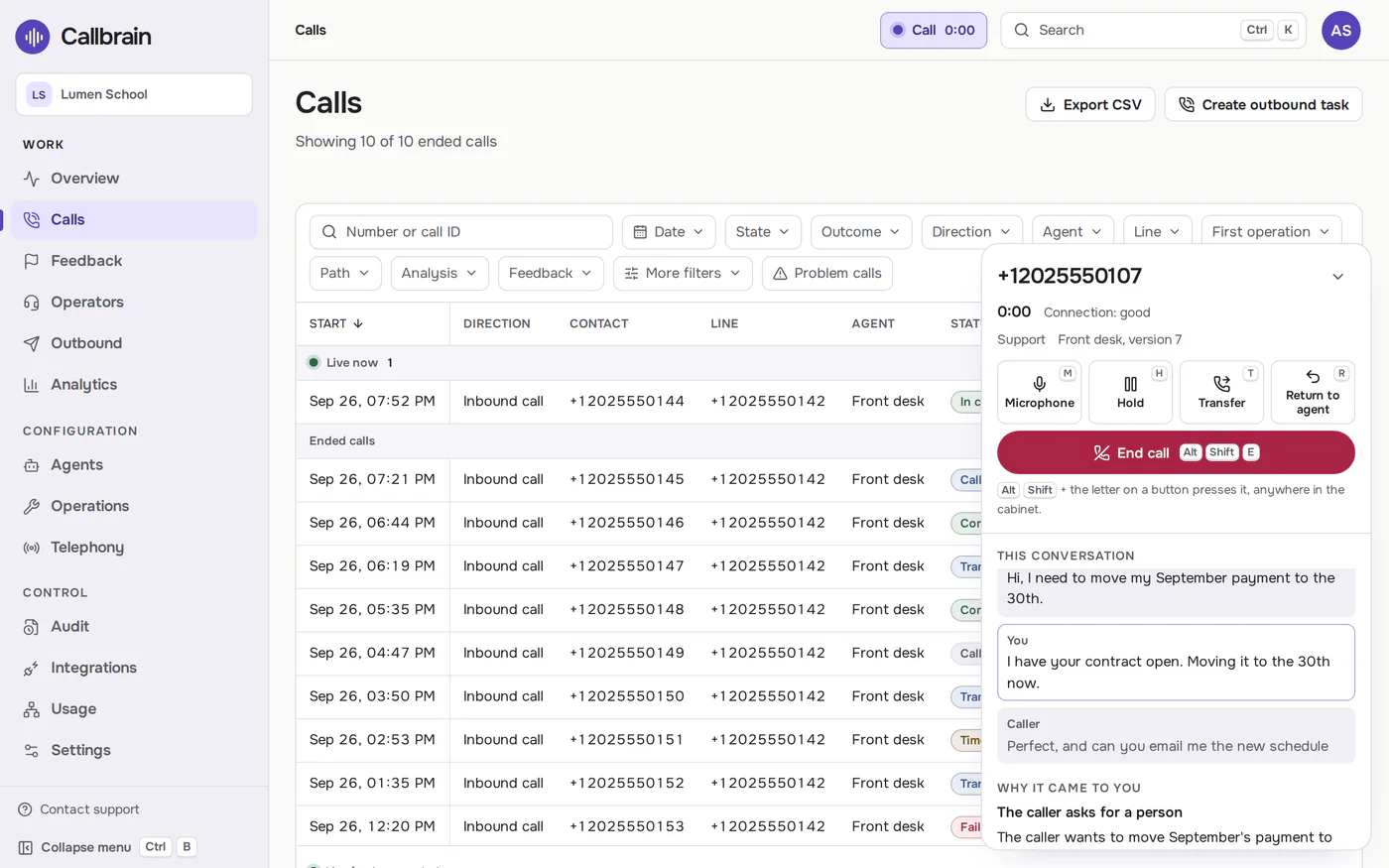
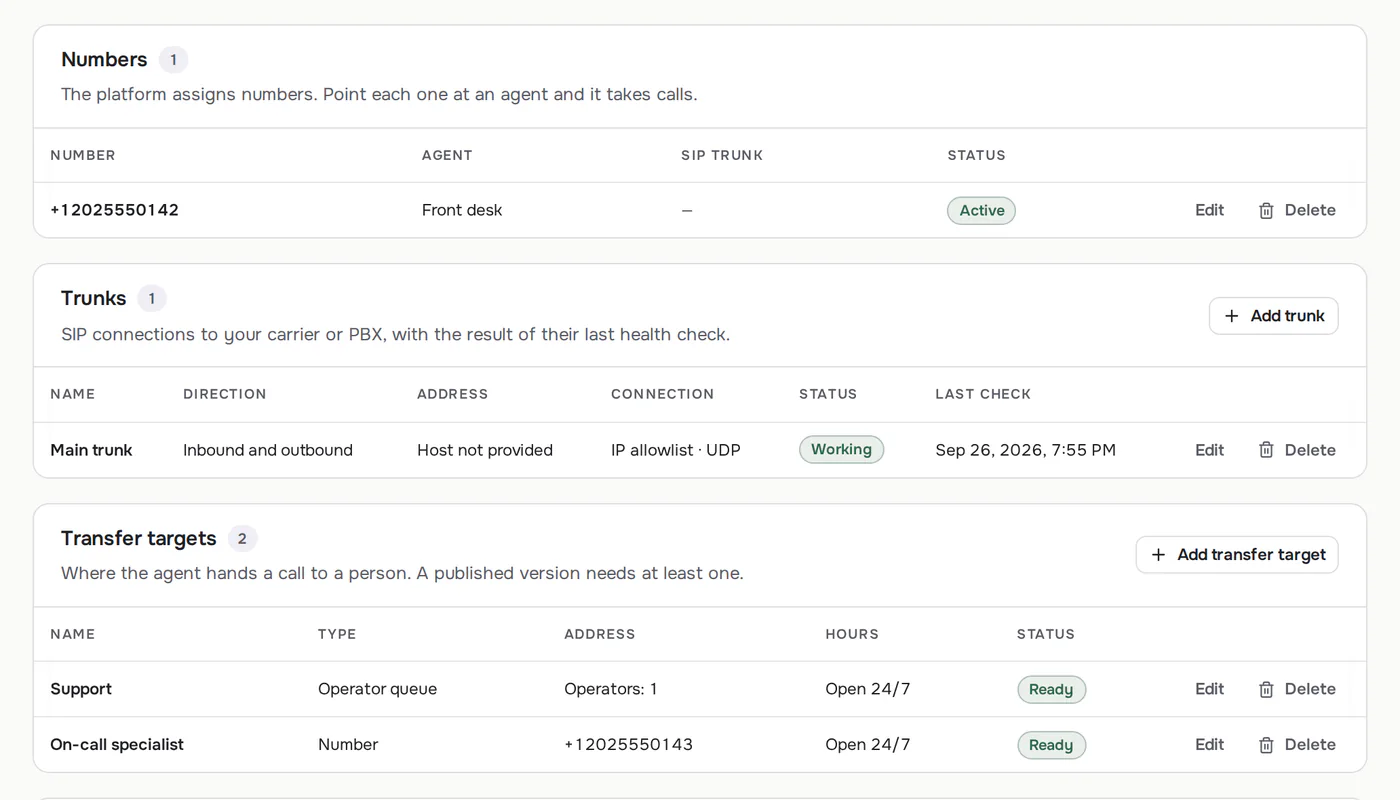
The customer's account: the call center overview, one call with its transcript and the operations the AI ran, the browser softphone during a transfer, and the telephony settings. The screens are from callbrain.app and use sample data.
The starting point
A human phone team is paid for whole shifts and night premiums, handles one call per operator and speaks only the languages its people speak. After every call, someone retypes it into the CRM.
I was hired to design a finished commercial service for phone systems and AI, end to end, with a fully synthesized voice and more than 50 languages. The team was one engineer and me.
What we did
An AI operator on the company's own number in 3 minutes
Callbrain connects to a company's number, any SIP trunk, Asterisk, FreePBX or a cloud PBX, and a company without one gets a demo number and a PBX. Setup takes 3 minutes, with no new phone system to buy. The operator answers inbound calls and places outbound ones: reminders, callbacks, payment follow-ups and campaigns.
57 languages and replies in under a second, without hiring a single speaker
The operator runs on realtime voice models with a fully synthesized voice. It replies in under a second, in the caller's language or the one set for the number, 57 in all. It stops mid-sentence when the caller cuts in and keeps up when they change the subject. We tuned the voice path for phone lines, jitter included. One AI operator covers languages a human call center would have to staff shift by shift.
No cap on calls, and the data stays in the customer's country
The service runs in geographically distributed data centers, with no limit on the number of calls at once, so a spike never leaves callers waiting in a queue. It already carries more than 100,000 minutes of conversation a month. Recordings stay in the customer's home country, and inference can run in the country where the customer works.
The CRM work gets done during the call
A company's API becomes a list of operations the operator may run: find the customer, check an order, book, cancel. Each one is described to the agent, checked, redacted and logged. It works with Salesforce, HubSpot, Zendesk, Bitrix24, amoCRM, 1C and any REST or SOAP API, and the company's own system stays unchanged. Refunds and other sensitive steps wait for an employee's approval. The typing after every call that a human team does by hand is gone.
92% of calls closed without a human, and people take only the rest
The AI operator closes 92% of calls on its own. For the rest, routing works out what the caller needs and transfers the call to the right operator by skill, language and who is online. Before saying hello, the operator sees a summary and a live transcript in a browser softphone. When nobody is free, the AI operator books a callback.
Quality control on every call, with no QA team
100% of calls are recorded, transcribed, searchable and scored. The account shows where calls stall, why callers asked for a person and how they felt, and predicts each caller's rating from the conversation. When the team flags an answer, the next version of the agent learns from it.
A minute 3 to 5 times cheaper than a human operator's
A minute of conversation costs $0.16, billed per second with every feature included, which is 3 to 5 times less than a minute of a human operator, with no shifts, night premiums or hiring for each language. A company that moves its calls to Callbrain spends 50 to 80% less on its call center.
The result
A company connects Callbrain to its own line in 3 minutes, and the AI operator closes 92% of calls without a human at 3 to 5 times less a minute than a human operator, so the call center costs 50 to 80% less. It carries more than 100,000 minutes of conversation a month, and Aula's 24/7 resident line already runs on it.
Full case · PDF
Callbrain
An AI operator closes 92% of calls without a human, in 57 languages, and costs 3 to 5 times less a minute
- 01The architecture: telephony, realtime voice, the operations layer
- 02Distributed data centers and in-country inference
- 03The voice path: synthesized voice, 57 languages, jitter
- 04Connecting a company's API: operations, approvals, audit trail
- 05Routing to people and call analytics
- 06What a minute of conversation costs to run
The full Callbrain case
The public story stops here. The PDF has the rest: the architecture before and after, the migration plan, how the team works with AI agents, what it all costs to run and where the savings came from.
More case studies
All case studies
Want the next case study to be about your company?
In a 30-minute call we pick the first task to hand to AI and estimate what it will save you.