Case study · AI model gateway
AIRouterIn five weeks, one person launched an OpenRouter-class AI gateway that has since processed 168 billion+ tokens
AIRouter sends requests to many AI providers through one API and does everything OpenRouter does. On top of that it runs inference inside the customer's country, bills in local currency and issues local closing documents, so companies get the best models, stay compliant with personal-data law and pay 20% less than they would buying from the providers directly. I designed the architecture from the data center up, and the service launched in five weeks with a team of one, where a platform of this scope usually takes a full team and several quarters. It has since processed more than 168 billion tokens in more than 29.5 million API requests for 50+ client companies.
- Client
- AIRouter
- Product
- AI model gateway, OpenRouter class
- Customers
- 50+ client companies
- Traffic
- 168 billion+ tokens in 29.5 million+ API requests
- Infrastructure
- Instances in several countries, designed from the data center up
- My role
- Fractional CTO
- Team
- 1 person, where such platforms usually need a team
- Website
- airouter.kz
In numbers
- tokens processed in 29.5M+ API requests, counted live on its site
- 168B+
- to launch with a team of one, where such platforms take quarters
- 5 weeks
- what a client pays compared with buying from providers directly
- −20%
- client companies reach 547 models under one contract
- 50+
- of router overhead, with automatic fallback across 14 providers
- <50 ms
- inference in the country, so the data stays home and the law is met
- Local
The product
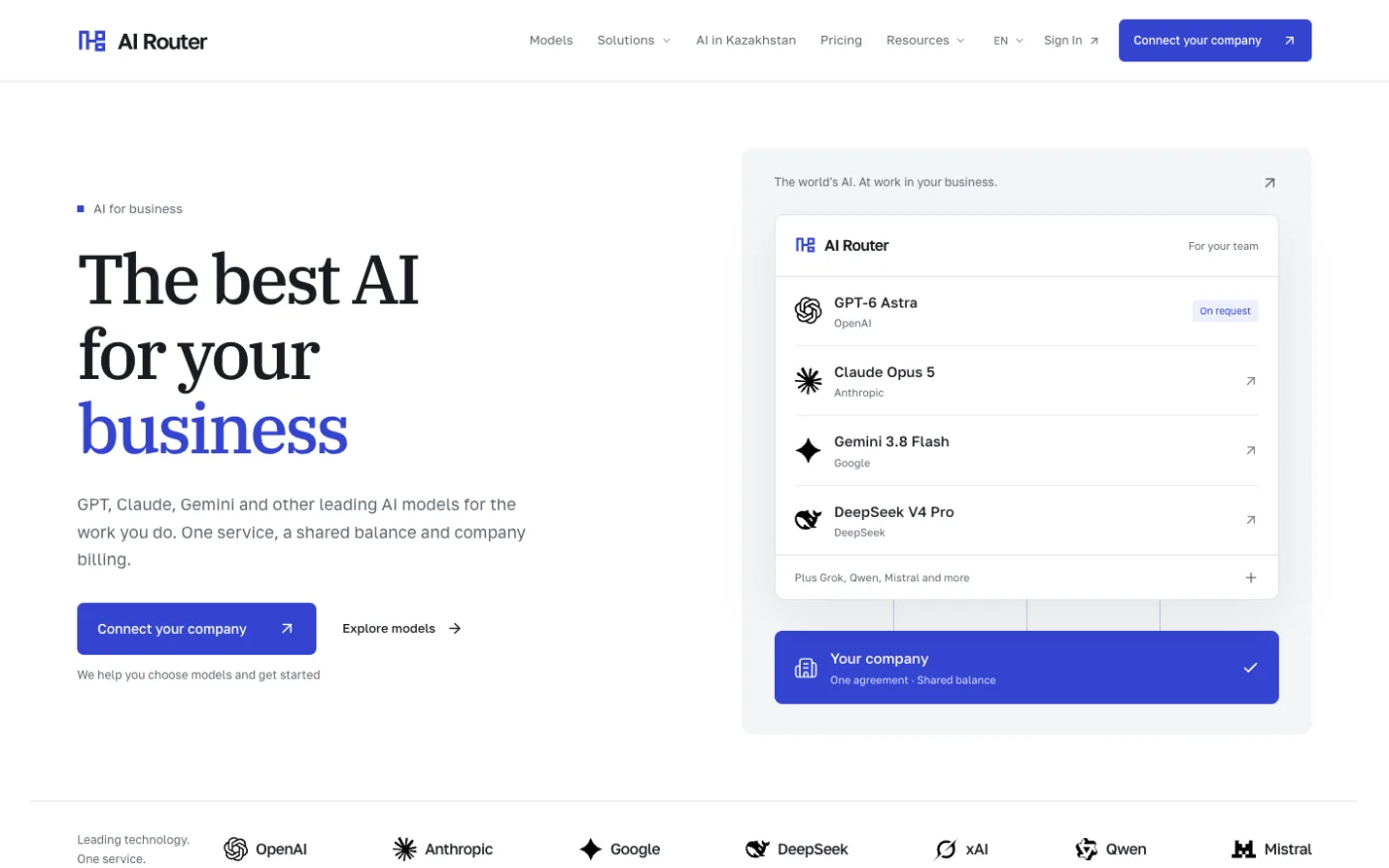
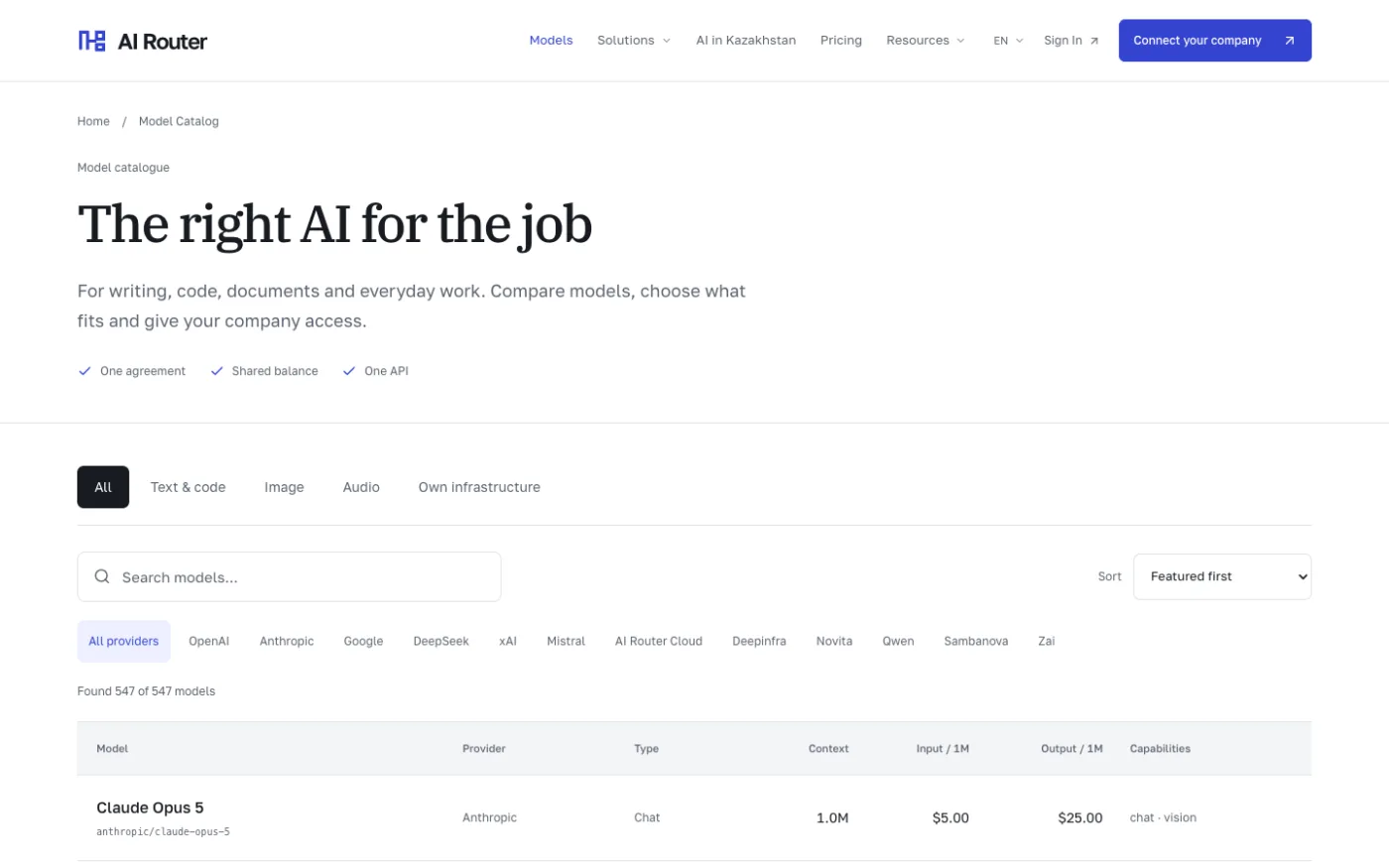
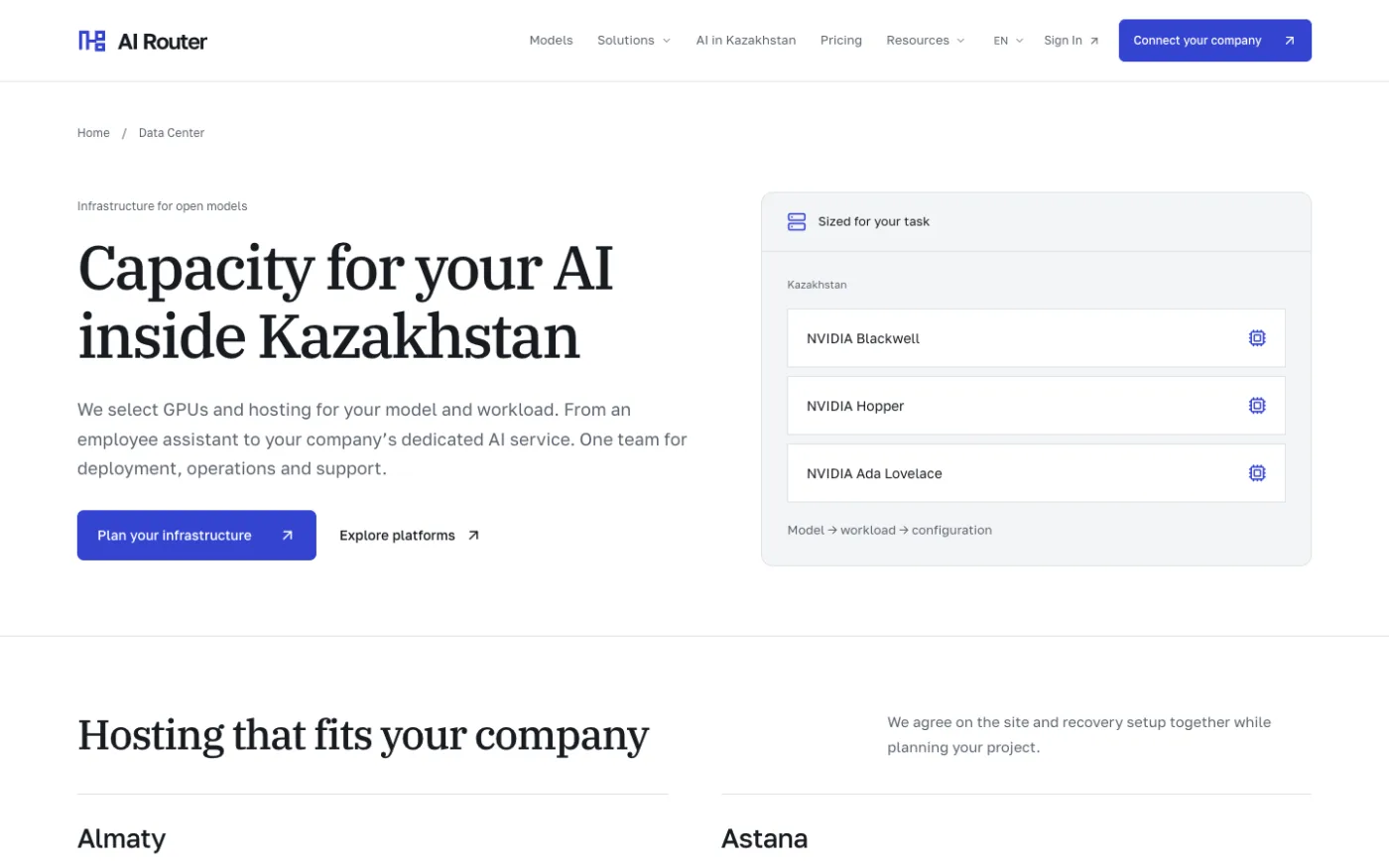
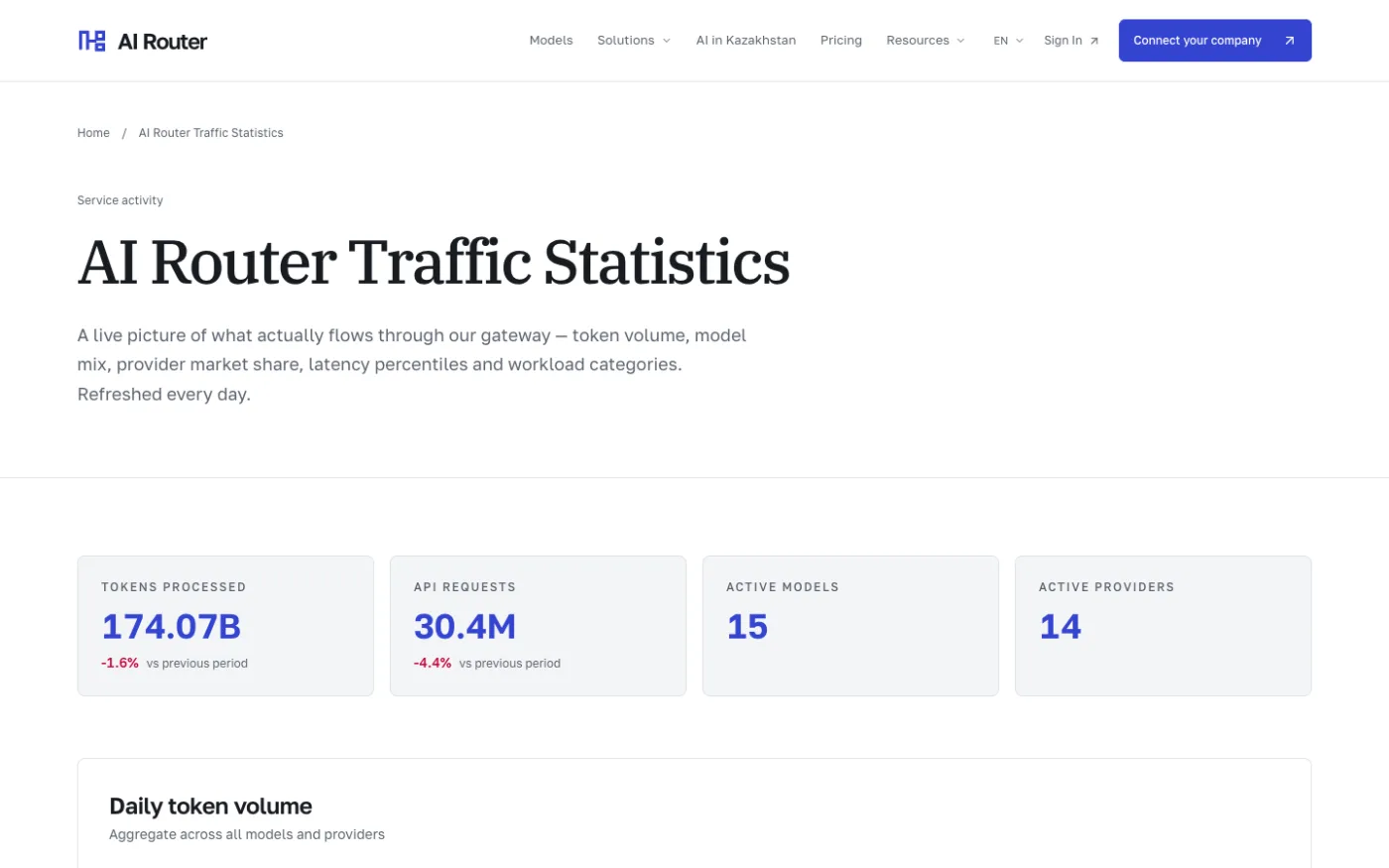
The public site: every leading model under one company agreement, a catalogue of 547 models, dedicated GPU capacity in Kazakhstan and live traffic statistics.
The starting point
Companies want the best AI models from many providers through one entry point. In many countries they also need the data to stay inside the country, to pay in their own currency, and to get closing documents their accounting will accept. Global gateways cover the first need and leave the rest to the customer.
AIRouter set out to give customers all of that in one service that is easy to use, and brought me in to design it and get it to market fast.
What we did
One API in place of 14 separate integrations, under 50 ms added
Requests go to different AI providers through one API, and the router picks the provider automatically, the way OpenRouter does, adding under 50 ms to a request. The catalogue lists 547 models, so a customer's developers integrate once and switch models without rewriting their code.
Everything OpenRouter offers, from launch day
When a model or provider fails, the request falls back to another one, so one vendor's outage does not become the customer's outage. Providers are chosen by price and speed, which keeps spend down without anyone tuning it by hand. The API takes images, PDFs, audio and video, supports tool calling and structured outputs, and caches responses. Teams get workspaces with budgets and guardrails for sensitive data.
Data stays in the country, and the compliance risk goes away
Inference runs locally in several countries, so a customer's data stays in its own country and the service complies with personal-data law. Companies that cannot send data to a foreign gateway can now use leading models without legal exposure.
Billing the finance department accepts on day one
Customers in each country pay in their local currency and receive local closing documents for their accounting. In Kazakhstan that means invoices in tenge, paid by bank transfer, with no currency conversion and no arguments with accounting over foreign invoices.
Designed from the data center up, so a new market is a new instance
I designed the architecture as many instances placed by country, and I was responsible for the design from the data center up. Entering another market means placing another instance of a design that already works.
One person took the service to launch in five weeks
The team was one person, and the service launched five weeks after the start. A gateway of this scope usually takes a team and several quarters to reach the market.
168 billion+ tokens for 50+ companies, at 20% below direct prices
The service's own site counts its traffic live: more than 168 billion tokens processed in more than 29.5 million API requests. More than 50 client companies use it, and each pays 20% less than it would buying the same models from the providers directly.
The result
One person launched AIRouter in five weeks, and it has since processed more than 168 billion tokens for 50+ client companies, each paying 20% less than buying from the providers directly. Local markets got an OpenRouter-class service they use under their own law, pay for in their own currency and put in their own books. Infrastructure launches rarely reach the market at that speed and cost.
Full case · PDF
AIRouter
In five weeks, one person launched an OpenRouter-class AI gateway that has since processed 168 billion+ tokens
- 01The architecture: instances by country
- 02Data-center design for local inference
- 03Routing and fallback between providers, by price and speed
- 04Compliance with personal-data law
- 05Local-currency billing and closing documents
- 06The five-week launch plan, delivered by one person
The full AIRouter case
The public story stops here. The PDF has the rest: the architecture before and after, the migration plan, how the team works with AI agents, what it all costs to run and where the savings came from.
More case studies
All case studiesWant the next case study to be about your company?
In a 30-minute call we pick the first task to hand to AI and estimate what it will save you.