Yjs vs database polling for collaborative editing teams
Yjs vs database polling affects sync conflicts, offline edits, server load, and user trust. Compare both before you promise live docs.
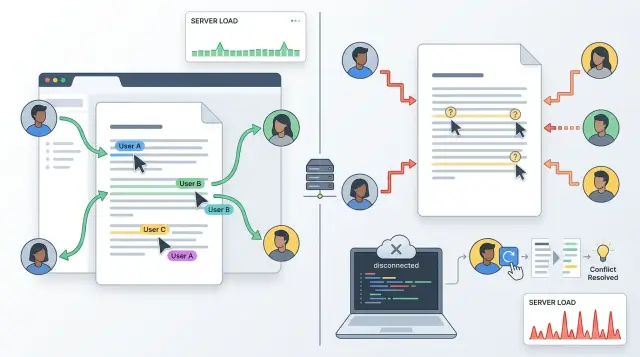
Table of Contents
Why this choice causes trouble later
The choice between Yjs and database polling looks small when your editor is still a prototype. A team can ship a clean demo, type into the same document on two laptops, and feel finished. That confidence usually comes from a happy path: nobody goes offline, nobody edits the same sentence at once, and nobody asks what happens when changes arrive late or out of order.
Problems start when the sync rules stay vague. The product can look fine for weeks and still fail the first time real users rely on it. Two people edit one paragraph, one tab reconnects late, and a simple "last write wins" rule wipes out a line someone thought was safe. Users can forgive a slow page now and then. They do not forgive missing text.
Demos hide this because demos rarely create pressure. Most teams test with short sessions, stable internet, and one person making tidy edits. Real work is messier. Someone leaves a laptop asleep on a train, another person keeps typing on weak hotel Wi-Fi, and both expect the document to make sense later. If the editor was built around polling rows from a database, conflict handling often stays shallow until the first bad overwrite.
The hard part is not just the merge. Cursor positions, undo history, comments, presence, and local drafts all depend on the same sync rules. Once customers start using the editor, changing those rules gets expensive fast. You usually have to rebuild how the document is stored, how the client applies updates, and how the server tracks history.
That rebuild spreads further than teams expect. It touches tests, support, analytics, and every odd bug that already has a workaround. A startup may think it is choosing a transport detail. It is really choosing how trust works inside the editor.
Users notice one lost sentence before they notice a hundred milliseconds of delay. Once they lose trust, the editor feels broken even if the interface still looks polished.
How each approach moves edits
Yjs and database polling move edits in completely different ways. That difference becomes obvious as soon as people start typing at the same time.
With Yjs, each client keeps a local copy of the document and shares small updates as people edit. A user types a word, deletes a sentence, or moves a block, and the app sends only that change. Other clients apply the same update and stay close to the current state without reloading the whole document.
Database polling works more like repeated checking. The client asks the server for the latest version every few seconds, or after a save event, then compares the response with what it already has. In many apps, that means moving a whole record or a large JSON blob even when only one line changed.
That is the practical split. One model sends tiny document updates. The other keeps asking for fresh state on a timer.
For a simple notes app, polling can feel good enough at first. One person edits, clicks away, and everyone else sees the new version a few seconds later. For a shared editor with active typing, comments, cursors, and presence, polling starts to feel clumsy. The interface needs more loading states, more merge rules, and more moments where people wonder, "Did my change stick?"
The sync model also affects parts of the product that seem unrelated at first. It changes your storage format, revision history, server read and write patterns, save indicators, support workflow, and how often users report "missing" edits. Teams get tripped up because they think they are choosing a transport detail, when they are really choosing how the whole editor behaves.
If the product promise is live collaboration, the way edits move through the system is not a minor detail. It decides how much data you move, how responsive the editor feels, and how many support tickets show up later.
Where conflicts show up first
The first conflict usually appears in plain text. Two people open the same paragraph, both change the same line, and both think they are editing the current version.
With database polling, the app often saves a full document snapshot every few seconds. That sounds simple, but it creates a blunt rule: whoever saves last can replace what the other person meant to say. The text may still look clean, yet one person's intent is gone.
Picture a shared product note. One editor changes "Launch on Monday" to "Launch on Tuesday." At the same time, another changes it to "Soft launch on Monday." A polling setup may keep only one result after the next save cycle. Nobody gets a clear warning, and the team finds the mismatch later.
Why Yjs feels different
Yjs handles conflicts closer to the edit itself, not at the whole document level. If two people type into the same sentence, Yjs can merge many of those character and word changes without stopping the session or asking users to pick a winner.
That does not mean every result is perfect. Yjs is very good at preserving edits. It is less magical about meaning. If two people rewrite the same sentence in opposite ways, the final text may merge technically and still read awkwardly. Even so, both edits usually remain visible, which is a lot better than silent loss.
That is why this decision shows up quickly in shared writing tools. Polling tends to hide conflict until save time, refresh time, or the next reload. Yjs creates fewer hard collisions in text, so users experience the editor as active instead of fragile.
Structured content still needs rules, even with Yjs. Comments, tables, and mentions do not behave like plain text. If two people edit the same table cell, you need a policy. If one person deletes a comment thread while another replies, you need a policy. If someone renames or removes a mentioned user, you need a policy. Yjs can carry those changes, but your product still has to decide what they mean.
That is the part teams often miss. Text merging is only the first layer. The harder conflicts sit in the document features wrapped around the text.
What offline users actually experience
Most teams treat offline editing like a rare edge case. It is not. People lose signal on trains, in elevators, at client sites, and during shaky Wi-Fi handoffs. When that happens, users ask one simple question: "Did my text survive?"
With database polling, the answer depends on how much extra work your team built around the editor. Polling usually stops when the tab cannot reach the server. If the app saves every few seconds, those save attempts fail until the connection returns. The person can keep typing, but the browser may hold changes only in memory unless you add local storage, draft recovery, and a queue for unsent edits.
That queue matters more than teams expect. Without it, reconnect can turn into a mess. A user comes back online, the app fetches newer server content, and the local draft may overwrite it, duplicate parts of it, or disappear. Polling by itself does not solve offline conflict handling. Your team has to invent the rules.
Yjs feels different because it keeps local changes first and syncs them after reconnect. A user can edit a document on a flight, open the laptop later, and still have those edits. If someone else changed the same document while they were away, Yjs can merge both sets of changes instead of forcing your app to compare whole snapshots.
Users notice reconnect behavior more than raw sync speed. Most people forgive a short catch-up delay. They do not forgive lost paragraphs, duplicate lines, or a cursor that jumps backward after reconnection.
A small example makes this obvious. Imagine a founder updating meeting notes from a phone with weak signal while a teammate cleans up the same notes from a desktop. In a polling setup, both people may think they saved successfully until the app refreshes and one version wins. In Yjs, each person usually sees their edits stay put, then merge when the connection settles.
Live editing looks impressive in a demo. Reconnect behavior is what users remember the next day.
What you pay for in operations
The cost has two parts: machines and human time. Teams often estimate the server bill and miss the support cost, which can end up larger.
Polling looks simple because you can keep your current database and ask it for changes every few seconds. The problem is that the reads keep coming even when nobody types. A document open in 200 browser tabs can still hit the database all day, and short polling intervals make that much worse.
If you poll every 2 seconds, you buy faster updates with steady load. If you poll every 10 or 15 seconds, you reduce load but users start asking why edits feel late. That tradeoff lands on the database first, then on the people who have to explain lag, stale views, and "I thought my change saved" reports.
Yjs shifts the cost elsewhere. It cuts the constant read traffic, but now you run sync infrastructure, presence state, and a plan for document storage. You also need snapshots, update logs, compaction, and recovery for clients that reconnect after hours offline.
In practice, polling spends money on repeated reads, cache pressure, and larger database capacity. Yjs spends money on websocket or sync servers, document persistence, and state cleanup. Both approaches cost support time when users say changes disappeared or arrived late. Offline use adds more testing work, because reconnection bugs rarely show up in happy path demos.
Support load is where many teams get surprised. With polling, users report missing changes because two people edited close together and one screen stayed stale for too long. With Yjs, users report strange merges, cursor issues, or a document that looks different after reconnect. A well-built Yjs editor often has fewer trust-breaking failures, but the bugs can take longer to inspect.
A small team can live with polling for internal notes or low-traffic admin tools. Public collaboration at scale is different. Once many documents stay open at once, idle polling becomes a tax you pay every minute.
Operations cost is not just cloud spend. It is database headroom, on-call noise, debugging time, and the number of user complaints your team can absorb before trust drops.
How to choose step by step
Start with editing actions, not tech. A shared note where two people type plain text has very different needs from a contract editor with comments, mentions, draggable blocks, and table edits. Write down what users can actually do: type, delete, paste, reorder, comment, resolve, and edit at the same time. That list tells you more than any feature chart.
Then count concurrency honestly. If most documents have one editor and one reader, database polling may be enough for a while. If four, five, or ten people can type in the same document at once, this stops being a theory question. It becomes a product risk question.
A practical way to decide is simple. Pick one real document flow and build the smallest test that matches it. Simulate the highest number of editors you expect on one document. Test weak Wi-Fi, mobile reconnects, tab sleep, and repeated disconnects. Measure reads, writes, bandwidth, and reconnect spikes. Then promise only the behavior your test actually shows.
Offline behavior needs its own test. Turn off the network, make edits for a few minutes, then reconnect. Check what happens to inserts, deletes, comments, and reordered blocks. Polling can look fine in a stable office demo and fall apart the moment a phone drops signal on a train.
Watch cost early, not after launch. Polling often looks cheap at first because the code is familiar. Then usage grows, clients reconnect in bursts, and your database starts doing busywork instead of serving actual changes. Yjs adds setup and a different mental model, but it can cut waste when people edit often and reconnect a lot.
A good rule is simple: match the architecture to the editing pattern you can prove. If your team sells "Google Docs style" collaboration, test like that promise is already public. This is exactly the kind of decision a Fractional CTO should force into a small, measurable trial before the team builds months of product on the wrong base.
A simple team example
Picture a five-person product team: a product manager, a designer, two engineers, and a writer. They update specs every day. Most editing sessions last 10 to 20 minutes, often between meetings, after a customer call, or while fixing a bug.
That rhythm matters. People do not edit in neat turns. They jump in, change a sentence, add a note, and leave. Ten minutes later, someone else opens the same doc and edits the same section.
With database polling, the first version looks cheap and simple. The app saves the document to a database and checks for changes every few seconds. For light use, that can seem good enough. Then the PM rewrites acceptance criteria while an engineer updates an API note and the designer tweaks the same paragraph. One save lands after another, and part of someone else's edit disappears.
The team usually does not blame the system first. They think someone deleted text by accident. That is where trust starts to slip.
Now add one more detail: the writer edits specs on a train with weak signal. They open the doc, lose connection, and keep typing. Polling gives them an old version for a while, then reconnects at a bad moment. When the app syncs again, they can hit a conflict or overwrite newer text without noticing right away. A short offline session turns into manual cleanup.
Yjs takes more setup. You need a shared document model, sync transport, and a way to store updates. Still, this same team usually gets a much better result once people edit together every day. The PM, engineer, and designer can change nearby text in the same session, and the writer can keep working when the signal drops. When the connection comes back, Yjs merges the edits instead of making one person rebuild the paragraph.
That is the practical difference. Polling looks cheaper at the start. For a team that edits specs in short, overlapping bursts, Yjs usually fits the work better and creates less rework.
Mistakes that create rework
Teams often choose the wrong editing model because the happy path looks smooth. Two people type, cursors move, text updates fast, and it feels done. The rework starts later, when one user loses connection, another pastes a large block, and the document returns in a state neither person expected.
One mistake shows up again and again: shipping a last-write-wins rule without telling users. People see "collaborative editing" and assume the system will merge changes or at least warn them before it drops anything. If the newest save silently overwrites someone else's work, users will blame the editor, and they will be right.
Another costly mix-up is treating presence as the same problem as document sync. Cursors, avatars, and "Oleg is typing" style signals make a product feel alive, but they solve a different problem. Presence tells users who is there. It does not decide how edits merge, how ordering works, or what happens after a disconnect.
Teams also skip the tests that reveal whether the editor is safe to trust. Simple typing tests are easy to pass. The painful cases matter more: pasting a few thousand words at once, undoing after another person edits the same paragraph, disconnecting one tab for five minutes and reconnecting, opening the same document on a phone and laptop at once, or editing while latency spikes.
Those checks usually tell you more than a polished demo. The prettier demo can easily come from the weaker design if you test only on clean local networks with two browser tabs.
The last mistake is choosing by demo feel instead of failure behavior. Polling can look fine when edits are sparse and everyone stays online. Trouble appears when documents stay open for hours, users switch devices, or two people make overlapping changes. At that point, teams often patch around the problem instead of fixing the model underneath it.
Pick the approach that behaves well when things go wrong, not just when everything looks calm. That choice can save months of cleanup later.
Quick checks before you commit
A live editor can look fine in a demo and still fail on day three, when two people edit the same paragraph and one laptop drops offline. Before you commit, answer a few blunt questions and write the answers down.
If two people type in the same sentence at the same time, do you expect both edits to stay? If yes, polling will feel rough unless you add custom merge logic quickly. Will anyone keep editing without a connection for more than a minute? If yes, Yjs usually fits better because it can queue local changes and sync later. How many open tabs will sit idle but still poll the database every few seconds? That number turns into read traffic, noisy logs, and a monthly bill.
You also need a clear owner for merge rules in rich text, comments, and cursor position. Your database will not answer those questions for you. Someone on your team has to decide what happens. And when a user reports, "my text disappeared," your support team needs a clear explanation. If the answer is vague, the product is not ready for collaborative editing.
The question about richer content matters more than many teams expect. Plain text is one thing. Comments, mentions, selections, pasted formatting, and deleted blocks create much harder cases. If you rely on polling, you often end up rebuilding parts of a conflict system by hand.
A small example makes this obvious. Imagine a founder edits meeting notes on a plane while a teammate updates the same doc from the office. With polling, the offline user often gets an old copy, then runs into overwrite warnings or strange merges later. With Yjs, both sides usually keep their intent, and the sync step is much less dramatic.
One more test helps: ask support, product, and engineering to define "data loss" in one sentence. If each team gives a different answer, stop and settle that first. The architecture choice gets easier once everyone agrees on what failure looks like in plain words.
What to do next
Pick one document type and test that first. A product spec, support note, or internal checklist is enough. Build the smallest version that includes real editing, reconnect logic, autosave, and permissions, because mock demos hide the problems that matter.
If you are still stuck, a narrow prototype will answer more than another week of debate. You will see where edits collide, what happens after a laptop wakes up, and how much cleanup your team has to do when people edit at the same time.
During the test, track a few things: how often two people change the same part of a document, what users see after losing connection and coming back, whether offline edits merge cleanly or need manual fixes, how many complaints show up in chat or support tickets, and how much write volume and server load the test creates.
Do not promise full live collaboration across every screen until real users try it. A smooth demo is easy to fake. Trouble shows up when someone edits offline on a train, another person reconnects after sleep, and a third person still has an old tab open.
A short pilot with 10 to 20 users is often enough. Give them one clear task, let them use it for a week, and read every complaint. If people hesitate, lose text, or ask who overwrote what, the architecture still needs work.
If your team wants a second opinion before it commits, Oleg Sotnikov at oleg.is can review the sync model, infrastructure cost, and rollout risk. As a Fractional CTO and startup advisor, he works with teams on decisions like this before they turn into months of rework.
Small tests save money. Real usage tells the truth much faster than broad promises.
Frequently Asked Questions
When is database polling good enough?
Database polling fits best when most documents have one editor at a time, edits stay simple, and a short delay is acceptable. It can work for internal notes or low-traffic tools. Once several people type in the same document at once, it usually starts causing rework.
Why does polling lead to lost text?
Polling often saves or compares full document snapshots instead of small edits. If two people change the same area before the next sync, one save can replace the other without a clear warning. Users notice that as missing text, not as a sync detail.
Does Yjs solve conflicts by itself?
No. Yjs does a much better job keeping both sides of text edits, but it does not decide product meaning for you. You still need rules for comments, tables, mentions, deleted blocks, and undo behavior.
Which option is better for offline editing?
Yjs usually handles offline work better because it keeps local edits first and syncs them after reconnect. Polling needs extra work for local drafts, queued changes, and conflict handling after the network returns. Without that work, reconnect can overwrite or duplicate content.
Why do teams often trust Yjs more?
People trust the editor that keeps their words. Yjs tends to preserve edits during overlap and reconnect, so users see fewer silent losses. A slightly slower sync feels tolerable; vanished sentences do not.
Is polling cheaper to run?
At the start, polling can look cheaper because you keep your current database and write familiar code. Over time, steady read traffic, stale views, and support issues can cost more than expected. Yjs moves cost to sync servers, storage for updates, and more careful debugging.
What should we test before choosing?
Build one real document flow and test it under stress. Have several people edit the same section, turn the network off and on, let tabs sleep, and reconnect devices after a few minutes. Measure what users see, not just server numbers.
How much concurrency pushes a team toward Yjs?
If you expect four or more people to type in one document at the same time, treat this as a product risk, not a small tech choice. That level of overlap usually pushes teams toward Yjs. If most docs have one editor and one reader, polling may hold for a while.
What gets tricky after plain text editing?
Plain text is only the first step. Comments, mentions, tables, selections, cursor positions, and undo often break first because they need clear merge rules. Many teams handle text well enough, then get stuck on the features around the text.
Should we run a prototype before we commit?
Yes. A small pilot with real users will show more than another week of debate. If your team wants a second opinion before committing, a Fractional CTO can review merge rules, offline behavior, and ops cost before the wrong choice spreads through the product.


