Weekly CTO brief: what founders should expect
A weekly CTO brief helps founders spot risks, blocked decisions, margin pressure, and hiring signals in one page they can read in ten minutes.
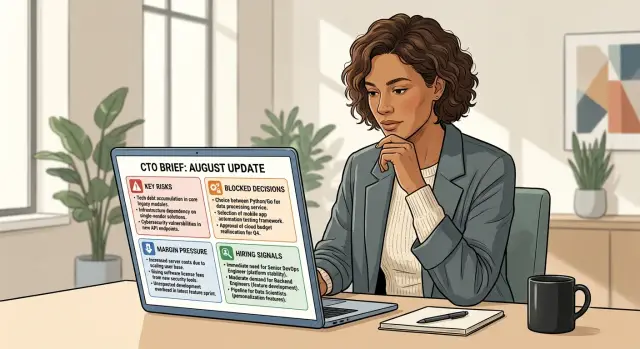
Table of Contents
Why founders need a short CTO brief
Founders rarely miss problems because nobody mentioned them. They miss them because the signal is scattered across Slack threads, ticket comments, standups, dashboards, and side chats. Each update looks harmless on its own. Together, they can point to a delayed release, rising cloud spend, or a customer problem that is close to becoming churn.
Long status docs do not fix this. They often make it worse. A five-page update can bury the only facts that need attention now: what might break next week and what decision the team cannot make alone. When every project gets the same space, urgency disappears.
A short weekly CTO brief works because it forces choice. The CTO has to decide what changed, what matters to the business, and what needs a founder call. That makes the brief useful. It is not a diary of engineering activity. It is a filter against surprise.
Ten minutes is a good limit because founders read under pressure. If the brief takes half an hour, it gets skimmed, saved for later, or ignored until a problem gets expensive. One page is enough to answer the questions that move the company: where risk is rising, what is blocked, whether margin is getting squeezed, and whether hiring signals point to a deeper issue.
This matters even more when the founder is not technical or works with a fractional CTO. They do not need implementation detail. They need clear choices they can act on the same day.
What fits on one page
A weekly CTO brief should answer the same small set of questions every week. If the format keeps changing, founders waste time figuring out where the real issue is. One page is enough when the team sticks to the few items that affect speed, cost, and risk.
Most teams only need five things:
- what shipped, and what slipped
- the biggest risks to delivery, revenue, or reliability
- decisions the founder or leadership team must make
- cost changes that affect margin, such as cloud spend or contractor use
- team signals, such as open roles, overloaded people, or slow hiring
Keep each item short. Two or three lines are enough. If a topic needs a deep discussion, name it and move on. The page is for fast scanning, not for storing every detail.
Plain language beats technical detail. "Payments fail for 3% of users on mobile" is clear. "The checkout flow has regression issues after the refactor" is much less useful unless the founder already knows the codebase well. Write the business effect first, then add the technical cause if it matters.
It also helps to separate facts, decisions, and opinions. Mixing them together makes a report hard to trust. A simple pattern works well: fact - deployment time rose from 8 minutes to 25 minutes after the last pipeline change. Decision needed - approve one day this week to fix the build process. Opinion - fixing it now will save several hours next month.
That structure keeps the brief honest. Facts show what happened. Decisions show what leadership must do. Opinions still belong on the page, but they should be labeled as opinions.
How to ask for risks
Most teams bury risk inside long status notes. Founders do not need every bug, Slack thread, or side concern. They need the few risks that can change the plan.
Ask your CTO for the top three to five risks only. If the list is longer, the team has not sorted noise from danger yet. A good weekly CTO brief gets sharper when it forces ranking.
Each risk should fit in one sentence written in plain words. "Payment retries fail for some annual plans, which could delay launch by a week" is useful. "Billing flow instability under review" is not.
For each risk, ask for five things in a tight format: what the risk is, who or what it affects, the likely impact on launch, revenue, or customers, what changed since last week, and whether leadership needs to decide anything now.
The impact line matters most. A founder can live with many technical problems if they stay small. The same founder should care right away if a risk can push a launch, raise support load, hurt conversion, or create refunds. Put the business effect next to the technical issue so nobody has to guess.
The "what changed" line keeps the brief honest. A risk that stays red for four weeks without movement tells you something is stuck. A risk that moved from "possible" to "active" needs attention now. A risk that dropped in impact can leave the page.
It also helps to separate risks from issues. An issue already happened. A risk might happen soon. That small distinction leads to better conversations and better decisions.
If you work with a fractional CTO, this discipline matters even more. You are paying for judgment, not for a copy of the team's backlog. The brief should show where the company could get hurt, how badly, and whether the team is reducing that danger week by week.
How to surface blocked decisions
Blocked decisions waste more engineering time than most founders realize. Teams can work around small issues for a few days, but founder calls on pricing, scope, hiring, vendor approval, or a custom deal can stop progress fast. A CTO brief should pull those choices into one small section near the top so they are impossible to miss.
Use the same format every week. State the exact choice only the founder can make. Name the person or team waiting on that answer. Show what waiting will cost in time, money, or lost learning. Then add the latest date to decide without changing the current plan.
The cost of waiting should be concrete. "Billing work is delayed" is too vague to push action. "If we wait past Thursday, two engineers pause for three days and the launch moves to next sprint" is much clearer. If the delay adds spend, write the number. If it risks revenue, say which deal or customer segment it affects.
Name one owner who needs the answer. Many briefs hide this behind phrases like "engineering is blocked." A person is usually blocked, not a department. Write "Head of product needs a yes or no on feature scope" or "Recruiter needs approval to open the senior backend role."
A latest date matters because open loops drift. Without a deadline, blocked decisions roll from one brief to the next until they quietly change the plan.
A simple entry might read like this: decide by Tuesday whether to keep custom invoicing in the first release. The product lead needs the answer. If the decision waits until Friday, design stays frozen, one engineer switches to lower-priority bug work, and the pilot slips by a week.
That level of detail turns a status update into a decision tool. It also makes the founder's job smaller: answer the question on time, and the team moves again.
How to spot margin pressure
Margin pressure often shows up in engineering before finance puts a name to it. Costs start climbing, delivery slows, and the team spends more time fixing work than shipping it.
A founder does not need a full spreadsheet in the weekly CTO brief. A few numbers usually tell the story:
- cloud and hosting spend
- vendor or software costs that changed
- contractor hours or outside help added
- output for the week, such as releases, completed work, or customer-facing improvements
The trend matters more than the total. If cloud spend rises 15% and the team ships at the same pace, that may be fine. If costs rise 15% and output drops, margin is getting squeezed. The same applies when contractor use keeps growing because internal work keeps stalling.
Delivery slowdowns often hide the real problem. A team can look busy and still lose margin every week. Reopened tickets, repeated QA failures, rushed fixes, and small outages all eat time twice. You pay for the first version, then you pay again to repair it.
A simple example makes this obvious. Say a startup adds a new vendor, keeps the old one for safety, and brings in a contractor to patch the integration. Monthly spend jumps. Release pace stays flat because engineers keep chasing data bugs. Support also gets busier. That is margin pressure, even if revenue has not moved yet.
Ask the CTO to write one plain sentence about cause and one plain sentence about action. The cause might be duplicate tools, oversized infrastructure, or too much rework after release. The action might be cutting an unused service, tightening release checks, or dropping a feature that keeps creating support work.
After ten minutes, you should be able to answer one question: are costs rising because the company is growing, or because the engineering system is getting messy?
What hiring signals actually matter
A hiring request should tell you where the team is breaking, not just what title someone wants to add. "We need two more engineers" is too vague. A useful weekly CTO brief separates roles the company needs now from roles that would simply make the team more comfortable.
Urgent hiring usually has a clear cost. One person owns releases, handles incidents, reviews most pull requests, and answers every hard production question. If that person gets sick, quits, or burns out, delivery slows at once. That is a business risk, not a wish list problem.
A few signals deserve attention every week:
- work piles up behind one person or one small team
- lead time keeps growing even when priorities stay the same
- on-call, support, and feature work hit the same people every week
- important work gets delayed because nobody else can approve, deploy, or fix it
- the team has dropped lower-priority work for several weeks in a row
Even then, headcount is not always the answer. A weak process can look like a hiring gap. If engineers spend hours waiting for reviews, chasing unclear specs, or fixing repeat bugs, another hire may just join the same mess. A good CTO brief should say how much of the pain comes from process and how much comes from a real lack of capacity.
This is where lean teams often surprise founders. Better test coverage, clearer ownership, automated code review, or tighter release steps can remove the need for a hire. Oleg Sotnikov has shown this in AI-first teams: with the right workflow and tooling, a small team can keep moving without adding payroll right away.
The brief should also show the cost of doing nothing. If the team does not hire, what slips in the next 30 to 60 days? Maybe churn risk rises because bugs stay open longer. Maybe revenue work waits another sprint. Maybe one engineer keeps carrying too much and becomes a retention risk.
Hiring gets easier to judge when the CTO names the tradeoff in plain language.
How to build the brief each week
Build the brief on one day, not in scraps across five. When updates arrive at different times, the founder gets stale numbers and mixed priorities. Tuesday afternoon or Friday morning both work, as long as the team sticks to the rhythm.
Ask three groups for input on the same day: tech, product, and operations. Tech covers delivery, incidents, spend, and risks. Product adds scope changes or customer pressure. Operations fills in support volume, billing issues, or process slowdowns that pull engineers away from planned work.
Before anything reaches the founder, one person should cut duplicates and noise. The same problem often shows up three times under different labels, such as a delayed release, a growing QA queue, and a sales demo blocked by a bug. Merge those into one note with the business effect, the owner, and the next move. If you use a fractional CTO, that person should own the final edit.
A short workflow keeps this clean. Gather updates in a shared note within a two-hour window. Merge repeat items and cut status chatter. Rank each item by urgency and business effect. End with the two or three decisions the founder must make.
That ranking matters more than most teams expect. A noisy internal problem can look urgent, while a small pricing or infrastructure change quietly pushes margin down. Put the item that costs money, delays revenue, or creates customer risk above the item that is only annoying.
The final page should take about ten minutes to read. Start with what changed this week. Then list the few issues that need attention now. Close with the decisions that are blocked without founder input, such as approving a hire, delaying a feature, or changing a cloud budget.
Send the brief on the same day every week, even when the update feels quiet. That habit gives founders a steady view of risk and keeps small problems from hiding for a month.
A simple example from a startup team
A SaaS startup ships a new checkout flow on Tuesday, right before a promotion. By Thursday, payment bugs start piling up. Support usually gets two or three billing tickets a day. Now it gets 16. Some customers see duplicate charges. Others cannot renew at all.
A useful weekly CTO brief would make this plain in one page. It would not hide the problem inside a long sprint update or a wall of metrics.
The founder might see something like this:
- the new payment release pushed error rates from 0.5% to 2.2% in two days
- refund requests increased, and support spent 12 extra hours on billing issues this week
- the team found a likely fix, but it depends on a pricing decision the founder has not made yet
- one senior engineer owns most of the payment logic and third-party billing setup
That blocked pricing decision matters more than it looks. The engineer can patch symptoms, but the full fix changes if the company keeps usage-based billing or moves part of the product to a flat monthly plan. Until the founder picks one direction, the team cannot finish the work with confidence.
This is where margin pressure shows up. Refunds eat revenue right away. Support time rises. Marketing spend gets wasted if new customers hit a broken checkout. Even a small bug can turn into a money problem fast.
The staffing signal matters too. If one senior engineer handles the payment code, vendor rules, and edge cases alone, the team has a bottleneck. That does not always mean "hire now." It may mean cross-training one other engineer next week, documenting the billing flow, and pulling that person out of routine feature work for a few days.
A good brief turns this into a short decision set: pause the promo, choose the pricing path, approve refund rules, and reduce the single-person dependency. A founder can read that in ten minutes and know where the real risk sits.
Mistakes that make the brief useless
A weekly CTO brief fails when it reads like a status dump. Founders do not need a page full of meetings held, tickets closed, or branches merged. They need a clear view of what may hurt delivery, cost, uptime, or revenue.
If the brief says "12 PRs merged, auth refactor moved forward, mobile team stayed busy," it sounds active but says almost nothing. A busy team can still miss a launch, carry rising cloud spend, or sit behind a product decision nobody made.
Another common mistake is hiding bad news under cheerful updates. Some CTOs soften the real issue by placing it after a long list of wins. That wastes time. If checkout errors doubled, a client deadline slipped, or a vendor bill jumped, put that near the top in plain words. Good briefs make bad news cheap to say.
Vague decision requests create the same problem. "Review strategy" or "align on priorities" asks the founder to guess what is blocked. A useful brief names the choice, the deadline, and the tradeoff. "Choose between shipping self-serve billing this month or moving two engineers to enterprise onboarding" is clear. A founder can answer that in minutes.
Hiring requests often turn into hand-waving. "We need two more engineers" is not a signal. It is an opinion. If the team is under real strain, the brief should show proof: cycle time is rising for three straight weeks, on-call load is pulling senior engineers off product work, defects stay open longer than usual, revenue work slipped because the same people handle support and delivery, or one person owns a risky part of the stack with no backup.
This matters even more in lean teams. Oleg Sotnikov often talks about running strong systems with a tiny AI-augmented operation. That only works when leaders separate real bottlenecks from habit, noise, and comfort hiring.
A useful brief is direct, a little blunt, and easy to act on. If a founder can read it in ten minutes and know what needs a decision today, the page is doing its job.
A quick weekly check and next step
A founder should be able to scan the page over coffee and know whether the week moved the company forward or exposed a problem. If the brief feels dense, vague, or padded with status noise, it missed the point.
A good weekly CTO brief passes five simple checks:
- it names current risks, not generic worries
- it shows which decisions are blocked and who needs the answer
- it points to cost or margin pressure, even if the change looks small
- it shows hiring signals, whether that means a missing skill, a weak process, or too much work on one person
- each item says what changed this week
That last point matters a lot. "Build is slow" is not enough. "Build time went from 12 to 22 minutes after adding mobile tests" is useful. "Support load is high" is weak. "Two engineers spent 9 hours on repeat customer setup issues" tells you where time is leaking.
Keep the page short enough to read in ten minutes. One page is a good limit because it forces choices. If a team cannot explain the week clearly in that space, they usually do not understand the week clearly either.
Then pick one action for next week and give it an owner. One action is often enough. It might be "approve the database migration plan," "replace the manual onboarding step," or "pause hiring until support volume is measured for two more weeks." A named owner matters. Deadlines help too.
After reading the brief, you should know what got riskier, what got more expensive, what is waiting on a decision, and where the team is starting to bend.
Many founders need a few weeks to build that habit. An outside advisor can speed it up. Oleg Sotnikov at oleg.is works with startups as a Fractional CTO and startup advisor, and this kind of reporting reset is one of the practical ways that relationship can help. When the brief is clear, it stops being a weekly ritual and starts working like an operating tool.
Frequently Asked Questions
What is a weekly CTO brief?
It is a one-page weekly update that tells the founder what changed, where risk is rising, and which decisions need an answer now. It should filter noise, not retell everything the team did.
How long should the brief take to read?
Aim for about ten minutes. If it takes much longer, most founders will skim it and miss the part that needs action.
What should always be on the page?
A good page covers what shipped or slipped, the top risks, blocked decisions, cost changes, and team signals. Each item should explain the business effect in plain words, not hide it inside technical detail.
How many risks should I ask for each week?
Ask for the top three to five only. If the list is longer, the team probably has not ranked what could actually delay launch, hurt revenue, or create customer pain.
How should blocked decisions be written?
The brief should name the exact choice, the person waiting on it, what delay will cost, and the last date to decide without changing the plan. That gives the founder a simple yes or no instead of a fuzzy strategy talk.
How do I spot margin pressure in the brief?
Look for cost going up while output stays flat or drops. Rising cloud spend, more contractor hours, repeat QA failures, refunds, and support time often show that the engineering system is getting messy and squeezing margin.
Should hiring signals be part of the brief?
Yes, but only when the request shows a real business problem. The brief should explain whether one person has become a bottleneck, whether lead time keeps growing, and whether process fixes could remove the pain before you add payroll.
Who should put the brief together?
One person should own the final version, usually the CTO or fractional CTO. That person should gather input from tech, product, and operations on the same day, cut duplicate updates, and send one clean page.
What makes a CTO brief useless?
Vague language usually gives it away. If you see lines like "team stayed busy" or "review strategy," the page is hiding the real issue instead of naming the risk, the decision, and the cost of waiting.
What should a founder do after reading the brief?
Pick one action right away and give it an owner and a date. After you finish the page, you should know what got riskier, what got more expensive, what is blocked, and what you need to answer this week.


