Weekly architecture hour: one decision, one risk, one owner
Use a weekly architecture hour to make one decision, name one risk, assign one owner, and end each session with clear follow-up.
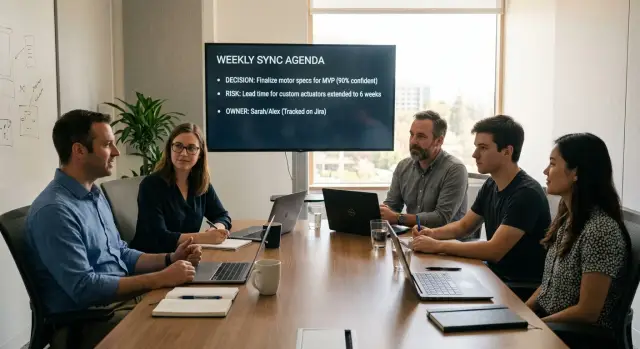
Table of Contents
Why these meetings drift
Smart teams can spend a full hour talking and still leave with nothing firmer than "we should think about it." The problem usually is not skill. It starts when one meeting tries to do too much at once: make a decision, review old work, brainstorm new ideas, and solve every edge case on the spot.
That kind of agenda almost guarantees side arguments. Someone raises a database choice, another person pulls the discussion toward hiring, and a third wants to reopen a deployment issue from last week. Each point may be valid, but the group keeps switching levels. People end up arguing about principles when they really need a simple yes or no.
That is why an architecture meeting agenda gets messy even on strong teams. Engineers care about quality, so they bring caveats. Leads care about risk, so they ask for more proof. Founders care about speed, so they push for action. None of that is a problem on its own. The meeting drifts when nobody decides which question matters today.
Repeated debates make it worse. When the same topic comes back every Tuesday, people stop believing that decisions will stick. Some stop preparing because they expect another loop. Others talk longer because they think the only way to get traction is to win the room. That wastes time and slowly eats away at trust.
Perfect consensus sounds nice, but it slows teams more than most people admit. A weekly architecture hour should create movement, not settle every concern. If the group leaves with one clear decision, one named risk, and one person who owns the follow-up, the meeting worked. The rest can wait for the next hour or for a smaller discussion with the right people.
What this hour is actually for
A weekly architecture hour has one job: make one decision that unblocks work, name the one risk that could change that decision, and assign one person to the next step.
That goal is smaller than most teams expect, and that is exactly why it works. People often bring broad topics like "API design," "cloud costs," or "auth" and then spend an hour circling tradeoffs. The meeting gets better when the scope gets tighter. Instead of "auth," decide whether the team will extend the current provider or replace it this sprint. That is concrete. People can act on it.
The decision should connect to a real delay. If nobody is blocked, save the topic for a document or a smaller chat. This hour is for choices that slow design, coding, delivery, or hiring. A simple test helps: if the team leaves without an answer, what work slows down tomorrow?
The room also needs one risk. Without that, teams make neat decisions that fall apart a few days later. Pick the risk most likely to force a rethink, such as a compliance rule, a migration cost, or a dependency on another team. You are not trying to list every possible problem. You are naming the one that could change the call.
Then assign the follow-up. Teams lose time when everyone agrees and nobody is responsible for the next move. Before the meeting ends, one person should own the next step. That might mean checking the risk, writing a short decision note, or turning the choice into tickets.
A tight architecture meeting agenda can feel almost plain. Good. One decision, one risk, one owner is enough.
Set the agenda before people join
Most meetings drift before anyone speaks. People walk in with half-formed concerns, someone adds a fresh topic on the spot, and the hour turns into live problem discovery. That is not what a weekly architecture hour is for.
Ask for topics before the meeting. Each person should send a short note that explains what changed, what needs a decision now, and what happens if the team waits. If a topic appears for the first time in the room, move it to next week unless it is truly urgent.
Some topics are not ready yet. If the team still needs logs, estimates, customer input, or a quick test, do that work first. A meeting cannot fix missing facts. It only reveals that the prep is incomplete.
The agenda should contain one plain question, not a theme. "Should we move file uploads to object storage this quarter?" is clear. "Discuss storage architecture" invites wandering opinions.
Under that question, write one risk that could change the decision. Keep it to a line. Maybe the migration could cause downtime. Maybe the new setup adds cost the team cannot justify yet. One risk keeps people focused on what matters most.
Do one last check before sending the invite. The topic should arrive before the meeting, the question should be specific, the discovery work should already be done, and only the people who can affect the outcome should be invited.
That last point matters a lot. Invite the engineer who owns the area, the person who feels the business impact, and the person who can approve the tradeoff. Leave spectators out. A smaller room usually gives you a faster answer.
If you can read the agenda out loud in under 30 seconds and it still sounds clear, you are in good shape. If it sounds vague or packed with jargon, rewrite it.
Run the hour step by step
If the room starts wide, the meeting drifts. A good weekly architecture hour starts narrow and stays narrow until someone owns the next move.
Start by reading the decision question out loud. Make it a real choice, not a theme. "Should we split the API and worker into separate services this month?" works. "Talk about scaling" does not.
Then give context in two minutes or less. Share only the facts people need right now: what changed, what hurts, and what constraint matters most. If the setup needs ten minutes, the problem probably is not framed well enough yet.
After that, hear the strongest options only. Two is usually enough. Three already pushes it. Ask each person to argue for one option they would actually ship, not every path they can imagine. That keeps smart people from turning the hour into a brainstorming contest.
A simple rhythm works well:
- State the question.
- Give the short context.
- Compare the best options.
- Test the one risk that could change the answer.
- Call the decision or assign the missing fact.
This is where many teams stall. They keep adding scenarios because nobody wants to be wrong. In practice, one serious risk tells you more than ten small worries.
Once the options are clear, someone needs to call the decision. If the room has enough information, say, "We are doing option B." If one fact is still missing, say exactly who will get it and by when. Shared ownership usually means no ownership.
Close with a named owner and a checkpoint date. The owner writes the outcome, takes the first action, and brings back results. The checkpoint can be the next architecture hour, a short review on Friday, or a release check next week.
A meeting that ends with a date moves work forward. A meeting that ends with "we should think more" usually returns in the same shape next week.
Keep the discussion from turning into a debate
A good architecture hour gets one decision closer to done. The moment people start replaying old arguments, the meeting loses its point.
Cut off reopened points fast. You do not need to be rude. Say, "We already decided that part. Do you have new evidence?" If the answer is no, move on. That one sentence saves a lot of time.
Opinions get loud when the decision question gets fuzzy. Keep bringing the group back to a plain question such as, "Are we choosing option A or B for this release?" That matters more than anyone's preferred style or old war story.
Ask for proof, not confidence. If someone says a design will be "better," ask what that means in practice. Will it cut response time, reduce support work, lower cost, or make delivery faster this month? If nobody can show a clear reason, treat it as a preference rather than a decision driver.
Time limits help more than people expect. Give each speaker two minutes to make a case, then move to questions. Long monologues make others defensive. Short turns keep the room calm and force people to say what matters.
Side issues need a parking lot. A discussion about one API often drifts into hiring, code style, vendor pricing, or last quarter's outage. Those may be real concerns, but they do not belong in the same hour unless they change today's decision. Write them down, assign a later slot, and keep going.
One simple rule keeps things moving: settled points stay settled unless new facts appear, claims need evidence or a clear tradeoff, side issues go to a separate note, and the group returns to the decision question every time it drifts.
This matters even more in small startup teams, where founders and senior engineers often know enough to argue every angle. That can look thorough, but it often hides indecision. A useful meeting ends when one person owns the next step and everyone knows what was decided.
Write the outcome so people can act on it
When the call ends, most teams have a fuzzy memory, not a decision. Fix that in five minutes. Write one short paragraph while everyone still agrees on the wording. If it takes half a page, the team probably did not decide much.
The note should answer four plain questions: what did we choose, why did we choose it now, what risk needs watching, and who will act on it by when.
Write the reason in simple language. Do not paste a transcript or every opinion from the room. Capture the tradeoff that tipped the choice. "We picked option B because it cuts release work from two steps to one, even though it adds migration work this week" is enough. A month later, that sentence stops the same debate from coming back.
Name one risk, not a long list. Pick the risk that could change the decision if it gets worse. Maybe the new queue could raise cloud cost, or a library could block mobile support. One clear risk gives the owner something real to watch.
One owner matters more than shared responsibility. Teams often write "backend and ops" when nobody wants the follow-up. Put one name next to one due date. Other people can help, but one person closes the loop.
A simple format works well:
Decision: Move background jobs to a dedicated queue service.
Reason: It removes job delays during traffic spikes and cuts support noise.
Risk to watch: Monthly cost may rise if retry volume stays high.
Owner: Maya
Due: Friday
Store the note where the team already works. If they use Jira, add it to the ticket. If they use GitLab, put it in the issue or merge request. Post the same short summary in chat if needed, but keep one place where the current note lives. A weekly architecture hour only moves work forward when the next person can read the note and start without asking what happened.
A simple example from a startup team
A five-person startup needs background jobs for two things this month: sending purchase emails and processing uploaded images. The team already uses PostgreSQL for the app. One engineer wants a Redis queue because it feels familiar. Another wants to keep jobs in PostgreSQL so the team has one less service to run.
That is a good architecture hour topic because the decision is clear. It is not a general talk about "scaling later" or a broad review of every queue tool on the market. The team brings only two options into the room: a PostgreSQL-backed queue or a Redis-based queue.
The discussion stays useful when the group ties each option to this week's work. A PostgreSQL queue is simpler to ship because the database already exists, backups already run, and the team does not need extra ops work. A Redis queue may handle higher job volume later, but it adds setup, monitoring, and one more thing to break on a small team.
They also surface one risk and keep it specific: retry failures under load. If workers crash during a traffic spike, the app could send duplicate emails or leave image jobs stuck for hours. That risk matters now because the startup plans a product launch next week, and support will feel the pain first.
So the meeting ends with a small, testable move. The team chooses the PostgreSQL queue for the next release, with a rule to revisit the choice if job volume grows past a set limit. One engineer owns the follow-up this week.
The written outcome is short: decision - use a PostgreSQL-backed queue for the current release; risk - retries may fail under load and cause duplicate or stuck jobs; owner - Maya will run a load test with forced worker restarts by Friday.
That is enough to keep product work moving. The checkout team can build email receipts now instead of waiting for a bigger infrastructure project, and the image feature can move into testing on the same path. The meeting did its job because the team left with a choice, a risk, and a person responsible for testing the choice.
Mistakes that waste the hour
A weekly architecture hour should reduce uncertainty. Many teams turn it into a standing argument instead. The pattern is familiar: too many people join, too many topics land on the table, and nobody leaves with a clear next step.
The damage usually comes from a few habits.
Too many people in the room slows everything down. When every team sends a representative, people repeat context for late stakeholders, protect their own area, and pull the group away from the actual decision. Keep the group small. Invite the people who own the problem, not everyone who might have an opinion.
Turning the meeting into a design review causes a different kind of stall. A design review asks for broad feedback. This hour should end with one decision or one clear next step. If people start debating naming, code style, or every possible edge case, park those details for a smaller follow-up.
Reopening old arguments every week burns time fast. If the team already made a decision about a database, API pattern, or hosting setup, treat it as current until new facts appear. The meeting should not become a courtroom where closed cases reopen by habit.
Leaving without an owner is another common failure. A decision without a name next to it usually dies by Friday. Someone must own the follow-up, even if the follow-up is only "test this approach and report back next week."
Then there is the most common startup mistake: packing the agenda with unrelated topics. One hour cannot cover caching, hiring needs, mobile crash reports, and CI costs well. Pick one decision. The rest can wait.
A simple boundary helps. If the topic needs deep technical review, schedule a separate working session. If it needs a decision and a next step, keep it in the architecture hour.
A quick weekly checklist
A weekly architecture hour works when the prep takes five minutes and the outcome is easy to spot. If the team cannot answer a few short questions before the call starts, the topic is not ready.
Use the same short check every week:
- Can we turn the topic into one clear decision question?
- What is the one risk that deserves airtime?
- Who owns the follow-up?
- Can we write the result so a teammate can scan it in under a minute?
- Did anything move this week because of this hour?
This checklist looks almost too simple, but that is the point. Good teams do not need a clever architecture meeting agenda. They need a repeatable one. When a founder, engineering lead, or fractional CTO keeps the format tight, the room stays calmer and people stop trying to win the argument.
If your team keeps leaving with "we should think about it," cut the scope harder next week. One decision, one risk, one owner is enough.
What to do next
Run this format for four weeks before you judge it. Teams often change the meeting after one awkward session, and that usually makes things worse. A simple weekly architecture hour needs a little repetition before people stop treating it like an open debate.
For the next month, keep the rules steady. Stick to one decision, one active risk, and one owner. Use the same short template every week instead of rebuilding the agenda. Watch which topics move fast and which ones keep getting pushed forward. Remove people from the invite list if they join often but rarely affect the decision.
After four weeks, look at outcomes, not opinions. Did decisions happen sooner? Did fewer issues bounce between meetings? Did owners actually close the follow-up, or did work stall once the call ended?
If debate still keeps growing, cut the attendee list first. A smaller group makes tradeoffs clearer. People who need context can still read the notes later.
If the meeting feels clumsy, change the template before you change the whole process. You may only need a better prompt at the top, such as "What decision do we need today?" or "What risk gets worse if we wait a week?" Small edits are easier for teams to follow than a brand new format every month.
Some startups also need a neutral person to hold the line. If founders and engineers keep reopening the same choices, outside help can reset the rhythm. Oleg Sotnikov at oleg.is works with startups and small companies as a fractional CTO and advisor, and this is the kind of practical decision process that can help a team move faster without adding heavy process.
You do not need a perfect architecture meeting agenda. You need a meeting that ends with movement. If the team leaves the room with one clear decision, one named risk, and one owner, the hour is doing its job.
Frequently Asked Questions
What is a weekly architecture hour supposed to achieve?
It should end with one decision that unblocks work, one risk worth watching, and one person who owns the next step. If the team leaves with that, the hour worked even if some open questions remain.
How many topics should we put on the agenda?
Stick to one decision question per session. When you pack in several topics, the room jumps between them and nobody finishes anything.
What makes a topic ready for this meeting?
Bring it only when the team needs a choice now and already has the facts to compare options. If you still need logs, estimates, or customer input, gather that first and bring the topic later.
Who should attend the architecture hour?
Keep the room small. Invite the engineer who owns the area, the person who feels the business impact, and the person who can approve the tradeoff. Everyone else can read the note later.
What should we do when people reopen old decisions?
Stop it early and ask for new evidence. If nothing changed, keep the current decision and move on, or the same debate will eat the whole hour.
How do we keep the discussion from turning into a debate?
Use a tight format: state the question, give brief context, compare the best two options, test the main risk, and call the next move. Short turns help too, because people make sharper points when they have two minutes instead of ten.
What if the team cannot make a decision in the room?
Name the single missing fact, assign one person to get it, and set a date. Do not leave with "we need to think more" because that only brings the same problem back unchanged.
What should we write down after the meeting?
Write a short note right after the meeting with the choice, the reason, the risk to watch, the owner, and the due date. Keep it plain enough that a teammate can scan it in under a minute and start work.
When should we move a topic out of the architecture hour?
Move it out when it needs broad design review, open brainstorming, or deep technical work. Keep this hour for decisions that block delivery, not for every idea the team wants to explore.
How can we tell if this format is actually working?
Give it a few weeks, then look at outcomes. If decisions happen sooner, fewer topics bounce between meetings, and owners finish follow-ups, the format is doing its job.


