Week-one CTO audit for customer promises already at risk
A week-one CTO audit starts with customer promises, outage pain, and revenue risk so you can fix the parts of the stack that matter first.
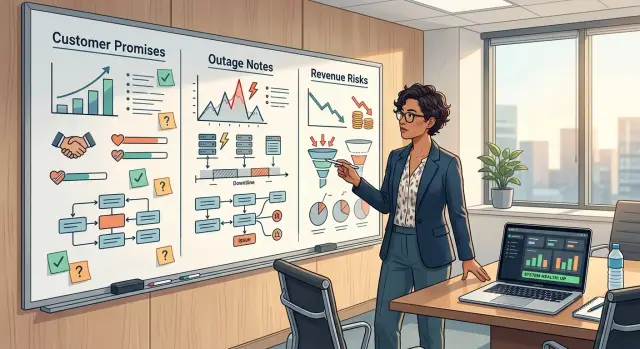
Table of Contents
Why live promises come first
A CTO's first week should start with promises customers already paid for.
Revenue rarely disappears because a file is messy or naming rules drift. It disappears when the product no longer does what customers were told it would do: reports arrive on time, data stays safe, invoices go out, logins work, and the service stays up.
Sales and support usually know those promises better than engineering. They repeat them in demos, onboarding calls, renewal talks, and ticket replies. If customers hear the same claim over and over, that claim is part of the product whether it appears in a contract or not.
Start with the failures that hit the business first: uptime problems, data loss risk, blocked workflows, and broken integrations tied to billing, reporting, or delivery. A rough codebase can wait a few days. A sync bug that drops orders or a login issue that locks out paying users cannot.
That is why a first-week audit should look more like a service failure review than a code style review. Start with the customer promise, then trace it to the part of the stack that carries it. Ask three direct questions: where can this break, how often does it break, and what does it cost when it does?
A small SaaS team might think old frontend code is the biggest problem. Then support logs tell a different story. Customers log in without trouble, but invoice emails fail every evening. Finance teams wait until morning and blame the product. That is a live promise failure. Fixing it protects renewals faster than cleaning up components.
This order also sharpens the team's focus. Engineers stop debating taste and start looking at impact. Product, support, and ops can point to the same risk list. When you ask for urgent fixes, the reason is obvious: this promise brings in money, and this one is already breaking.
List the promises customers already bought
Most teams think they know what customers were promised. Memory is unreliable. Sales remembers the pitch. Support remembers complaints. Customers remember the sentence that made them buy.
Pull the wording from the places where buyers saw it before and after payment: contracts, order forms, demo scripts, recorded sales calls, help docs, setup guides, onboarding emails, and pricing notes that make specific claims.
Turn each promise into one short sentence. Keep it concrete. "Data exports finish in under 10 minutes" is useful. "Fast exports" is not. "Two-way sync with Salesforce" is testable. "Works with your workflow" tells you nothing.
This part feels dull, but it saves time later. Once every promise sits in a single sentence, you can sort and compare them without arguing over wording. You also stop mixing marketing language with actual commitments.
Split the list into two groups. Hard promises include uptime targets, response times, integrations, security steps, import speed, billing rules, and anything shown in a demo as normal product behavior. Soft promises include cleaner dashboards, easier setup, better visibility, or nicer reports. Soft claims matter, but they rarely trigger refunds on their own.
Then mark the promises tied directly to money. Renewals usually depend on a handful of outcomes, not the whole product. If customers upgrade for SSO, audit logs, higher API limits, or reliable scheduled reports, flag those items. If an account will churn because nightly syncs fail twice a week, that promise moves to the top.
A simple sheet is enough: promise, source, hard or soft, revenue tie, and current status. One row might say, "Customer data sync completes every night by 6 a.m." Source: demo and help doc. Hard promise. Revenue tie: yes. Current status: unstable.
When you finish, the list should sound like customer language, not engineering language. That gives you a better starting point than any repo review.
Trace each promise to the stack
A promise only matters if the stack can keep it.
Take each promise and map the full path from the user action to the systems and people behind it. "Your data syncs every hour" sounds simple, but it may depend on an API, a queue, a worker, a database, a third-party vendor, and one engineer who notices when the worker stops.
Keep the map literal. For each promise, write down the service that handles the request, any job or worker that runs after it, outside vendors in the path, the person who owns each part, and any step a human still does by hand.
This is where teams get surprised. They often know who wrote the code, but they do not know who owns the result. Those are different things. If a billing retry fails at 2 a.m., one named person should be able to see the alert, understand the flow, and fix it. If nobody can do that, the promise is already fragile.
Mark every single point of failure. One database with no failover. One vendor with no backup. One engineer who understands a messy webhook path. One script running on an old server nobody wants to touch. Customers do not care which part broke. They only see that the promise was missed.
Manual work deserves extra attention. Many startups quietly depend on someone exporting a CSV, restarting a worker, approving a queue, or checking an inbox before customers notice anything. That may hold together on a Tuesday afternoon. It falls apart at night, on weekends, and during holidays.
Say a SaaS company promises "daily reports by 8 a.m." The real chain might be a midnight data import, a cleanup job at 1 a.m., report generation at 4 a.m., email delivery at 7 a.m., and a support check at 8:30 a.m. If the cleanup job fails and nobody sees it until business hours, the promise is false for every customer in that batch.
In the first week, this map tells you more than a long code review. It shows which promises rest on stable ground and which ones depend on habit, luck, and one tired person checking Slack before breakfast.
Score the damage before you touch code
A broken promise does not hurt all at once. It hurts in layers.
If checkout fails for 20 minutes, support gets flooded. If it keeps failing for a day, refunds start. After a week, customers stop trusting the product and sales calls get harder.
Before anyone opens an editor, score each issue across three time windows:
- One hour: how many users get blocked right now, and how many tickets will that create?
- One day: how much money could you lose through refunds, delayed deals, or missed renewals?
- One week: how many customers might leave, downgrade, or tell others not to buy?
This changes the conversation fast. A bug that looks small to engineers can cost more than a messy subsystem no customer ever sees. A flaky billing webhook, slow login flow, or broken export often matters more than ugly code.
Use numbers, even rough ones. Count refund requests. Count support time. Count deals sales cannot close because a demo breaks or a promised feature fails during trial. Ten support tickets at 15 minutes each already burn two and a half hours in a day. One enterprise prospect delaying a contract because SSO does not work can outrank five annoying bugs.
Then rank problems by business damage, not by how satisfying they are to fix. Teams often grab easy cleanup first because it feels productive. That is a trap. The right order usually protects cash, trust, and renewals.
A strong first-week audit ends with three fast moves, not ten. Pick the fixes that reduce pain quickly: stabilize login, stop duplicate charges, or remove the timeout that breaks onboarding. Leave the week with that short list, clear owners, and a rough before-and-after number for each fix.
Run the audit in your first week
This work should feel more like fieldwork than architecture review. You are trying to find broken promises tied to money, renewals, and trust, so you start with people, complaints, and real workflows before you start arguing about code quality.
Five focused days are usually enough to set priorities.
On day one, sit with sales, support, product, and ops. Ask each team the same question: what do customers expect every day, and where do we fail them most often? Write down exact promises, not vague themes.
On day two, read open incidents, recent support tickets, refund requests, and angry customer notes. Look for repeats. If three customers complain about delayed reports or failed logins, that is a business problem, not a small bug.
On day three, run the top customer journeys yourself. Sign up, log in, pay, invite a teammate, export data, or complete whatever path matters most. Risk becomes obvious when you use the product like a customer.
On day four, check the basic safety rails: alerts, backups, logs, deploy steps, and rollback steps. If nobody knows whether backups restore cleanly, you already found a serious gap.
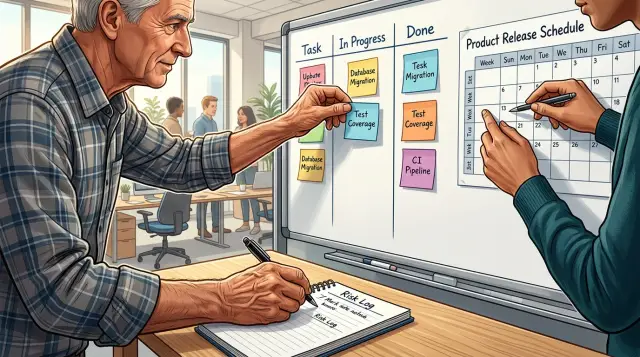
On day five, write a short risk list with an owner and a date next to each item. Keep it brief. One page that names the promise, the failure point, and the next action is enough.
This schedule works because it stays close to reality. A SaaS team might think its problem is slow development, then discover the bigger issue is failed billing emails going unnoticed for days. One fix can protect more revenue than a month of cleanup.
If you are working as a fractional CTO, resist the urge to produce a giant audit deck. People need a short list they can act on next week. Name the top risks, assign them, and review progress in public.
A simple example from a SaaS team
A B2B SaaS team sold a paid plan with daily data exports. Customers used those files for finance reports every morning, so that promise had a direct effect on renewals and support load.
The export flow looked small enough that nobody worried about it. One cron job ran overnight on a single server, built the files, and sent them out. The team had no alert if the job stopped, no retry if it failed halfway through, and no backup option for support.
Then the pattern got expensive. Exports broke on Fridays, when a heavier weekly batch put more pressure on the database and slowed the job until it timed out. Support learned about it on Monday from angry tickets, not from the system itself.
That gap matters more than it sounds. Customers do not care whether the failure came from a query, a worker, or a server. They care that the daily export they paid for did not arrive.
This is exactly the sort of problem a first-week audit should catch before anyone argues about code style or a rewrite. The first fixes are plain: add monitoring to check whether the job finished, add retries for failures that clear on a second run, and give support a manual fallback so they can rerun one export without waking an engineer.
None of that is glamorous. It solves the part that hurts revenue first.
The database may still need work, and in this case it probably does. Slow queries and shaky batch logic often sit under export failures. But a CTO who starts with a large database rewrite can spend two weeks cleaning internals while customers keep missing files.
A better call is to stabilize the promise first, then fix the deeper cause. Once alerts fire within minutes and support can recover the export the same day, the team buys time to clean up the database properly.
Mistakes that waste the first week
A first-week audit goes off track fast when the new leader starts with code style, naming rules, or folder cleanup. Those jobs feel productive because they are easy to see. They almost never protect revenue.
Another bad move is trusting the roadmap over what customers deal with right now. Roadmaps often show the team's hopes. Support queues, failed jobs, churn notes, and refund requests show what the business actually owes today. If a feature launch sits at the top of the plan while billing fails twice a month, the plan is wrong.
You also miss a lot when you ask only engineers what matters. Engineers know where the code hurts. They do not always see what customers feel first. Talk to support, sales, customer success, and finance early. A support lead may tell you that weekend imports fail every Sunday. Finance may tell you card retries break at month end. Those details rarely show up in sprint boards.
Some of the most expensive failures happen outside office hours: billing runs, invoice emails, weekend jobs, renewal flows, trial endings, support handoffs, and alerts that fire but nobody reads. These checks are boring. They also catch real leaks.
A huge audit document is another common mistake. New CTOs sometimes spend days writing a 40-page report full of architecture notes, risk scores, and future ideas. Then nobody owns the fixes, so nothing changes. A shorter document with clear owners, deadlines, and a simple order of attack works better.
The pattern repeats itself. A SaaS team asks a new leader to "clean up engineering." He spends four days reviewing pull request habits and service boundaries. Meanwhile, renewal emails keep going out with broken links, and support patches the problem by hand. That team did not need a cleaner repo in week one. It needed someone to protect the promise customers already bought.
If you bring in a fractional CTO at this stage, the useful question is simple: which promises can fail this week, and who owns each fix by Friday?
Quick checks before you ship fixes
A fix is not ready just because the tests pass. It is ready when the team knows what promise failed, how they will spot the same break again, what they will tell customers, how they will roll back the release, and what proof will show the promise now holds in production.
Teams often stop one step too early. They find the bug, write the patch, deploy it, and feel done.
Five release checks
- Ask one person to explain the customer promise in one sentence, then describe the exact failure path. If they drift into code details or tell two different stories, the team has not pinned down the real risk.
- Check how fast you detect a repeat. Good monitoring should show the problem within minutes. If you only learn from angry emails or a founder checking logs by hand, the system is still exposed.
- Give support a plain answer before the release goes out. Customers do not need a lesson on queues, locks, or database timeouts. They need a clear sentence about what went wrong, who was affected, and what changed.
- Test rollback like you expect trouble. If the team needs a long runbook, three approvals, and a lucky guess, rollback is not real.
- Decide what counts as proof after release. Pick one or two signals tied to the promise itself, such as checkout success rate, export completion time, or failed login count.
Small teams skip the third and fifth checks all the time. They fix a billing delay, deploy it, and move on. Then support still cannot answer customers in simple words, and nobody watches renewal failures for the next hour. A technical fix turns into a trust problem.
This is where plain discipline helps. If one engineer can explain the promise and the break path, support has a short response ready, rollback is one calm action, and the post-release metric is on screen, the release is much safer.
Ship when each check has a clear owner. If any answer sounds vague, wait a bit longer.
What to do next
Take the top two or three risks from the audit and turn them into a 30-day plan. Keep it short. If you list ten fixes, the team will finish none of them.
Each item should tie back to a promise a customer already pays for. Start with the promises that touch renewals, onboarding, billing, uptime, or data accuracy. Clean code can wait if invoices fail or reports arrive late.
Put the plan on one page so founders can read it in two minutes. For each fix, include the customer promise at risk, the owner, the target date, and one simple success measure.
Use measures that anyone can understand. "Support tickets about failed imports drop from 12 a week to 2" works. "Checkout errors stay under 0.5% for 14 days" works too. "Improve reliability" is too vague and invites debate later.
Keep ownership clear. One fix needs one name, even if two people help. Shared ownership often means no ownership, especially in a small startup where everyone already juggles too much.
Founders also need to know what will not happen this month. Say it plainly. If the team spends two weeks fixing broken billing retries, the UI polish sprint moves back. That tradeoff is normal. Hiding it only creates surprise.
If the team lacks senior technical judgment, an outside review can help. A fresh set of eyes often spots where the real risk sits: architecture, infrastructure, data flow, release process, or a promise sales made that the product still cannot keep.
That is the kind of work Oleg Sotnikov does through oleg.is. His fractional CTO and startup advisory work focuses on architecture, infrastructure, and practical fixes for teams that need to protect revenue quickly without hiring a full-time CTO.
A good 30-day plan should feel a little boring. That is usually a good sign. It means the team knows what broke, who will fix it, and how they will tell if the fix worked.
Frequently Asked Questions
What should a CTO check first in the first week?
Start with the promises customers already pay for every day, like logins, billing, reports, exports, syncs, and uptime. Trace each promise to the systems and people behind it, then check where it breaks and how much money or trust it costs.
Why should I avoid starting with code style and cleanup?
Code cleanup rarely stops churn on its own. Fix the problems that block users, delay billing, break reports, or put data at risk first, because those failures hit renewals and support load right away.
How do I find the promises customers already bought?
Pull the exact wording from sales calls, demos, contracts, help docs, onboarding emails, and pricing notes. Turn each promise into one short sentence that a customer would recognize, such as "daily exports arrive by 8 a.m."
Which promises deserve attention first?
Put hard promises at the top, especially the ones tied to renewals, upgrades, onboarding, billing, uptime, and data accuracy. If a customer will leave because that promise fails, move it ahead of anything that only annoys the team internally.
How do I trace a customer promise to the stack?
Map the full path from the customer action to the result they expect. Write down the app or service, jobs, vendors, database steps, alerts, manual actions, and the person who owns each part so you can spot weak points fast.
How should I score the damage before touching code?
Score the damage over one hour, one day, and one week. Count blocked users, support time, refunds, delayed deals, and churn risk, even if you start with rough numbers.
What does a practical first week audit look like?
Use the week like fieldwork. Talk to sales, support, product, and ops first, read recent incidents and tickets, run the top customer journeys yourself, check alerts and backups, then end the week with a short risk list that names an owner and date for each fix.
What mistakes waste the first week?
Teams waste time when they trust the roadmap over live failures, ask only engineers, or write a huge report nobody acts on. Another common miss is ignoring nights, weekends, and month end jobs, where billing, imports, and alerts often break first.
How do I know a fix is ready to ship?
A fix is ready when the team can explain the broken promise in plain language, detect a repeat quickly, roll back without drama, and watch one or two production signals that prove the promise now holds. Tests help, but they do not replace monitoring, rollback, and a clear customer message.
What should happen after the audit ends?
Take the top two or three risks and turn them into a 30 day plan with one owner, one date, and one simple success measure for each item. If the team lacks senior judgment, bring in an outside CTO advisor to review the stack and help set the order of work.