Vendor exit clauses that prevent months of engineering rework
Vendor exit clauses deserve a technical review before you sign. Check data export, API limits, and auth terms now to avoid expensive rewrites later.
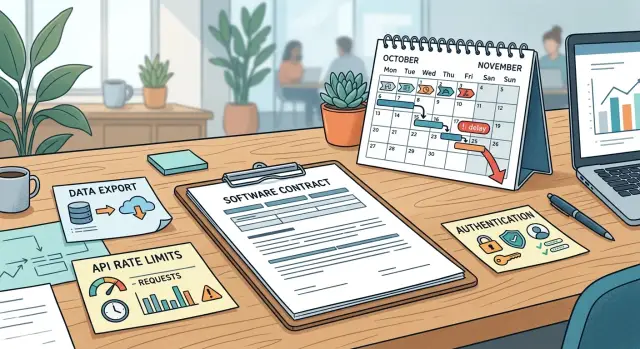
Table of Contents
Why this hurts later
Most teams compare vendors on price, features, and setup speed. That makes sense on signing day. The real cost often shows up a year later, when the product holds customer data, sits inside daily work, and is hard to leave.
Exit terms matter because engineering ends up doing the hard part. Legal signs the contract once. Engineers live with the consequences for months.
If export is partial, slow, or messy, migration turns into cleanup. Teams write scripts, fix broken fields, chase missing history, and open support tickets for data they assumed they already owned. A move that looked routine becomes a rescue project.
An API alone does not solve this. Plenty of vendors have one, but strict rate limits can stretch a weekend migration into weeks. Scripts stall, retries pile up, and the cutover date slips. That delay hits testing, support planning, and customer trust.
Authentication causes a different kind of lock-in. If logins depend on the vendor's own identity system, or if account mapping is awkward, users feel the pain directly. People lose access, create duplicate accounts, or need manual resets in the middle of the switch.
A growing company can absorb a higher subscription bill for a while. Three engineers burning two months on a bad exit is harder to absorb. That cost almost never shows up in a sales conversation, but it is often the one that matters most.
What to confirm before signing
A harmless-looking contract can still hand your team a future migration bill. The risky parts usually hide in plain language about data access, usage limits, and login methods.
Start with ownership. Your company should own the records you enter and the metadata that makes them usable later: IDs, timestamps, tags, audit history, file references, and relationships between records. A flat CSV with names and emails is not enough if you later need to rebuild a working system.
Then ask how engineering can pull everything out. Exporting one screen at a time is fine for reporting. It is useless for a real move. You need clear terms for bulk API access, full account exports, attachments, and formats your team can work with, such as JSON, CSV, or a database dump.
Rate limits need plain answers too. Some vendors are generous during onboarding and far tighter later, or they change limits by plan. That can turn a short migration into a long, expensive one. Get the caps in writing and ask whether temporary increases are available during offboarding.
Authentication deserves the same level of scrutiny. If the product ties users to the vendor's own login flow, switching later gets messy. Confirm which methods you can keep, which ones you can replace, and whether users can move without a painful account reset.
Before anyone signs, legal, product, and engineering should be able to answer four simple questions in plain English. Can we export raw data and metadata together? Can engineering pull data in bulk? Do rate limits change by plan or at renewal? Can we keep or replace the current login method? If those answers are vague, the contract is not ready.
Data export terms that matter
Most exit language focuses on notice periods and fees. The part that saves engineering time is the export section.
"CSV export" sounds reassuring, but it often means reporting data, not the full working dataset. Teams get names, totals, and a few status fields, then discover that notes, internal IDs, status history, custom fields, and record relationships are missing. The data is technically exported, but not in a form you can rebuild from.
Files are another common surprise. The contract should say whether exports include attachments, uploaded documents, images, message history, and audit logs. If those live in a separate store or require a support request, you need to know that before you sign.
Format matters almost as much as access. Engineers need to know whether they will receive CSV, JSON, an SQL dump, an object archive, or a mix. They also need a schema, stable field names, and clear rules for timestamps, deleted records, user IDs, and foreign keys. Without that, a two-day move can become a month of cleanup.
Large accounts need one more check. Ask how exports work when the dataset is big enough to hit timeouts, storage caps, or API limits. Can the vendor prepare a bulk export on its side? Does it split data into predictable chunks? How long do download files stay available? Small details like that decide whether offboarding is smooth or chaotic.
Get support promises in writing. If the vendor says it will help during offboarding, the contract should spell out what that means: exported data, supported formats, inclusion of files and logs, bulk export options for large accounts, response times, named contacts, and any extra fees. If that wording is missing, assume your team will do the hard parts alone.
When rate limits stretch a migration
A migration can look simple on paper and still run weeks late because the old vendor only allows small batches at a fixed pace.
Teams often see "API available" in the docs and stop there. That is not enough. If your account can pull 120 records per minute and you need to move millions, the timeline changes fast. It gets worse when the vendor publishes one limit in the docs and hides another in a support article or lower-tier plan.
Check every level of throttling. Some vendors cap requests per minute, per hour, and per day. Others set separate limits by endpoint, workspace, or token. If you miss one of those, your estimate is wrong before the migration starts.
Bulk endpoints matter even more than the raw cap. Async export jobs, large page sizes, and full dataset dumps can cut weeks off a move. If every object needs its own API call, engineers end up writing queue logic and retry logic just to stay under the limit.
Temporary increases during exit are worth negotiating up front. One short burst of extra throughput can save a month of delay. Without that clause, the vendor has little reason to help once you have decided to leave.
Build failure into the estimate. Retries, timeouts, partial responses, and duplicate pages consume the same API budget as successful calls. A migration that looks like four days on a spreadsheet can easily take nine once real-world failures show up.
A simple model works well. Count the records in each object type. Check limits per minute, hour, and day. Confirm bulk export or async job support. Add 15 to 30 percent for retry overhead. Then ask for a written path to a temporary limit increase. If the numbers still do not work, fix the contract before anyone signs it.
Authentication can make the switch harder
Pricing and notice periods get most of the attention, but authentication often creates more work than either one.
Start with the plan you are actually buying, not the product page. Many vendors advertise SSO and then lock it behind a more expensive tier. If your plan only supports local accounts, users may get trapped in a login setup that is hard to move later.
Ask the vendor for exact answers. Does your plan include SSO, and which methods are supported? Are SAML, OAuth, and SCIM all available, or only one of them? Can users keep the same identities, email addresses, and group mappings after a move? How do MFA rules, domain restrictions, and enforced login methods affect the cutover? What happens to service accounts, bots, and API users during and after the switch?
These details change the size of the project. SAML and OAuth are not interchangeable in practice. SCIM matters because it controls provisioning and deprovisioning. Without it, teams often rebuild groups, roles, and access rules by hand.
Identity continuity matters more than many teams expect. If users need brand new accounts, you break audit trails, ownership records, and approval history. That gets messy fast in finance, support, and engineering systems.
Service accounts deserve their own review. A company can move staff logins in a week and then lose another month fixing broken scripts, CI jobs, and sync processes because old tokens stopped working or permissions changed.
One simple test is hard to fake. Ask the vendor to describe, in writing, how a customer with 500 users, enforced MFA, and automated provisioning leaves the product without losing access history or breaking integrations. If the answer is vague, the exit will be painful.
How to review the contract with engineering
Legal catches pricing, renewal terms, and liability. Engineering catches the work hiding behind the contract. You need both in the same review.
Start with a plain inventory. Engineering should list every system that sends data to the vendor, pulls data back out, or depends on that vendor for login, billing, support, or reporting. Small dependencies cause the ugliest surprises. A tool that looks isolated can turn out to sit under your customer portal, admin dashboard, and nightly jobs.
Then test the export before signing. Do not accept promises like "full export available on request." Pull a sample. Open the files. Check whether they include attachments, timestamps, IDs, audit history, and relationships between records. If the export shows up as a pile of CSV files with no clear mapping, the migration just got bigger.
Treat the API the same way. Engineering should sketch the calls needed for a full move, not just daily use. That means reading everything out, recreating it somewhere else, and verifying that nothing went missing. If those calls are too slow or too fragmented, the portability story falls apart.
Authentication needs its own line item. Write down how staff log in and how customers log in. Note whether the vendor supports SSO, SAML, OAuth, SCIM, or only local accounts. If users live inside the vendor's identity system, leaving gets painful fast.
This review does not need a thick document. One page is often enough if it covers the systems that depend on the vendor, the tested export format, the API calls needed for a full migration, the login flows for employees and customers, and the contract wording legal should push back on. Give legal exact edits instead of general concerns. "Customer can export all records, files, and metadata without manual vendor help" is far easier to negotiate than "please improve portability language."
A simple example from a growing SaaS team
A 12-person SaaS company chose a combined platform because it handled billing, user events, email, and admin work in one place. Setup was fast. The monthly price looked fine. The team wanted to ship product work instead of stitching together four separate tools.
Six months later, the math changed. Customer count grew, a few add-ons kicked in, and the new bill no longer made sense for a small team. They decided to move to a simpler stack with lower fixed costs.
That is when the contract started to bite.
The vendor had an API, but daily caps slowed everything down. The team could not pull users, event history, and account metadata in one clean job over a weekend. They ran exports in batches, waited for limits to reset, checked for missing records, and started again. A job they expected to finish in days stretched into weeks.
Auth made it worse. Several internal scripts used service accounts created inside the old platform. Those accounts did not transfer cleanly to the new setup, and the permission model did not match either. Engineers rebuilt access rules, rotated tokens, updated background jobs, and retested every workflow touching user data.
Two engineers spent most of a quarter on the switch. Product work slipped. A reporting feature customers were waiting for got delayed. The company kept paying for the old vendor because it could not cut over safely.
Nothing about this looked dramatic when the contract was signed. That is the problem. A short review of export terms, API limits, and authentication migration would have exposed the risk early. The team still might have picked the same vendor, but at least it would have known the cost and planned around it.
Common contract mistakes
Most of these problems start the same way. Teams check price, security, and uptime, then treat the exit as something to worry about later. By the time later arrives, the vendor is already wired into real work.
One mistake is calling report exports "portability." Summary CSV files are not the same as raw records with IDs, timestamps, history, and relationships. Teams also forget to ask about attachments, comments, audit trails, and old logs. Those missing pieces are often the ones legal, finance, or support needs most.
Another mistake shows up in technical review. Engineering tests a few normal API calls, sees data come back, and moves on. That does not tell you whether pagination works at scale, whether deleted records are still available, or whether the API exposes the same fields the UI shows. It definitely does not tell you how long it takes to pull millions of records under real limits.
Rate limits create a lot of quiet pain. Teams notice them only when they start planning a migration and realize the vendor allows a tiny number of requests per minute. If those limits live only in public docs, the vendor can change them later. Put the numbers, burst limits, and any temporary migration allowance in the order form or contract.
Auth gets the same wishful treatment. Teams assume an SSO migration will be easy because both tools mention SAML or OAuth. In practice, user IDs may not match, group mapping may break, SCIM may behave differently, and the old vendor may do little to help move account state or history.
The safer approach is not glamorous, but it works. Ask for a raw export sample. Include files and logs. Test the API under realistic limits. Trace how a real user account moves from one system to the next. A small review now is a lot cheaper than months of cleanup later.
A five-minute check before approval
Before anyone signs, stop at the last page and ask a few blunt questions.
Can you export all customer data, files, logs, and metadata yourself, or do you need the vendor to run a manual process? If you pull everything through the API, can you finish within your real deadline, not an ideal one? If you switch later, can users sign in another way, such as email and password, SSO, or your own identity system? Does the contract say the vendor will help during exit, with clear response times and technical support? Did an engineer read the API and auth docs, or did the team rely on sales slides and a demo?
One weak answer can slow a migration by weeks. A manual export means waiting in a support queue. Tight rate limits can turn a two-day pull into a month. Locked-in authentication is worse because it touches every user account and every support message.
A simple rule helps: if engineering cannot explain the exit path in plain English, approval is early.
Build this review into procurement
Put these checks into procurement, not into a rescue plan six months later. The best time to fix bad exit terms is before the order form is signed.
A short internal note is enough. Cover how data comes out, what API limits apply during a migration, and which auth methods you can use now or switch to later. If that note is missing, the contract is not ready.
Have legal and engineering review the same checklist. Legal sees wording risk. Engineering sees the work hidden behind it. That shared review prevents a lot of back-and-forth later.
It also helps to run a small proof before you commit to a long term. Export a sample dataset. Import it into a test environment. Try the API with realistic volume. Test how users log in if you move them somewhere else. One afternoon of testing can expose weeks of future rework.
If a vendor avoids clear answers or refuses simple contract terms, treat that as product risk, not paperwork. Keep another option open or push for a shorter term while you learn more.
If you want an outside technical review before signing, Oleg Sotnikov at oleg.is works as a fractional CTO and startup advisor. He helps startups and small teams review vendor risk, migrations, infrastructure, and practical AI adoption, which is often cheaper than cleaning up a rushed exit later.
Frequently Asked Questions
Why do exit clauses matter if the vendor looks affordable now?
Because the bigger cost often shows up when you leave. A cheap tool can turn expensive fast if your team spends weeks pulling data, fixing broken fields, and rebuilding logins during a move.
What data should we be able to export?
Ask for raw records and the metadata that makes them usable later. That usually means IDs, timestamps, custom fields, tags, attachments, audit history, and links between records, not just names and totals.
Is a CSV export enough?
Usually no. CSV files often work for reports, but they often miss record history, internal IDs, file links, and relationships your team needs to rebuild the system.
How can I tell if API limits will slow a migration?
Count how many records you may need to pull, then compare that number with limits per minute, hour, and day. Also check whether the vendor offers bulk exports or async jobs, because those matter more than a basic API.
Should rate limits go into the contract?
Yes. Put the actual caps, burst rules, and any temporary increase for offboarding in the contract or order form. If the numbers only live in docs or sales emails, the vendor can change them later.
What should we ask about SSO before signing?
Start with the plan you will buy, not the marketing page. Confirm whether it includes SSO, which methods it supports, and whether users can keep the same identities, email addresses, MFA rules, and group mappings after a move.
Do service accounts and bots need a separate review?
They often break after a move if the old vendor controls the identities or tokens. Have engineering map every service account, bot, API user, and background job before signing so you know what you must rebuild later.
Do we really need engineering in the contract review?
Yes, because legal sees wording risk and engineering sees the work hiding behind it. Ask engineering to test a sample export, review the migration API calls, and trace how staff and customers would log in after a switch.
What is the fastest way to test exit risk before approval?
Run a small proof with real data. Export a sample, open the files, check for IDs and history, then test how long the API takes under real limits and how a few users would sign in on the new system.
When should we ask for a shorter term or walk away?
Push back when the vendor gives vague answers on full export, bulk access, auth migration, or offboarding help. If they refuse simple terms, keep another option open or ask for a shorter contract while you learn more.


