Usage based pricing needs more than a pricing page
Before you test usage based pricing, set up clean metering, monthly reconciliation, and a fair dispute process so invoices match real use.
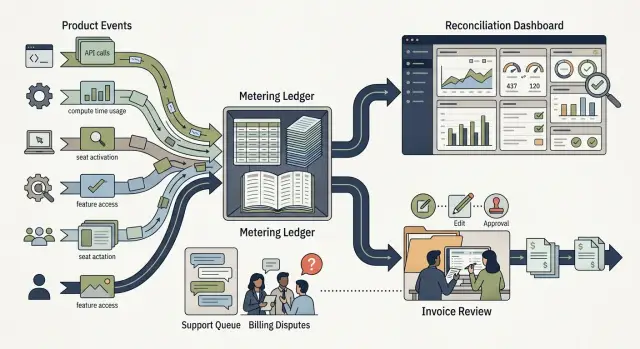
Table of Contents
Why pricing tests fail before the first invoice
Many pricing tests die on the first bill. The problem usually is not the price. It is the gap between what the customer thinks they used and what your system counted.
Teams can spend weeks on plan names, packaging, and discount ideas, then leave the hard part for later. They skip the plumbing behind usage based pricing: which events count, when they count, how retries behave, what happens to late data, and who can trace a number back to raw activity.
That gap shows up fast. A customer sees 820 exports in the product, but the invoice says 1,040. Maybe your meter counted failed attempts. Maybe it counted retries twice. Maybe the dashboard uses local time while billing closes in UTC. The customer does not care which team caused it. They see a bill they do not trust.
One bad invoice can end the test before you learn anything useful. Support jumps in, finance issues credits, engineering digs through logs, and the pricing experiment turns into a trust problem. After that, even correct invoices get more pushback because customers remember the first mistake.
Before you expose any usage charge, settle four rules:
- what counts as billable usage
- when usage becomes final for billing
- how you correct bad or missing records
- how someone can explain a charge line by line
Audit history matters more than many teams expect. If a number changes, you need to show why it changed, who corrected it, and what period it affected. Without that trail, every dispute turns into a custom investigation.
This is why early pricing experiments often fail quietly. Teams think they are testing willingness to pay, but they are really testing whether their metering system can produce a bill that matches the product story. If the counting rules are fuzzy, the experiment tells you nothing about demand. It only tells you the billing path is not ready.
What you're actually charging for
If a customer cannot explain the unit on an invoice in one breath, trouble starts early. A good usage based pricing model begins with one billable unit that sounds plain and specific, such as "processed document," "successful API call," or "minute of generated audio."
Vague units create arguments. "Operations" sounds flexible to a product team, but a buyer will ask what counts as one operation, why two similar actions cost different amounts, and whether failed attempts should appear on the bill.
The unit should match a customer action, not the noise inside your system. Background jobs, retries, health checks, internal admin tools, and bot traffic can flood a metering system with events, but customers did not ask for most of them. If your system retries a job three times because your queue had a bad day, that is your cost, not their usage.
The next choice matters just as much: when does usage count? Teams usually pick one of three points. They count on request, on success, or on delivered result.
Each choice changes the customer experience. Counting on request is simple, but customers may hate paying for failed uploads or broken inputs. Counting on success feels fairer, but you need clean rules for partial success. Counting on delivered result is often easiest to defend, though it can be harder to track when several services touch the same job.
Write the edge cases before you launch. Do not leave them for support to guess later. Decide what happens with failed uploads, canceled jobs, duplicate events, test accounts, sandbox traffic, and internal demos. A short policy beats a clever one.
If a customer submits one file and gets one usable result, most people accept one charge. If they submit one file, your system retries it four times, and the invoice shows five units, they will dispute it.
This is the step many teams skip during pricing experiments. They test numbers before they define the thing being sold. Get the unit, the counting moment, and the edge cases on paper first. Billing gets easier, and invoice disputes drop fast.
Build the billing path step by step
Most usage based pricing breaks in the space between product activity and the invoice. The fix is boring, but it works: treat billing like a data pipeline, not a spreadsheet someone patches at month end.
Start by naming one billable event clearly. Pick a stable name that will still make sense six months later, such as "document_processed" or "api_request." Do not tie the name to a plan or a price. Plans change. The event name should not.
For every event, record the same small set of fields every time:
- a unique event ID
- an exact timestamp
- the customer or workspace ID
- the plan version that applied at that moment
That plan version saves a lot of pain. If a customer upgrades in the middle of the month, you still know which rule applied to each event. You do not need to guess later or recalculate old usage against new pricing.
Store raw events first and leave them unchanged. Then write billable totals to a separate ledger. Raw events answer "what happened?" The ledger answers "what are we charging for?" If you mix those together, checks get slow and disputes get messy.
Before you create an invoice, freeze the billing period. Close the window, run the totals, and stop late events from changing the number. If something arrives after the cutoff, move it into the next period or add it as a clear adjustment. Finance needs fixed numbers. Customers do too.
The last step is visibility. Customers, support, and finance should all see the same usage view, based on the same ledger and traceable back to raw events. If support sees one count, the customer portal shows another, and finance exports a third, every question turns into detective work.
A simple test works well: if a support agent cannot explain a line item in two minutes, the billing path is still too loose.
Match product data to billed amounts
A price model fails when the product says one number and the invoice shows another. With usage based pricing, you need a regular check between three layers: raw product events, billable usage totals, and the final amount on the invoice. If those numbers drift apart, support gets the complaint long before finance spots the pattern.
A simple schedule works better than a heroic month end review. Run reconciliation every day. Compare how many events the product logged, how many of those events counted for billing, and what charge those totals would create if you invoiced right now. Daily checks catch small breaks while they are still easy to explain.
Teams usually find the same problems again and again. An event never reaches the billing table because a queue failed for ten minutes. A retry writes the same event twice. Two services disagree on time, so usage lands in the wrong billing window. Late events also appear after a daily cutoff and change yesterday's total.
If you sell API calls, storage, or seats that expand during the month, these errors add up fast. A gap of 2 percent may sound small, but across a large customer it can mean a very different invoice. That is when disputes start, and the team has to rebuild the story from logs.
A decent daily report is often enough if it stays clear and boring. It should show raw event counts by customer and day, billable counts after filters and deduplication, the draft invoice amount, any mismatch beyond your threshold, and every manual adjustment made that day.
Manual adjustments need their own trail. Do not leave a number in a spreadsheet with no story behind it. Store the reason, the date, and the owner's name every time someone changes a billed amount. When a customer asks why their invoice changed, your team should answer in minutes, not after three Slack threads and a database query.
Teams that run solid production systems already treat logs, metrics, and billing data as part of the same operational picture. That habit saves a lot of pain when pricing experiments move from a test idea to real money.
Handle disputes without burning support time
Support teams get buried when a customer says, "this invoice looks wrong" and nobody can see the full story in one place. Give support a single screen with the billed metric, the customer's plan rules, the date range, any credits, and every manual adjustment. If they need three tools and two Slack threads to answer one question, the process will break as soon as volume grows.
The first reply matters more than most teams think. Before anyone investigates, support should collect the same facts every time: the invoice line item, the billing period, the account or workspace ID, the charge the customer questions, and a short note on what they expected instead. That small intake step cuts a lot of wasted back and forth.
After that, follow a fixed review path. Support confirms the account details, billing checks the metering and reconciliation records, and a product or engineering owner joins only if the numbers still do not match the pricing rules. Keep the path the same for every dispute, even when the customer is loud or important. Consistency protects revenue, and it also protects trust.
Credits and refunds need written rules. If a meter failed, a job double counted usage, or your invoice logic applied the wrong tier, issue the correction fast. If the charge matches the contract and the recorded usage, explain it clearly and close the case. Do not let refunds depend on who complained the longest.
Save the final decision with the evidence behind it. Over time, patterns show up. You may find that most disputes come from one confusing line item, one broken event source, or one plan rule that customers keep reading the wrong way. That record turns support tickets into product fixes, which is much cheaper than arguing about the same charge every month.
A realistic example from a SaaS team
A SaaS team decided to test usage based pricing on one narrow feature first: API calls. They kept the base subscription the same and charged a small overage once customers passed a monthly limit. On paper, it looked simple. Count each request, total it at month end, and put the number on the invoice.
The trouble started after a release week that put more pressure on their queue workers than usual. Some requests timed out, the queue retried them, and the billing pipeline treated each retry as a fresh billable event. Customers still saw one result in the product, but the metering system recorded two or sometimes three charge events for the same action.
One customer spotted it fast. Their invoice showed a sharp jump in API usage compared with the week before, and their own logs did not match the billed amount. Support could not answer right away because the invoice total came from a different path than the product analytics dashboard.
Finance and engineering sat down with raw event exports, queue logs, and invoice line items. They matched request timestamps, customer IDs, and event IDs. That is where they found the real problem: duplicate event IDs moved through the billing path, and the invoicing job counted them more than once.
They fixed the issue in two places. First, they added idempotency checks so the pipeline ignored repeat events from retries. Second, they changed reconciliation to compare billed usage against a clean event table before any invoice went out.
They also issued credits instead of arguing over a small print explanation. That choice saved time and kept trust intact. For the next two billing cycles, they ran shadow invoices in the background and compared raw product usage, cleaned billable usage, and draft invoice totals every day.
The numbers stayed close, and any mismatch had a clear reason. This is the kind of dry architecture work teams skip when they rush pricing experiments. It does not look like pricing strategy, but it decides whether customers believe your bill.
Mistakes teams make when they rush
Teams usually break usage based pricing long before the first invoice goes out. They rush to test revenue ideas, but they skip the quiet plumbing that decides what counts, when it counts, and how anyone proves it later.
The first mistake is simple: they count the wrong things. Retries, health checks, internal admin actions, backfills, and failed jobs slip into customer totals. A team sees higher usage, finance sees more billable activity, and the customer sees a bill for work they did not ask for.
Another common mess starts when someone changes pricing rules in the middle of a billing cycle. Product updates a threshold, finance updates a spreadsheet, and support gets no clear record of which rule applied to which date range. Without version history, every dispute turns into guesswork.
A weak metering system also hides trouble by aggregating too early. Teams sum events into daily totals, then delete the raw records to save storage. That looks tidy until a customer asks, "Why did our bill jump on Tuesday?" If the team cannot trace the number back to source events, they cannot answer with confidence.
Different teams often read from different totals. Product checks one dashboard, finance pulls another report, and support looks at a third tool with delayed data. Then reconciliation becomes a manual argument instead of a simple check. One source says 1.2 million events, another says 1.1 million, and nobody knows which number should reach the invoice.
The rush usually shows up in support first. If the team starts pricing experiments before support scripts and exception rules exist, every unusual case lands in a queue with no playbook. That includes credits for outages, duplicate events after a retry storm, usage created by sandbox accounts, plan changes during an active cycle, and corrected invoices after a bug.
A small SaaS team can avoid most of this with one boring habit: keep raw events, rule versions, and billed totals connected. This is the kind of operational discipline Oleg Sotnikov talks about on oleg.is when he works with startups on architecture and technical operations. When someone questions a charge, the team should pull one timeline, show what happened, and fix exceptions fast instead of debating whose dashboard is right.
Quick checks before you go live
A pricing model is not ready when the pricing page looks good. It is ready when product, finance, and support can all explain the same charge with the same numbers. If that does not happen, usage based pricing turns into manual fixes and angry tickets.
Run a short prelaunch check against real account data. Keep it blunt. Write the billable unit in one plain sentence. "We charge for each processed document" is clear. "We charge for compute adjusted workflow activity" is not.
Then rebuild one past invoice from stored events, prices, credits, and account changes. If the team needs spreadsheets, memory, or guesswork, the metering system is not ready. Ask support to answer "why was I charged?" for one test account. They should find the usage records, rate, and any credit in a few minutes.
Test late events on purpose. If usage arrives after the period closes, the system should place it in the right month or create a clear adjustment. It should never disappear or count twice. Do the same for credits, refunds, and manual overrides. You need to know who changed the amount, when they changed it, and why.
Billing usually breaks on small details, not big design mistakes. A customer upgrades mid month. An event arrives six hours late. A sales rep adds a one time credit. If your records cannot show that full story, the invoice may still go out, but dispute handling gets slow and expensive.
One dry run usually exposes the weak spots. Pick a few accounts with different histories: one steady customer, one with a plan change, and one with a manual adjustment. Generate the invoice, compare it to raw usage, then ask someone outside the billing team to explain it back in plain English.
If any step feels fuzzy, stop and fix it first. A delayed pricing experiment is annoying. A month of invoice disputes is worse.
Next steps for a safer rollout
A safe usage based pricing rollout starts smaller than most teams expect. Pick one metric, one customer segment, and one billing cycle. If you try to launch with several meters, exceptions, and plan types at once, you will spend the first month sorting out confusion instead of learning from real billing data.
Before you charge anyone, run shadow invoices. Track usage in production, calculate what each customer would owe, and compare that number with what your product team expects and what finance can explain. This step catches strange edge cases early, like duplicate events, missing records, or customers whose usage spikes because of one background job.
Keep the first rollout narrow and boring. Use one meter people can understand without a long FAQ. Test it on one segment with similar behavior. Stick to one clear billing period, such as monthly. Review the numbers by hand for the first few invoice runs.
That manual review matters more than teams like to admit. A dashboard can look fine while individual invoices still make no sense. Read a sample of accounts line by line and ask one simple question: could support explain this bill in two minutes?
After the first month, review every dispute, even the small ones. Do not treat disputes as support noise. Each one points to a rule that is vague, a meter that drifts from product reality, or an invoice that hides the logic customers need to trust the charge.
Write down what you change after each dispute review. Maybe you exclude internal retries, cap certain background actions, or add clearer invoice labels. Small rule changes can remove a lot of repeat work for support and finance.
If you want a second set of eyes before launch, Oleg Sotnikov at oleg.is works with startups and small businesses as a Fractional CTO and startup advisor. An outside review of the architecture and rollout plan is usually cheaper than repairing trust after bad invoices.
Frequently Asked Questions
What should count as billable usage?
Count one customer action that maps cleanly to the value they got, like a processed document or a successful API call. Do not bill for retries, failed jobs, health checks, internal admin work, sandbox traffic, or anything your system created on its own.
Should I charge on request, success, or delivery?
Most teams should charge on success or on delivered result, because customers accept those rules more easily. Charging on request looks simple, but people push back fast when they pay for failed uploads, bad inputs, or timeouts.
Why do customers dispute usage invoices so often?
They argue when the product shows one story and the invoice shows another. If a customer sees one result in the app but your bill counts retries or late events, they stop trusting the number before you learn anything from the pricing test.
What data should every billable event include?
Record a unique event ID, an exact timestamp, the customer or workspace ID, and the plan version that applied at that moment. That small set lets your team trace a charge, handle mid-cycle plan changes, and stop duplicate counting.
Do I really need to store raw events?
Yes. Keep raw events unchanged, then write billable totals to a separate ledger. Raw events answer what happened, and the ledger answers what you charged for. If you merge those jobs, checks get slow and disputes get messy.
How often should I reconcile usage and invoices?
Run reconciliation every day, not only at month end. Compare raw product events, billable totals after filters and deduplication, and the draft invoice amount. Daily checks catch broken queues, duplicate events, and time window mistakes before they turn into angry tickets.
What should I do with late events after the billing period closes?
Close the billing window, freeze the totals, and keep the invoice fixed. If usage arrives after the cutoff, move it into the next period or add a clear adjustment with a reason. Do not let late data quietly rewrite a closed bill.
How should support handle a billing dispute?
Give support one screen with the billed metric, plan rules, date range, credits, and manual adjustments. Start every case with the same facts, then let billing check the meter and reconciliation trail before engineering jumps in. That keeps most cases short and consistent.
Can I test usage pricing before I start billing customers?
Yes, and you should. Run shadow invoices first, compare them with product data every day, and ask support to explain a few sample bills in plain English. If your team needs spreadsheets, memory, or guesswork, wait before you charge real money.
What is the safest way to roll out usage based pricing?
Start with one meter, one customer segment, and one billing cycle. Review early invoices by hand, write down edge cases before launch, and issue fast corrections if your meter gets something wrong. A narrow first rollout gives you cleaner feedback and fewer trust problems.


