URLSession vs Alamofire in Swift: when generated clients fit
URLSession vs Alamofire in Swift: compare retry control, decoding complexity, generated clients, and the boilerplate your team can manage.
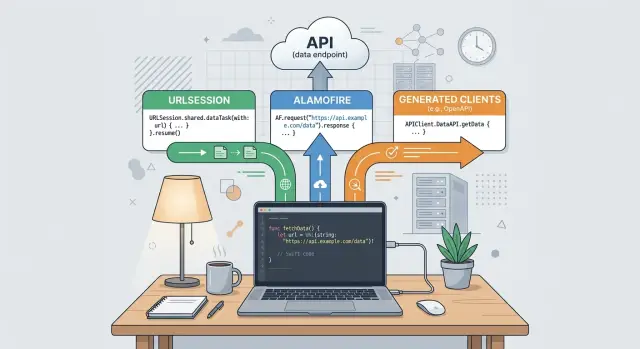
Table of Contents
Why this choice gets messy fast
Teams often start with the wrong question. They ask which tool can call an endpoint. URLSession, Alamofire, and generated clients can all do that. For a simple GET request, they can look almost identical in a code review.
The trouble shows up a few weeks later. One request needs a retry after a timeout. Another API sends errors in a different shape. A third endpoint returns a date string that does not match your decoder settings. Each issue is small on its own, but the work stacks up quickly.
That is why this choice gets messy. You are not just choosing how to send requests. You are choosing where retry rules live, how decoding failures appear, how much custom code your team owns, and how easy the whole thing is to test when production gets weird.
Small decisions spread through an app. One developer adds a quick URLSession helper. Another puts retry code in a view model. Soon, two screens handle the same 401 error in different ways. Logs do not match. Tests miss edge cases because every feature team mocked the network a little differently.
Generated clients can reduce that drift, but they bring a different tradeoff. They add structure and consistency, yet they can feel heavy when the API changes often or when the generated code does not fit how your team likes to work. Alamofire removes a lot of repeated setup, but your team still needs clear rules for interceptors, adapters, and decoding. Raw URLSession stays close to the platform, though it often means writing more code than expected.
Habits matter as much as features. A careful team with strong conventions can do well with URLSession. A rushed team can turn any library into a mess. If people keep solving retries, errors, and tests in ad hoc ways, the app gets harder to change no matter which networking layer sits underneath.
What each option really gives you
The debate often sounds bigger than it is. All three paths can ship a solid app. The difference shows up later, when the codebase grows, the API changes, and a tired teammate has to debug a failing request at 6 p.m.
URLSession gives you the most control. You decide how requests are built, how errors are mapped, how retries work, and how responses are decoded. That usually means fewer dependencies and less hidden behavior. It also means more code, and you own every sharp edge.
Alamofire sits in the middle. It removes a lot of repetitive work around request building, validation, uploads, downloads, and response handling. For teams that want cleaner networking code without building their own small framework, that can save time. The tradeoff is simple: you work with Alamofire's patterns, not only your own.
Generated API clients solve a different problem. They mirror an API spec, often OpenAPI, and give you typed request and response models from the start. When the backend contract is stable and well maintained, this can cut a lot of manual work. When the spec is messy or stale, the generated code turns into clutter fast.
A simple rule helps:
- Pick URLSession if you need custom behavior and your team is fine writing networking code.
- Pick Alamofire if you want less boilerplate and a smoother default request flow.
- Pick generated clients if the API spec is reliable and you want consistency more than fine tuned control.
The wrong choice rarely breaks launch day. More often, it makes maintenance annoying. A small app can survive with any of these options. A growing app feels every extra layer, every repeated decoder fix, and every workaround accepted too early.
When retry control decides the choice
Retry control is where the gap becomes obvious. If your app gets 429 or 503 responses, the client needs to wait the right amount of time, respect Retry-After when the server sends it, and avoid hammering the API again too soon.
With plain URLSession, you write that behavior yourself. That means more code, but you get full control over backoff, jitter, max attempts, and which failures deserve another try.
Alamofire gives you a cleaner place to put those rules. Its retrier and interceptor flow works well when you need to refresh an expired token once, retry the original request, and keep that logic out of every API method.
Generated clients are more mixed here. Some expose hooks for auth refresh and retries. Others hide the transport layer so deeply that custom retry rules turn into awkward patches. That gets old fast if reliability matters.
Non idempotent POST requests need extra care. A retry can create a duplicate order, payment, or message if the first call reached the server but the response got lost on the way back. Good retry control lets your team retry safe requests by default and block replay for POST endpoints unless the backend supports idempotency keys.
A practical setup usually includes custom backoff for 429 and 503, one shared token refresh path, clear rules for POST requests that must not replay, and logs for every retry attempt. Teams often skip the logging. That is a mistake. If a request fails after the third attempt, you need logs that show each retry, the status code, and the attempt number. Otherwise, a token refresh loop and a real outage can look exactly the same.
If retry behavior is simple, generated clients can be enough. If retry behavior affects uptime, URLSession or Alamofire usually gives your team a safer place to work.
When decoding needs decide the choice
If your API returns plain JSON with stable field names, Swift already gives you a good path. Codable handles simple objects well, and both URLSession and Alamofire can decode them without much trouble. In that case, decoding usually does not decide the tool.
The problems start when the response shape gets messy. Many APIs wrap the real data inside envelopes like data, attributes, meta, or errors. That means extra structs, more unwrapping, and sometimes a second mapping step before the app has something useful to show on screen. Alamofire can make the request code nicer, but it does not remove that work.
Shared decoder rules matter more than many teams expect. One endpoint sends snake_case, another sends ISO8601 dates, and a third sends timestamps as strings. If you do not set common decoder defaults early, every developer solves the same problem in a slightly different way. That gets messy fast. One well configured JSONDecoder often saves more pain than changing networking libraries.
Mixed success and error bodies are especially annoying. Some APIs return one JSON shape on success and a completely different one on failure. Now you need to inspect status codes, decode one model for 200 responses, and a different model for 400 or 500 responses. With URLSession, you write that flow yourself. With Alamofire, you still make the same parsing decisions, just with less request setup code.
Generated clients help when the schema is current and maintained. They can generate models, request types, and response wrappers that reduce hand written decoding code. That is a real win for larger APIs. But if the spec lags behind the actual backend, generated code becomes busywork.
Small teams feel this quickly. If they add a second API and each one formats dates and errors differently, shared decoding rules matter more than whether the request came from URLSession or Alamofire.
How much boilerplate your team can carry
Teams talk a lot about control. Daily maintenance matters more. The real cost is how many files a developer touches to add one endpoint, fix one header, or update one decoding rule.
URLSession usually means more custom code. Someone has to build requests, encode query items, attach auth headers, check status codes, decode bodies, and map errors. That is fine when the app talks to one small API. It starts to drag when each new endpoint repeats the same pattern with tiny changes.
Alamofire cuts a lot of repeated upload and response code. That helps when your app sends files, tracks progress, or handles the same response shapes again and again. You give up some Foundation simplicity, but many teams accept that trade because the code gets shorter and easier to scan.
Generated clients remove even more typing. If your backend has a clean schema and changes stay predictable, generation saves time and reduces copy and paste mistakes. The catch is ownership. Someone has to maintain the generator, review the output, handle version drift, and decide what happens when the generated code does not fit a real edge case.
New hires feel this before anyone else. They need one clear pattern. If one endpoint uses raw URLSession, another uses Alamofire, and a third lives in a generated folder with manual edits, they slow down before they write a single feature.
Tests matter more than raw line count. Forty plain lines with request tests and decoding tests are often better than ten clever lines nobody trusts. Small teams, especially teams that use AI in their workflow, usually do better when the networking layer is boring and easy to verify.
A workable setup has one place for shared headers and the base URL, one way to decode success and error responses, one rule for when code generation is allowed, and one testing approach for both hand written and generated calls. If your team can keep that pattern clear, a bit of boilerplate is fine. If the pattern already feels mixed, less code will not fix the confusion.
A simple way to decide
Start with the work your app repeats every day, not with library names. The right choice usually becomes obvious when you look at the requests your team will maintain, the strange responses you must decode, and the retry rules you cannot afford to get wrong.
Make a quick inventory of your API jobs. Write down the calls your app makes all the time: login, refresh token, load feed, upload image, save profile, sync background data. That list matters more than abstract arguments.
Then mark the requests that need special retry behavior. A simple GET that fetches a list can retry after a timeout. A payment call, account update, or file upload often needs stricter rules. If your app has many cases like "retry on 429, but only after refresh" or "never retry this POST," plain URLSession can feel too manual, while Alamofire gives you a cleaner place to put those rules.
Next, count the responses that break simple Codable. If most endpoints return clean JSON with stable fields, URLSession stays very reasonable. If your API has envelopes, mixed error formats, odd date fields, or one property that changes type between endpoints, the decoding layer will take real effort no matter what tool you pick.
A quick gut check is usually enough:
- Few endpoints, simple JSON, custom retry rules: URLSession often wins.
- Many similar endpoints from a clean API spec: generated clients can save time.
- A medium sized app with hand written requests and shared interceptors: Alamofire is often the middle ground.
One test beats a long meeting. Build one real endpoint three ways: URLSession, Alamofire, and a generated client. Pick an endpoint with auth, one query parameter, and one annoying decode case. Compare the code your team writes, and compare the files you will still own six months from now.
That last part matters most. A small team can carry some boilerplate. A tired team with two APIs, deadlines, and on call duty usually should not.
Example: a small product team adds a second API
A small team launches version one with URLSession. That makes sense. They have one backend, a handful of requests, and plain Codable models. Two engineers can read every network call in one sitting, so a little boilerplate does not hurt much.
Three months later, they add a payments API. The app still ships features every week, but the network layer stops feeling simple. The new API has short lived tokens, refresh rules, stricter error codes, and rate limits that tell the client to back off and retry. Suddenly, the code that looked clean for five endpoints starts spreading the same logic across twenty.
This is where the choice gets real. URLSession still works, but the team now has to build shared retry code, auth refresh handling, and request rebuilding on its own. That is fine if one person owns the network layer and keeps it tidy. It gets messy when three people copy the same fix into different files.
Alamofire helps when the team wants one place to handle the rules both APIs share. A request interceptor can attach tokens, refresh them, and retry after a 401 or rate limit response. That saves time and cuts subtle bugs. The team can keep moving on product work instead of arguing about where retry code belongs.
Generated clients help in a different case. If both APIs publish clean specs, client generation can produce models, endpoints, and a lot of decoding code for you. That works best when the specs stay accurate. If the payment provider documents one thing and returns another, generated code turns into a fight.
In this example, a split approach often wins. Keep URLSession for the first simple service. Move shared request rules to Alamofire when retries and token refresh start to repeat. Use generated clients only for APIs with solid specs and stable schemas. That keeps the codebase boring in the right places, which is usually what a small team needs.
Mistakes teams make
A lot of teams pick a networking approach, then create problems with the way they use it. The tool matters, but the habits matter more. Most of the mess starts after the choice, not before it.
One expensive mistake is retrying every failed request the same way. A GET that times out is one thing. A POST that creates an order, sends an email, or charges a card is different. If the app retries that POST without an idempotency rule, users can end up with duplicate records or double charges. Teams usually notice this late, when support starts seeing "I only tapped once" complaints.
Another mistake is hiding every server failure behind one vague message like "Something went wrong." That looks tidy in the UI, but it blinds both users and developers. A 401, a validation error, and a temporary 503 should not all look the same. When you flatten every response into one generic error, debugging gets slow and users cannot tell whether they should retry, log in again, or fix their input.
Teams also create confusion when they mix URLSession and Alamofire in random parts of the app. One screen may use custom retries and detailed logging. Another may skip both. Headers, timeout rules, decoding behavior, and cancellation start to drift. Six months later, no one remembers why one endpoint behaves differently from another.
Generated clients cause a different kind of trouble. People trust the generated code because it compiles, then never read the models. That is risky. If the API returns null where the model expects a value, or sends dates in two formats, decoding breaks in ways that look mysterious until someone opens the model file and reads it carefully.
A small test suite catches most of this early:
- Test date parsing with real samples from the API.
- Test error bodies, not just success responses.
- Test retry behavior for POST and PATCH.
- Test one malformed payload on purpose.
These tests do not take long. They save a lot of cleanup later, especially when a second API gets added and small inconsistencies turn into app wide bugs.
Quick checks before you commit
A networking choice often looks simple until the team has to live with it for six months. Most bad picks come from one problem: the team chooses a style before checking how it works under pressure.
Before you commit, write down the rules you expect the client to follow and keep that note to one page. If retry behavior takes three meetings to explain, your setup is already too complex. Good rules sound plain: retry once on timeout, never retry a 400, refresh auth once on 401, stop after that.
A short checklist usually exposes the weak spots:
- If another team controls the API spec and updates it late, a generated client may slow you down instead of saving time.
- If a junior developer cannot trace one request from call site to decoded model this week, the pattern is too hard for the current team.
- If your tests only cover happy responses, you do not know how the app behaves when the server sends empty bodies, broken JSON, or slow replies.
- If switching from URLSession to Alamofire, or the other way around, would force a full rewrite, your transport layer leaks into too much app code.
- If retry logic lives in five files, nobody owns it.
One practical test works well. Ask a developer to add a new endpoint, mock a timeout, and handle a malformed response in under an hour. If that feels routine, the approach fits. If it turns into a hunt across interceptors, wrappers, generators, and model adapters, pull back.
Generated clients make sense when the spec is stable and the team trusts it. URLSession fits teams that want tight control and can handle some boilerplate. Alamofire fits teams that want a faster path to common request patterns without building every piece themselves.
Leave yourself an exit. Keep request building, decoding, and retry policy separate enough that you can swap the transport later. Teams that do this early waste less time when the app grows, a second API appears, or the original choice stops fitting.
Next steps for your team
Pick one default now. Teams lose more time from mixed patterns than from living with one imperfect choice for a while. The debate matters less than having one shared way to build requests, handle failures, and decode responses.
A good first pass is simple. Choose one house style for new work. If your app needs tight retry control and you do not mind writing more code, start with URLSession. If you want less wiring around requests and responses, Alamofire is a fair default. If the API is large, stable, and clearly described by a spec, generated clients can cut a lot of repeated work.
Then write the rules before the next feature lands. Decide which calls can retry, how many times, and which errors stop the request right away. Do the same for decoding. Set one date format policy, one naming strategy, and one way to handle empty or partial responses. Revisit the choice after the first real production bug. That bug usually shows whether your setup is too loose, too rigid, or simply too noisy.
A small team can keep this straightforward. If you already call your own backend and next month product adds a payment or analytics API, do not let that second API bring a second networking style into the app unless you hide it behind the same internal interface. If one part of the codebase uses raw URLSession, another uses Alamofire, and a third uses generated models, debugging gets messy fast.
Write the rules down in one short internal document. Keep it practical: request building, Swift retry logic, Codable API decoding defaults, and where custom code is allowed. That document saves time in code review because people stop arguing from memory.
If the team still feels stuck after that first pass, a short outside review can help. Oleg at oleg.is works as a fractional CTO and startup advisor, and his focus on lean engineering and AI first delivery fits this kind of decision well. A quick architecture review is often enough to spot where retry policy, decoding rules, or transport choices are making the app harder to maintain.


