Two products one roadmap: how to spot the split early
Two products one roadmap often means different buyers, sales calls, and support work. Learn the signs early so your team can plan before friction grows.
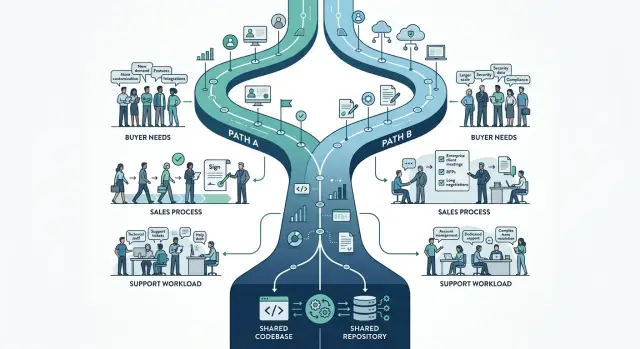
Table of Contents
What this looks like
It usually starts with a roadmap that looks efficient on paper. The team ships from one codebase, one backlog, and one set of release notes. But two buyer groups show up with different reasons to buy, so they do not really see the same product.
One group wants speed, easy setup, and a clear result in the first week. The other wants control, approvals, security answers, migration help, and deeper admin tools. They may use some of the same screens, but the reason they buy is different enough that the product story starts to pull apart.
You usually feel that tension in the interface first. Features that help one group look like clutter to the other. A simple workflow picks up extra settings, more roles, more steps, and edge-case options. None of those additions look wrong on their own. Together, they make the product harder to explain in one clean sentence.
Sales feels it early too. One prospect wants a fast self-serve trial and a simple monthly plan. Another wants a long buying cycle, security reviews, special terms, and promises about roadmap items that are still vague. When sales keeps asking for exceptions to close deals, that is often a buyer conflict, not a messaging problem.
Support hears the split in plain language. One new customer asks, "How do I get started today?" Another asks, "How do I map this to our team structure and approval flow?" When onboarding, docs, and support calls keep branching into two very different paths, the market has already split even if the team has not said it out loud.
That is what "two products, one roadmap" looks like in practice. The code is shared, but the buyer, sales motion, and support model keep drifting apart. Teams often argue about features at this stage. The deeper issue is simpler: they are serving two products without naming the split.
Where the cracks appear first
The split usually shows up in customer work long before anyone talks about separate products. The code still looks shared, the team still ships from one backlog, and everything seems fine at a glance. Then the same feature starts making sense for one buyer and feeling awkward for the other.
Pricing is often the clearest early signal. One group wants simple seats, predictable limits, and fast approval. The other wants custom terms, security review, or usage-based pricing. If the team forces one pricing model onto both, one side feels overpriced and the other feels under-served.
Demos drift next. Sales calls for one prospect focus on speed, ease, and getting started this week. Calls for the other focus on control, compliance, reporting, or team workflows. When reps need two different stories to sell the same product, there is a good chance the split already exists.
Onboarding gives the problem away even faster. Both customers may sign up through the same page, but after the first few steps they need different help. One wants templates, self-serve setup, and a short path to value. The other needs admin setup, approvals, training, and sometimes a handoff to a different owner inside the company.
Renewals make the difference hard to ignore. One customer renews because a small team saved time every week. Another renews because finance got better controls or leadership got cleaner reporting. Those are different outcomes, different budget owners, and usually different support needs.
A few signs show up again and again. The same feature gets called "too basic" by one buyer and "too complex" by another. Sales asks for custom packaging more often every quarter. Support tickets cluster around different jobs to be done. Customer success starts tracking different definitions of success for different accounts.
A growing SaaS team can carry that tension for a while. After that, roadmap discussions turn into buyer arguments. That is the point to pause and name the split before the org chart does it for you.
Compare the buyers side by side
A side-by-side comparison cuts through a lot of internal debate. Shared code can hide the fact that different people buy the same product for different reasons. That is often where the problem starts.
Put both buyer groups on one page and compare the business facts, not your feature ideas.
| What to compare | Buyer group A | Buyer group B |
|---|---|---|
| Job they hire the product to do | Keep client work moving and easy to report | Control one internal process and reduce mistakes |
| Who signs the deal | Agency owner | Operations director |
| Who uses it every week | Account managers | Team leads and staff |
| Common purchase objection | "Will this work across many clients?" | "Will this fit our approval rules?" |
| Features used often | Reporting, permissions, templates | Approval flows, audit trail, task routing |
| Features used sometimes | Integrations, exports | Reports, dashboards |
| Features used never | White-label options | Client portal tools |
A table like this does more than describe personas. It shows where the product story changes. One buyer may care about speed to launch and client-facing polish. The other may care about control, compliance, and fewer internal errors.
Watch the gap between the person who signs and the person who uses the product. If one group has the same person doing both, while the other group has a manager buying for a team, your sales motion changes right away. Demos, onboarding, pricing, and support all start pulling in different directions.
Objections matter just as much as goals. If one group asks about flexibility and branding while the other asks about security and process rules, the team will build very different proof points to close each deal. Sales may still call it one product. Support usually feels the split first.
The "never" column is especially useful because it shows what each buyer does not care about. When one group depends on a feature the other group ignores, roadmap fights usually follow.
If you cannot fit both buyers into one clear comparison without vague language, you probably do not have one buyer with a few edge cases. You have two separate product demands sharing one codebase.
How to test the split
Start with evidence, not opinions. Pull your last 15 to 20 wins and losses and sort them by buyer type. Keep it simple: who bought, who passed, what they wanted first, and what blocked the deal.
This usually reveals the split faster than roadmap debates do. One group buys because the product is quick to launch. Another cares more about controls, custom setup, or approval flows. If both groups sit inside the same roadmap, the conflict is already there.
Look at the work around the product
Support tells the truth that strategy slides often hide. Tag recent tickets by use case, team size, and urgency. Do the same for feature requests if you track them.
Watch for clusters. Small teams may ask for speed, templates, and fewer steps. Larger teams may ask for permissions, audit trails, and more help during rollout. When the same code serves both, the support load starts to split before the org chart does.
Then map the sales path for each buyer group from first call to close. Write down what made them book a demo, what questions came up first, who joined the evaluation, what sped up or slowed down the deal, and why they bought, delayed, or walked away.
Put the paths side by side. If one buyer closes after a short demo and another needs security review, custom pricing, and multiple follow-ups, you are not looking at one clean motion.
Compare the cost of keeping each buyer happy
Now check setup time, training effort, and renewal work for each group. Count hours, not feelings. If team A needs a 30-minute setup and team B needs two weeks of onboarding, that gap matters. If one group renews quietly and the other needs heavy account work every quarter, that matters too.
At that point, name the source of the conflict. Sometimes the mess comes from positioning. The product is fine, but the site and demos attract the wrong buyers. Sometimes pricing causes it. A plan built for one team size pulls in another group that expects a very different product. Sometimes the product shape is the real issue, and no packaging fix will hide it.
A good test ends with a plain answer: keep one product with clearer positioning, or split the experience on purpose. An experienced fractional CTO can usually run this kind of audit in a week because the clues already sit in sales notes, support queues, and onboarding work.
What can stay shared
When one roadmap starts serving two different buyers, teams often split the wrong thing first. They fork the code, create new teams, or talk about separate databases before they have separated the promise. That is backwards. Keep the parts that solve the same job in the same way, and split the parts that change what each customer expects.
Shared code usually survives longest in the quiet layers. Rules for storing data, syncing records, sending events, handling errors, and enforcing the same security checks can often stay together. If both groups need the same outcome from that code, one implementation is usually cheaper and easier to maintain.
What should split earlier is the customer-facing path. If each group needs different defaults, different language on the screen, different approval steps, or different permission rules, treat those flows as separate even if they sit on top of the same engine. Users feel those differences right away, and support teams do too.
A simple rule works well here. Keep something shared if both sides would accept the same behavior without debate. Split it if sales would pitch it differently, if onboarding needs different setup choices or training, or if support needs a different playbook to answer the same question.
That is why product promises matter more than system boundaries at first. If one buyer expects speed and simplicity while the other expects control and audit trails, you already have two products in practice. You can still run one codebase for a while, but you should stop pretending they are the same offer.
The backlog should follow that reality. Keep one shared backlog only for work that clearly helps both sides. Bug fixes in common logic belong there. So do performance work, core security updates, and internal tools used by both flows. But if an item helps only one buyer type, move it out of the shared queue. Otherwise the stronger sales motion will keep winning, and the other product will slowly decay.
Most teams miss the order. Separate the promise first, then the workflow, then ownership. Split the database or the team only when shared code starts slowing both sides down.
A simple example from a growing SaaS team
Imagine a SaaS team with one reporting product for marketing work. At first, the customer base looks similar enough to keep everyone on one roadmap. Agencies buy it to manage many client accounts. In-house marketing teams buy it to track one brand, one budget, and one approval chain.
For a while, the overlap hides the problem. Both groups need dashboards, campaign data, scheduled exports, and clean charts. The same reporting engine, data model, and API can serve both. On paper, it still looks like one product.
The split shows up in daily use. Agency customers ask for fast client switching, branded reports for each client, and tighter seat controls so account managers only see the right accounts. They also want reusable templates across clients because that saves real time every week.
In-house teams ask for different things. They want approval steps before reports go out, budget views tied to campaigns, and a much shorter setup because they are not onboarding ten clients at once. They care less about brandable exports and more about internal visibility.
At that point the team still has shared code, but it no longer has shared packaging. Sales calls split too. Agencies respond to "manage many clients in one place." In-house buyers respond to "control spend and approvals without extra admin." Support starts to divide in the same way. One group needs help with permissions and client-facing output. The other needs help with workflows, finance views, and rollout inside a single company.
The reporting code can stay shared. The customer promise cannot.
You can usually spot the break when demos for each buyer start from different screens, the onboarding checklist no longer fits both groups, and support tickets cluster around different jobs to be done.
At that point, forcing one plan usually creates a muddled product. A small team can still keep one codebase, one reporting layer, and one infrastructure setup. But it should name the two product paths clearly, price them differently, and stop pretending the same sales motion fits both.
Mistakes teams make
The first mistake is usually small. A team sees two groups asking for different things, then adds toggles, permissions, and custom settings instead of making a product choice. That feels safer in the moment. Six months later, the app is harder to sell, harder to explain, and much harder to support.
This happens a lot when teams have two products hiding inside one roadmap but still talk as if they sell one thing. Shared code can hide the split for a while. The codebase still looks tidy. The business does not.
Another common mistake is letting one large prospect reset the roadmap. A big deal appears, sales gets excited, and suddenly the team builds workflow rules, reporting, or security requirements that only make sense for that buyer. The short-term win can cost a year of focus. Smaller customers get slower releases, confusing plans, and a product that no longer fits why they signed up.
Pricing often breaks next. Teams try to force one model onto buyers with very different budgets and buying habits. One group wants self-serve and a clear monthly price. The other expects contracts, approvals, and extra support. If you push both into the same pricing box, one side feels overcharged and the other feels under-served.
Teams also get stuck when they judge every account by one success metric. That sounds neat on a dashboard, but it hides the real difference. A small team may care about quick setup and daily use. A larger company may care about control, audit trails, and rollout across departments. If both accounts get measured the same way, the product team learns the wrong lesson from the data.
The most expensive mistake is waiting for internal conflict before admitting the split. By then, sales blames product, product blames support, and support carries the pain from both sides. It is much cheaper to name the tension early and decide what stays shared, what gets separated, and which buyer matters more right now.
This is often where outside product or Fractional CTO help is useful, because someone has to call the split before the company does it by accident.
Quick checks before you commit
Teams often wait too long because the code still looks shared. The better test is simpler: can the same business story, product flow, and support model work for both buyers without strain?
Use five quick checks.
- Look at the homepage. Can one clear message explain why both buyer groups should care within a few seconds? If one group needs different promises, proof, or language, you already have a split.
- Run the same demo for both groups. If sales needs extra slides, a different order, or a separate call to get one group over the line, the product story is no longer one story.
- Walk through onboarding. Can most new users reach their first useful result in the same flow? If one group needs setup help, custom defaults, or a human handoff while the other does not, that gap will keep growing.
- Read the first support questions. If both groups ask different things on day one, support will feel the split before engineering admits it.
- Open the pricing page. Can both buyers understand what they pay for without booking a call? If pricing only makes sense after a long explanation, you may be selling two products with one label.
If three or more checks fail, stop forcing one roadmap. You can still share code, but you should stop acting as if the product is the same.
A fresh operator often helps here. Someone outside the daily arguments can separate what should stay shared in the codebase from what needs its own positioning, onboarding, and support path. That decision can save months of internal debate and a lot of messy rework later.
What to do next
Start with names a customer would understand. Do not call them Track A and Track B. Call them what they are, such as "self-serve team tool" and "enterprise workflow service." Clear names stop fuzzy roadmap debates fast.
Then give each track its own shape on one page. Define who buys it, what promise they expect, what metric tells you it works, and which requests belong to that track.
If both tracks share the same code today, that is fine. Shared code is not the problem. Confused decisions are. Keep shared code only where it saves real time without forcing constant arguments. Core infrastructure, auth, billing, deployment, and common data layers often stay shared longer than people expect.
Split the parts that keep pulling the team into opposite choices. That usually means onboarding, packaging, pricing rules, support flows, admin controls, and roadmap priorities. If one buyer wants speed and simplicity while the other wants control, approvals, and custom work, treat those as separate product decisions even if the backend still overlaps.
Each track also needs one success metric that matches the buyer. A self-serve product might care about activation in the first week. A sales-led offer might care about close rate, time to launch, or expansion revenue. If one metric keeps hurting the other, you found a real boundary.
Set a review date before you create separate teams. Four to eight weeks is often enough to learn something useful. Look at the same signals every time: lost deals, support load, roadmap fights, release delays, and customer confusion. If those numbers calm down, keep one team and two clear tracks. If they get worse, split ownership on purpose.
Many founders need outside help at this stage. When the split starts affecting architecture, hiring, and process, it gets expensive fast. If you want a practical second opinion, Oleg Sotnikov at oleg.is does this kind of Fractional CTO work: defining the boundary, deciding what should stay shared, and keeping the roadmap from drifting while the team grows.
Frequently Asked Questions
How can I tell if we really have two products?
You likely have two products when the same feature feels too simple for one buyer and too heavy for another. Sales, onboarding, and support start using different stories for the same app, even if the code still sits in one place.
What is the first warning sign to watch for?
Pricing usually shows the split first. If one group wants self-serve plans and the other wants contracts, security review, or custom terms, your buyers already expect different offers.
Can we keep one codebase if buyers are different?
Yes, shared code can stay fine for a while. Keep the engine, data layer, and common security logic together if both buyer groups accept the same behavior there.
Should we split the codebase right away?
No. Split the promise and the customer path before you split the code. Most teams move too early on architecture and too late on positioning, onboarding, and pricing.
How do we test the split quickly?
Pull your last 15 to 20 deals and sort them by buyer type. Compare who bought, what they wanted first, what slowed the deal, and why they renewed or walked away.
What should stay shared?
Keep anything shared that solves the same job in the same way for both groups. Core data handling, auth, billing, infrastructure, and common bug fixes often stay together longer than the UI and sales motion.
What should we separate first?
Split the parts customers feel first. Start with messaging, demos, onboarding, pricing, admin controls, and support playbooks, because those areas expose the buyer conflict every day.
Can pricing alone make one product feel like two?
Yes, pricing can create or expose the problem fast. When one buyer wants a clear monthly price and another expects approval cycles and extra support, one plan usually fits neither side well.
When should we ask for outside product or CTO help?
Bring in outside help when roadmap meetings turn into buyer arguments and nobody agrees on what belongs in the product. A good operator can review sales notes, support tickets, and onboarding work and call the split without internal baggage.
What should we do in the next 30 days?
Name the two tracks in plain language, then give each one its own buyer, promise, and success metric. Run that setup for four to eight weeks and watch lost deals, support load, release delays, and customer confusion.


