Training reviewers for AI-assisted operations: simple plan
Training reviewers for AI-assisted operations starts with simple checks for missing facts, tone drift, and false confidence so teams review faster.
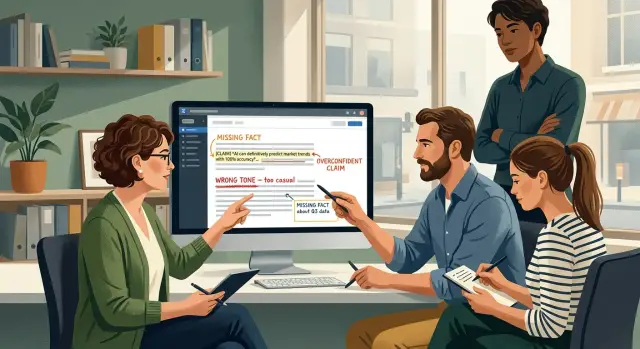
Table of Contents
Why reading every word does not work
A reviewer who checks every sentence line by line spends most of their time on the safest parts of the draft. They fix commas, swap words, and smooth out phrasing while bigger problems pass through. That feels thorough, but it is often the slowest way to review AI output.
Most low-risk text does not need that much attention. If an internal note says "meeting moved to 3 pm" or "draft attached for review," a full read-through adds little. The cost shows up when reviewers burn ten minutes polishing harmless wording and miss one wrong claim that changes a decision.
Grammar also pulls attention in the wrong direction. People spot awkward wording fast because it is easy to see and easy to fix. Missing facts are harder. Wrong tone is subtle. Unsupported claims can sound polished. False confidence is the worst of the lot because it reads like certainty even when the model guessed.
These are the risks that deserve most of the review time:
- missing facts that leave out a limit, exception, or next step
- wrong tone that sounds rude, too casual, or too certain for the situation
- unsupported claims that state results without proof
- false confidence that hides doubt behind smooth language
A simple example shows the tradeoff. If a draft customer update has one clumsy sentence, the reader may shrug and move on. If that same update says an issue is fixed when the team only found a workaround, the message creates confusion fast. The wording matters less than the claim.
For training reviewers for AI-assisted operations, the aim is not "read everything more carefully." The aim is faster and safer review. Reviewers should scan for the few errors that cause real damage, then move on. That gives teams shorter review cycles, fewer bad approvals, and less wasted effort on text that was fine the first time.
Give reviewers a narrow job
Most review slows down when one person tries to fix everything at once. They check facts, rewrite sentences, soften tone, trim length, and debate word choice. That turns a 10 minute check into a 40 minute one.
Give each reviewer a small area of responsibility. In an AI review process, the reviewer should look for risk, not polish. If the draft is safe and accurate, it can move forward even if the wording still feels rough.
A narrow review job usually means the reviewer checks only a few things:
- claims that sound stronger than the source supports
- numbers, dates, names, and titles
- promises the company may not be able to keep
- missing facts that change the meaning
- tone problems that create legal, brand, or customer risk
Everything else can wait. Editors can fix awkward phrasing later. That split matters more than most teams expect. When reviewers start line editing, they miss the bigger problem: a confident sentence built on a weak fact.
A simple example helps. Say an AI drafts a client update for a software team. The sentence says, "We cut outage risk by 80% and fully automated release checks." A reviewer does not need to rewrite it into smoother prose. The reviewer needs to ask two questions: where did 80% come from, and does "fully automated" overpromise what the team actually does?
That kind of review is faster and more useful. It also makes feedback cleaner. Instead of vague notes like "needs work," the reviewer can write, "Verify the 80% figure," "name the system you changed," or "remove the promise unless ops can prove it."
This is how strong teams handle AI output at scale. They do not ask reviewers to admire the writing. They ask them to catch what could mislead a reader, trigger pushback, or create a promise nobody intended to make. Once that risk is cleared, an editor can make it sound good.
Build a short scorecard
Most reviewers get slow when the form asks for "comments" and leaves everything open. A short reviewer scorecard works better because it turns judgment into a few clear checks. People stop hunting for every flaw and start checking AI output for the mistakes that matter.
Use simple yes/no questions. If a reviewer cannot answer a question in under a minute, the question is too vague.
A good scorecard can fit on one screen:
- Do the facts match the source material?
- Do numbers, dates, names, and product details match exactly?
- Does the tone fit the audience and channel?
- Does the draft sound more certain than the evidence supports?
- What should happen next: approve, revise, or escalate?
This format fixes two common problems. It cuts down vague feedback like "this feels off," and it makes reviewers more consistent. Two people can look at the same draft and compare answers instead of debating taste.
Facts need the strictest rule. If the source says "about 20%" and the draft says "30%," mark no. If a support reply promises a delivery date that nobody confirmed, mark no again. Reviewers should not spend time polishing wording until the facts line up.
Tone needs its own check because correct facts can still land badly. A customer email should sound calm and direct. A social post can be lighter. An internal note can be short. If the draft sounds pushy, defensive, or too casual for the channel, it needs revision.
False confidence in AI is easy to miss because the writing often sounds smooth. Reviewers should watch for words like "will," "always," or "proven" when the source only supports "may," "often," or "early signs show." That small check prevents a lot of avoidable trouble.
The final choice keeps work moving. "Approve" means it is ready. "Revise" means the issue is clear and easy to fix. "Escalate" means the reviewer found legal, policy, brand, or technical risk that needs a stronger owner. When every review ends with one of those three choices, nobody has to guess what happens next.
Train reviewers with examples
For training reviewers for AI-assisted operations, examples beat lectures. People learn faster when they see a real draft, spot the risky line, and decide what to do with it. A short practice set from your own work is enough.
Start with five flawed drafts that look normal at first glance. Pick work your team already handles, such as a customer reply, an incident summary, a meeting recap, a release note, or an internal update. Each draft should have one clear problem: a missing fact, the wrong tone, or a sentence that sounds sure when the model does not know.
Do not ask reviewers to mark up the whole piece. Ask them to point to the exact sentence that creates risk. That keeps the exercise focused and cuts down on vague feedback like "this feels off." If they can name the sentence, they can usually name the fix.
Then ask for a one-line explanation. Keep it plain. "Claims the bug is fixed, but no one confirmed it." "Sounds cold for a delayed order message." "Leaves out the approval date, so the update is incomplete." One line is enough. Long explanations often hide weak judgment.
A side-by-side comparison helps more than a rule sheet. Show the weak draft next to a strong revision and keep the change small. For example:
- Weak: "The issue is resolved and users should have no further problems."
- Strong: "We restarted the service at 10:40. Errors dropped, but we are still watching for repeats."
The second version is better because it names what happened and avoids false confidence in AI. Reviewers should learn to prefer clear facts over smooth language.
Repeat the exercise until people make similar calls on the same examples. You do not need perfect agreement. You want steady judgment. When most reviewers flag the same sentence, give the same one-line reason, and choose a similar revision, they are ready for real work.
Use a realistic operations example
Pick one task your team already handles every week. A good training drill is an AI-drafted customer update about a billing issue, because it forces reviewers to check facts, tone, and promises under a little pressure.
For training reviewers for AI-assisted operations, this works better than abstract rules. People learn faster when they can see the kind of message that might go out today, with the kind of mistake that can trigger a reply from an angry customer.
Three drafts, three different problems
Draft one says: "Your payment went through and your plan is active." That sounds fine at first glance, but it leaves out the real reason the customer wrote in: the invoice also includes a prorated charge from a mid-cycle upgrade. The reviewer should send this back. The note can be short: add the missing billing fact, state the amount, and explain why it appeared.
Draft two says: "Hey, sorry this got weird. I totally get why you're upset." The facts may be correct, but the tone is too casual for a customer who already complained twice. The reviewer should send this back as well. Ask for a calmer version that sounds respectful, clear, and steady.
Draft three says: "We will reverse the charge today and make sure this never happens again." That is the most risky one. If the support team cannot issue same-day refunds, and nobody can promise a problem will never happen again, the reviewer should escalate it. Money, policy, and legal promises need a higher level check.
A reviewer does not need to rewrite every sentence. They only need to decide what happens next:
- approve if facts are complete, tone fits, and the message makes no promise the team cannot keep
- send back if the draft is mostly usable but needs a fix
- escalate if the draft touches refunds, contracts, compliance, or other sensitive claims
That simple drill teaches the habit you want. Reviewers stop acting like copy editors and start acting like risk filters.
Keep reviewers aligned week to week
Teams drift fast when they review AI output in isolation. One reviewer flags a claim as too confident, another lets it pass, and by Friday nobody uses the same standard.
A short weekly review session fixes most of that. Keep it to 20 or 30 minutes, and only discuss disputed calls from the past week. Pick the cases where reviewers disagreed, then ask three plain questions: what fact was missing, what felt off in the tone, and where did the answer sound more certain than the evidence allowed.
That habit matters more than long rule documents. In an AI review process, people learn faster from a real borderline case than from a page of abstract rules.
Save one strong example for each situation that comes up again and again. You do not need a huge library. A few labeled examples are enough, such as:
- a reply that sounds polished but skips an important fact
- a draft that is factually fine but too casual for a customer message
- an answer that states a guess like a confirmed fact
- a case where the reviewer should approve with a small edit, not reject
These examples become the team’s shared memory. When someone new joins, they can compare their judgment against cases the team already settled.
If the team repeats the same debate for two or three weeks, the reviewer scorecard is too vague. Update it right away. Add one line, tighten one definition, or split a fuzzy category into two clearer ones. Small changes beat a full rewrite.
New reviewers should also shadow two live reviews before they work alone. Watching a real review helps them see pace, judgment, and how to handle uncertainty. After that, let them review a few items on their own and compare their calls with a more experienced reviewer.
This is how training reviewers for AI-assisted operations stays practical. The goal is not perfect agreement on every sentence. The goal is consistent judgment on the mistakes that matter.
Catch tone drift early
Tone drifts faster than facts. A message can be accurate and still leave a bad impression if it sounds cold, pushy, vague, or defensive. In an AI review process, that matters because readers notice tone before they judge the details.
Write down how your team should sound in three common cases: support replies, sales messages, and internal notes. Support should sound calm and human. Sales should sound clear and confident without pressure. Internal notes can be blunt, but they still need respect and plain language.
Most tone problems become easy to catch once reviewers know what to watch for:
- Cold: "Per policy" or "Your request cannot be processed"
- Pushy: "Act now" or "You don't want to miss this"
- Vague: "We are looking into it" with no owner or next step
- Defensive: "As already stated" or "If you read the message carefully"
A short banned list helps more than long writing advice. Ban phrases that overpromise, such as "This will never happen again" or "guaranteed results." Ban phrases that dodge responsibility, such as "We apologize if you felt" or "There seems to have been an issue." People trust a simple sentence more: "We missed this. We fixed it. You will see the update today."
Teams often miss tone drift because each message looks fine on its own. The pattern shows up over a week. Support starts sounding legal. Sales starts sounding needy. Internal notes start sounding sharp. Reviewers should flag repeated wording, not just single bad lines.
Keep a tiny set of approved openings and closings for common cases. For support, an opening like "Thanks for flagging this" works better than stiff filler. A closing like "If this still looks wrong after the update, reply here and we'll check it" feels direct and helpful. Sales can open with the prospect's problem and close with one clear next step, not a hard push.
A simple exercise works well for training reviewers for AI-assisted operations. Show two versions of the same reply. One says, "We regret any inconvenience." The other says, "You're right to ask about this. We sent the wrong file and fixed it." The second one sounds like a person, not a shield.
If reviewers keep seeing the same weak phrases, add them to the banned list that day. Tone stays steady when the list stays short and current.
Mistakes that slow review down
Most review systems get slower because managers ask one person to do three jobs at once. They want reviewers to catch risky claims, polish the writing, and approve the final version in one pass. That sounds neat. In practice, it creates slow, tired reviews and random decisions.
A reviewer should not fix every awkward sentence. If they start rewriting, they stop checking whether the output is true, complete, and safe to send. Good review is mostly triage. Is anything missing? Is anything wrong? Does the tone fit the situation?
The split between risk checks and copy editing matters more than teams expect. If you mix them, tiny wording issues pull attention away from bigger problems. A reviewer may spend five minutes changing commas and miss the one sentence that makes a claim without proof.
That happens a lot with false confidence in AI. The text sounds smooth, so people assume it is grounded. A confident sentence still needs support. If the model says a customer approved a change, the reviewer should ask, "Where is that in the source?" If nobody can point to it, the sentence should not pass.
Another common mistake is pushing speed too early. New reviewers need time to learn the rules, compare outputs with source material, and see what counts as a real issue. If you score them on speed in week one, they will skim, guess, and approve text that should have been stopped.
Source material also needs to stay visible. Reviewers cannot do solid checking AI output if they only see the draft. They need the original ticket, transcript, notes, policy, or data summary next to the generated text. Hide the source, and review turns into opinion.
A simple setup works better:
- One reviewer checks facts, missing context, and tone.
- Another person or later pass handles grammar and style.
- New reviewers train on examples before anyone times them.
- Every draft stays attached to its source material.
- Any strong claim needs proof, not just polished wording.
Picture a team reviewing an AI-written incident update. The language is calm and clean, but it says the issue affected only one region. The logs show three regions. If the reviewer focuses on wording, that bad claim ships. If the reviewer checks source first, they catch it in seconds.
That is why training reviewers for AI-assisted operations should stay narrow at first. Ask them to verify reality, not to make the prose pretty. Speed comes later, after judgment gets consistent.
Run a quick check before release
Most bad AI drafts give themselves away fast. A reviewer does not need to read every line to catch them. Two minutes is often enough if the check stays tight and the reviewer scorecard is blunt.
Start with hard facts. Check names, dates, prices, and policy details first. These are the parts that trigger support issues, refund disputes, and confused follow-up messages. If a draft names a fee, a deadline, or a rule, someone on the team should own that fact.
Then read the first and last lines out loud. Tone problems often sit there. The opening can sound cold or oddly cheerful. The closing is where false confidence in AI shows up most often, especially when the draft promises action or results that nobody approved.
A short pass works well:
- Mark any claim with no source, system record, or clear owner.
- Stop on promises about timing, actions, or outcomes.
- Check whether the tone fits the situation.
- Decide approve, revise, or escalate before the two minutes are up.
A small example makes the risk obvious. An AI-written support reply says, "Your refund will arrive within 24 hours." If your real policy says 5 business days, that draft is not close enough. The reviewer should mark the claim, send it back for revision, or escalate if nobody can confirm the faster timeline.
This part of the AI review process should stay simple. Approve when the facts are clear and the tone fits. Revise when the draft is mostly right but sloppy. Escalate when it makes a promise that has no owner, no source, or no approval. That keeps checking AI output fast without trusting the draft more than it deserves.
What to do next
Start small. Pick one workflow that already creates repeat review work, such as support replies, internal status updates, or AI-written draft reports. Run your scorecard on that single workflow for one week before you try to spread training reviewers for AI-assisted operations across the whole team.
Ask reviewers to judge risk, not polish. They do not need to fix every awkward sentence. They need to catch three things fast: missing facts, tone drift, and claims that sound sure when the source is weak or unclear.
Use a simple weekly check:
- Count how many missing facts reviewers caught
- Count how many tone problems they flagged
- Count how many overconfident claims they stopped
- Note which scorecard rules led to real fixes
- Cut rules that created comments but did not reduce risk
This part matters more than most teams expect. A scorecard that creates lots of comments but misses bad claims is worse than useless. It slows review down and gives people false confidence in AI output.
Keep the test tight. Use the same workflow, the same review steps, and the same small group of reviewers for the week. At the end, look for patterns. Maybe one rule catches real issues every day. Maybe another rule only creates debate about wording. Remove that rule and keep moving.
A small example makes this easier to see. If your operations team reviews AI-written customer updates, one reviewer may catch that a delivery date was invented, another may notice the tone sounds too casual for an upset client, and a third may flag a sentence that promises a fix before engineering confirmed it. Those are real review wins. Debates about commas are not.
If your team needs outside help, bring in someone who has built lean operating systems around AI, not someone who starts with heavy process. A Fractional CTO or advisor such as Oleg Sotnikov can help shape the review flow, set the scorecard, and keep the setup practical. That makes sense when you want a process people will actually use, without adding another layer of tools or meetings.


