Test data builders for cleaner, safer product tests
Test data builders keep product tests readable and stable by replacing copied fixtures with clear defaults you can change in one place.
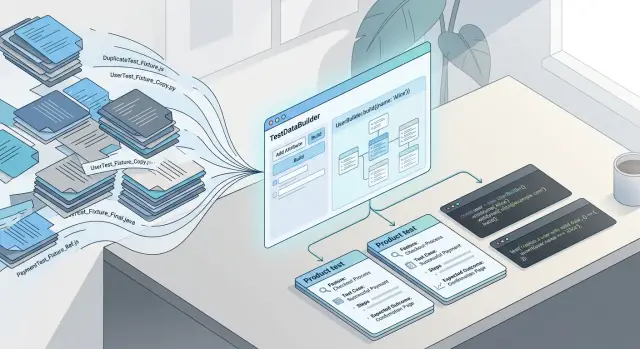
Table of Contents
Why copied fixtures keep breaking tests
Copied fixtures look harmless at first. A team needs a user, order, or product record, so someone duplicates a JSON file, changes two fields, and moves on.
A month later, there are a dozen versions of the same shape across the test suite. They still look close enough, but each copy has small edits nobody remembers. One file uses priceCents, another still has price, and a third adds currency because one test needed it in a hurry.
That drift is where the trouble starts. Tests keep passing for a while, so the mess stays hidden. Then a real schema change lands. A developer renames a field or makes a nested value required, and suddenly dozens of tests fail at once. The code change was small. The cleanup isn't.
The noise is often worse than the failures. If a product test checks one rule, like "hide the buy button when stock is zero," the setup should make that obvious. Copied fixtures bury the point under pages of unrelated data.
Review slows down too. A reviewer has to scan a wall of fields and guess which ones matter. Most of that setup is just background, but it still takes time to read. Small changes start to feel risky.
Debugging gets dragged into the same mess. When a test fails, you first have to work out whether the product code broke or the fixture drifted out of date. Teams burn time opening old fixture files, comparing near duplicates, and fixing fields that had nothing to do with the behavior under test.
A few early signs usually show up:
- The same object shape appears in many files with tiny differences.
- One renamed field breaks tests in unrelated areas.
- Test diffs are longer than the product change.
- Review comments keep asking, "Which of these fields do we care about?"
The real problem is not the amount of test data. It's copied setup that spreads knowledge across too many files. Every edit turns into search, compare, and guesswork. That's why fixture-heavy test suites feel fragile even when the product code is fine.
What a builder changes
A builder is a small test helper that creates valid data, then lets each test change only the parts it cares about. That sounds like a small shift, but it changes how tests read and how often they break.
A plain base object is just raw data in one file. It works at first, but tests tend to copy it and tweak a few fields. Soon you have ten versions of the same user, cart, or subscription object, and nobody knows which one still matches the model.
A fixture is a little better. It gives you one reusable sample object, so you stop repeating the whole shape. The trouble starts when one fixed sample has to cover too many cases. Tests begin mutating it, cloning it, or adding one-off fixture files for edge cases.
A builder sits in the middle. It starts with safe defaults, but it stays flexible. Each test asks for a valid object and then says what is different in this case.
const product = new ProductBuilder()
  .withPrice(0)
  .withStatus("draft")
  .build()
That style makes the intent obvious. A reader does not need to scan a 40-line object and guess what matters. They can see, almost immediately, that this test cares about a free draft product.
Named methods help more than people expect. Changing price: 0, status: "draft" inside a copied object works, but withPrice(0) and withStatus("draft") read closer to the reason for the test. They also give the team one place to name business rules in normal language. If a field gets renamed later, the test can stay readable even if the underlying shape changes.
One shared source of defaults also cuts down churn. When the model adds a new required field, you update the builder once. Tests that do not care about that field keep working because they still build valid data. Without a builder, that same change can touch dozens of copied fixtures.
That's why builders usually make a suite feel calmer. There's less setup noise, fewer scattered fixes, and a much clearer signal when someone reads a failing test six months later.
Start with one simple builder
Pick the object your team copies most often. In product tests, that's usually a user, order, product, or subscription. If one shape shows up in ten files, that's enough reason to stop pasting it by hand.
A lot of teams make this part harder than it needs to be. They try to cover every model at once, add random values, or hide setup behind helpers that do too much. A better start is smaller: one create function, one object, plain data.
function createProduct(overrides = {}) {
  return {
    id: "prod_1",
    name: "Starter plan",
    price: 29,
    currency: "USD",
    active: true,
    tags: [],
    ...overrides,
  };
}
This works because the defaults are safe and boring. A test can read the object and understand it fast. Nothing reaches into a database, calls the clock, or generates surprise fields behind the scenes.
The override part matters just as much as the defaults. Some fields change all the time, like price, status, plan name, or trial length. Let the test pass only what it needs, and keep everything else steady.
That keeps the test focused. If you want to check what happens when a product is inactive, write createProduct({ active: false }) and move on. You do not need a second fixture file called inactiveProduct, then a third for inactiveDiscountedProduct, then five more a month later.
Builders help most when they return plain objects with no hidden work. If a helper silently creates related records, adds timestamps, or mutates values based on the environment, people stop trusting it. Once trust is gone, copied fixtures come back.
Start small. Replace copies in three or four tests that already share nearly the same fixture. That gives you a quick read on whether the defaults feel right. You will usually spot two issues fast: some defaults are too specific, and a few fields need better names. Fix those early and keep reusing the same builder until it feels boring.
That is the goal. A simple builder people understand beats a clever factory nobody wants to touch.
Set defaults without hiding intent
Good defaults save time. Bad defaults turn tests into puzzles.
A builder should give you a believable object in one line, then let each test change only the detail it cares about. Random defaults usually make that worse. If a product name, price, or status changes on every run, the test stops reading like a short story and starts looking like noise.
Pick plain, realistic defaults instead: a normal product title, a stable price, a published status, a real-looking SKU. Boring data is easier to trust.
Keep defaults realistic
A useful default should look like something your app would actually store. If your product tests deal with active catalog items, make the default product active. If most orders start as unpaid, use unpaid. That keeps the common path short and easy to read.
The same rule applies to dates and counts. A builder that creates 17 reviews, 6 discounts, and several nested relations by default is doing too much. Most tests do not need that setup, and extra data makes failures harder to understand.
Name helper methods after business meaning, not raw field names. withArchivedStatus() says more than withStatus("archived"). forWholesaleCustomer() is clearer than setting five flags by hand. When builders speak the language of the product, the test tells you what matters without forcing you to inspect every property.
That also keeps overrides small. A good test changes one or two fields, not twelve. If you are checking that free shipping appears above a price threshold, the test should only override price or cart total. Everything else should stay on sane defaults.
A simple pattern works well: start with one believable object, add a few helper methods for common business cases, let tests override single fields when needed, and leave optional relations empty unless a test actually needs them.
Huge builders usually fail for the same reason copied fixtures fail. They try to cover every case at once. If a product builder always creates categories, images, inventory records, reviews, suppliers, and promotions, even a small schema change can ripple through dozens of tests.
Builders work better when they stay narrow. Build a product by default. Add a supplier only in supplier tests. Add reviews only in review tests. That keeps the setup honest. Readers can see what the test depends on, and small model changes stay local instead of breaking half the suite.
If a builder hides too much, people stop trusting it and go back to copied fixtures. That's the warning sign. Trim the defaults, rename the helpers, and make the common path obvious again.
A small product test example
Builders pay off when the test reads like a product rule instead of a setup chore. Say a product needs only three fields for most checks: price, stock, and status. Give those fields sensible defaults, then override only the detail that matters.
const aProduct = (overrides = {}) => ({
  name: "Basic plan",
  priceCents: 2000,
  stock: 12,
  status: "active",
  ...overrides,
});

const applyDiscount = (product, percent) => {
  if (product.status !== "active") return product.priceCents;
  if (product.stock < 1) return product.priceCents;
  return Math.round(product.priceCents * ((100 - percent) / 100));
};
The builder gives you a clean product shape every time, and the test shows only what changed.
it("applies a discount to an active product that is in stock", () => {
  const product = aProduct({ priceCents: 2000, stock: 5, status: "active" });

  expect(applyDiscount(product, 10)).toBe(1800);
});

it("does not discount an out of stock product", () => {
  const product = aProduct({ stock: 0 });

  expect(applyDiscount(product, 10)).toBe(2000);
});
Those tests read almost like product rules. One says an active product with stock gets the discount. The other says the rule stops once stock hits zero.
That matters because someone can scan the file later and see the point of the test right away. They do not have to read ten lines of filler data before finding the actual rule.
The next win shows up when the product shape changes. Imagine priceCents becomes price. If you copied raw fixtures into thirty files, you now have thirty edits to make. With a builder, most tests stay the same because the setup lives in one place.
const aProduct = (overrides = {}) => ({
  name: "Basic plan",
  price: 2000,
  stock: 12,
  status: "active",
  ...overrides,
});
After that change, tests like aProduct({ stock: 0 }) still say exactly what they said before. You update the builder once, adjust the code that reads the field, and move on. That is a much better trade than chasing copy-paste across the whole suite.
Mistakes that make builders hard to trust
If a builder makes tests shorter but less clear, people stop using it. Good builders cut noise. Bad ones just move the noise to a hidden place.
One common mistake is hiding important values behind magic defaults. A price of 9999, a timezone of "UTC", or a status of "active" may look harmless until a test fails for a reason nobody can see. Defaults should be plain and boring. If a value affects the behavior under test, the test should set it in the open.
Another mistake is forcing a long method chain before a test can run. When someone has to write aProduct().withStore().withSeller().withRegion("US").withTaxRule().withInventory(3) just to reach the real assertion, the builder stops helping. A test should read like one short story. If setup needs ten calls, split the builder, improve the defaults, or add a helper with a clear name.
Keep builders separate from database work. A builder should create a data shape, not open a transaction, call a repository, or seed half the app. Once a builder writes to the database, it becomes slower and harder to reason about. Use one tool for in-memory data and another for persistence when a test truly needs it.
Shared mutable objects cause quiet damage. If one test changes a product name, stock count, or nested options list and another test reuses that same object, failures start to look random. Each test should get a fresh object. Clone when needed. Do not pass the same live object across files.
You can usually tell a builder is drifting when people add comments to explain what it secretly does, small model changes break unrelated tests, different teams invent different styles for the same data, or new tests fall back to copied fixtures anyway.
Style drift causes more trouble than people expect. One team writes productBuilder().active(). Another writes makeProduct({ status: "active" }). A third mixes both. Pick one style and keep it plain. The goal is not elegance. The goal is that any developer can open a test and understand the setup in a few seconds.
A simple rule helps: make common cases easy and unusual cases explicit. If a discount rate, locale, or permission level matters to the test, set it where the reader can see it. When builders stay predictable, people keep using them. When they hide too much, copy-pasted fixtures come back fast.
Quick checks before you add another fixture
A new fixture feels quick. A month later, it is often one more file nobody wants to touch.
Before you add it, read the test as if you joined the team yesterday. If you cannot tell what matters in about a minute, the test is already too cloudy. Builders help because the noisy defaults stay out of the way while the few fields that matter stay visible.
A useful builder also gives you one place to change shared defaults. If your product starts requiring a new field like currency or status, you should update that default once and move on. If ten tests need ten separate edits, you did not save time. You just spread copy-paste into more files.
Shape matters too. A builder should return the same kind of object every time. If buildProduct() sometimes returns nested pricing data and sometimes does not, people stop trusting it. Tests turn into a guessing game, and then teammates start making ad hoc fixtures again.
Overrides need to stay obvious. When a test cares about price: 0 or inventory: 1, put that in the test body where people can see it fast. Do not hide it inside a helper with a vague name like buildEdgeCaseProduct(). That name saves a few seconds now and wastes much more time later.
Use a short check before adding another helper or fixture:
- A new teammate should understand the product state without opening three other files.
- You should know the single place where a shared default belongs.
- Building the object twice with different overrides should keep the same shape.
- The override fields in the test should tell the story without extra hunting.
- If nobody calls an old builder anymore, delete it before adding a new one.
Small teams feel this pain most when the catalog or checkout model changes. One extra required field can break thirty tests if each file owns its own fixture. With builders, you fix the default once and keep the test-specific values explicit.
That is the standard worth keeping: one stable shape, one home for defaults, and tests that still read like plain product behavior.
Next steps for a growing test suite
Start where the pain is loudest. Pick the file that keeps getting touched, keeps growing, or breaks every time a product field changes. One noisy file will teach your team more than a full rewrite ever will.
That first target is usually easy to spot. It has the same fixtures copied over and over, with tiny edits in each case. A new required field lands, and suddenly ten tests fail for the same dull reason.
Builders work best when they arrive during normal work. If someone opens a test to fix a bug or add a case, that is a good time to replace copied data with a builder. The product keeps moving, and the suite gets cleaner without a separate migration project.
A big rewrite sounds tidy, but it often stalls. People get tired, naming drifts, and half the suite ends up on the old style anyway. Small, steady changes usually win.
You do not need a long team document to make this stick. Keep the rules short: use one builder name per domain object, give builders defaults that pass normal validation, override only the fields a test cares about, keep random data out unless the test checks randomness, and turn repeated copied fixtures into a builder or helper.
Those rules stop most of the mess before it starts. They also make review faster because everyone can see what a test is trying to prove.
One more habit pays off: treat builder updates like product code. When a builder changes, ask whether tests became clearer or whether the defaults got too clever. Hidden logic is where trust starts to drop.
If your team has reached the point where every schema change breaks half the suite, an outside review can help. Oleg Sotnikov at oleg.is works as a fractional CTO and startup advisor, and this kind of cleanup often fits naturally into a broader review of engineering workflow and product architecture.
You do not need perfect coverage of every model on day one. Clean up the files people already touch, keep the rules short, and let the better pattern spread through real work.
Frequently Asked Questions
What is a test data builder?
A test data builder is a small helper that creates valid test objects with safe defaults. Your test then changes only the fields it cares about, so the setup stays short and easy to read.
When should I replace fixtures with a builder?
Use one when you keep copying the same user, product, order, or subscription object into many tests. If one field rename breaks files all over the suite, a builder will save you time fast.
How is a builder different from a fixture?
A fixture gives you one fixed sample object. A builder gives you a valid default object and lets each test override just the parts it needs, which keeps edge cases from turning into more copied files.
What is the easiest way to add a builder to an existing test suite?
Start with the object your team copies most. Write one simple function like createProduct(overrides = {}) that returns plain data with boring defaults, then replace a few repeated fixtures in tests you already touch.
What makes good default values in a builder?
Pick defaults that look like normal app data and pass validation. Keep them steady, avoid random values, and leave optional relations empty unless a test really needs them.
Should builders use random values?
Random data usually makes tests harder to read and debug. Use stable values for names, prices, and statuses unless the test checks randomness or uniqueness on purpose.
Should a builder talk to the database?
No. Keep builders focused on in-memory data shapes so tests stay fast and predictable. If a test needs persistence, use a separate helper for database setup.
How do builders help when the schema changes?
Update the builder once and keep the same test calls where possible. If your tests say aProduct({ stock: 0 }), they still read well even after you rename an internal field in the builder.
How do I know a builder has become too clever?
Watch for hidden logic, long method chains, and surprise data that the test did not ask for. If people need comments to explain what the builder does, trim it back and make the common path obvious again.
How should a team roll this out without a huge refactor?
Skip the big rewrite. Replace copied setup during normal bug fixes and feature work, keep one naming style per object, and review builder changes like product code so the helpers stay simple and trustworthy.


