Technical speakers for accelerators with real operator lessons
Choose technical speakers for accelerators with a simple screen that filters out trend slides and finds operators who teach real tradeoffs.
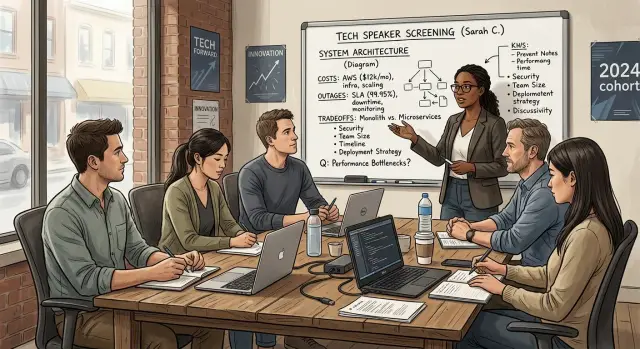
Table of Contents
Why good cohorts still get empty talks
Strong founder groups still end up in weak sessions for a simple reason: a polished speaker can sound useful long before they say anything a team can act on.
Early-stage teams do not need another talk full of trend lines, market maps, and big claims about where tech is going. They need help with the mess in front of them now. If a founder has a broken onboarding flow, rising cloud costs, or an unreliable AI feature, a slide about market momentum will not help.
That gap costs more than an hour on the calendar. It burns attention, delays decisions, and sends teams back to work with the same confusion they had before the session. In an accelerator, that cost is real. One vague talk can take the time a team needed to fix pricing, ship a feature, or kill a bad idea.
When you book technical speakers for accelerators, it is easy to mistake polish for depth. Some speakers know startup language so well that they can sound smart while staying safely abstract. They talk about best practices, innovation, and scale, but never say what they chose, what they gave up, what broke, or what they would do differently now.
Operators teach differently. They explain decisions under pressure. They say, "We picked the cheap option first because we had six weeks and one engineer," or, "We added the model, but support tickets doubled, so we rolled it back." That kind of detail gives founders something better than inspiration. It gives them judgment.
The best sessions are not always the smoothest. A speaker who has run real systems usually talks about limits, bad calls, and ugly tradeoffs. That may sound less impressive than a perfect trend deck, but it is far more useful.
A cohort does not need a performer who can fill 40 minutes without friction. It needs someone who can save each team one bad hire, one wasted month, or one expensive technical mistake. That is the bar worth screening for.
Start with the problem founders have now
Most weak sessions fail before the speaker joins. The topic sounds smart, but founders walked in with one live problem: slow releases, rising cloud bills, messy AI experiments, or a product nobody can safely change. Start there.
Use this month as your time frame. Do not ask what founders struggle with in general. Ask what is blocking progress right now. The answers are usually concrete: demos break before investor meetings, the team cannot decide whether to ship fast or clean up the code, or nobody trusts the output from a new AI feature. Write those down and rank them by urgency.
Then pick one audience level. A room of first-time founders needs a different session from a room of technical founders who already ship every week. If you mix levels, the speaker will drift into broad advice. Broad advice feels safe, but it rarely changes what a team does on Monday.
You also need a clear action after the talk. Good outcomes are small and specific. Founders should leave ready to cap cloud spend, change how they scope an MVP, add one release check before deployment, or stop building custom AI layers before they fix the data flow underneath.
Tradeoffs matter as much as tactics. Decide which choices you want the speaker to unpack. Maybe you want founders to hear when speed beats polish, when a cheap setup creates real risk, or why a small team should pick boring tools over clever ones.
That filter cuts out a lot of trend talk. An operator who has run real systems can explain the cost of each choice, not just the upside. Someone who has kept a product running with a tiny AI-augmented team can talk plainly about what they cut, what they automated, and where they refused to take shortcuts. Founders remember lessons like that because they can use them the same week.
How to tell if someone has run real systems
People who have carried production systems talk differently. They remember the ugly parts: the outage at 2 a.m., the launch that slipped by three weeks, the budget cap that killed a nice idea. If a speaker stays at the level of trends, mindset, and vague best practices, they may not have lived with the consequences.
When you screen speakers, listen for tradeoffs more than opinions. An operator can explain why they kept a monolith longer, why they picked one cloud service over another, or why they delayed a rewrite even when the code annoyed everyone. More importantly, they can tell you what that choice cost.
Failure is another strong signal. Real operators do not pretend every decision worked. They can name a migration that dragged on, a hiring mistake, an alert setup that created noise, or an AI workflow that looked cheap until review time doubled. Those details usually come from work they actually owned.
Useful speakers also give context in plain numbers. They tell you how big the team was, how much time they had, what the budget looked like, what load the system carried, and what changed after the decision. "We had two engineers, eight weeks of runway, and one enterprise customer waiting" tells you much more than "we moved fast and stayed focused."
You should notice what they do not do. Operators rarely make sweeping predictions about where all software is going. They stay close to practice because real systems punish certainty. They talk about a specific team, a specific deadline, and a specific mess they had to clean up.
A concrete example helps. If a speaker says they took a product used around the world, reduced the team to a tiny AI-augmented operation, kept near-perfect uptime, and cut cloud spend through architecture changes, that is something you can test. Ask what broke, what they stopped paying for, and which parts still needed humans every day.
If a candidate can give you numbers, constraints, one failed call, and one tradeoff they still debate, they probably have something founders can use on Monday.
Questions that expose judgment
A strong speaker can tell you what they owned, what broke, and what they gave up to keep things moving. People who live inside real systems do not speak in slogans. They remember limits, compromises, and the cost of being wrong.
Use a short screen and push past polished claims. If someone says, "I led platform scale," ask what they operated with their own hands. Was it a product customers used every day, an internal tool, a data pipeline, or a sales demo dressed up as production? That answer tells you whether they can help founders or just impress them.
A few questions do most of the work. Ask what system they operated themselves and what they personally owned day to day. Ask for one hard tradeoff they made under pressure, what they protected, and what they accepted losing. Ask what they would do differently now. Ask which mistake changed their process after that. Then ask them to explain the whole thing to a non-technical founder who only cares about cost, speed, and risk.
Listen for specifics. Good answers include numbers, constraints, and consequences. "We kept uptime high by cutting extra services and simplifying deployments" is useful. "We adopted modern practices" is not.
The question about what they would do differently matters more than most teams expect. Anyone can tell a clean success story. Fewer people can say, "I chose speed over cleanup, and it cost us two weekends later. Next time I would ship less and protect observability first." That kind of answer shows judgment.
The last question is where many technical speakers fail. A founder audience does not need a deep tour of tools. They need plain language. If the speaker cannot turn a messy technical choice into a simple business tradeoff, the session will drift into abstraction.
You are not hiring a lecturer. You are picking someone who can spare founders one bad decision. That usually comes from scars, not slides.
How to run a 20-minute screen
A short screening call works when you tie it to one founder problem. Pick the pain your cohort actually has: slow releases, weak onboarding, rising cloud bills, messy data, or vague AI plans. If the speaker cannot stay on that problem for 20 minutes, they will probably drift during the session too.
Give them one simple scenario and ask how they would teach it. For example: "A seed startup ships on Friday, traffic jumps, error rates climb, and the founders have no rollback plan. What would you teach them in 15 minutes?" That question forces them to teach from experience instead of giving a trend talk.
Then listen for decisions and limits. A real operator says what they would do first, what they would skip, and what might fail anyway. Someone who only knows the conference version of the topic will name tools, repeat popular ideas, and stay abstract.
You can keep the call tight with five prompts: what founder mistake does this talk fix, what real system or incident will you teach from, what tradeoff would you make in this case, what should founders not do yet, and what outline would you deliver minute by minute.
Direct answers matter more than polished ones. If they spend three minutes circling around "it depends," ask what it depends on. Good speakers can narrow the problem fast. They may add nuance, but they still choose a path and explain why.
Use the last two minutes to test structure. Ask for the actual outline they would deliver: opening example, main lesson, one mistake founders often make, and one action founders can use that week. If they cannot sketch that live, they probably do not own the material deeply enough.
A good screen gives you a clear yes or no. By the end, you should know the founder problem, the scenario, the tradeoffs, and the shape of the talk. If you only learned which tools they like, skip them.
Review past talks carefully
A polished deck can hide a thin talk. Watch one full session, not a clipped promo or a short conference intro. The fastest test is simple: do they teach through one real system they actually ran?
Strong talks stay close to lived work. You should hear the setup, the pressure, the decision, and the result. A stronger example sounds like this: one company cut a full product team down to a tiny AI-augmented operation, kept uptime near perfect, and accepted slower feature experiments for a quarter. That gives founders something solid to think about.
Weak talks drift. They jump from trend to trend, flash tool logos, and never stay with one problem long enough to explain what changed. If the speaker says five product names in two minutes but cannot explain one hard choice in plain words, the talk will probably waste your cohort's time.
A few signals help. One example should stay in focus for several minutes. The speaker should name a decision point, not just the outcome. They should explain what they gave up to get the win. The lesson should still work even if you remove the brand names. And the story should sound specific to their own work, not copied from a generic startup script.
Listen for language normal founders can follow. Real operators do not need fancy phrasing to sound smart. They can say, "We picked the slower path because the faster one broke support," or, "We saved money on infrastructure, but debugging got harder for two months."
That tradeoff is the point. Founders do not need slogans like "move fast" or "use AI everywhere." They need someone who can say when a choice worked, when it backfired, and who should avoid it.
If every example feels familiar in a generic way, trust that feeling. Real operator-led talks leave fingerprints. They include budget limits, bad calls, and fixes that took longer than expected.
Mistakes that waste a session
A weak talk usually fails before the speaker enters the room. The biggest mistake is booking the most famous name in the space and assuming name recognition will carry the hour. It rarely does. Founders do not need a polished tour of trends. They need someone who has shipped, broken things, fixed them, and can say what they would do differently now.
Confidence fools people all the time. Some speakers sound certain because they have repeated the same talk for a year. That is not the same as operating experience. A person who has actually handled outages, cut cloud spend, trimmed a bloated stack, or kept a product running with a tiny team usually speaks in plain tradeoffs, not slogans.
Broad topics waste more sessions than bad delivery. If you let the speaker choose something like "The future of AI for startups" or "How to scale fast," the room gets a pile of general advice that fits every company and helps none. A narrower topic works better because founders can test it next week. "How to pick your first monitoring setup" is useful. "How to review vendor lock-in before you sign" is useful too.
Another common mistake is skipping the screening call because the deck looks sharp. Slides are cheap. A clean deck can hide recycled ideas, vague stories, and no recent hands-on work. Ten or twenty minutes of live conversation tells you far more. Ask for one hard decision they made, what it cost, what broke, and what they would not recommend anymore.
The last mistake is simple: ignoring whether founders can use the advice right away. Good accelerator sessions leave people with one or two actions they can take within days. Bad ones leave them with notes full of phrases and no next step.
Usefulness beats fame. If the speaker cannot help a founder make a better decision next week, the slot is too expensive no matter how impressive the bio looks.
A simple booking example
Picture a B2B SaaS accelerator with twelve founders who all ask the same question: should we add AI now, and if yes, where? The program manager needs one session that helps teams make a real product call, not another hour of market noise.
Speaker A sends a polished deck about agents, market size, and where the space is going. The slides look current. The talk sounds smart. But when the manager asks, "What did you ship, what did it cost, and where did it break?" the answers stay vague.
Speaker B takes a different approach. Instead of broad claims, they explain one production workflow they helped run. They show how a team used AI for support triage before touching the main product. They break down model cost per task, review steps for risky outputs, the handoff back to a human, and the failure points that forced them to change the first version. They also say what they would not automate yet.
That speaker gets the slot.
Founders leave with clearer decisions because they can map the story to their own product. One team decides to test AI on internal ticket tagging first. Another drops a half-formed plan for a full "agent" feature because the support load is too small to justify the spend. A third team realizes they need better logging before they try any automation at all.
The program manager now has a useful screen for future sessions: ask for one workflow the speaker ran in production, ask what failed in the first version, ask for rough costs and review steps, and ask what founders should avoid for the next six months.
This approach works because it rewards operators who teach from lived systems. Trend talks can sound impressive for 20 minutes. Clear tradeoffs stay useful after the room empties.
Before you confirm the session
Before you book the session, ask for five plain answers by email or on a short call. The bar should stay simple: they must teach from work they actually owned, not from slides built around trends.
Start with ownership. Ask, "What system did you run yourself, and what were you responsible for?" A strong speaker names the product, the scale, and their part in it. A weak one stays at the level of advice, not operations.
Then ask for one mistake. You are looking for someone who can say what went wrong, why they chose it, and what it cost. The best answers sound a little uncomfortable. That is usually a good sign. People who have carried the pager, missed the deadline, or cleaned up a bad choice tend to teach with more honesty.
Clarity matters just as much. Ask them to explain one lesson as if half the room has no engineering background. Founders do not need jargon. They need a speaker who can turn a technical issue into a business choice with clear tradeoffs and plain words.
Time discipline is easy to test. Give them a tight format, such as 12 minutes of teaching and 8 minutes for questions, and ask how they would structure it. If they cannot trim their material before the session, they probably will not do it on stage.
The last check is action. Ask what founders can do within seven days after the talk. Good answers are concrete. Bad answers are broad.
A fast pass is simple. They name a real system and their exact role. They explain one bad call and the fix. They teach plainly. They fit your time limit. They leave founders with one step to try next week.
What to do next
If you book technical speakers for accelerators, stop choosing them from memory or reputation alone. Use the same short scorecard every time, even for people who look impressive on paper. That keeps the bar clear and makes weak picks easier to spot before they reach the cohort.
Your scorecard does not need much. Check whether the speaker ran a real system, team, or product. Check whether they can explain one hard tradeoff without vague language. Check whether they have a failure story with a concrete fix. Check whether the talk fits the stage your founders are in. Then check whether founders will leave with one action they can use this week.
Keep a small bench of operators instead of searching from scratch for every event. You do not need dozens. A handful is enough if they cover different founder stages, like pre-product, early revenue, and the point where reliability, hiring, or infrastructure start to hurt.
Before you announce any session, ask the speaker for a tight outline. One page is plenty. It should name the founder problem, the real example they will use, the tradeoff they plan to unpack, and the practical takeaway. If they send broad themes and polished slogans, skip them.
If your team wants a second opinion, an outside operator can help. Oleg Sotnikov at oleg.is does this kind of practical advisory work across startups, product architecture, production systems, infrastructure, and AI-first development. That kind of filter is useful when you need to tell the difference between lived experience and a trend talk.
Use the next event as a test, not a finished system. After the session, ask founders what they wrote down, what they disagreed with, and what they changed in the following week. Then update your scorecard and bench. After two or three rounds, your process gets much sharper, and your sessions get a lot more useful.


