Technical risk in revenue forecasts: what a CTO adds
Technical risk in revenue forecasts hides delivery limits, margin squeeze, and vendor dependence. See how a CTO brings them into planning.
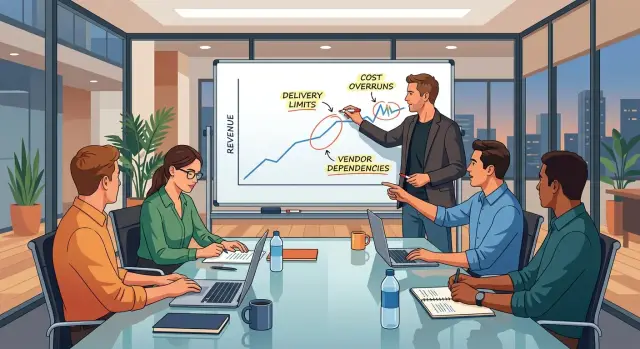
Table of Contents
Why forecasts miss technical risk
Many revenue plans start with a target and work backward. The team picks a launch month, adds pipeline assumptions, and turns that into bookings or growth. It looks clean on a slide. It also skips the part that decides whether the plan can happen at all.
The usual problem is simple. Teams treat engineering like a black box. Finance sees a roadmap. Sales sees release dates. Leadership sees expected revenue. Too few people ask the harder question early enough: can the team ship this work, support it, and keep margins healthy at the same time?
Sales targets never tell the full story. A product can have real demand and still miss the forecast because the work behind it takes longer, costs more, or depends on tools and vendors the company does not control. When that happens, the number was never solid. It only looked solid.
The missing risks are usually familiar. The team has less delivery capacity than the roadmap assumes. Old systems slow releases and create rework. A vendor, API, or cloud service can delay launch or raise costs. Support, security, and maintenance take time that nobody put into the model.
These are not edge cases. They show up in normal product work. A team may promise a Q3 launch, then lose three weeks to a billing integration, another two to performance fixes, and more time to customer-specific requests. Revenue does not slip because demand disappeared. It slips because the plan ignored how software gets built.
Margin pressure starts the same way. If a forecast assumes new revenue arrives cleanly, it misses the extra engineering hours, infrastructure spend, and vendor fees needed to deliver that revenue. A feature can sell well and still hurt the business if every new customer makes the system more expensive to run.
A CTO brings those limits and trade-offs into the forecast before leadership approves the numbers. They can say what the team can ship, what must wait, which dependencies are fragile, and where each extra promise starts to squeeze margin.
That matters even more in smaller companies, where one delayed release can move the whole quarter. Someone with deep delivery experience, including a fractional CTO, can often spot the gap between the spreadsheet and the actual work in a single planning cycle.
Without that view, the forecast becomes a wish list with formulas. With it, the number has a much better chance of surviving contact with the roadmap.
What technical risk looks like in plain language
Technical risk is the gap between what the forecast assumes and what the team can actually build, launch, and support. A spreadsheet may assume a feature goes live in June, works for 5,000 users, and needs little extra support. The product team may already know that timeline is too tight.
Delivery limits and rework
Delivery limits are straightforward. A small team can only do so much in a quarter. If the plan expects four engineers to ship a new onboarding flow, rebuild billing, fix old bugs, and add reporting at the same time, the math is wrong before work starts.
Rework makes the gap wider. Teams often build the first version quickly, then spend weeks fixing what the first pass missed. Security checks, failed payments, permission rules, slow pages, and messy data all add time. A feature that looked done in two weeks can take six once real users touch it.
That delay moves more than the launch date. Sales pushes demos back. Marketing shifts campaigns. Finance waits longer for cash to come in. One technical miss can ripple through the whole revenue plan.
Costs and dependencies
Margin pressure starts when the product costs more to run than the plan expects. Cloud spend can rise fast if the system uses too many servers, stores too much data, or calls expensive AI or third-party services too often. Support costs grow when rushed releases create more tickets and manual fixes.
Custom work hurts margins too. One large customer asks for a special workflow, then another wants a different version. Soon the team maintains several exceptions, and each sale brings more engineering and support work than the forecast assumed.
Dependency risk means part of the plan depends on something outside your control. A vendor can raise prices. An API can change limits or uptime. A payment provider can add review steps. Sometimes the risk sits inside the company: one engineer knows the deployment setup, one contractor owns the data pipeline, or one founder still approves every technical choice.
That is technical risk in plain terms. Time slips. Costs rise. Revenue depends on tools, systems, and people that may not hold up under the plan.
How delivery limits weaken revenue plans
Revenue plans often assume the product team can ship on the date written in the roadmap. That is where numbers start to drift. If sales expects a launch in June, but the team has capacity for August, the forecast is already too high.
A CTO checks the plan against real team output, not hope. That means looking at how many engineers are available, what they are already committed to, how much testing the release needs, and which work usually slips. A team may have ten features on the roadmap, but if it usually finishes four per cycle, the revenue model should follow that pace.
One delayed feature can also hold back far more than its own revenue line. A release may depend on a billing update, a security review, or one API integration. If that one piece misses its date, the whole release moves. Sales does not care whether the delay came from backend work, mobile testing, or vendor approval. The revenue still lands later.
Backlog size matters more than an optimistic deadline. A large backlog is not just a list of future work. It is a sign that the team has more demand than delivery room. When leaders keep adding items without removing others, dates stop meaning much. The team either cuts quality, ships partial work, or misses the date.
Hiring gaps make this worse, even when demand is strong. A company may see clear market interest and assume growth will follow. But one open role can slow the whole chain. If there is no senior frontend engineer, design-ready work sits untouched. If there is no DevOps support, releases wait for environment fixes and deployment checks.
A simple capacity check usually changes the forecast fast:
- Compare planned release dates with the team's recent delivery pace.
- Count blocked work, not just work in progress.
- Flag any feature that depends on one person or one outside vendor.
- Treat open hiring roles as schedule risk, not future capacity.
The real question is not "Can we build it?" It is "Can this team build it by that date, at that quality, with these dependencies?" That question cuts weak revenue assumptions before they reach the board deck.
Where margin pressure starts in the product plan
Risk often shows up before launch, when the product plan treats delivery as the only cost that matters. Revenue may look healthy on paper, but gross margin can drop fast once the product has to run every day for real customers.
A prototype is cheap. A live product is not. Teams often leave out normal operating costs such as hosting and storage at real customer volume, monitoring and logs, security work, incident response, and support time for manual fixes and customer follow-up.
None of these costs are unusual. The problem is that many teams price the product as if those costs stay tiny after launch.
Rushed delivery makes the margin problem worse. When a team cuts corners to hit a date, it creates extra work later: slow queries, brittle integrations, missing tests, and hand-run processes. Engineers spend their week fixing issues that should have been prevented, and operations turn into a series of manual steps. Revenue still comes in, but each customer becomes more expensive to serve.
Enterprise deals can shrink margin even faster. A sales team may promise SSO, custom roles, special reports, longer data retention, or a private deployment to close one account. Sometimes that deal still makes sense. Sometimes it creates one-off engineering work, extra support, and new infrastructure costs that never make it back into the forecast.
An experienced CTO changes that discussion early. They ask basic questions that finance and sales often skip: what does one more customer cost to support, which promises need custom work, and what will on-call, monitoring, and security add each month?
A small example makes it obvious. A SaaS product closes three mid-market customers and celebrates the new ARR. Two months later, cloud spend doubles, error tracking bills rise, and engineers spend evenings handling incidents from a rushed release. Revenue went up, but gross margin moved the wrong way because the plan counted build cost and ignored run cost.
The dependencies that change the numbers
Many forecasts assume the team controls the full path to revenue. It rarely does. Outside tools, outside vendors, and a few hard-to-replace people can change launch dates, costs, and even what the product can sell.
The common dependencies are easy to spot: payment tools that handle charges and subscriptions, AI models that power support or search, cloud services that run the app and database, and contractors who own an integration, migration, or mobile release.
Each one can move the numbers quickly. If a payment provider raises fees, margin drops on every sale. If an AI model vendor changes pricing, a feature that looked cheap in a pilot can become expensive once usage grows. If a cloud service adds stricter limits, pages slow down, jobs queue up, and conversion can slip.
This is why risk often hides in dependency lists, not in code. The product may work exactly as planned and still miss the forecast because the cost base changed under it.
People are a dependency too. One expert may be the only person who understands billing rules, a fragile API connection, or the release process. When that person leaves, takes vacation, or gets pulled into a production issue, a whole stream of work can stop. The sales plan may still assume a launch in June, but the team can no longer ship it.
Not every dependency is a problem. Some are manageable because the team has a backup vendor, shared knowledge, cost limits, and a clear exit path. Risk gets serious when one vendor, one contractor, or one employee can block revenue with no fast replacement.
A simple test helps. Ask four questions: can we swap this dependency, how long would it take, what would it cost, and who else can run it? If the answers are vague, the dependency changes the forecast.
How a CTO adds this to planning
A CTO turns a forecast into an operating plan. Each revenue number needs a release, a team, and a system that can carry the load. When that chain stays vague, risk hides inside optimistic dates.
Start with the revenue assumption behind each release. If the plan says a new feature will bring in 20 enterprise deals, write that down in plain words. Then ask a blunt question: what must ship for those deals to close and go live?
From there, map each assumption to the work behind it. That usually means one feature, one team, one system limit, and sometimes one outside vendor. A mobile launch may depend on app review timing. A new pricing tier may depend on billing changes. A security promise may depend on compliance work that sales never included in the original plan.
A useful planning pass is simple:
- Name the release and the revenue it is supposed to create.
- Tie that revenue to the exact product work and the people doing it.
- Put three dates on the calendar: best case, likely case, and delayed case.
- Add cost ranges for infrastructure, support, and compliance.
- Flag any risk that needs a leadership decision now.
Those three dates matter more than most teams admit. Sales plans often lean on the best-case date. A CTO usually moves the forecast to the likely date and keeps the delayed date as downside protection. That change alone can save a board deck from turning into fiction.
Costs need the same treatment. New revenue can look healthy on paper and still hurt margin once cloud usage grows, support tickets climb, or audit work lands on the team. A CTO adds those ranges early, while the plan is still easy to change.
The last step is often the most useful. Some risks are not delivery problems. They are decision problems. If a release depends on hiring, changing scope, or replacing a vendor, leadership needs to decide before the launch window gets tight.
A realistic example
A SaaS company sells workflow software to mid-sized teams for $99 per user each month. It plans a new Enterprise tier at $30,000 a year. Sales already has one large prospect in the pipeline, and the forecast assumes that deal will close right after the new tier goes live.
The first version of the forecast looks great on paper. Product says the release will ship in July, so finance books revenue from August onward. The model assumes one enterprise deal worth $30,000, plus 15 existing customers upgrading by the end of the quarter. That adds about $120,000 in new annual recurring revenue.
Then the CTO reviews the plan and adds the missing technical detail. The prospect will not sign without SSO, audit logs, and a CRM integration. Engineering thought two of those items were "nice to have." They are not. The QA window is also only five days, which is too short for new access controls and billing logic. On top of that, the team depends on a third-party identity provider with rate limits that need testing under real load.
After that review, the numbers change:
- Launch moves from July to September.
- The large prospect likely closes in October, not August.
- Two upgrade accounts move into the next quarter because the CRM integration slips.
- The company adds one contract QA engineer for six weeks and one senior backend contractor for the integration work.
- Vendor costs rise because the identity provider needs a higher plan.
The revised forecast is less exciting. New annual recurring revenue for the quarter drops from $120,000 to about $55,000. Delivery cost rises by roughly $28,000. Margin for the quarter looks worse.
But this version is far more believable. Sales can still work the large account, finance can plan cash with fewer surprises, and the team is less likely to rush a weak release that creates support issues later.
That is what a good CTO adds to revenue planning: not pessimism, but a plan that matches the work, the limits, and the actual chance of shipping on time.
Mistakes teams make
Many forecast problems start before anyone opens a spreadsheet. Sales and finance agree on launch dates, pricing, and expected volume, then engineering gets asked to make it fit. That feels fast. It also hides the real limits of delivery.
Scope is rarely the only issue. Trouble comes from scope plus team size, integration work, testing time, release risk, and the cost of keeping the product stable after launch.
One common mistake is counting only new feature work. Teams estimate what they can build, then forget the hours that go to bug fixes, customer support, security updates, on-call work, and routine maintenance. A roadmap can look full of revenue-driving features while half the team spends its week protecting the product that already exists.
Another mistake is treating every dependency as if it will land on time. Forecasts often assume the payment provider, data vendor, cloud change, outside agency, or internal platform team will all deliver exactly when needed. Real projects do not work that way. One slip can delay revenue by a quarter, even if your own team performs well.
A few patterns show up again and again:
- Leaders approve a launch date before engineers review the real scope.
- Teams estimate build time but skip support and maintenance load.
- Finance uses one cost number and one launch date, with no range.
- Product leaders treat technical debt like a separate cleanup project.
That last mistake causes more damage than many people expect. Technical debt is not only an engineering problem. If slow builds, fragile code, or manual releases add two extra weeks to every release, revenue lands later and margin gets thinner. The forecast should reflect that.
Single-point plans create false confidence too. A plan with one date and one cost line looks neat, but it gives leaders no room to think. A better plan uses a likely case, a slower case, and a cost range tied to the real work.
A quick check before you approve the forecast
Most forecast errors start with assumptions that nobody owns. Sales may expect a release in June, engineering may expect August, and support may not know the launch will bring more tickets, onboarding work, and cloud spend.
Ask a short set of questions and insist on names, dates, and costs:
- Who owns each assumption behind the revenue number?
- Can the team ship the release and keep the current product healthy at the same time?
- Which vendors, APIs, or platform dependencies could delay launch or raise cost?
- What costs show up after launch, such as support, infrastructure, security reviews, or bug fixing?
- If one team falls behind, what slips first: scope, launch date, conversion target, or margin?
Then compare the answers with real team capacity. A roadmap can look fine on a slide and still break in practice. If the same engineers must build the release, fix production issues, support customers, and handle partner changes, the revenue line already carries technical risk whether finance names it or not.
A simple example makes this obvious. Say a company expects a new enterprise feature to close five deals next quarter. The number assumes billing changes, SSO support, audit logs, and a vendor integration all land on time. If the integration team slips by two weeks, sales does not just lose two weeks. Legal review may move, onboarding may bunch up, and the first deals may slide into the next quarter. Margin also gets thinner if the team rushes, pays for extra vendor usage, or adds manual work after launch.
A CTO brings discipline to this check. They push each assumption until it has an owner, a delivery limit, and a cost line. If you do not have a full-time CTO, a fractional CTO can still pressure-test the plan before the forecast turns into a board number.
What to do next
Put the forecast in the same room as the people who have to make it real. Finance can explain the target, product can explain what must ship, and engineering can say what the team can actually deliver. That one review often exposes the gap behind the numbers.
For each major revenue line, add a short note beside it. Keep it plain: what has to ship, what could delay delivery, what extra cost could cut margin, and which vendor, API, or partner the plan depends on.
A note like "new billing flow must ship in May, one backend hire is still open, payment approval is pending" changes the conversation quickly. The number may still be possible, but now everyone can see the conditions attached to it.
Do not leave the forecast untouched after the first planning meeting. Update it when scope grows, hiring slips, a vendor changes pricing, or a partner misses a date. Teams often adjust the product plan and forget to adjust the revenue model. That is how small misses turn into a weak quarter.
This review does not need to be heavy. A 30-minute check each month is often enough if the team is honest and the notes stay short. If the same risk shows up twice, treat it as part of the forecast, not as a side comment.
Some teams need an outside view because internal meetings get political. Oleg Sotnikov at oleg.is does this kind of Fractional CTO work, with hands-on experience across product architecture, infrastructure, delivery planning, and AI-first operations. For a startup or small company, that kind of review can be enough to catch a bad assumption before it reaches the forecast.
Schedule the review. Put the risk notes next to the numbers. Then change the forecast when the facts change, not after the miss.
Frequently Asked Questions
What does technical risk mean in a revenue forecast?
Technical risk is the gap between what the forecast assumes and what the team can actually ship, run, and support. If the model says a feature goes live in June but the team needs until August, the revenue number already sits on weak ground.
Why do launch dates slip even when customers want the product?
Demand can stay strong and the plan can still slip because software work takes longer than the roadmap suggests. Billing changes, testing, security checks, performance fixes, and customer-specific requests often push the date out.
How does technical risk hurt margin as well as revenue?
Revenue can rise while margin falls if each new customer adds more cloud cost, vendor fees, support work, or engineering time than the plan expected. Rushed releases make this worse because the team spends more time fixing issues after launch.
What does a CTO add to forecast planning?
A CTO checks team capacity, release dependencies, support load, and run costs before anyone locks the number. They compare the roadmap with the team’s recent delivery pace and move the forecast closer to what the team can really do.
When does a dependency become a serious forecast problem?
It becomes a real risk when one vendor, one API, one contractor, or one employee can delay launch or raise cost with no quick backup. If you cannot swap it fast, price it clearly, or name who else can run it, the forecast should reflect that risk.
Do small companies need this kind of review more than large ones?
Yes, because small teams feel delays faster. One blocked release, one missing hire, or one fragile integration can move the whole quarter for a startup or small company.
How should we handle open hiring roles in the forecast?
Treat open roles as schedule risk, not future capacity. If the forecast needs a senior engineer you have not hired yet, use the slower case until that person joins and starts contributing.
Should we forecast with one launch date or several scenarios?
Use at least three dates: best case, likely case, and delayed case. Sales may want the first date, but finance should build around the likely date and keep the delayed one in view.
What mistakes make forecasts look better than reality?
Teams often count feature work and forget bug fixes, support, security updates, maintenance, and post-launch operations. They also assume every vendor and partner will deliver on time, which makes the plan look cleaner than real work ever is.
Can a fractional CTO help with this if we do not have a full-time CTO?
A fractional CTO can review the plan, test the assumptions, and flag weak spots without a full-time hire. That works well when you need an outside view on delivery, infrastructure, margin pressure, or vendor risk before the numbers reach the board.


