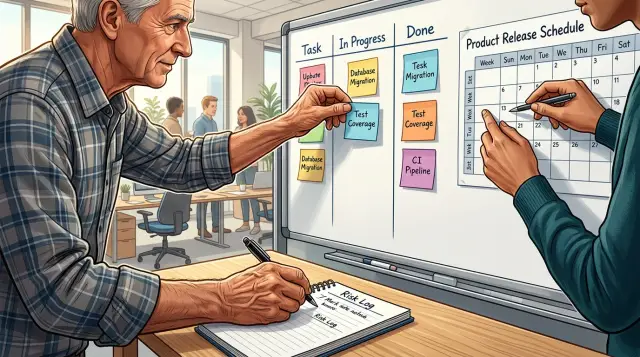
Technical rescue plan after three missed releases in a row
A technical rescue plan for teams that missed three releases: cut scope, reset owners, restore rollbacks, and ship a smaller release first.
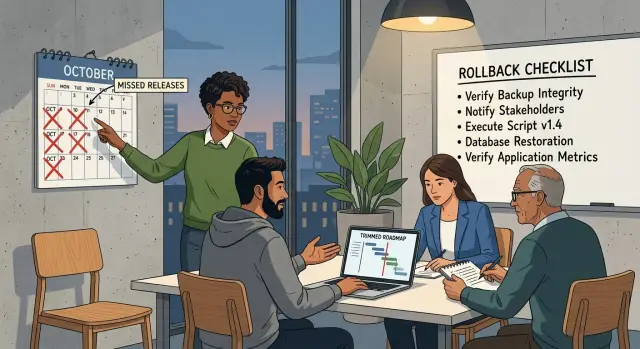
Table of Contents
What three missed releases usually mean
Three missed releases in a row usually point to a management problem before they point to a coding problem. The team may be working hard, staying late, and still falling behind because the plan asks for too much at once. Features, bug fixes, edge cases, and last-minute requests all get packed into one release until nothing feels optional.
That creates a false sense of progress. Everyone stays busy. Tickets move. Meetings happen. But the release never gets close enough to ship. Most of the time, the team has made more promises than it can finish with confidence.
Ownership is another common issue. Teams often talk about shared responsibility, but shared responsibility can turn into no real decision-maker. When release day gets messy, nobody wants to make the final go or no-go call. Product wants one more fix. Engineering says maybe. QA sees risk. The release slips because nobody clearly owns the decision.
Rollback problems make all of this worse. A team that never practices rollback starts treating every deploy like a one-way door. Then even a small bug feels dangerous. People hesitate, patch in production, or delay the release over something they could have undone in minutes if the rollback path were clean and tested.
Stress also hides the real blockers. Under pressure, teams talk about symptoms: too many bugs, too many meetings, too much rework. The deeper issue is often smaller and more specific. One service has no owner. One approval step takes two days. One dependency keeps breaking at the end. Tired teams stop seeing patterns and start reacting one release at a time.
A common startup version looks like this: five people try to launch a new feature set, fix old defects, improve onboarding, and update infrastructure in the same sprint. They miss the date, carry everything forward, and then add more work on top. By the third miss, the pattern is usually obvious: unclear ownership, bloated scope, and no safe way to back out changes when something goes wrong.
What to stop this week
After three missed releases, the team usually has too many active promises and no single finish line. Pushing harder rarely fixes that. The first step is to stop the work that keeps the next ship date blurry.
Freeze new feature requests for one release cycle. That includes ideas from founders, sales, support, and senior engineers. If something is not required for the next release to work, write it down and park it. A short freeze often saves weeks of churn.
Side work needs the same treatment. Teams often keep a few "small" efforts alive at the same time: cleanup tasks, experimental tools, design refreshes, internal dashboards, half-finished migrations. Each one steals attention. If it does not change the outcome of the next release, stop it for now.
Pick one target date and one backup date. Not three possible windows. Not "late next month." One date the team aims for, and one fallback date if something real breaks. That forces tradeoffs and ends the habit of pretending everything can still fit.
Then define the smallest useful version you can ship. Be strict. Ask one question: what does a customer need to complete the main job once, without manual rescue from the team? That is the release. Nice-to-have flows, extra settings, polished edge cases, and admin extras can wait.
This is where many recovery efforts fail. People start sneaking work back in. Someone says a feature is "almost done," so it stays. Someone else wants one more integration because a prospect asked for it. That is how a fourth release slips.
A simple filter helps. Keep an item only if it passes all three checks:
- It changes whether the release is usable.
- One owner can finish it before the target date.
- The team can test it and roll it back safely.
If an item fails one of those checks, cut it. Shipping a smaller release on time does more for team confidence than another ambitious plan that misses again.
Cut scope until the plan fits
After three missed releases, the team does not need a bigger promise. It needs a smaller one. The recovery release should solve one customer problem from start to finish, even if the result feels plain.
State the problem in one sentence. If you cannot say it clearly, the scope is still too wide. A good test is simple: can a customer do one useful job after this release that they could not do before?
Everything else moves out. That includes edge cases that affect a tiny group, extra screens that feel nice, visual polish, and small feature ideas that crept in along the way. Teams often keep these because each item looks harmless on its own. Together, they wreck the date.
Risk matters as much as size. A small change can still sink the plan if it touches permissions, billing, migrations, or several services at once. Separate risky items from low-risk items. Ship the boring, clear work first. Boring releases are often the ones that finally go out on time.
Refactors need extra discipline here. A rescue release is not the moment to rewrite auth, clean up the database layer, replace the component library, or tidy the deployment setup "while we are here." Those jobs might be worth doing later. They do not belong in the first recovery step.
If a team plans to launch invoicing, the first release might only let users create and send a basic invoice. Recurring billing, multi-currency support, custom templates, and dashboard polish can wait. That choice may feel uncomfortable. It is still better than missing a fourth release.
This is the center of the whole reset: ship a smaller thing that works, then expand it.
Reset ownership on every moving part
Three missed releases usually mean the team has work, tickets, and good intent, but not clear control. When five people can change the plan and nobody owns the final call, the release drifts day by day. The fix starts by putting names on decisions.
Use three owners for the release:
- A scope owner decides what stays in the release and what gets cut.
- A delivery owner tracks daily progress, blockers, and handoffs.
- A release readiness owner checks testing, migrations, config changes, rollout steps, and rollback steps.
On a very small team, two people can cover these roles. Putting all three on one person usually hides risk until the last day.
Then assign every task to one named person. "Backend team" is not an owner. "Mobile" is not an owner. A real name changes the conversation from vague status updates to direct follow-up: is the payment retry fix done or not?
Someone also needs the authority to stop the release. Pick that person before the week gets messy. If test failures pile up, a migration stays unproven, or rollback steps fail in staging, that person pauses the launch. Teams that skip this often push too far and spend the weekend undoing damage.
Do not turn ownership cleanup into a long meeting. Fifteen minutes is enough if the board is visible. Ask a few direct questions: who owns final scope, who owns daily delivery, who owns release readiness, who can stop the release, and which tickets still have a team label instead of a name.
An outside lead can help here. A Fractional CTO often spots fuzzy ownership faster than the team does because they are not protecting old habits or old reporting lines. Still, the rule stays simple: one decision, one owner, one name.
Bring back rollback discipline
A release is not real if the team cannot undo it quickly. After three missed releases, many teams fear rollback because it feels like admitting failure. That fear makes things worse. People keep patching a bad deploy, users keep seeing errors, and the team loses another day.
Set rollback triggers before release day. If sign-in fails, checkout breaks, error rates jump past an agreed limit, or response times stay too high for several minutes, roll back. Do not turn that moment into a long argument in chat. The team needs simple rules that remove emotion from the call.
Keep the last stable version ready to restore at all times. That means more than keeping an old build somewhere. The team needs the exact image, config, migration notes, and feature flag state required to get back to a known good version. If a database change blocks rollback, the release is not ready.
Practice the reverse path
Teams rehearse launches and skip the reverse path. That is a mistake. Run the rollback steps in staging before each release window, and sometimes during smaller live changes when the risk is low. A written runbook helps only if someone has used it recently.
Time the full recovery. Start the clock when someone says "roll back" and stop it when users are back on the stable version. If recovery takes 40 minutes, record that number. Then fix the slow parts so the next rollback takes 15.
Write down one name for the rollback call. Usually that is the release owner, engineering lead, or Fractional CTO when the team is in rescue mode. One person decides, one person runs the steps, and the rest of the team verifies that the service is healthy again.
A simple rule keeps everyone honest: if nobody can restore the last stable version quickly and predictably, the team should not ship the new one.
A four-week rescue plan
After three missed releases, the team needs a short plan with hard limits. Do not try to fix culture, tooling, architecture, and delivery all at once. Get one smaller release out first.
Weeks 1 and 2
In week 1, cut scope until one person can explain the whole release on a single page. Keep only the work that users need right now. Assign one owner to every moving part: code changes, test data, deployment steps, approvals, and rollback.
If two people own the same task, nobody owns it. If a task has no owner, either assign it or remove it before the week ends. This is also the time to freeze side work, delay nice-to-have fixes, and stop taking new feature requests from sales or founders.
Week 2 is for finishing the core work and clearing blockers every day. Keep the daily check-in short. Three questions are enough: what shipped yesterday, what blocks today, and who will remove that block before the day ends. Long status meetings waste time when the release is already late.
An outside lead can help if the team keeps arguing about priorities or nobody wants to make the final call. The job is plain: protect the smaller scope and stop old debates from reopening.
Weeks 3 and 4
Week 3 is for the release path itself. Test the build, deployment, migrations, config changes, monitoring, and alerts as one chain. Then rehearse rollback on purpose. If the team cannot undo the release in a calm, repeatable way, it is not ready to ship.
Write the rollback steps in plain language. Name who makes the call, who runs the commands, who checks data, and how long the team will wait before rolling back. Vague confidence is useless here.
Week 4 is shipping week, but the release should be smaller than the team first wanted. Launch when the right people are online, watch errors closely, and keep the owner list active for at least the first day.
Do not celebrate too early. If login errors rise, queues back up, or support tickets spike, act fast and roll back cleanly. A small, boring release after a string of misses is a real win because it proves the team can ship again.
Example: a startup team with a slipping launch
A small startup team had already missed three release dates. The problem was not effort. Everyone worked late, but the release kept growing. They were trying to launch billing, reports, and SSO in the same cycle, with bugs still open in each area.
The team said all three parts were "almost done." That usually means none of them is ready. Billing still had edge cases around failed payments. Reports looked fine in demos but slowed down on larger accounts. SSO worked for one provider, but not for the two biggest customers the company cared about.
The reset started with one blunt decision: cut scope until one clean release fit on the calendar. They dropped reports from the current cycle and moved SSO to the next one. Billing stayed because the company needed it to start charging customers.
They also fixed ownership. Before the reset, five people had partial control and nobody had final control. Afterward, one engineer owned release readiness. That covered release notes, test status, go or no-go calls, and rollback. One product lead owned scope. That meant no new features slipped in after the plan was set.
The new plan was simple: ship billing in this release, freeze reports until billing is live, move SSO to the next cycle, and review rollback steps before launch day. For the first time in weeks, the team could explain the release in one sentence.
They spent the next seven days closing billing bugs, testing payment failures, and rehearsing rollback in staging. An outside Fractional CTO can force this kind of reset, but the team still has to follow it every day.
They shipped billing first. It was not a giant launch, and that was the point. A week later, support had fewer surprises, finance could track real revenue, and the team had proof that it could finish something again. Only then did reports go back into planning, with SSO behind it instead of beside it.
Mistakes that keep the team stuck
Recovery plans usually fail for a simple reason: the team keeps changing the recovery itself. After three missed releases, people get nervous and start swapping priorities every few days. That feels active, but it resets work, creates fresh guesses, and teaches everyone that this week's plan will not survive until Friday.
One trap is replacing the plan every week. A team cannot rebuild trust in delivery if the target moves before anyone finishes the last fix. Two steady weeks beat four clever pivots.
Another problem shows up when leaders add "urgent" work after testing starts. This is where release scope breaks apart. If QA starts on Tuesday and someone slips in one more change on Wednesday, testers are now chasing a different product. Small late changes often create the exact bugs that push the release out again.
Shared ownership causes the same drift. If three people own one decision, nobody makes the final call when tradeoffs get uncomfortable. Product says ship it, engineering wants one more fix, and the founder asks for a last-minute tweak. The team waits, work piles up, and the date slips without anyone saying it clearly.
Teams also treat rollback like a backup note at the bottom of a checklist. That is a mistake. If a release goes bad, the team needs to know who can stop it, how rollback works, and how long it takes. Weak rollback discipline makes people afraid to ship, and fear slows every release.
The last trap is trying to repair culture, architecture, and process in the same week. It sounds ambitious. In practice, it spreads attention so thin that nothing gets fixed. A messy codebase can survive another month. A confused release process usually cannot.
A good outside lead will push a simpler rhythm: keep the plan stable, freeze scope when testing begins, give each decision one owner, and rehearse rollback before release day. It is not glamorous work. It is the work that gets a stuck team moving again.
Quick checks before the next release
When a team has missed three releases, the safest move is a short go-or-no-go check the day before launch. Five plain questions catch most avoidable mistakes, and they take less than 20 minutes if the team already did the work.
Does this release fix one specific problem? If the answer sounds like "several improvements" or "some cleanup plus the new flow," scope is still too wide.
Can you name one owner for every unfinished task? "The team" is not an owner. If a task has no name next to it, it will slip at the worst moment.
Can you roll back from one short runbook? The person on call should know the exact steps, the order, and the stop point. If rollback depends on memory or chat history, it is not ready.
Did you test the release path on a setup that looks like production? A deploy to a laptop or an empty staging setup does not count. Use real configs, real data shapes, and the same build steps.
Did stakeholders hear what you cut and why? Silence creates surprise, and surprise turns small scope cuts into trust problems.
A small example makes this concrete. A startup plans to ship a new onboarding flow, analytics changes, and a billing update in one push. The safer release keeps onboarding, cuts billing, assigns one person to the last migration script, runs a dry deploy on a realistic environment, and sends a short note to the founders: "We cut billing to protect the launch date."
What to fix after the team ships again
One successful release does not mean the problem is gone. It only proves the team can still ship when the path is narrow enough. The next step is to find out why the path got blocked in the first place.
Start with scope. Look at the last few releases and ask a blunt question: why did work keep getting added after the team already had more than it could finish? In many teams, scope grows for ordinary reasons. Sales asks for one more change, a founder wants polish, or engineers keep folding cleanup work into a release that is already late.
Write down the pattern, not just the latest example. You want a short record of what pushed the team past its limit and who allowed it.
Most reviews show the same blockers coming back in three places: fragile code that creates late bugs, process gaps around cutoffs and dropped work, and handoff problems where product, engineering, and QA keep waiting on one another. If the same blocker appears twice, treat it as part of the system. It is not bad luck.
For the next two release cycles, keep the rhythm almost boring. Use the same planning window, the same release owner, and the same rollback check every time. If new work appears mid-cycle, move it to the next release unless it fixes a real production issue. Teams often break again because they celebrate one good release and then go right back to improvising.
The team should also be able to explain, in one sentence each, what changed and why it worked. If nobody can answer that, the team probably fixed symptoms, not the delivery habit.
If you need an outside read on scope control, ownership gaps, or release habits, Oleg Sotnikov at oleg.is does this kind of Fractional CTO work. That sort of review helps when a team is too close to its own process to see why dates keep slipping.
The goal is simple: get two more calm, predictable releases out the door. After that, deeper architecture and process fixes start to pay off.
Frequently Asked Questions
How do I know if three missed releases point to a planning problem?
Look at the pattern, not the effort. If the team stays busy, works late, and still carries work forward every cycle, the plan is too big or nobody owns the final calls. Three misses in a row usually mean scope, ownership, or rollback problems more than slow coding.
What should we stop right away after the third missed release?
Start by freezing new feature requests for one release cycle. Pause side projects, cleanup work, and experiments that do not change the next ship date. Then pick one target date, one backup date, and cut everything that does not help users finish the main job.
How small should the recovery release be?
Make it small enough that one person can explain the whole release in one sentence. The release should solve one customer problem from start to finish, even if it feels plain. If you need extra polish, edge cases, or admin extras to explain it, the scope is still too wide.
Who should own the release on a small team?
On a small team, assign clear roles even if two people cover them. One person owns scope, one tracks delivery, and one owns release readiness and rollback. Give every task one named owner, and pick one person who can stop the launch when risk gets too high.
When should we freeze scope?
Freeze scope when testing starts at the latest. After that point, late changes create new bugs, reset QA, and blur the finish line. If someone asks for one more change, move it to the next release unless it fixes a real production problem.
What counts as a real rollback plan?
A real rollback plan lets the team restore the last stable version fast, with the exact build, config, and notes it needs. Set rollback triggers before launch, rehearse the steps in staging, and time the recovery. If the team cannot undo the deploy calmly, the release is not ready.
Should we keep refactors in the rescue release?
No. Save refactors for later unless they block the release directly. Rewriting auth, changing the database layer, or swapping tooling during a rescue cycle usually adds risk without helping users right now.
How should daily check-ins work during recovery?
Keep them short and direct. Ask what shipped yesterday, what blocks today, and who will clear that block before the day ends. Skip long status meetings and use the check-in to remove blockers, not to retell the whole project.
What should we check the day before launch?
Run a fast go-or-no-go review. Confirm that the release solves one clear problem, every unfinished task has one owner, rollback steps work from one runbook, and the team tested the deploy on an environment that looks like production. Also tell stakeholders what you cut so nobody gets surprised after launch.
What should we fix after we finally ship again?
Do not treat one on-time release as the finish line. Review why scope grew, where handoffs stalled, and which late risks kept coming back. Then keep the next two cycles boring and steady with the same release rhythm, the same owner rules, and the same rollback checks.