Technical ownership model matters more than your stack
A technical ownership model with clear decisions beats a shiny stack when teams ship slowly, argue often, and miss simple handoffs.
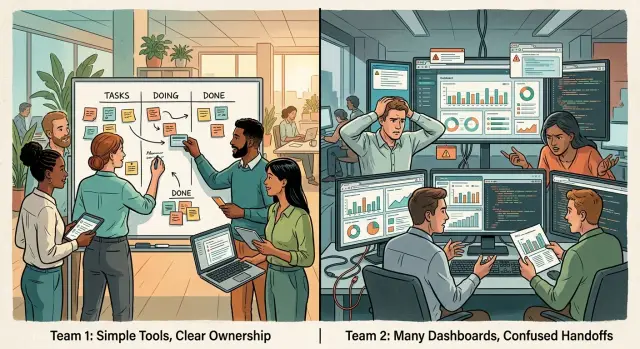
Table of Contents
Why good tools still lead to slow teams
A team can buy better tools on Monday and still miss the same deadline on Friday. New code assistants, cleaner dashboards, and faster deploys help, but they don't fix confusion. When nobody knows who decides, who reviews, and who owns the result after release, work slows down fast.
The pattern is easy to spot:
- Approvals take days because several people want a say, but nobody closes the decision.
- The same architecture debate returns every sprint.
- Handoffs between product, engineering, testing, and operations stay vague.
- Bugs come back because each team fixes one piece and assumes someone else owns the rest.
An older framework rarely does as much damage as that kind of confusion. Old tech adds friction to a few tasks. Weak ownership adds friction to every task. A change that should take an afternoon turns into meetings, waiting, rework, and a tense release.
It gets worse when teams keep buying tools to solve a people problem. A faster editor won't settle a product tradeoff. Better CI won't tell the team who can approve a risky database change. An AI coding tool can generate code in minutes, but it can also create a bigger review queue if nobody owns the final call and production behavior.
Clear ownership speeds up decisions and improves quality because each area has a named decider. One person owns the call, asks for input when needed, and carries the result after launch. That doesn't remove teamwork. It removes fog.
You see this in real companies all the time. One team runs a slightly older stack but ships every week because people know who owns backend changes, frontend choices, and release calls. Another team uses newer tools and still stalls on basic decisions. In most cases, the ownership model explains the gap better than the stack.
When ownership is clear, teams argue less, ship sooner, and fix problems without drama.
What technical ownership means
A technical ownership model is simple: every system area has one person responsible for it. That doesn't mean they do all the work. It means they make sure the work moves, decisions don't stall, and the area stays healthy over time.
Ownership needs a name next to it. If your team has a billing service, mobile app, admin panel, or data pipeline, someone should have the final call for each one. People can disagree, suggest better options, and raise risks. When the team needs a decision, everyone should know who makes it.
That matters more than many teams expect. A team can have smart people, modern tools, and neat diagrams and still move slowly if nobody owns the final choice. Meetings get longer. Small debates stay open. Problems sit around because each person assumes someone else will pick them up.
Input and decision rights are different. Input means engineers, product managers, support staff, or security people can add context and push back. Decision rights mean one owner listens, weighs the tradeoffs, and chooses a path. Good owners don't ignore feedback. They just don't leave the team waiting.
Ownership also continues after release. Shipping code is only part of the job. The owner watches what happens next, tracks bugs and alerts, decides whether to roll back or patch, cleans up loose ends, and learns from the result.
Think about a login system after a release. If login attempts start failing for 3 percent of users, ownership answers one question fast: who jumps in first, who decides the fix, and who checks a week later that the problem stayed fixed? Without that, the team wastes time on confusion instead of repair.
How weak ownership shows up at work
Weak ownership rarely fails in one dramatic moment. It shows up in small delays, repeated questions, and work that keeps moving without getting done.
Bug reports are often the first clue. Support files the issue, product reviews it, frontend says the problem started in the API, backend says the input came from the UI, and the ticket circles for days. Everyone adds notes. Nobody owns the outcome. The customer doesn't care which layer caused it. They only see that the bug is still there.
Incidents drag for the same reason. An outage starts, several people jump in, and each person handles one small piece. One engineer checks logs. Another restarts a service. A manager asks for updates every ten minutes. Still, no one says, "I own recovery. I'll make the call and keep this moving." The team burns time on handoffs and half decisions.
The backlog fills with work that looks active but goes nowhere. A feature stays open because engineering waits for product, product waits for design, and nobody can settle the tradeoffs. Teams often call this a planning problem. Most of the time, it's an ownership problem.
Fuzzy boundaries create quiet waste too. Two engineers build similar internal tools without knowing about each other. One team patches a problem while another plans a rewrite for the same area. The same bug gets tracked in different places with different priorities. Meetings get longer because every decision needs too many people in the room.
That's why some teams with average tools move faster than teams with better tools. Clear ownership cuts waiting time, reduces duplicate work, and gives people permission to finish things. If tickets keep bouncing, incidents keep dragging, and backlog items keep aging, check who owns the decision and who owns the final fix.
A simple example with two teams
Team A runs a plain setup: React, Node.js, and PostgreSQL. Nothing flashy. But payments belong to Mia, search belongs to Dan, and deployment belongs to Priya. Everyone knows who makes the final call in each area. Other people can question a plan, review code, and suggest a better path. One person still owns the decision.
Team B uses newer tools: serverless functions, an event bus, several AI coding assistants, and polished dashboards. The trouble starts in meetings. Four engineers share payments. Two product managers can change scope. Operations owns deploys, except when backend needs an infrastructure change. Almost every choice turns into a group discussion.
A new feature arrives: coupon codes at checkout. In Team A, Mia writes the plan that afternoon, points out one database change, and asks Priya for a release window. QA knows where to send questions because Mia owns checkout. Two days later, the feature goes live behind a flag. When support finds a tax mismatch in production, Mia checks the logs, spots a bad rounding rule, and ships a fix in 40 minutes. She doesn't need approval from six people because the ownership line is clear.
Team B moves slower, even with better tools. Planning takes three meetings because nobody owns checkout from start to finish. One engineer changes the pricing service, another updates the UI, and operations waits for a handoff that never feels complete. The release slips by a week. After launch, some coupons fail for returning users. Support posts in chat. One engineer checks frontend logs, another checks cache rules, and product asks whether to roll back. After 90 minutes, they still debate who can turn the feature off.
The bug in Team B isn't harder. The path to action is. That's why the ownership model usually matters more than the stack itself. Good tools help after a team can decide, build, release, and fix with clear responsibility. Without that, even a modern stack feels slow.
How to set ownership step by step
A technical ownership model works when every system and every recurring workflow has one person who can make a call. Without that, teams waste hours in chat, meetings, and handoffs. The stack may be fine. The confusion isn't.
Start with a simple map of what the team actually runs every week. Include product areas like billing, login, and onboarding, but also internal work such as CI/CD, incident response, analytics, and releases. If nobody names these areas, ownership stays vague and gaps stay hidden.
Then set it up in a practical order:
- Write down each system or workflow that can block delivery, support, or revenue. Focus on real work, not org chart boxes.
- Put one name next to each area. A group can support it, but one person owns the final call.
- Define what that person can decide alone. They might choose monitoring rules, approve schema changes, or set release timing within agreed limits.
- Decide where conflicts go. If the mobile owner and backend owner disagree, name who breaks the tie and how quickly that happens.
- Recheck ownership after incidents, missed deadlines, or messy launches. Those moments show where the model failed.
One person owning an area doesn't mean they do all the work. It means they keep it moving. They ask for help, pull in the right people, and make sure open questions don't sit for four days because everyone assumed someone else would answer.
Small startups often get this wrong when they assign ownership to "engineering" or "the platform team." That sounds safe, but it creates drift. If the deploy pipeline fails on Friday night and three people start asking who should fix it, the problem isn't the tool.
Keep the rules short enough that people remember them. A one page ownership sheet beats a long policy document nobody reads. Review it every few months, especially if the team adds new products, hires new leads, or changes how releases work.
Mistakes teams make
Teams often try to fix ownership problems with more structure, more titles, or more tools. That usually makes the mess worse.
A common mistake is splitting one service across several leads when the work doesn't need it. A backend lead owns delivery, an infrastructure lead owns deploys, and a product lead approves every change. Now nobody can make a clean call quickly. The service slows down because every small choice turns into negotiation.
Small technical calls shouldn't go to a committee. If a team needs three meetings to decide how to handle retries, logging, or a schema change, the problem isn't the stack. The problem is unclear authority. Committees feel safe, but they spread responsibility so thin that people stop acting.
Another bad habit is changing the stack to avoid a hard people problem. A team argues, misses deadlines, and decides the answer is Rust instead of Go, or a new frontend framework instead of the current one. Six months later, the same people still avoid decisions. The code changed. The behavior didn't.
Being on call is where weak ownership gets expensive. Every alert needs a named owner. Not a channel. Not a shared rotation with fuzzy boundaries. A person. If an alert fires at 2 a.m. and three people ask, "Is this mine?", the system already failed before anyone opened the dashboard.
Titles fool teams too. A senior engineer, staff engineer, or engineering manager doesn't automatically own outcomes. Some people have long resumes and still avoid direct calls when tradeoffs get uncomfortable. Ownership shows up in plain actions: they decide, explain the choice, and stay with the result.
The warning signs usually show up early. Two people think they own the same area, so they block each other. Five people comment on a small design choice and nobody closes it. The team rewrites parts of the stack while the same incidents keep coming back. Alerts bounce around because no one owns that part of the system.
If this sounds familiar, stop redrawing the org chart and stop shopping for new tools. Pick one area, give one person clear authority, and make that visible to everyone who works with it.
A quick checklist for your team
Most teams can spot ownership problems in one meeting. If nobody can answer simple questions about who decides, who fixes, and who follows up, the stack isn't the main issue.
A good ownership model feels almost boring. People know where to go, decisions move, and cleanup work doesn't drift for weeks.
- Can your team name one owner for each service, deployment pipeline, and incident path? If two or three names come up every time, nobody really owns it.
- When a tradeoff appears, do people know who makes the final call? Discussion is fine. Confusion about authority is what slows teams down.
- Watch the small choices. If a minor library update, alert rule, or API change sits unresolved for days, your decision path is too fuzzy.
- Read your last few postmortems. The useful ones end with one owner and one due date, not a vague promise that "the team" will improve something later.
- Check how your roadmap moves. If too many people must approve every change, even small tasks turn into waiting games.
This works because it looks at daily behavior, not org charts. A team may say it has clear ownership, but the calendar usually tells the truth. Long chat threads, repeated meetings, and stalled follow up work mean ownership is still shared in the wrong places.
A simple rule helps: if two or more points above feel messy, fix ownership before you buy another tool or start a rewrite. Better tools can help, but they rarely solve a team that can't decide.
One small step can change a lot. Write down each service owner, each incident owner, and one person who breaks ties on technical decisions. Do that this week, then check again in a month. If small decisions start closing faster, you're moving in the right direction.
Where the tech stack still matters
A messy ownership model can slow any team, but stack choices still affect real outcomes. They shape what you spend, how hard it is to scale, and how safely you handle data. If your app serves a few hundred users, many stacks will work. If you process payments, health data, or millions of events a day, the wrong choice gets expensive fast.
Security is a clear case. A team that picks tools with weak defaults, poor update habits, or thin support creates extra risk for itself. Scale is another. Some tools feel fine at first, then start to fight you when traffic grows, background jobs pile up, or the database becomes a bottleneck.
Team skill usually matters more than trends. A calm team with deep experience in a boring tool often ships faster than an excited team learning three new tools at once. If your developers know PostgreSQL, Go, or React well, that practical knowledge can beat a stack that only looks better in a diagram.
Startups often make this mistake when they copy a larger company. They add Kubernetes, event buses, multiple databases, and five cloud services before they have a stable product. The team spends more time wiring things together than solving customer problems.
Stack decisions matter most when they affect security and compliance, expected traffic and data volume, current team skill, and integration with systems you already depend on.
Integration costs are easy to miss. Every new service adds setup work, monitoring, access rules, billing, and failure points. Migration risk is real too. Moving a live product to a new framework or cloud setup can eat months, distract the team, and create bugs customers notice right away.
A good ownership model helps teams make these calls with less drama. One person doesn't need to make every decision alone, but someone should own the final call, the tradeoffs, and the review date. That cuts down on endless debates like "Should we rewrite this in Rust?" when the real issue is a slow query or weak caching.
Good ownership also makes tool choices more boring, which is usually a good sign. The team writes down why it chose a tool, what problem it solves, what it will cost to run, and what would trigger a change later. That keeps the stack in its proper place: important, but still secondary to team accountability and clear decisions.
What to do next
Pick one area your team already complains about. Good starting points are releases that slip, bugs that bounce between people, or product requests that sit for days because nobody wants to make the call.
Give that area one direct owner. Not a committee, not "engineering" as a group, and not a person who only relays messages. One person should decide, ask for input, and close the loop. That's how a technical ownership model starts to work in real life.
For the next 30 days, track a few numbers: how long it takes to make a normal technical decision, how many handoffs happen before work ships, how fast the team resolves an incident or urgent bug, and how often the same issue returns because nobody fixed the root cause.
Those numbers tell you more than a tool demo will. A team can live with an average stack for a while. It struggles far more when decisions stall and nobody feels accountable.
Resist the urge to replace major tools first. A new issue tracker, a fresh CI setup, or a different framework can make the team feel busy without fixing anything. Two months later, the same delays usually return because the confusion stayed in place.
Once one area improves, repeat the same pattern somewhere else. Move from one messy workflow to the next. Small wins matter here. If decision time drops from five days to one, people notice. If incidents close in 30 minutes instead of three hours, trust comes back fast.
If you need an outside view, Oleg Sotnikov at oleg.is works with startups and small businesses as a Fractional CTO. His work is usually practical: clarify ownership, tighten architecture and infrastructure decisions, and help teams adopt AI in ways that reduce friction instead of adding more tools.
Start with one owner, one problem, and a month of honest tracking. That's usually enough to see whether the stack is the issue or ownership is.
Frequently Asked Questions
What is a technical ownership model?
It means each service, workflow, or system area has one named person who makes the final call and stays with the result after release. Other people still review, suggest changes, and raise risks, but one owner keeps the work moving and closes open questions.
Why does ownership matter more than the stack?
Because unclear authority slows every task, not just one tool or feature. A team with plain tools can still ship fast when people know who decides, who approves, and who fixes problems after launch.
Does one owner mean one person does all the work?
No. One owner does not do all the coding, testing, or support work. That person sets direction, asks for input, makes the call when the team gets stuck, and follows through when something breaks.
How do we set ownership without making it too complex?
Start small. Write down the services and workflows that block delivery, support, or revenue, then put one name next to each area. Keep the rules short enough that people remember them and review them after incidents or missed deadlines.
What should an owner decide on their own?
Give owners room to decide normal technical choices in their area, like schema changes, alert rules, rollout timing within agreed limits, and bug fixes. For bigger calls that affect several teams, name a tie breaker so nobody waits in meetings for days.
What if two owners disagree?
Name the person who breaks the tie before the conflict happens. If the backend owner and mobile owner disagree, a lead or CTO should make the call fast and record it so the same debate does not return next sprint.
How can I tell if ownership is weak on my team?
Look for tickets that bounce between teams, incidents that drag, repeated architecture debates, and backlog items that stay open without a clear blocker. Long chat threads and too many people in small decisions usually point to the same problem.
Should we fix ownership before we change tools or frameworks?
Usually yes. Fixing ownership often removes more delay than a new framework, a new issue tracker, or another AI tool. Change the stack first only when security, compliance, cost, or scale problems already hurt the business.
What should we measure for the first 30 days?
Track how long normal technical decisions take, how many handoffs happen before a feature ships, how fast the team resolves urgent bugs or incidents, and how often the same problem returns. A month of honest numbers will show whether confusion still blocks the team.
When does the tech stack actually matter a lot?
The stack matters most when it affects security, compliance, traffic, data volume, team skill, and integration cost. If the current setup creates real risk or constant operational pain, change it. If the team mostly suffers from slow decisions, fix ownership first.


