Technical owner for systems in a small software company
Learn when a small team should add a technical owner for systems instead of another people coordinator, and what to check first.
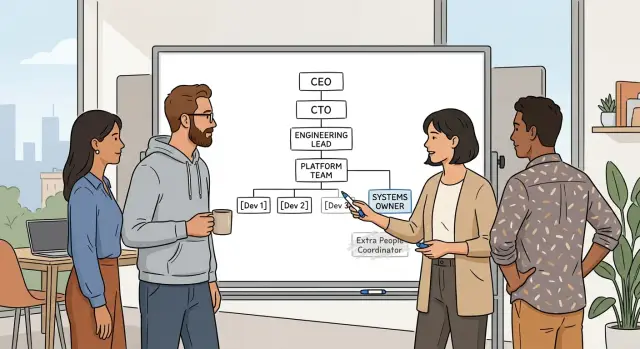
Table of Contents
Why work slips between people
Small teams rarely struggle because people do not care. Work slips because each person owns one slice of the effort, while nobody owns the whole system.
A backend developer fixes code. Someone on infrastructure adjusts the server. Support replies to the customer. A week later, the same bug is back. Everyone touched it. Nobody owned the full path from cause to customer impact.
This usually shows up around releases, incidents, and handoffs. Deploy rules live in chat threads, old comments, or in one person's head. A release fails, the team asks what the normal process is, and gets three different answers. That is not a process. It is shared memory, and shared memory breaks under pressure.
Managers help, but a people manager usually tracks progress, handles schedules, and keeps conversations moving. That still leaves a gap. If the same queue jams every Friday, or the same migration step fails every second release, better reporting will not fix it. The company gets cleaner updates, but the system stays fragile.
That is why bugs bounce between engineering, infrastructure, and support so often. Each group can explain one part of the problem. Nobody feels fully responsible for the full path. Support sees the pain. Infrastructure sees the alert. Engineering sees the code. The failure sits between those views.
When ownership is fuzzy, teams usually add meetings. A new sync appears for releases. Another one covers incidents. Another one handles customer escalations. The calendar fills up because meetings are trying to patch a missing owner. They almost never solve the missing owner.
A technical owner for systems closes that gap. This person owns how shared systems behave across team lines: release rules, failure patterns, runbooks, access rules, and the follow-up work that stops repeat issues. That usually helps more than adding another coordinator, because the problem is not a lack of updates. The problem is weak system ownership.
What this role owns
A technical owner for systems owns the parts of the company that everyone depends on and nobody fully protects. In most small software companies, that means production, the path from code to release, and the cleanup after something breaks.
When an outage happens, this person does not just join the call. They make sure the team records what failed, fixes the cause, and changes the process so the same problem does not return next week. They do not have to do every task themselves. They own the result.
They also set and maintain the shared operating rules. Logs need a clear format. Alerts need thresholds that catch real trouble instead of waking people up for noise. Access rules need to be simple enough for people to act fast and strict enough to keep risky systems under control.
Ownership here means decision rights, not total workload. The role does not mean one person deploys every service or reviews every pull request. It means one person keeps the system consistent, settles disagreements, and closes gaps between product code, infrastructure, support, and operations.
Some parts of the stack need a named owner because delay is expensive. If changes to the database schema, billing flow, authentication, CI pipeline, or production secrets can hurt customers fast, the team should know who approves them and what checks happen first. Small teams often skip this and call it flexibility. Most of the time, it is just unclear responsibility.
A short priority list keeps the role practical. In many teams, the first jobs are simple:
- make releases easy to roll back
- cut alert noise so real issues stand out
- limit production access and review it often
- give every incident one owner and one follow-up action
- fix the slowest or riskiest part of delivery first
That focus matters because small teams cannot improve everything at once. Without clear priorities, engineers pick whatever annoys them most that day. With a real owner, the team spends time on the few system problems that keep causing stress, delays, or customer pain.
When the role works, people stop arguing about who should handle operations debt. Deployments feel calmer. Incidents end faster. The team starts trusting the system instead of tiptoeing around it.
When you need this before another manager
A small team usually does not break because nobody tracks people. It breaks because nobody owns the hard technical calls that cut across code, data, infrastructure, and incidents. When that gap grows, another coordinator adds meetings, not speed.
You can see it in the waiting. Engineers finish their part, then sit for a day or two because nobody will decide where a service should run, how an API should change, or whether a risky fix is safe to ship. The backlog looks full, but the real blocker is delayed technical decisions.
The same patterns show up again and again. Outages bounce between frontend, backend, and infrastructure because each group can explain its piece, but nobody owns the whole path. One senior engineer gets pulled into every fire, review, migration, and "quick question." Coordinators spend half the week collecting technical answers from three people and sending them back out. Small changes turn into long message threads because nobody has the authority to say, "We're doing it this way."
When that happens, the org chart is already giving you the answer. You do not need another layer for 1:1s, standups, and status updates. You need someone who owns shared technical systems, makes cross-system decisions, and stays on point when production gets messy.
The clearest test is simple: ask who owns reliability for one customer flow from request to database to deploy. If the answer is a list of names, or a long pause, the role is missing.
This is often one of the first things a fractional CTO notices in a small team. Once one person gets clear authority over system decisions, teams stop waiting so much, incident calls get shorter, and senior engineers spend less time acting like human routers.
If two or three of these signs feel familiar, test the role before hiring another manager. Give one trusted engineer a clear system scope for 30 days and measure one thing: how much waiting disappears.
What the role is not
Small teams often create this role for the wrong reason. They feel pain, add a new title, and hope the mess goes away. It usually does not.
A technical owner for systems does not replace a team lead or a product owner. Team leads still coach people, help with delivery, and handle day-to-day team issues. Product owners still decide what the team should build and why. The systems owner answers a different set of questions: how the system fits together, what can change safely, where the risks sit, and who decides when tradeoffs appear.
It also cannot be a title with no power behind it. If someone owns a system, they need a small but clear set of rights. They should be able to stop risky shortcuts, approve structural changes, and push cleanup when the team keeps stacking quick fixes.
If they have the title but still need three other people to bless every decision, the role is empty. Small companies do this all the time. They name someone as the owner, then leave the real authority scattered across founders, senior engineers, and whoever happens to be online. That gives one person extra responsibility without control, which is a fast way to burn them out.
The role is also not an excuse to dump every hard problem onto one engineer. Good ownership narrows decisions. It does not turn one person into the permanent fixer for every fire.
How to add the role without making a bigger mess
Add this role around the work that keeps getting stuck, not around status or titles. Start with the systems that create the most waiting time. Releases, test environments, database changes, support handoffs, and production alerts are common trouble spots.
Look back at the last month. If the same systems caused delays more than once, assign an owner there first. Keep the first version narrow. One person can own a small set of messy systems far better than a big, vague area.
The rollout can stay simple. First, write down the three to five systems that caused the most delay, using real examples. A release that slipped because nobody owned the deploy pipeline is better than a generic note about "coordination issues." Then pick one owner for that set. Choose the person who understands how the system behaves under pressure, even if they are not the most senior person on the team.
After that, put the decision rights in writing. State what they can change on their own, what still needs approval, and who they must inform after a change. Run a short weekly review for risks, incidents, and broken handoffs. Twenty minutes is usually enough if people bring facts instead of opinions. After 30 to 60 days, check the scope again. If it is too wide, split it. If it is too narrow, add one more system.
The written decision rights matter more than the title. Many teams say someone "owns" a system, but that person still needs several approvals to fix a deploy rule or change an alert threshold. That is not ownership. It is extra responsibility with no control.
A simple rule helps: if a person carries the pager, answers for outages, or gets pulled into every messy handoff, that person needs clear authority. Otherwise the team keeps waiting for side approvals, and the same problems return next week.
If you use outside Fractional CTO support, ask for a quick review of the role before you announce it. A second pair of eyes can spot weak boundaries fast. One page with systems, decisions, and review rules is usually enough to make the change stick.
A simple example from a 12-person team
Picture a 12-person software company with five engineers, a designer, a tester, a project manager, a founder, and a few people across sales and support.
On paper, the team looks organized. In practice, deploys break twice a month. One service uses the wrong environment variable. A migration runs in the wrong order. An alert fires, but nobody notices until a customer writes in.
The project manager tries the usual fix. They add another standup, ask for more status updates, and spend more time chasing owners. Work still moves, but the same problems keep coming back. The issue is not people coordination. The gap is inside the system.
No one owns the release checklist. No one checks whether CI rules still match how the team works. Monitoring has holes. Access rules drift. Small changes pile up until one bad deploy turns into half a day of cleanup.
Instead of hiring another coordinator, the team gives one engineer a clear systems scope. That person does not become the boss of the engineers. They keep writing code, but they also own a short list of duties that used to belong to everyone and therefore to no one.
They tighten the deploy process, clean up CI steps, remove old scripts, set one release rule for database changes, and make sure alerts reach the right person. They also close small gaps early, before those gaps turn into repeat incidents.
After a month or two, the change shows up in numbers. Deploy incidents drop. The team no longer loses two evenings a month to avoidable release problems. Standups get shorter because fewer tasks need rescue work. Engineers stop guessing who should fix tooling issues.
That is why many small software companies need clearer system ownership before they need another layer of meetings.
Mistakes teams keep making
When delivery starts to hurt, small companies often change the wrong box on the org chart. They add another coordinator whose job is chasing updates, moving tickets, and scheduling more meetings. That can make the team look more organized. It rarely fixes broken deploys, messy handoffs, or the same outage showing up again.
Another common mistake is splitting ownership across too many part-time volunteers. One engineer watches CI when they have time. Another checks production logs. A founder approves database changes. A senior developer jumps in during incidents. On paper, that looks flexible. In real life, nobody spends enough time fixing root causes because everyone already has a full-time job.
Some teams do create a systems owner, but only on paper. They hand out the title, keep the same sprint load, and give the person no real authority. That person cannot pause a risky release, cannot set standards, and cannot make teams clean up repeat failures. It burns people out fast.
Teams also use the wrong scorecard. They celebrate ticket output and closed tasks while repeat failures keep draining the same engineers. If deployments still need a hero late at night, or the same integration breaks every few weeks, high output does not mean much. Track repeat incidents, rollback frequency, handoff delays, and the hours people spend chasing problems they have already seen before.
For many small teams, the first smart org chart change is not another people manager. It is one person with clear system ownership, protected time, and enough authority to stop the same mess from returning.
Quick checks before you change the org chart
Before you add another person to coordinate people, look at how work moves through your shared systems. Teams often think they have a communication problem when they really have an ownership problem.
A calendar full of syncs can hide a simple gap: nobody owns the deploy pipeline, the backups, the auth flow, or the billing logic from end to end. Everyone touches the system, but nobody decides how it should be run, changed, or protected.
Use a short check before you change anything:
- Can one person name themselves as the owner of each shared system?
- When a change could break production, does everyone know who can approve it or stop it?
- Do you track repeat incidents by cause, not just by date?
- Would another coordinator remove the root cause, or just organize the response?
Patterns matter more than one bad week. A single messy release is normal. The warning sign is repetition: the same service breaks, the same risky change slips through, and the same handoff fails between product, engineering, and operations.
That is where this role earns its place. It does not replace team leads or founders. It gives shared systems standards, decision rights, and follow-through.
If your answers are vague, do not redraw the org chart yet. First write down the systems you depend on, assign one owner to each, and see where the gaps collect. If most of those gaps land in shared infrastructure or release decisions, you probably need stronger system ownership before you need another layer of people management.
What to do next
Do not redraw the whole org chart at once. Pick one system area that already causes repeat confusion, maybe deployments, billing, customer data, or internal tools. Small teams usually improve faster with one clean test than with a company-wide shuffle.
Then write the role down in plain language: the system this person owns, the decisions they can make on their own, the changes they must review with others, and the results they are responsible for this month.
Keep the scope narrow. "Owns platform reliability for the API and deploy process" is clear. "Owns engineering quality" is vague, and vague roles create the same old mess with a new title.
Pick someone who already sees how the system works across code, support, and operations. Do not choose the busiest person, the loudest person, or the most senior person by default. The right owner stays calm under pressure and can make tradeoffs when two teams want different things.
Tell the team what changes on day one. They should know who makes the call when priorities clash, who keeps the runbook current, and who follows an issue until it is actually closed. That is when the role proves useful: fewer dropped tasks, less waiting, and fewer meetings that only exist because nobody owns the problem.
Review the change after one month. Ask simple questions. Did handoffs get shorter? Did incidents close faster? Did fewer decisions bounce between people? If the answer is mixed, tighten the scope before you add another role.
If you want an outside view, Oleg Sotnikov at oleg.is works with startups and small teams on system ownership, architecture, and Fractional CTO support. A short review is often enough to show whether you need clearer technical ownership, better boundaries, or no new manager at all.
Frequently Asked Questions
What does a technical owner for systems actually do?
They own the shared technical systems that cut across team lines. That usually means releases, production, alerts, access rules, runbooks, and the follow-up work after an incident.
They do not need to do every task themselves. They make decisions, close gaps, and make sure the same problem does not keep coming back.
When should a small company add this role?
Add this role when work keeps waiting on cross-system decisions. If deploys fail in the same way, incidents bounce between teams, or one senior engineer gets dragged into every fire, you have an ownership gap.
Another coordinator often adds updates and meetings. A systems owner removes waiting by making the call and fixing the weak part of the process.
How is this different from a team lead or project manager?
A team lead focuses on people, delivery, and day-to-day team support. A project manager tracks work, dates, and communication.
The systems owner answers a different set of questions. They decide how shared systems should work, what changes look safe, and who owns the fix when something breaks across code, data, and infrastructure.
What should this person own first?
Start with the systems that cause repeat delays or customer pain. In most small teams, that means the deploy pipeline, production alerts, database changes, access to production, and support handoffs.
Keep the first scope small. One messy area with clear ownership works better than a big title with fuzzy boundaries.
Does the owner have to do all the ops work?
No. They own the result, not every ticket.
The team still writes code, changes infrastructure, and handles support. The owner keeps the system consistent, settles tradeoffs, and makes sure someone fixes the root cause instead of leaving a temporary patch in place.
How much authority should this role have?
Give them enough authority to stop risky shortcuts and approve changes inside their scope. If they carry the pager or answer for outages, they should not wait for three side approvals to fix alert rules or pause a bad release.
Write those decision rights down. If the team gives them responsibility without control, the role will fail fast.
Who should take this role on a small team?
Pick someone who understands how the system behaves under pressure. Look for calm judgment, clear tradeoffs, and the habit of following issues all the way through.
Do not default to the busiest or most senior person. The right owner sees across code, infrastructure, support, and release work.
How can we test this role without changing the whole org chart?
Run it as a 30-day test. Choose one shared system area, name one owner, and write down what they can decide on their own.
Tell the team what changes on day one. Then watch how much waiting disappears around releases, incidents, and handoffs before you make a bigger org change.
What should we measure after the first month?
Watch for fewer repeat incidents, fewer rollback problems, and shorter handoffs between teams. You should also see less waiting for technical decisions and less rescue work after releases.
If the numbers stay flat, tighten the scope. Many teams start too wide and bury the owner under too many unrelated problems.
Can a fractional CTO help us set this up?
Yes. A fractional CTO can review your shared systems, spot weak ownership lines, and help you define a narrow scope with real decision rights.
That outside view often saves time because someone with fresh eyes can see where your team waits, where authority leaks away, and whether you need a systems owner at all.


