Startup technical workshops that drive follow-through
Startup technical workshops help founders leave with decisions, owners, and next steps. Compare live teardown, office hours, and working sessions.
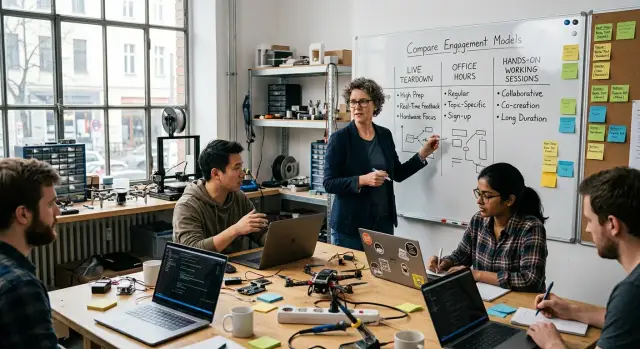
Table of Contents
Why panel talks often stall
Panel talks sound useful because they put several smart people in one room. The problem is the format. When four speakers try to cover product, hiring, architecture, fundraising, and AI in 40 minutes, each topic gets a few shallow minutes and then the clock wins.
That spread of attention feels efficient, but it rarely helps a founder make the next hard call. One speaker says to ship faster. Another says to stop and clean up the stack. A third says to hire before building more. All of them might be right for some company, but nobody has to choose what fits yours.
Panels also reward opinions more than decisions. Speakers share stories, compare tools, and pull lessons from companies with different teams, budgets, and deadlines. The audience leaves with a pile of ideas, but no owner, no due date, and no first task for Monday morning.
The social effect makes this worse. A good panel has energy. People nod, laugh, and write down quotes. The room feels smart, and that feeling can trick a team into thinking progress happened. It didn't. The backlog is still there. The blocker still exists. The hard tradeoff is still unresolved.
A founder might walk out with notes like "switch to microservices," "cut cloud spend," "improve testing," or "try a new AI tool." That's a lot to hear in one sitting. It's not a plan. If nobody decides who will review the cloud bill by Friday or who will inspect the release process next week, the work stays where it was.
That is why technical workshops usually work better when the goal is follow-through. They narrow the problem, keep the group on one decision, and turn talk into assigned work. Panels still have a place in broad learning or community events. They just tend to stop right before the useful part, when someone commits to action.
Live teardown gives fast, shared context
One of the fastest ways to make a workshop useful is to put a real product, stack, or workflow on the screen. A live teardown cuts through guesswork because everyone sees the same thing at the same time. That shared view matters more than polished opinions.
Slides hide too much. It's better to show the current state: the product as users see it, the release flow, the backlog, the repo, the logs, or the handoff between sales and engineering. If checkout fails, open checkout. If releases take four days, show the actual path from commit to production.
A good teardown doesn't inspect everything. It stops at the first few blockers that hurt users or slow delivery in obvious ways. Once the group finds the places where work piles up, bugs repeat, or releases stall, it should stay there until the cause is clear.
A simple pattern works well. Start with one real flow the team uses every week and ask someone to walk through it exactly as they do it today. Pause at any point where friction costs time, money, or trust. Then write down only the fixes the team can test soon.
That last step is where many sessions fail. A teardown should end with a short list, not a giant roadmap. Three or four fixes are enough if the team can start them this week.
For example, a startup might review its release process and discover that every deploy waits for one senior engineer, test data is inconsistent, and nobody checks errors after launch. Those aren't abstract problems. The team can assign owners, add a basic post-release check, clean up the test data, and remove one approval step before Friday.
This format works because it gives people a shared picture of reality. Once everyone sees the same bottleneck, the next action usually becomes obvious.
Office hours fit narrow questions
Office hours are the most focused option. They work best when a team doesn't need a full group session. It needs a clear answer to one stuck point.
That point should be small enough to name in one sentence. A team might ask, "Should we split the monolith now?" or "Do we buy an auth tool or build a basic version ourselves?" One decision, one blocker, or one tradeoff is usually enough for a single slot.
This format breaks down when people bring a pile of half-related topics. The discussion gets fuzzy fast. If the problem requires people to sketch flows, review code together, or sort out several moving parts, office hours are too small for the job.
Keep each slot short. Fifteen to twenty minutes is often enough. A tight limit forces people to prepare, state the real problem, and stop talking in circles.
A simple structure helps: 2 minutes for context, 10 minutes to test options, 3 minutes to choose the next step, and 2 minutes to write it down.
That final step is easy to skip, and that's a mistake. Before the next team joins, capture the answer in plain words. Note what the team decided, why it chose that path, who owns the next action, and when it will check the result.
This is where an experienced Fractional CTO can help. A founder may arrive with a narrow but expensive question, such as whether to hire another engineer now or first fix a slow release process. In a short office-hours slot, a good advisor can cut through the noise and point to the next move.
Choose office hours when teams need direction, not group work. They fit moments when a startup is close to moving but keeps getting stuck on one technical choice.
Working sessions move the work forward
Use a working session when talk is no longer the problem. The problem is that nobody has made the next decision, written the next task, or agreed on who owns it. Unlike panel talks, working sessions should end with something concrete.
The room matters. Put in the people who can answer questions and make tradeoffs live: the founder, the engineer who knows the system, the product owner, and anyone who will do the follow-up work. If the people with real context are missing, the session turns into guesswork.
Pick one output before the meeting starts. One is enough. It might be a short plan for the next 2 to 4 weeks, a backlog with clear priorities, or a decision note that settles an open issue. Trying to get all three usually wastes time.
This format works because people stop speaking in general terms. They look at the same board, doc, architecture sketch, or error list and make choices in real time. When someone says, "we should fix this soon," push for a real call: who fixes it, by when, and what gets dropped to make room.
A small example makes the difference clear. A startup has slow onboarding, rising support tickets, and no agreement on whether the issue is product flow or backend latency. A working session can map the user path, check the logs, and finish with a ranked backlog. One engineer takes the signup bottleneck. The product lead rewrites two screens. The founder approves the scope tradeoff. That's actual movement.
An outside technical lead can help here too. Someone like a Fractional CTO can keep the group from drifting, challenge soft assumptions, and turn a vague complaint into a plan the team can execute next week.
If your team already knows the problem and needs action, skip the stage talk. Get the owners in one room and leave with names, dates, and a document people will actually use.
How to choose the right format
A good format solves one bottleneck. If the team leaves with more opinions but no next step, the format was wrong from the start.
Pick the problem before you pick the speaker, the time slot, or the room. A live teardown works when people need shared context fast. Office hours fit small, narrow questions. Working sessions make sense when the team already understands the problem and needs focused time to move it.
The number of decision-makers matters more than many teams expect. If one founder or tech lead can decide alone, office hours are often enough. If product, engineering, and operations all need to agree, a live teardown gives everyone the same picture. If the decision is already made and execution is stuck, a working session is usually the better use of 90 minutes.
It also helps to ask a blunt question: does this team need advice, or does it need working time? Advice helps when people are unsure what to do. Working time is better when they already know the next move but keep delaying it because nobody sits down and does it.
Set one concrete output before you book anything. Keep it plain and measurable, such as the top three technical risks, a decision on the next architecture step, a rollout plan for one feature, or a cleaned-up backlog for the next sprint.
Then match the format to that output. Don't shape the session around whoever is available to talk. A smart guest can still waste the hour if the room needs a decision or a working draft instead of commentary.
This is where many workshops go off track. Teams book a panel because it's easy to organize, then hope useful action appears later. It rarely does. If you want follow-through, choose the format that produces the artifact you need by the end of the session.
A simple startup example
A seed SaaS team is six weeks away from launch. The product is close, but every release slips by two or three days. Sales calls are booked, the roadmap is tight, and the team starts to worry that launch week will turn into a cleanup sprint.
They begin with a panel talk. The advice sounds good: keep pull requests smaller, test earlier, and tighten handoffs between engineering and QA. Everyone agrees with the points, but the meeting ends the way many panels do. The team has ideas, not decisions. No one owns the next move.
A live teardown changes that. The team picks one delayed release and walks through what happened, step by step, from the last code change to production. In less than an hour, two gaps become obvious.
First, engineers ask for code review too late, so reviews stack up near the end of the day. Second, QA sees features only after developers call them done, which leaves almost no time to catch edge cases before release.
The team then runs a short working session. Instead of talking about best practices in general, it changes the workflow for the next two sprints:
- Engineers must open pull requests by 2 p.m. if they want same-day review.
- QA adds test cases when the ticket starts, not at the end.
- The product lead checks release timing every Friday and flags anything that slips.
They also set dates. The new review rule starts tomorrow. The QA change starts with the next sprint. The team meets again in ten days to see whether the delay shrank.
That's the difference between a useful workshop and a forgettable talk. One gives broad tips. The other gives the team a short list, clear owners, and a date to check whether the fix worked.
Mistakes that kill follow-through
Most sessions fail for ordinary reasons, not because the format itself was wrong. Teams often leave the room feeling busy and smart, then do nothing on Monday.
One common mistake is letting speakers drift into trends, tools, or broad opinions when the team came in with a real problem. If the issue is slow releases, talk about the release process. Don't spend 20 minutes debating where AI might go next year.
The room can also get too crowded. A workshop with ten people and no clear decision-maker turns into commentary. A smaller group usually works better: the person who owns the problem, the person who can approve the fix, and one or two people who will do the work.
Scope kills momentum too. Teams sometimes try to cover product, infrastructure, hiring, and fundraising in one sitting. That sounds efficient, but it spreads attention so thin that no single decision gets enough depth. Pick one problem. If you still have energy left, schedule the next session.
Notes matter more than most teams think. If nobody writes down the final call, people remember different versions of the same conversation. Before the session ends, one person should capture three things: what the team decided, who owns the next step, and when they will report back.
The last part is where many sessions fall apart. Teams end with "we should do this" and no review date. That usually means the task sinks below daily work. Put the first review on the calendar before anyone leaves, even if it's only a 20-minute check-in next week.
A simple example: a startup asks a Fractional CTO to help fix outages and slow deploys. The meeting starts well, then drifts into hiring plans, pricing, and investor updates. Nobody assigns the deployment cleanup, and nobody checks progress. Two weeks later, the same outage happens again.
A tighter session looks less impressive, but it works. One problem, one owner, one written decision, one review date.
A quick checklist before the event
Most workshop problems start before anyone joins the call. If the team shows up with a fuzzy goal, no source material, and no time blocked after the meeting, the session turns into talk.
Start with one sentence that names the problem. Keep it tight and specific. "Trial users stop after the second setup step" is useful. "We want better product growth" is not.
Prep matters more than polish. A rough doc, a real dashboard, or a screen recording of the broken flow gives everyone the same starting point fast.
Before the session, do five things:
- Write the problem in one sentence that anyone on the team can repeat.
- Pick one person to take notes and record decisions, open questions, and next steps.
- Decide what the session should produce before it starts.
- Block follow-up time on the founders' calendar within the next seven days.
- Send real material in advance, such as docs, screenshots, logs, metrics, or a current workflow.
That named output matters more than people expect. "Discuss architecture" is too loose. "Leave with a draft migration plan," "rank the top five issues," or "agree on the next experiment" gives the room something concrete to finish.
The note owner shouldn't have to guess what matters after the event. Ask them to capture three things as they happen: what the team decided, who owns each action, and when the team will review progress.
Founders should protect time after the session while the details are still fresh. Even 45 minutes two or three days later is enough to turn notes into tickets, emails, or a decision memo. If that slot never gets booked, good ideas usually sit in a document until they go stale.
Real inputs beat polished slides almost every time. If the topic is onboarding, share the current funnel and the drop-off point. If the topic is infrastructure cost, share last month's spend, the service list, and one or two pain points. People make better decisions when they can see the actual work.
What to do after the workshop
A good session can still fade out by the next morning. The fix is simple: turn the notes into a short action list the same day, while everyone still remembers what mattered and why.
Keep that list tight. If you leave with 14 ideas, nobody knows where to start. Three to five tasks is usually enough for the first pass.
Write each task as a clear next step, not a vague goal. Pick one owner for each task. Set a review date before people leave. Cut anything that nobody can start this month.
That last point matters more than many teams admit. Early startups often keep weak ideas alive because they sounded smart in the room. If no one has time, budget, or access to begin now, move the idea to a parking lot and stop treating it like real work.
A simple review date keeps momentum alive. One startup might leave a live teardown with four actions: fix slow onboarding, remove one manual support step, add basic error tracking, and test a smaller pricing page change. If each item has an owner and a date on the calendar for next Tuesday, the workshop turns into progress. If the team says, "we should get to this soon," it usually dies there.
This is where these sessions either pay off or become another nice conversation. Follow-through depends less on the event itself and more on the quality of the next seven days.
A short written recap helps. Keep it to one page: what you decided, what you dropped, who owns what, and when you will check results. Share it with everyone who will touch the work, not just the people who attended.
If a founder needs outside help turning a teardown or working session into a practical plan, Oleg Sotnikov at oleg.is does that kind of Fractional CTO and startup advisory work. It fits teams that need a clear technical path and concrete next steps, not another broad discussion.
Frequently Asked Questions
Why don’t panel talks lead to action?
Panels spread attention across too many topics. You hear smart opinions, but nobody has to choose what fits your team, assign the work, or set a date to check results. If you need movement, use a format that ends with owners and next steps.
When should we run a live teardown?
Use a live teardown when the team argues from different assumptions or lacks a shared view of the problem. Put the real product, workflow, repo, logs, or release path on screen so everyone looks at the same bottleneck and can decide what to fix first.
What should we show in a live teardown?
Show one real flow the team uses every week and walk through it exactly as it works today. Skip polished slides and open the actual checkout, backlog, deploy path, support handoff, or error log. That makes the first obvious blocker easy to spot.
How long should office hours be?
Keep office hours tight. Fifteen to twenty minutes usually works if the team brings one narrow question, shares a little context, and leaves with one decision plus one next step. If the issue needs deep review across several moving parts, book a longer working session instead.
When is a working session better than office hours or a panel?
Choose a working session when the team already knows the problem and needs to make choices in real time. This format works well when you want a ranked backlog, a short plan for the next few weeks, or a written decision that settles an open issue.
Who should be in the room for a technical workshop?
Invite the people who know the system, can approve tradeoffs, and will do the follow-up work. In most cases that means the founder, the engineer with real context, the product owner, and anyone who owns the next task. If the decision-maker stays out, the room drifts into guesses.
How do we pick the right format?
Start with the bottleneck, not the speaker. Pick a live teardown if you need shared context fast, office hours if one person can answer one narrow question, and a working session if execution keeps stalling. Set the output first, such as a migration decision or a cleaned-up backlog, then match the format to that output.
What should we prepare before the workshop?
Write the problem in one clear sentence and gather real material before the session. Bring the current workflow, screenshots, logs, metrics, or a rough doc so people can work from reality instead of memory. Also name one person to capture decisions, owners, and review dates while the session runs.
What usually kills follow-through after the session?
Most teams lose momentum because they leave with too many ideas and no short action list. Turn the notes into three to five tasks the same day, assign one owner to each task, and put the first review on the calendar within a week. If nobody can start an idea soon, park it and move on.
Can a Fractional CTO help us run these sessions better?
Yes, if your team needs a clear technical call and not another broad discussion. A good Fractional CTO can spot the real blocker, keep the room focused, and turn a vague complaint into a practical plan with owners and dates. That helps most when slow releases, outages, stack choices, or process problems keep coming back.


