Startup org chart for teams under 20: two clear models
Compare two startup org chart patterns for teams under 20, see where decisions stall, and pick a structure that fits your founders, leads, and workload.
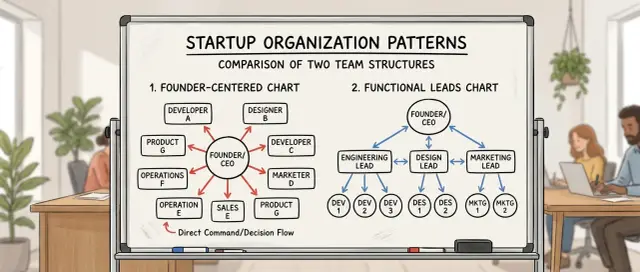
Table of Contents
Why decisions slow down in small teams
A team of 8 or 12 people should move quickly. Often it doesn't. The usual reason is simple: too many decisions still land on one founder.
When one person approves product changes, pricing calls, hiring, vendor choices, and technical tradeoffs, work backs up fast. People wait for a Slack reply, a quick call, or a five minute review that never stays five minutes. One blocked decision can stall design, code, customer support, and sales on the same day.
Teams usually make this worse by trying to work around the bottleneck. A designer asks the founder, an engineer asks the product lead, and sales asks whoever spoke last in a meeting. Each person gets a slightly different answer. Nobody is being careless. The structure is vague, so people keep checking until they hear something they can act on.
Urgent work adds another layer of chaos. A customer issue, a demo request, or a bug in production jumps to the front of the line. Planned work slips, then the team replans, then slips again. After a few weeks, people stop trusting the roadmap because they expect it to change by Friday.
This churn hits small teams harder because the same people carry several jobs at once. An engineer may also handle infrastructure. A founder may also run product. A marketer may also support sales. When reporting lines are fuzzy, every decision pulls two or three people into the room when one should be enough.
A clear org chart does not add bureaucracy. It removes repeat approvals. People know who decides, who gives input, and who only needs an update. That saves time and cuts the mental drag of asking the same question twice.
Pattern 1: the founder centered chart
In a founder centered chart, founders keep the biggest calls close. They decide product direction, weigh technical tradeoffs, and stay involved in hiring. Most people report to one founder, or to a founder pair, even if a senior engineer or designer helps with daily work.
A common setup is simple: engineering, product, and design report to the technical founder or CEO, while sales, marketing, and customer work report to the commercial founder. Founders also make the final call on new hires.
This model fits an early company that still changes every week. One customer call can change the roadmap. One failed release can force a rewrite. In that stage, direct founder control is often faster than adding managers and approval steps.
The reason it works is context. Founders usually know the product story better than anyone else. They know why the company started, which customer pain matters most, what the team promised investors, and which corners they can cut for now. That shared context helps them make fast calls without long meetings.
A seven person startup can work well this way. The founder talks to users in the morning, tells the engineer which feature to drop after lunch, and interviews a candidate before the day ends. Nothing sits in a queue. Nobody wonders who owns the final decision.
This structure can also reduce mixed signals early on. If one person makes the product call and the hiring call, the team gets a more consistent direction. That matters when the company is still learning what it is building and who it is building for.
It is not elegant on paper, and that's fine. For a small team still searching for fit, speed matters more than neat reporting lines. When founders stay close to the work, they can keep decisions moving while the product is still taking shape.
Where the founder centered chart breaks
A founder centered setup works when the team is tiny and the product still changes every week. It usually starts to strain once a founder has eight or more direct reports. At that point, every question lands in one inbox, one chat thread, or one meeting.
The cost is not just the founder's time. The whole team starts waiting. Engineers pause on scope, tool choices, architecture tradeoffs, or release timing because they need a final call from the same person who also approves hiring plans, talks to customers, and updates investors.
That delay gets worse when the founder's calendar shifts away from delivery. A sales call runs long. Fundraising takes over two weeks. Several hiring loops need attention. None of that is wrong, but product decisions still pile up. A senior engineer can know the best next step and still wait two days for approval.
You can usually spot the break before the chart changes on paper. Meetings multiply because people need the founder in the room. Small product calls turn into bottlenecks. Work moves in bursts instead of a steady flow. Strong hires ask for permission too often.
The most expensive part is what happens to early senior hires. People who joined to own an area start feeling like messengers. They gather context, make a recommendation, then wait for the founder to decide anyway. Good people don't stay energized in that setup for long.
This is where strong early hires get stuck. The head of engineering cannot fully own technical calls. The product person cannot trade scope against speed. The operations lead cannot fix process problems without checking upward first.
A founder can stay close to the product without holding every decision. If every issue, large or small, still routes through one person, the model has outlived the stage it was built for.
Pattern 2: the functional leads chart
Once a team has enough repeat work every week, one person cannot keep all decisions in their head. That is when a structure with clear functional leads starts to pay off.
One person owns engineering, one owns product, and one owns sales or operations. Founders still set direction, choose the larger bets, and decide how fast the company should grow. They stop approving every small call.
That shift matters more than the boxes on the chart. If the engineering lead still needs founder approval for every bug fix, release choice, or tool change, the team will keep waiting. The same goes for product and sales. Titles do not help if real authority stays stuck at the top.
Each lead should handle daily work inside their area. Engineering decides how work gets built and when old systems need cleanup. Product decides what moves first and what can wait. Sales or operations handles customer requests, delivery pressure, and internal process without pulling founders into every detail.
Founders usually keep a short list of decisions: company goals for the quarter, budget and hiring limits, major product bets, and choosing or replacing leads. Everything else should move inside the functions.
If a customer asks for a custom feature, sales can check whether the request is real, product can judge fit, and engineering can estimate the work in the same week. Nobody needs to wait two days for a founder to answer a routine question.
This model fits teams that plan weekly and do enough repeat work to spot patterns. It works well when the company has regular sales calls, a predictable product cycle, and a steady flow of engineering tasks. It can also fit a team that brings in outside leadership for one gap, such as a Fractional CTO taking engineering ownership until the team is ready for a full time lead.
The trade is simple. Founders give up some control, and the team gains speed.
Where the functional leads chart breaks
A chart with functional leads can look clean on paper. Trouble starts when the team is still too small to keep each lead busy with real management work every week.
If one lead manages only two people, that role can add a layer without removing much confusion. Questions travel up to the lead, then back to the founder, then down again. A team of 12 can end up acting like a team of 50, with slower decisions and more waiting.
This also breaks when founders and leads pull in different directions. The founder wants to ship a rough feature in five days because a customer is waiting. The engineering lead wants to rebuild part of the system first. The marketing lead wants a cleaner launch plan. None of those goals are silly on their own, but a small team rarely has enough slack to chase all of them at once.
Functional charts can also split the customer problem into neat internal boxes. Sales cares about closing. Product cares about scope. Engineering cares about quality and speed. Support cares about tickets. The customer sees one product, not four functions. When each lead protects their own area, the team can miss the actual problem: signup is confusing, setup takes too long, or one bug keeps blocking renewals.
One weak lead can hurt more than founders expect. In a founder led setup, a weak manager often affects a few decisions. In a functional setup, that person can slow an entire function. An unclear engineering lead creates rework for every developer. A shaky product lead fills the roadmap with half formed work. The founder then spends even more time fixing decisions than before.
The failure pattern is usually obvious. Leads ask for alignment meetings before simple calls. Team members stop talking across functions directly. The founder steps in to settle small disputes every day. Problems sit between teams because no one owns the full outcome.
Some teams avoid this by delaying full lead roles until the workload is real. Others use a part time leader for one function while the rest of the team stays flatter. That often works better than hiring titles before the company has enough scale for them.
How to choose between the two
Choose the chart by looking at decisions, not titles. A team under 20 does not need a perfect structure. It needs a structure that lets people get a clear yes or no without waiting two days for the right meeting.
Start with one plain exercise. Write down the decisions your team makes in a normal week. Keep it concrete: product scope changes, production fixes, customer promises, hiring, vendor spend, and release timing. If a decision shows up often and people still ask, "Who approves this?", the chart is already telling you something.
Then mark one person who gives the final answer for each decision. One person, not a group. Teams slow down when three people all think they have veto power. If the founder makes most final calls and the team still moves fast, the founder centered chart may still fit. If decisions already happen inside product, engineering, sales, or operations, a functional leads chart is usually a better match.
Count direct reports next. This part is less glamorous, but it catches many problems early. When one founder has eight or nine people coming to them for approval, planning, and feedback, work starts to pile up in that one inbox. A lead with too many direct reports hits the same wall.
A simple check helps. List the weekly decisions that need a final call. Put one owner next to each decision. Count how many people report to each founder or lead. Then look for the spots where work waits on one person. Pick the structure that removes those waits without adding extra layers.
Try not to solve delay by adding managers too soon. Small teams often get more speed from clearer ownership than from a bigger chart. If two leads can make daily calls without pulling in the founder, that is usually better than adding another approval step.
After you choose, test the setup for four to six weeks. Watch for repeated stalls, missed handoffs, and decisions that bounce between people. If the same bottleneck shows up every week, change the chart again. A good org chart is not the one that looks neat on paper. It is the one that keeps decisions moving on an ordinary Tuesday.
A simple example with 12 people
Picture a 12 person startup with two founders, six engineers, one designer, one product manager, one marketer, and one customer success hire. The people stay the same in both versions. What changes is who can say yes, who can make small calls alone, and who becomes a bottleneck.
Founder centered model
In the first model, the CTO founder handles most product and tech calls. Engineers go to that founder for tradeoffs, architecture choices, and release timing. The designer and product manager also pull that founder into daily decisions because design, scope, and engineering are tightly tied.
This can work early on. The CTO founder knows the product best, so the team gets fast answers when the work is simple and the release schedule is light.
A busy release month exposes the weak spot. Customer success brings in three urgent issues from users. The marketer needs a firm launch date for a campaign. Two engineers need a call on a risky backend change. The designer wants a decision on a last minute onboarding fix.
Now one person holds too many threads. The founder answers some questions fast, delays others, and changes priorities midweek because new information keeps landing on the same desk. People do not stop working, but they start waiting in small, expensive gaps.
Functional leads model
In the second model, an engineering lead handles daily engineering calls, and the product manager handles daily product calls. The CTO founder still owns bigger technical bets, hiring, and longer term direction, but no longer approves every small move.
During that same busy release month, customer success sends user issues to the product manager first. The product manager decides which problems must go into the release and which can wait a week. The engineering lead breaks work down, protects the release branch, and makes routine technical calls with the team.
The marketer gets dates from the product manager instead of chasing a founder. The designer works with the product manager on scope and with the engineering lead on feasibility. The CTO founder steps in only for the few calls that truly change the plan.
Same 12 people, different pace. In a founder led team, speed depends on one brain. In the second model, small decisions keep moving even when the month gets messy.
Mistakes that create avoidable delays
A simple org chart can still slow everything down. Trouble usually starts when nobody can tell who has the final say, who manages whom, or which decisions need approval.
One common mistake is giving two people equal say on the same call. It sounds fair, but it creates ties. Product wants one thing, engineering wants another, and both wait for the founder to break the deadlock. A small team can lose days this way, even when the issue itself is minor.
Another mistake is promoting the strongest builder into management too early. Great builders often move fast because they stay close to the work. Management is a different job. It needs hiring, feedback, planning, and saying no. If that person still carries critical delivery work, both jobs suffer. The team waits for answers, and the new manager gets stuck in meetings they never really wanted.
Frequent reporting changes create delay too. One week design reports to product. The next week design reports to the founder. Then engineering absorbs design for a sprint. People stop trusting the chart because they assume it will change again soon. That makes every decision heavier than it should be.
Hidden approval rules do quiet damage. If the team has to remember who said what in chat, or search old meeting notes to find approval, work slows down. People ask for permission twice. Some move ahead and get reversed later. Others wait because they do not want to step on toes.
A 12 person team feels this quickly. If one feature needs a founder, a product lead, and a tech lead to all say yes, the release date starts to depend on calendars instead of effort.
Most of these delays disappear when the team does three simple things: give one person final ownership for each type of decision, keep reporting lines stable long enough for people to trust them, and write approval rules in one visible place. Clear beats clever every time.
Quick checks for your current chart
An org chart can look fine on paper until a normal week puts pressure on it. You do not need a full reorg to spot trouble. A few simple checks usually tell you whether decisions have a clear home or keep drifting.
Ask five people who owns the roadmap, hiring, incident response, and pricing. If you get mixed answers, the structure is fuzzy where it matters.
Look at the founders' calendars. If they spend more than half the week clearing blockers, approving small calls, or settling team disputes, the team leans on them too much.
Count direct reports for each manager. If one person cannot meet everyone at least once a week, people start waiting too long for answers.
Watch one recurring decision, such as a customer discount or a release date. If it keeps bouncing between product, tech, and sales, the reporting lines are weak.
Small signs show up before big problems do. A developer asks product for a priority call, product sends them to the founder, and the founder asks sales for context. That loop can eat two days. Hiring often breaks the same way. One person thinks engineering owns the role, another thinks the founder does, and the opening sits untouched.
Incident response is another good test. During an outage, people should know who makes the call, who updates customers, and who decides whether to roll back. If the team debates ownership in the middle of the issue, the chart is already costing you time.
One more signal matters: how often the same topic comes back after it was supposedly decided. If pricing, scope, or ownership keeps reopening every week, the owner is not actually clear.
What to do next
Do not spend a month debating the perfect org chart. Pick one model and run it for one planning cycle. For most teams under 20, that means two weeks or one month. Long enough to feel the friction, short enough to change course without drama.
Write down who decides what in plain language. Skip job title theater. A note like "Maya decides backend architecture" or "Dan approves pricing changes" works better than a vague box on a chart. Share that note with the whole team, not just managers.
A short test plan is enough. Choose the chart you will use for the next cycle and set a review date. Name one owner for product calls, one for technical calls, and one for people calls if those are different people. Cut meetings that exist only because nobody knows who can decide. Keep the ones that clear blockers, settle tradeoffs, or coordinate work across functions.
Then watch where decisions still stall. If engineers keep waiting for founder approval, your team may need clearer technical ownership. If product and engineering keep reopening the same debate, the reporting lines may look neat on paper but fail in daily work.
A small example helps. If a 12 person team spends 30 minutes every day rehashing the same product engineering choice, that is roughly 10 hours a week gone across the group. One cleaner decision owner can give that time back quickly.
If the mess does not clear after one cycle, an outside operator can help. Oleg Sotnikov at oleg.is works with startups as a Fractional CTO and advisor, helping founders sort technical ownership, architecture decisions, and team structure without turning a small company problem into big company process. The right chart is the one your team can actually use on Monday morning.
Frequently Asked Questions
How can I tell if one founder is slowing the team down?
Watch your week. If engineers, product, or sales keep waiting for one founder to approve routine calls, you have a bottleneck. You will also see priorities change midweek because too many questions hit the same person.
When should we switch from a founder-led chart to functional leads?
Move when repeat work fills the week and people no longer need founder context for every call. If product, engineering, or sales can handle normal decisions on their own, give those areas clear owners.
How many direct reports are too many in a small startup?
Around eight direct reports, one person usually starts to struggle. The exact number is less important than the waiting time. If approvals pile up in one inbox, the structure no longer fits.
Can a 12-person startup still work with a founder-centered org chart?
Yes, if the product still changes fast and the team needs tight founder control. It stops working when the founder also handles hiring, customers, and investor work, because small decisions start to wait.
What decisions should founders keep for themselves?
Founders should keep company goals, budget limits, major hires, and larger product or technical bets. Daily scope calls, release choices, and routine tool decisions should sit with the team leads.
Do we need a full-time lead for every function?
No. Small teams often move faster with one or two real owners and a flatter setup everywhere else. Add a lead only when that area has enough weekly work to justify real ownership.
How do we stop product and engineering from bouncing decisions back and forth?
Give one person the final call for each type of decision. If product sets priority and engineering sets implementation, write that down so nobody reopens the same debate every day.
What should we document first to make decisions faster?
Start with plain ownership notes. Write lines like "Maya decides backend architecture" or "Dan approves pricing changes." Put them where the whole team can see them and use them in real work.
How long should we test a new org chart before changing it again?
Run it for one planning cycle, usually two to six weeks. That gives you enough time to spot repeated stalls without locking the team into a bad setup for months.
When does a Fractional CTO make sense for a team under 20?
Bring one in when technical ownership stays fuzzy, architecture debates keep reopening, or founders still approve routine engineering calls. A part-time CTO can set decision rules, steady delivery, and buy you time before you hire a full-time leader.


