Startup engineering maturity model for hiring plans
Use this startup engineering maturity model to rate release discipline, service ownership, and incident response, then set hiring plans that fit your team.
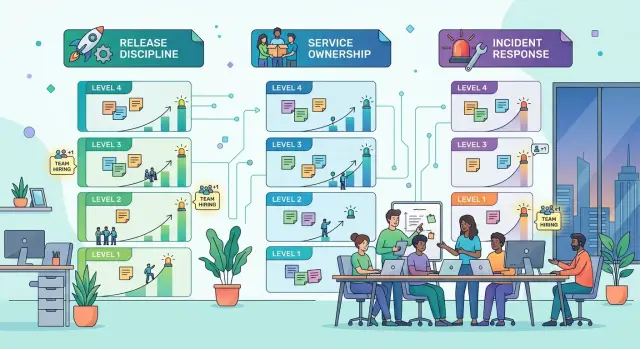
Table of Contents
Why hiring often misses the real problem
Many startup teams ask for more engineers before they fix the habits that slow them down every week. The request sounds reasonable. Work piles up, bugs linger, releases feel risky, and everyone feels stretched.
But headcount is often the most visible answer, not the right one. A team can add two people and still ship late if nobody knows who owns each service, how code reaches production, or who takes charge when something breaks.
Founders often have a blind spot here. They hear, "we need more developers," but they do not see every handoff, every rollback, or every confused message during an outage. So they approve hiring for pain they can see, while the real issue stays buried in daily work.
One bad incident makes this worse. A painful outage creates panic, and panic usually turns into a hiring request. If the outage happened because alerts were ignored, ownership was unclear, or nobody trusted the release process, another engineer will not fix much. The team will just spread the same mess across more people.
A simple score changes the conversation. Instead of arguing from stress or gut feeling, look at three signals: how predictable releases are, whether each service has a clear owner, and how the team reacts when production fails.
That is where an engineering maturity model helps. It separates a people gap from a process gap. Sometimes you do need another backend engineer. Sometimes you need a release checklist, one named owner per service, and a simple rule for who responds first during an incident.
This matters because hiring costs more than salary. New people need context, reviews, access, and management time. If the team already lacks release discipline, service ownership, and incident habits, every new hire lands in confusion.
A calm score gives you a better next step. You stop hiring to relieve stress and start hiring to fix the actual constraint.
Three areas to score
Most teams do not need a long audit. They need three scores they can agree on in one meeting, then repeat every quarter. Keep it small or nobody will use it twice.
The first area is release discipline. This is about how the team plans changes, ships them, and backs out when something goes wrong. Teams with decent release discipline ship smaller changes, know what is going out, and can roll back without panic. Teams with weak discipline batch too much work together, rely on memory, and turn every deploy into a tense event.
Next is service ownership. Every live system should have a clear owner, whether it is an API, a background worker, a billing integration, or the main database. The owner does not need to write every change. They need to know how the service works, approve risky updates, keep notes current, and answer for reliability. If nobody owns a system, bugs drift from person to person and hiring plans get fuzzy fast.
The third area is incident response. Look at three moments: when the team notices the problem, when someone takes charge, and what changes after the fix. Fast response does not mean constant heroics. It means alerts reach the right person, the team has a simple path to act, and they record one lesson that lowers the chance of the same issue next time.
A short scorecard usually works better than a detailed one. Ask plain questions:
- Did we ship small changes with a safe rollback path?
- Can we name one owner for every live service?
- When the last incident happened, how fast did we detect it, and what changed after?
If the team can answer without debate, the score is probably honest. If every answer starts with "it depends," the gaps are already visible. That makes later hiring decisions much easier.
What levels 1 to 4 look like
A team does not move up because it hires more people. It moves up when daily work stops depending on memory and heroics. Small teams can reach level 3. Large teams can still behave like level 1.
-
Level 1 teams work from memory. A release happens when one or two trusted people remember the steps, watch the logs, and fix whatever breaks. Service ownership is fuzzy, so people ask in chat who owns what or wait for the same senior engineer to reply. When an incident hits, the team reacts fast but not calmly. They patch the issue and move on.
-
Level 2 teams have a few shared routines. They might keep a release checklist, use a basic handoff, and write some runbooks. That helps, but one person still knows the odd details that keep production stable. Ownership starts to appear, yet the team still leans on individuals for hard calls. Incident response improves because people know the first few steps, though follow up fixes often stall.
-
Level 3 teams ship on a steady rhythm. Releases happen the same way each time, with clear checks and fewer surprises. Each service has an owner, and everyone knows who decides, who reviews, and who gets paged when something fails. Incidents still happen, but the team records them, fixes the cause, and updates the process so the same problem hurts less next time.
-
Level 4 teams look for patterns, not just fires. They review failed releases, noisy alerts, repeated support issues, and services that depend too much on one person. Then they change the system with better tests, clearer handoffs, and less hidden work. Chaos does not vanish, but repeat chaos becomes rare because the team keeps removing weak spots.
The jump from one level to the next is usually easy to spot. If your team cannot release without a certain person online, you are not at level 3. If the same outage comes back every month, you are not at level 4.
How to rate your team in one meeting
Use evidence, not memory. One meeting can give you a fair score if you bring the last 10 releases, the last 3 incidents, and a simple team map that shows who works on what. When people remember events differently, trust the tickets, deploy logs, and incident notes.
Start with the team map. Write down every service, background job, app, and internal tool. Then put one owner next to each. If two names sit next to the same service, keep talking until one person owns day to day care. Shared ownership often hides weak ownership.
Then walk through the last 10 releases in order. Mark where work stalled, who approved the release, and who stepped in when something broke. You are looking for release discipline, not speed. A team that ships slowly but the same way every time is in better shape than a team that ships fast only when one senior engineer is online.
Next, review the last 3 incidents. Write down who noticed the issue, who took charge, who fixed it, and how the handoff worked. This makes incident response visible very quickly. If alerts go to one person, fixes depend on one person, and updates come from one person, the score should stay low.
A simple way to keep the meeting honest:
- Give each area a score from 1 to 4.
- Attach one real example to every score.
- Lower the score if the example depends on one person saving the day.
- Lower the score if nobody can name an owner in under 10 seconds.
- Leave hiring ideas off the board until the scoring feels a little uncomfortable and true.
That last point matters. Teams often jump to roles too early: hire DevOps, hire QA, hire another senior backend engineer. Wait. If your score is based on vague impressions, the hiring plan will be vague too. Honest scoring usually points to a smaller fix first, like clearer ownership, a release checklist, or an incident lead rotation.
A simple example from a six person SaaS team
Picture a six person SaaS company with a product people like, steady trial signups, and a roadmap that keeps growing. On paper, the team looks ready to hire two more developers. In practice, the team is still fragile.
They ship only when both senior engineers stay online after release. Nobody trusts the process enough to push changes and walk away. If one senior engineer takes a day off, releases slow down or get postponed. That is not a headcount problem first. It is a release discipline problem.
Billing causes a different kind of drag. When a customer sees a wrong charge, the bug does not go to one clear owner. Product says engineering needs to fix it. Engineering says the issue started in pricing rules or plan setup. The ticket moves around for a day or two while support waits. Customers do not care which team touched it last. They just see a broken bill.
Incident response is even rougher. Alerts still go to the founder because nobody built an on call habit. When something breaks at 2 a.m., the founder wakes up, pings the team, and tries to guess who should respond. That might work at five customers. It gets expensive fast when the customer base grows.
The score is pretty clear:
- Release discipline is low to mid level. The team can ship, but only with manual supervision from senior people.
- Service ownership is low. Billing has no direct owner, so bugs bounce around.
- Incident response is low. The team reacts, but the founder is still the fallback system.
This changes the hiring plan. Adding more feature engineers now would probably add more code, more handoffs, and more after hours releases. The team needs one strong lead first. That person should set a release routine, assign billing to one owner, and create a basic on call rotation.
After that, new hires will land in a team that can absorb them. Before that, more hiring only hides the real problem for a few months.
How hiring changes at each level
A weak team does not need the same hire as a steady one. Miss that, and you can spend a large salary on a senior person who still cannot fix daily chaos.
At level 1, the team usually struggles with basic release discipline and messy incident response. A new manager will not solve that alone. You often need one or two hands on engineers who write code, ship small changes safely, set simple release rules, and document what to do when production breaks. A practical builder beats a strategic hire here.
At level 2, releases happen more regularly, but ownership still sits with a few people. This is where a team lead starts to make sense. The lead should spread service knowledge, push clearer handoffs, and stop the pattern where one engineer becomes the hero for every problem. If nobody shares context, the team stays fragile.
At level 3, the core engineering group usually works well enough that support roles start paying off. You may not need more product engineers first. You may need someone focused on testing, reliability, or developer workflow so the team ships faster with less rework. This is often where a good engineering manager or fractional CTO finds easy wins, because a small process change can save hours every week.
At level 4, hiring gets more boring in a good way. Hire against measured bottlenecks, not broad growth stories. If cycle time is fine but incidents still wake people up, hire for reliability. If engineers lose time in reviews and builds, hire for developer workflow. If quality drops under load, add test depth.
A simple rule helps:
- Level 1: hire builders who create basic habits.
- Level 2: hire a lead who spreads ownership.
- Level 3: hire support around team speed and quality.
- Level 4: hire for the narrow constraint you can measure.
That keeps the hiring plan tied to reality instead of hope.
Mistakes that distort the score
Teams usually rate themselves too high when they judge intention, titles, or confidence instead of daily behavior. This model only helps if it describes what the team actually does on an ordinary Tuesday.
Titles mislead first. Someone may carry a staff or lead title, but if releases still stall until a founder jumps in, the team has not reached the level that title suggests. Score the work, not the business card. Who approves releases, who fixes broken deployments, and who can ship without rescue matter more.
Shared responsibility creates the next problem. It sounds healthy, but it often hides a gap. If everyone owns a service, nobody makes the final call when latency climbs, costs spike, or a rollback starts. Real ownership means one person can say, "We will do this now," and the team accepts that decision.
Quiet weeks can fool people too. Some teams say their service is stable because they had no incidents last month. That means very little if nobody watches alerts, checks error rates, or reviews logs. Silence is not proof. Sometimes it only means the team did not see the problem.
Another common mistake is copying a big company chart too early. Startups add layers, split teams by specialty, and invent manager titles before the workload asks for it. Then handoffs grow, nobody feels close to production, and the score looks more mature on paper than it is in practice. A six person team rarely needs the same shape as a sixty person one.
The score also drifts upward when one loud manager dominates the meeting. Confidence is not evidence. The best way to stop that is to test every claim against recent examples:
- What happened in the last three releases?
- Who owned the last service issue from first alert to fix?
- Who decided the last rollback or hotfix?
- Which alerts does someone review every day?
If the room cannot answer those questions clearly, lower the score. That is not harsh. It is useful. An honest score leads to better hiring decisions because the team can hire for the gap it actually has instead of the story it likes to tell.
Quick check before you open new roles
This model only helps if it stops you from hiring on instinct. Before you write a job post, spend 10 minutes with your team and check whether the real gap is skill, ownership, or basic working habits.
If you cannot answer most of these questions quickly, a new hire will walk into confusion. That usually slows the team down for a month or two and leaves founders wondering why headcount went up but output did not.
Use this short check:
- Can the team point to one clear owner for each service or product area?
- Did the team ship more than once in the last month without panic, rollback drama, or after hours fixes?
- After the last incident, did someone write down what changed and what the team will do differently next time?
- Does every new engineer learn who can approve a release and who makes the final call when risk is unclear?
- Can the founders explain which scored gap the next hire will fix?
The last question is the one most teams miss. "We need a senior engineer" is not a reason. "We scored low on service ownership, so we need someone who can own billing and reduce founder dependence" is a reason. That kind of answer changes the role, the interview, and the first 90 days.
A six person SaaS team can often spot the problem fast. If nobody owns alerts, incidents bounce between people. If nobody knows who approves a release, small changes wait for the founder. If the team ships only when everyone is online, the issue is not hiring volume. It is weak release discipline.
This is also where an outside advisor or fractional CTO can be useful. A good one will not start by adding titles or writing a long org chart. They will ask simple questions, score the gaps honestly, and tie the next hire to one fix the team can feel within weeks.
Open new roles after that. Not before.
What to do next
Put the score on the calendar this week. Do it with the people who run the work every day: the engineering lead, the product lead, and whoever handles support or operations. The model only helps when the group compares real examples, not personal guesses.
If someone says release discipline is "good," ask what happened in the last three releases. Did the team use a checklist? Did anyone roll back? Did a release depend on one person staying online late? Use the same test for service ownership and incident response. Names, dates, and recent events cut through vague debate fast.
Then pick only three changes for the quarter:
- one release rule the team will follow every time
- one ownership gap that gets a clear owner
- one incident habit the team will practice after every issue
Keep the scope small. A team usually gets more from one clean release checklist than from a new hire dropped into a messy process. The same goes for ownership. If two services still belong to "whoever touched them last," fix that before you open a backend role.
Recheck the score before you write any new job post. This step saves money and prevents bad hiring logic. Many teams think they need more engineers when they really need cleaner handoffs, better on call behavior, or clearer service boundaries. If the score moves up after a few process fixes, the role you planned may change, shrink, or disappear.
An outside review can help if the team cannot agree on the score or keeps normalizing chaos. Oleg Sotnikov at oleg.is works with startups as a fractional CTO and can review release flow, ownership, and incident habits before you add headcount. That kind of check is useful when you want a plain answer about whether the problem is staffing, process, or both.
Do the meeting, choose the three fixes, and set a date to score again in 60 to 90 days. If the same pain shows up after that, your next hire will be easier to define and far more likely to help.
Frequently Asked Questions
How do I know if we need another engineer or better process?
Start with three scores: release discipline, service ownership, and incident response. If releases stall, owners stay unclear, or one person rescues every outage, fix that first. Hire when the score shows a real capacity gap after those basics improve.
What should we score first?
Score release discipline, service ownership, and incident response. Those three areas show whether your team ships in a repeatable way, knows who owns each system, and reacts without panic when production breaks.
What does low release discipline look like?
You will usually see manual steps, late-night deploys, and rollbacks that depend on one senior engineer. The team may still ship, but people do not trust the process enough to push changes calmly and leave.
Why is shared ownership a problem?
Shared ownership often means no one makes the final call. Bugs bounce around, risky changes wait too long, and outages drag on while people ask who should act. One named owner cuts that delay.
How can we rate the team in one meeting?
Bring the last 10 releases, the last 3 incidents, and a simple map of services and owners. Walk through real events, not opinions. Give each area a score from 1 to 4 and attach one recent example to that score.
What does level 3 look like in practice?
At level 3, the team ships on a steady rhythm, names one owner for each service, and handles incidents with a clear lead. People still hit problems, but they record what happened and change the process so the same issue hurts less next time.
Should a small startup use a maturity model?
Yes. A small team often gets more value from this than a larger one because weak habits show up faster. Even a six-person startup can spot whether founder dependence, fuzzy ownership, or messy releases block growth.
When should we hire a lead instead of another developer?
Hire a lead when the team already ships somewhat regularly but a few people still hold too much context. That person should spread ownership, tighten handoffs, and stop the pattern where the same engineer saves every hard situation.
What mistakes make teams rate themselves too high?
Teams score too high when they trust titles, confidence, or quiet weeks. Look at daily behavior instead. If founders still approve releases, alerts still wake the same person, or nobody can name an owner fast, lower the score.
Can a fractional CTO help before we hire?
A fractional CTO can review releases, ownership, and incident habits before you add headcount. That outside view helps when the team normalizes chaos or argues from stress. Oleg Sotnikov does this work and can help you decide whether you need staffing, process fixes, or both.


