Startup batch retrospectives for a better next cohort
Startup batch retrospectives help accelerators spot repeated founder pain, fix weak sessions, and build clearer workshops, office hours, and checklists.
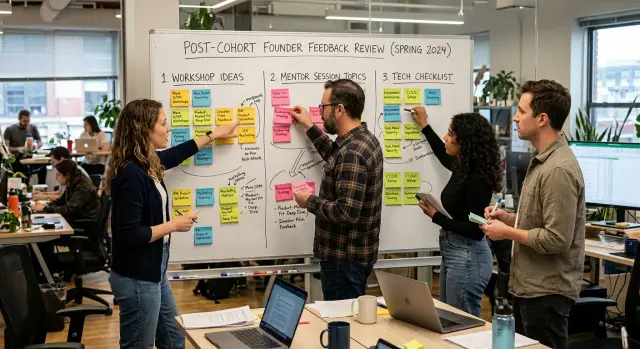
Table of Contents
Why the same founder problems keep coming back
Most cohorts don't struggle with brand-new problems. The same questions come up again and again. Founders ask when to talk to users, how to price, what to build first, when to hire, and how much tech they need before launch.
That pattern is normal. Early teams run into the same deadlines, the same investor pressure, and the same gaps in experience. If one batch gets stuck on scope, customer discovery, or architecture choices, the next batch usually will too.
The problem isn't a lack of feedback. Most programs collect plenty. The problem is that one-off comments rarely change anything by themselves.
One founder says a session felt too broad. Another says office hours came too late. Those notes end up in a document, and the next cohort gets almost the same schedule. Nothing turns the comments into a pattern, so the same misses repeat.
Vague workshop topics make that worse. A session called "growth," "fundraising," or "building your product" sounds useful, but it often leaves founders with loose notes and no clear next step. They leave with ideas, not decisions. Then mentors hear the same questions again in private calls, one founder at a time.
Timing matters as much as content. Advice that arrives two weeks too late can cost a team a month. A founder might spend days building features before anyone asks who asked for them. Another team might choose a messy stack before a technical review catches it. By then, the fix is slower, more expensive, and much more annoying.
That's why batch retrospectives matter. They turn repeated founder pain into something you can act on. Instead of treating each comment as a separate issue, you can spot where the program keeps creating confusion, delay, or extra work.
When a cohort repeats the same mistakes, the program usually teaches the right subject at the wrong time, in the wrong format, or at the wrong level. Fix that, and the next batch starts with fewer avoidable problems.
What to collect after each cohort
Memory fades fast. Send a survey in the last week of the batch and again a few days after demo day, while details still feel fresh. Keep the questions short. Ask which sessions saved time, which felt mistimed, where founders got stuck, and what they still had to solve on their own.
Don't stop with survey forms. Some of the best feedback hides in places nobody labels as feedback: mentor notes from 1:1 meetings, office hour summaries, repeated questions in chat, and follow-up requests after workshops.
Those notes show friction in plain language. A founder might rate a workshop well, then spend three office hours asking the same question about pricing, customer interviews, or cloud setup. That repeated pattern matters more than one annoyed comment.
When you review the material, pull out blockers that show up across several teams. Look for issues that cost time or create the same confusion again and again. Maybe founders struggle to define a narrow first customer. Maybe they delay analytics until it's too late. Maybe technical teams keep making the same early architecture mistakes. One complaint can still matter, but it shouldn't reshape the next batch unless it matches a wider pattern.
Then sort what you found by context, not just topic. Stage changes the need. Pre-seed teams usually need sharper help with problem discovery, early sales, and first product scope. Later teams often need support with hiring, reporting, or infrastructure costs. Team size matters too. A solo founder usually needs templates and faster decisions. A five-person team often needs clearer process and ownership.
Product type matters as well. A SaaS startup, a marketplace, and a deep technical product don't need the same workshop depth or the same technical checklist.
Once feedback is grouped that way, it stops being a pile of opinions. It becomes a working record of founder pain points you can use when planning the next cohort.
How to run the retrospective step by step
One review meeting is usually enough if you prepare well. Bring in program staff and the mentors who spent real time with founders, not a long guest list. The people in the room should know what teams struggled with week by week.
Good retrospectives start before the meeting. Read every survey, mentor note, and follow-up comment first. If you try to sort feedback live, the loudest story wins and the quieter patterns disappear.
A simple process works well:
- Put all feedback in one document or board.
- Group each issue under a plain theme such as sales, product, hiring, or tech.
- Mark how many teams hit the same problem.
- Note which problems hurt progress the most, even if fewer teams mentioned them.
- Pick a short list of changes for the next cohort.
The grouping step needs some discipline. Keep themes broad enough to show patterns, but not so broad that everything lands in the same bucket. "Product" can work. "General founder support" usually tells you nothing.
How to turn feedback into patterns you can use
Raw comments look messy after a cohort ends. "More product help," "the tech session was too basic," and "I needed this two weeks earlier" sound different, but they often point to a small set of repeat problems. Rewrite each comment as a plain problem statement: who struggled, with what task, and at what moment.
When a founder says a workshop was "not useful," don't keep that label. Translate it into something you can act on, such as "first-time founders couldn't turn customer interviews into a clear problem statement" or "teams with a working prototype needed pricing help, not idea validation." That small rewrite makes feedback usable.
Sort by type, not volume
Timing matters as much as topic. Founders often ask for more fundraising content when they really mean they needed it before investor meetings started. Note the stage where the pain showed up: week 1, after first customer calls, before demo day, or after the first build sprint. A good session at the wrong time still feels like a bad session.
You also need a clear split between beginner and advanced problems. Early teams usually need basics: customer discovery, MVP scope, simple tool choices, and ways to avoid wasted build time. Later teams ask narrower questions, like pricing tests, analytics setup, infrastructure costs, or how to review AI-generated code. Put both groups in the same session and one group gets bored while the other gets lost.
Then decide which pattern belongs in a workshop and which needs one-on-one support. If many founders trip over the same cap table question, run a group session. If one team has a messy cloud bill because of stack choices, give that team direct help from a technical advisor. Shared confusion should shape the curriculum. Context-heavy problems belong in office hours.
After a few cohorts, you should be able to build a short pattern library: the pain point, when it appears, who it affects, and the best format for help. That makes planning easier, and support arrives when founders can still use it.
How to improve workshops and expert sessions
Most batch sessions miss the mark for a simple reason: they're too broad. Founders leave with notes, but not with a decision or a fix. A better workshop has a narrow topic, a clear time limit, and one outcome people can use right away.
Before you schedule any session, write one sentence about the result. If the result sounds vague, the session is still too loose. "Understand security" is weak. "Leave with a basic access policy and a list of missing controls" is much better.
Past founder questions should shape the agenda. Use notes from office hours, feedback forms, mentor chats, and demo prep. If several teams asked about cloud spend, run a session on cost mistakes, trade-offs, and what to cut first. If founders struggled with product discovery, don't fill the slot with a general fundraising talk just because a speaker is free.
Generic advice also breaks down when founders try to apply it alone. Add live review time. A short session can end with a 15-minute review of one pitch deck, onboarding flow, roadmap, or deployment plan. People learn faster when they watch a real problem get corrected.
A simple filter keeps workshops useful:
- Focus each session on one problem.
- Keep it short enough to hold attention.
- Define one clear outcome before you book it.
- Include a live review, working exercise, or direct Q&A.
- Bring in an expert only when that issue showed up in the cohort.
Technical sessions need extra care. Founders usually don't need a broad panel on architecture. They need someone to look at their setup and say what is wrong, what is fine, and what can wait. A Fractional CTO can review hosting choices, release steps, AI tooling, or cloud costs in plain language. That's the kind of session founders can use the same week.
How to build technical checklists founders will use
Most founders don't miss the advanced stuff first. They miss the boring checks that hurt later: who owns production access, how to roll back a bad release, where errors show up, whether customer data is protected, and how fast cloud costs can climb.
A good checklist catches those gaps in 15 to 20 minutes. If it takes an hour, people stop using it or rush through it.
What to include
Group checks by the problems founders hit most often, not by engineering theory. Four groups usually cover most of the risk.
Product architecture should answer simple questions: what breaks if one service fails, whether the database has a backup, and whether the team can explain the system on one page.
Security should cover who can access production, whether secrets are stored safely, and whether admin accounts use strong login rules.
Costs should make teams estimate the monthly bill, identify the part of the stack most likely to spike spend, and confirm that someone is watching usage.
Delivery should cover how the team ships changes, whether they can roll back a release, and who checks bugs after launch.
Write every item as a plain question with a yes, no, or short note. Avoid terms that make founders feel they need an architect in the room just to understand the page.
"Do you have a way to restore your database?" works better than "Describe your disaster recovery posture." One gets an answer. The other gets silence.
Keep the format the same
Mentors need the same structure every time. If one mentor uses a spreadsheet, another writes free-form notes, and a third asks from memory, patterns disappear.
Use one page, the same order, and the same scoring rule for every team. Leave a small notes field for context, not essays.
That consistency makes the retrospective much more useful. After a cohort ends, you can count how many teams lacked logging, skipped access rules, or had no rollback plan. Then you can turn repeated misses into better workshops, office hours, and founder prep before the next batch starts.
The best checklist is a little blunt. Founders will use it if it feels practical, fast, and tied to problems they already recognize.
A simple example from one cohort to the next
One batch ended with the same complaint from several teams: they wanted more technical help. On the surface, that sounded like a request for more mentors, more coding sessions, or more time with engineers.
The retrospective showed something more specific. Most teams didn't need hands-on help writing code. They needed an early architecture review before they picked tools, hired freelancers, or started building the wrong version of the product.
In that cohort, a few founders chose a stack too early because it looked familiar. Others mixed product questions with technical ones and lost weeks on features that should have stayed manual. One team spent part of its budget on a setup that looked serious but didn't fit its first 100 users.
The program changed three things for the next cohort.
First, it added one workshop on early architecture choices. The session stayed simple: what needs custom code, what can stay manual, what can use no-code, and what can wait.
Second, it changed office hours. Instead of open technical Q&A, each team got a short architecture review slot. Founders came with the same inputs: product goal, user flow, expected load, budget, and team skills.
Third, the program made a short checklist that teams had to complete before building. It covered basics like user roles, data sensitivity, third-party tools, hosting needs, and what would break if demand grew faster than expected.
The next cohort looked different. Founders asked better questions earlier. Fewer teams changed stacks in the middle of the batch. Workshop feedback improved because the content matched the real pain point, not the broad request for "more technical help."
That second batch still exposed one problem. Some teams treated the checklist like paperwork and filled it in too late. The better fix was to tie it to a live review in week two. Once a mentor walked through it with them, the checklist became useful instead of ignored.
That's the pattern to watch for. The first request is often vague. The real issue usually sits one layer below it.
Common mistakes that waste useful feedback
The fastest way to ruin a retrospective is to treat one loud founder like a full sample. Every batch has a few people who speak early, speak often, and speak with confidence. That doesn't mean they reflect the rest of the group. Quiet founders often carry the best detail because they hit friction, worked around it, and moved on without making noise.
Timing causes another common failure. If you wait until demo day, you get polished answers, tired founders, and memory gaps. By then, people forget which workshop confused them in week two, which intro arrived late, or which technical task blocked them for three days. Feedback has a short shelf life.
Too many teams also overreact to one cohort. They rewrite the schedule, replace mentors, add new sessions, cut old ones, and change half the process at once. Then the next batch goes through a different program, and no one knows which change helped and which one made things worse. Small edits are easier to test.
Mentor opinions can muddy the picture too. Mentors often want sharper decks, cleaner pitches, or more polished roadmaps. Founders may need something else, like help choosing a simple analytics stack, setting up a release process, or deciding who owns product calls. Both views matter, but they are not the same.
A simple filter helps. Ask what founders struggled to do, not just what they liked or disliked. Keep mentor requests separate from founder requests in your notes. Count repeated issues before changing the program. Limit each cohort review to a few fixes you can actually track.
The last mistake is boring, but it breaks more progress than any workshop problem: action items with no owner. "Improve office hours" is not an action. Someone needs to rewrite the format, test it, and report back. The same goes for checklists, mentor briefs, and session updates.
If nobody owns the next step, feedback turns into a nice document and then disappears. The next cohort shows up, and the same pain comes back with slightly different wording.
What to do before the next cohort starts
The goal is simple: the next cohort should hit fewer avoidable problems. Before applications open, review every planned session and ask what past founder problem it fixes. If the last batch struggled with pricing, customer interviews, or shipping a stable product, replace broad talks with sessions that deal with those exact issues.
Mentors also need a clearer role than "show up and help." Each mentor should know when they enter the program, what problem they own, and what warning signs to watch for. A short brief works well: common mistakes from the last cohort, the week those mistakes tend to appear, and the outcome you want from each session.
A quick pre-launch review can keep the program honest:
- Which past problem does each session solve?
- When will founders need that session most?
- Who helps if the issue goes deeper than one workshop?
- How will you tell if the change worked?
Timing matters as much as content. Founders should get a technical checklist before they need it, not after they're already blocked. Send the setup list before product work starts, the security and data checklist before teams collect user data, and the fundraising prep list before investor meetings fill the calendar.
Most founders won't read a long handbook under pressure. Short checklists work better. Keep them practical, easy to scan, and tied to real deadlines. One page that saves a team from a bad production release is worth more than a polished 20-page guide nobody opens.
You also need a way to measure whether the program improved. Keep it simple. Track repeat questions, workshop attendance, mentor follow-ups, checklist completion, and how many teams still hit the same bottlenecks by the same week. If the same issue keeps coming back, the fix was too vague or came too late.
Repeated technical problems deserve extra attention. If every cohort runs into weak architecture decisions, messy deployment habits, or confusion around AI tooling, bring in outside help before the batch begins. Oleg Sotnikov at oleg.is works with startups as a Fractional CTO and advisor, so he's a practical fit for program reviews, technical checklists, and early architecture support. In many cases, a focused review before the batch starts costs less than running another cohort with the same blind spots.
Frequently Asked Questions
Why do the same founder problems show up in every cohort?
Because teams hit the same stage problems, and many programs treat feedback as separate comments instead of a pattern. When you sort feedback by timing, topic, and team stage, you can fix the part of the program that keeps causing the same confusion.
When should we collect feedback from founders?
Send a short survey in the last week of the batch and another one a few days after demo day. Also review mentor notes, office hour summaries, and repeated chat questions while people still remember what slowed them down.
What feedback should we pay attention to first?
Repeated blockers matter most, especially the ones that cost teams time or push bad decisions. If several founders struggle with pricing, scope, customer interviews, or early tech choices, that should shape the next cohort before one-off complaints do.
How do we turn vague comments into something useful?
Rewrite each comment as a plain problem statement with three parts: who struggled, what task they struggled with, and when it happened. That turns vague notes like "too broad" into something you can fix in the schedule or session design.
What belongs in a workshop and what belongs in office hours?
Use a workshop when many teams face the same problem. Use one-on-one support when the issue depends on one team’s product, stack, budget, or skills.
How focused should a startup workshop be?
Keep it narrow enough that founders leave with one decision, one draft, or one fix they can use right away. If the outcome sounds vague, the session will probably feel vague too.
What should a technical checklist cover?
Start with simple checks around architecture, security, delivery, and costs. Ask plain questions about backups, production access, rollback steps, error tracking, and who watches cloud spend.
How do we make founders actually use a checklist?
Make it one page and short enough to finish in about 15 to 20 minutes. Teams use it more often when a mentor walks through it early, instead of treating it like paperwork they fill in later.
What is the most common retrospective mistake?
A lot of teams give too much weight to one loud founder or change too many things at once. Make a small set of changes, give each one an owner, and check whether those changes reduce the same bottlenecks in the next batch.
When should we bring in a Fractional CTO for the next cohort?
Bring one in before the next cohort starts if teams keep making the same architecture, deployment, AI tooling, or cloud cost mistakes. A Fractional CTO like Oleg Sotnikov can review the program plan, tighten the technical checklist, and give founders early architecture feedback that saves time and budget.


