Staff level thinking: signs you need it before titles
Staff level thinking shows up when teams repeat tradeoffs, ship rework, and miss system effects. Learn the signs and what to do next.

Table of Contents
What this looks like in daily work
Some teams ship a lot and still feel stuck.
Tickets close. The sprint ends on time. Then the cleanup starts. One change fixes the customer issue but creates a support ticket, a billing mismatch, or a manual step for another team. Work moves forward, but the total mess does not get smaller.
You can usually spot the pattern in the same debates coming back over and over. In March, people argue about API shape. In April, they argue about logging. In May, they argue about ownership. The people in the room change, but the conflict barely changes. That is usually a sign that nobody owns the wider rule, so each team keeps solving the same problem from its own angle.
Managers often answer this with more meetings. Calendars fill up. Handoffs still break. Product thinks engineering agreed to one thing, engineering heard something narrower, and operations finds the gap after release. Extra check-ins can make it worse because people spend their time talking around the problem instead of fixing the structure behind it.
Strong engineers can hide this for a while. They patch a migration, rewrite a flaky job, or stay late to connect systems that should have fit together in the first place. On paper, the sprint looks healthy. The real cost shows up later as rework, stress, and slow decisions.
Growing startups hit this early. One team pushes for speed, another protects stability, and a third keeps reacting to customer requests. Each choice makes sense on its own. Together, they make the product harder to change every month.
A few signs tend to show up at the same time:
- teams finish work, then open follow-up tickets to fix side effects
- the same tradeoff returns every few weeks with different people involved
- meetings increase, but ownership stays fuzzy
- strong individual work fixes local pain and misses the wider pattern
That is usually when you need staff level thinking, whether the title exists yet or not. Someone has to look across teams, spot the repeated tradeoffs, and decide what should stay consistent.
When sprints stop helping
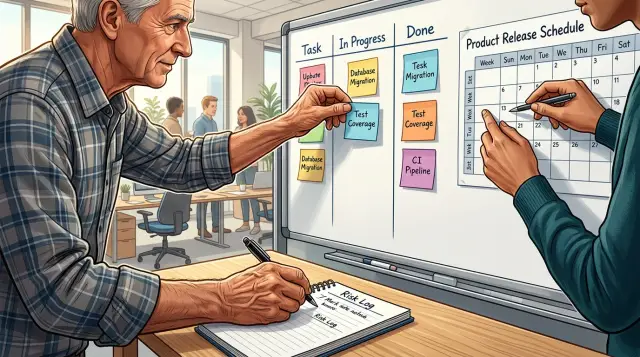
Sprint boards work well when the work is local. One team has a clear task, builds it, tests it, and ships it. Trouble starts when the blocker sits outside that board.
A product team can look on track while it waits on data rules, API limits, security review, or billing logic that nobody owns end to end. The sprint still moves. Tickets still close. The release still slips because the hard decision never made it into any backlog.
That is the shift. The problem is no longer speed inside one squad. The problem is that several teams keep making connected choices without anyone judging the total cost.
A common example looks harmless at first. One team takes a shortcut to hit a date. Another team adds checks or manual work to protect itself from that shortcut. A month later, everybody feels slower, and no single ticket explains why.
You see the same thing in planning. Dates move, not because estimates were terrible, but because teams never settled the shared rules early enough. They disagree on caching, retries, ownership, late data changes, or acceptable downtime. Those are product and system decisions. They do not fit neatly inside one sprint ticket.
Incidents usually tell the same story. A release breaks something important. The postmortem names four teams, three handoffs, and no single owner for the whole flow. That points to an ownership gap, not one careless engineer.
When this keeps happening, more ceremonies do not fix it. More standups do not create system judgment. More detailed tickets do not settle cross-team tradeoffs.
Founders often read this as a process problem. Sometimes it is. But just as often, the company needs someone who can see the whole product, settle tradeoffs early, and stop the same damage from spreading from team to team. In some companies that person is already there. In others, a fractional CTO fills the gap before a formal staff role makes sense.
Repeated tradeoffs are the real signal
This problem gets easier to spot when different teams keep pulling in opposite directions and nobody owns the rule that settles it.
Product wants flexibility. Support wants fewer exceptions. Engineering wants simpler code. Sales wants one more custom path for a large prospect. None of those requests are unreasonable. The problem starts when leaders treat the same tension like a brand-new debate every time it appears.
Pricing and onboarding are common trouble spots. Product wants more options because customers vary. Support wants a shorter list of supported setups because edge cases create tickets. Engineering wants one clean flow because every extra branch brings more testing and more bugs. Sales wants custom terms because one deal looks too good to lose.
Nobody is wrong there. The missing piece is someone who can see the whole system, write down the rule, and explain when an exception is worth the cost.
Without that, the tradeoff spreads:
- support writes workarounds product never planned for
- engineers add special handling nobody wants to maintain
- sales promises terms operations cannot support cheaply
- leaders reopen the same choice because no written rule exists
Cost cutting creates the same pattern. Operations may want to cut services, shrink hosting, or remove manual review. That can save money fast. It can also slow onboarding or double support load if nobody checks the full path. A cheaper setup is not a good decision if it creates more work everywhere else.
Written rules help because they let teams make the same decision without another meeting. A simple rule like "We allow custom requests only if they can become a standard option within one quarter" can stop a lot of churn.
This is one reason founders bring in a fractional CTO early. Someone working across product, engineering, support, and cost can name the repeating tradeoff and turn it into a rule people can actually use.
Rework loops mean decisions are landing too late
Rework gets expensive when it stops being a one-off miss and turns into a rhythm.
Design updates the same flow after engineering has already started. Engineers replace an integration because scope changed late. QA keeps finding the same class of failure in each release. Support reports an issue users have been hitting for weeks, but nobody treated it as planning input.
That usually means the team has plenty of activity but not enough cross-team judgment. People are doing their jobs. The gap sits between jobs.
Healthy teams revise plans. That part is normal. The warning sign is repetition. If the same checkout edge case, permission rule, onboarding confusion, or API limit keeps coming back, the issue is not speed. The team keeps learning too late.
The pattern often looks like this: design changes after build starts because hidden constraints surface late. Engineers rebuild part of the work after someone expands scope. QA files bugs that look different on the surface but share one root cause. Support hears complaints that should have changed the plan before release. Postmortems create action items, but the same issue returns next month under a new name.
At that point, sprint discipline helps only a little. Better tickets help a little too. The team needs someone to ask harder questions earlier. Which constraint matters most? Which tradeoff will hit other teams? Which support issue points to a product decision rather than a user mistake?
Take a simple case. A startup adds a customer portal. Design draws a clean flow. Engineering builds it. QA finds role conflicts. Support then hears that customers do not understand who can approve what. The team patches the UI, rewrites permissions, and updates help docs. On paper, those are separate tasks. In reality, one missing system decision caused all of them.
That is why many postmortems fall flat. Teams write actions at the task level: add a test, update a checklist, improve handoff. Those are fine actions. They do not change how the company makes cross-team decisions, so the loop comes back in a different form.
If rework keeps landing in different departments with the same shape, treat it as a system problem. Fix the decision path, not only the latest symptom.
Blind spots between teams hurt the whole product
The most expensive product problems usually sit between teams.
Design finishes its part. Engineering ships its part. Support handles the fallout. Nobody owns the full path a customer takes from signup to payment to daily use to support.
That gap stays hidden until customers feel it. A user creates an account, starts a trial, upgrades, and contacts support because access looks wrong. Support sees one status, billing sees another, and the product shows a third. Each team can explain its own screen. Nobody can explain the whole experience.
A lot of this starts with words that look shared but are not. One team treats an "account" as a company. Another treats it as a login. Product uses "plan" to mean pricing tier, while engineering uses the same word for feature flags. Those sound like small mismatches. They create messy permissions, bad reports, and edge cases that keep coming back.
Feature planning can miss the same way. A team approves a feature because it fits the sprint and looks useful. Nobody checks what it does to hosting cost, support volume, audit logs, or reliability. A simple UI change can double background jobs, create confusing invoices, or break finance reports at the end of the month.
Security and billing reviews often arrive too late. Teams make most product decisions first, then ask for a security check or pricing review near release. By then, the hard choices are already locked in. People either ship with risk or rewrite work they thought was finished.
A few questions expose these blind spots fast. Can one person explain the full path from signup to support without guessing? Do product, engineering, finance, and support use the same definitions for states and plans? Does feature planning include cost, reporting, and failure cases before build work starts? Do security and billing reviews happen before the shape of the feature is fixed?
If too many answers are "not really," the company does not have a sprint problem. It has a coordination problem.
A simple startup example
A SaaS company starts selling to larger customers. To win those deals, sales offers a new pricing plan with annual billing, custom approval steps, and a few contract exceptions for user limits.
Nothing about that sounds strange. Sales wants the deal. Product updates the upgrade flow. Support writes internal notes for edge cases. Engineering ships the first version fast so the company can close larger accounts.
The trouble shows up a few weeks later.
A customer asks why one manager can see reports that another manager cannot. Finance notices invoice totals do not match the discounts sales promised. Support starts doing manual fixes because the billing rules do not match the permission rules, and neither matches the reports customers export for their own finance teams.
Engineering now has to touch three parts of the product that looked separate during sprint planning: permissions, billing, and reporting. The team patches one issue and uncovers two more. A quick release turns into a rewrite.
Nobody failed because they were slow. The miss came from a shared blind spot. The team treated the pricing plan like a feature when it was really a product-wide change with business rules attached.
This is the kind of moment where staff level thinking pays off. Someone needs to ask early: which rules change for sales, support, finance, and engineering? Where will those rules live so every part of the product reads the same logic? What breaks if one team ships its part before the others catch up?
A normal sprint board rarely shows that cost. It mostly shows local work. It does not show conflicting assumptions across teams.
A strong product lead, senior engineer, or fractional CTO can catch this before the sprint starts. That often saves weeks of rework, a pile of support tickets, and some awkward calls with the first big customers.
A 30-day test
You do not need a workshop to test whether this problem is real. Use the next 30 days of normal work.
Look at recent incidents, reopened tickets, and delayed releases. The question is simple: did the team solve the local problem while making the wider system worse?
Keep the tracking light:
- write down decisions that got reopened two or more times
- mark cases where one team took a shortcut and another team paid for it later
- review incidents and note repeated root causes
- ask who owns the full outcome, not just one service or screen
- pick one recurring problem and give one person cross-team decision ownership for the month
Then watch how people talk. If everyone can explain their own part but nobody can explain the full chain from user action to business result, the blind spot is real.
One person does not need formal authority to run this test. In some companies, a tech lead can do it. In others, a founder or fractional CTO has to hold the thread across product, engineering, and operations.
At the end of the month, count how many issues got smaller once one person owned the tradeoff across teams. If that number is high, the title can wait. The thinking cannot.
Common bad responses
The first mistake is treating this like a promotion problem. A company sees repeated friction, gives one strong engineer a bigger title, and expects the system to clean itself up. Titles do not widen decision scope on their own. If that person still cannot shape API rules, data ownership, release boundaries, or team priorities, the mess stays put.
The next mistake is adding more process. Teams create extra planning meetings, review councils, and status check-ins. The calendar gets heavier, but ownership stays fuzzy. If nobody can say who decides, who gets consulted, and who follows the rule, the company just replays the same argument every week.
Another mistake is treating architecture like a one-time document. Someone writes a neat diagram, the team agrees with it, and real work moves on. Six weeks later, new features ignore the document because nobody turned it into daily rules for interfaces, alerts, testing, and change reviews. This kind of judgment lives in steady choices, not in one document.
Teams also split too early. On paper, smaller teams look faster. In practice, they create more handoffs if shared rules are still weak. Autonomy does not come from drawing more boxes on an org chart. It comes from teams being able to make local decisions without breaking each other.
The most expensive mistake is waiting for a crisis. Many founders ignore the pattern until a failed launch, outage, or ugly release forces action. By then, rework has already eaten months.
A better response is smaller and stricter. Set clear decision boundaries. Name who owns cross-team tradeoffs. Review a few recurring conflicts instead of every detail.
What founders and managers should check
Founders usually feel this before they can name it. The team ships, but the same arguments keep coming back. One week the fight is about speed. The next week it is about cost, rollback work, or who owns the risk after launch.
That often means the company needs shared judgment across the product, not just more effort.
Ask a few plain questions in a real planning meeting:
- Can one person explain the current tradeoff between speed, cost, and risk in simple language?
- Do product, engineering, support, and operations use the same meaning for words like "user," "planned," and "done"?
- Do teams that feel the impact later join major changes before build starts?
- Do you measure cleanup, rollback, and redo work, or only sprint velocity?
- When the same conflict returns, do you write a decision rule?
If the answer is "no" to two or more, the problem is already broader than sprint management.
Before you create the title
A new title feels like action, but it rarely fixes this pattern by itself.
Start with one recurring issue that keeps forcing cross-team tradeoffs. Maybe launches slip because one team pushes for speed while another cleans up the same work later. Maybe nobody owns the messy middle between roadmap, architecture, and delivery. Study that first, not the org chart.
Give one trusted person room to shape decisions across teams for a month. Do not turn it into a promotion test. Give them a clear problem, access to the people involved, and enough authority to ask hard questions about scope, dependencies, and long-term cost.
A simple monthly review helps more than a fast title change. Check where ownership is fuzzy. Look at tradeoffs that came up more than once. Ask which decisions moved work forward and which ones created rework. Write down the pain points if they return.
That does two useful things. It shows whether the company really needs staff level thinking, and it shows whether the problem is structural. Sometimes the answer is not a new senior title at all. It is clearer boundaries, fewer handoffs, or one shared rule for how teams make tradeoffs.
If the pattern keeps returning after a couple of cycles, an outside view can help. Oleg Sotnikov at oleg.is works as a fractional CTO and startup advisor, with deep experience in product architecture, infrastructure, and AI-first development. In cases like this, a short review from someone who can look across teams often clears up the real ownership gap faster than another round of titles and meetings.
Create the title after the work is visible, not before. When the role matches a real need, everyone can see why it exists.
Frequently Asked Questions
What does staff level thinking mean in plain terms?
It means someone looks past one team’s ticket board and judges the full cost of a decision. That person notices repeated tradeoffs, sets simple rules, and stops one team’s shortcut from creating work for everyone else.
How can I tell this is more than a sprint problem?
Look for patterns that keep showing up across product, engineering, support, billing, or operations. If teams close tickets but still create side effects, rework, and ownership fights, you have a system problem, not just a sprint problem.
Why do the same debates keep coming back?
Because nobody settled the wider rule. Each team solves the issue from its own angle, so the same tension returns with new people and slightly different wording.
What does a rework loop look like?
A rework loop happens when work looks done, then other teams keep fixing the fallout. You see it when design changes after build starts, QA finds the same class of bug each release, or support keeps reporting issues that should have shaped planning earlier.
Will more meetings solve this?
Usually no. More meetings often spread the confusion because people discuss the symptom again instead of naming one owner and one rule for the tradeoff.
What should one person own across teams?
Give one person ownership of the full outcome, not just one service or screen. They should decide shared rules, settle tradeoffs early, and make sure product, engineering, support, and operations use the same definitions.
Do I need to create a staff title first?
No. Start with the work first. If one person can reduce repeated conflicts, cut rework, and make decisions stick, then the title will make sense later.
How do I test this in the next 30 days?
Pick one recurring problem for the next month and give one person room to decide across teams. Track reopened decisions, follow-up fixes, delayed releases, and cases where one team saved time while another team paid for it later.
What should founders measure besides velocity?
Measure cleanup work, rollback work, support tickets tied to recent releases, and decisions that teams reopen more than once. Those numbers show hidden cost better than sprint velocity alone.
When does a fractional CTO help?
Bring one in when the company feels stuck between teams and nobody can judge the full product path. A fractional CTO can spot the ownership gap fast, write workable rules, and help before you commit to a full-time senior hire.