sqlc vs GORM vs Ent: choosing a Go data layer for growth
sqlc vs GORM vs Ent affects how your Go team writes queries, handles schema changes, and avoids risky refactors as the product grows.
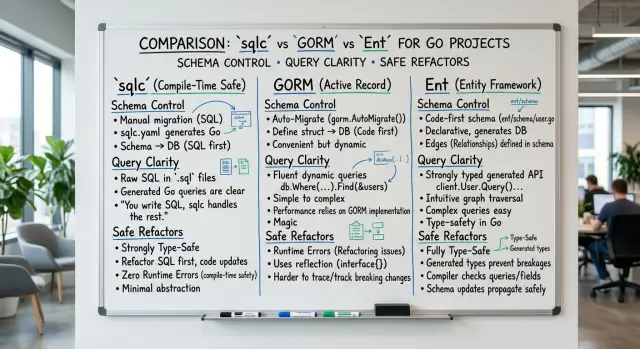
Table of Contents
Why this choice gets expensive later
Most teams choose a data layer when the codebase is small and time is tight. The choice feels local. It isn't. Your data layer shapes how you write migrations, how people review queries, and how fast you can fix a production bug when the database no longer matches the code.
The first month hides most of the cost. A tool that feels fast with three tables can get awkward with thirty. A shortcut that saves one day early can add friction to every change after that. That's why the sqlc vs GORM vs Ent decision is less about taste and more about the work your team will repeat for the next two years.
Switching later is rarely clean. You don't swap one package and move on. You touch models, tests, query code, migrations, helper functions, and often the way the team thinks about database changes. Review habits change too. A team used to reading plain SQL looks for one kind of risk. A team used to generated builders or ORM chains looks for another.
Growth changes the problem fast. More tables mean more joins. More joins mean more places where query intent gets blurry. More developers mean mixed styles, more accidental complexity, and more time spent asking, "What does this query actually do?" That time adds up.
A small startup can live with rough edges for a while. A growing product usually can't. Once reporting queries, backfills, admin tools, and customer-specific fixes show up, the data layer stops being a small technical detail. It becomes part of how the whole team ships work.
I've seen teams move faster after choosing a stricter path, even when it felt slower on day one. Clear schema ownership, readable queries, and safer refactors usually beat early convenience once the codebase starts to spread.
How the three options work day to day
Most teams feel this choice during a small change under pressure. A product manager asks for one new filter, one extra field, or a safer update path. The daily work looks very different in sqlc, GORM, and Ent.
With sqlc, you write SQL first. You keep queries in .sql files, run code generation, and call typed Go methods that match those queries. If your team already thinks in tables, joins, and indexes, this feels direct. Review is usually simpler because people can read the exact query instead of guessing what an ORM will send to the database.
GORM starts with Go structs, tags, and method calls. For basic CRUD work, that can feel fast. You define models, call query builders, and move on. The tradeoff shows up when queries get more specific. Long method chains are harder to scan, and the real SQL sits one step away from the code people review every day.
Ent also starts in Go, but in a stricter way. You define schema in Go, generate code, and use typed APIs for queries and relations. That gives the team a strong shape to work with. People who like autocomplete and compile-time guidance often enjoy it. The cost is extra ceremony. A simple schema change can pull you through schema files, generation, and updated calling code before the change feels finished.
The work moves around depending on the tool. sqlc puts more of it into SQL. GORM pushes more into Go structs and runtime query composition. Ent puts more into schema design and generated APIs.
That shift matters more than people expect. The real question in sqlc vs GORM vs Ent isn't which one looks nicer in a demo. It's where you want your team to spend attention every week: reading SQL, shaping Go models, or managing generated code with a strict schema layer.
Schema control and ownership
Schema control shapes how a team works every week. When a column changes, who makes that call first: the database or the Go code? If your team never answers that early, you usually get mixed habits, surprise migrations, and reviews that miss real risk.
With sqlc, the database stays in charge. You write migrations by hand, keep table rules in SQL, and write the queries yourself. Then sqlc generates typed Go code from those queries. Ownership stays clear. If someone wants a new index, a stricter constraint, or a renamed column, they change the migration and the SQL. Reviewers can see the exact database change instead of guessing what an ORM will do.
GORM pushes ownership in a softer direction. A lot of schema behavior can sit in Go structs, tags, and framework defaults. That feels quick at the start, especially for simple CRUD work. The problem is that some database details become easy to miss. A tag change can affect how a column behaves, and auto-migration features can make changes look smaller than they are. Teams can still use GORM carefully, but they need stronger discipline because the framework doesn't force explicit SQL-first thinking.
Ent takes a code-first path and makes it more formal. You define fields, relations, and many schema rules in Go files, and Ent generates code from that model. That gives application developers one clear place to work. It also makes refactors easier to follow if your team prefers Go over raw SQL. Still, the center of control moves into code, not the database layer itself. For some teams, that's a good trade. For others, especially teams with strong SQL habits, it feels one step removed from the real system.
So choose the direction on purpose. If your team wants schema, migrations, and queries to stay explicit, sqlc is usually the cleanest fit. If you want Go to define the model and generate the rest, Ent makes more sense. GORM is fine when the team accepts framework conventions and is willing to watch migration behavior closely.
Growth makes this choice harder to change later. A small team can live with fuzzy ownership for a while. A bigger team usually can't.
Query clarity when people review code
Code review gets slow when nobody can tell what a query does. Most reviewers want the same answers fast: which tables it touches, how it joins them, what filters it applies, and whether it returns more rows than expected.
sqlc is very clear on that front because the SQL sits in plain sight. A reviewer can read the exact query that will hit PostgreSQL or MySQL, check the WHERE clause, and move on. There's very little guessing. If a pull request changes a join from INNER to LEFT, everyone sees it right away.
GORM feels clean at first, especially for basic CRUD work. A simple Where("email = ?", email).First(&user) reads well enough. The trouble starts when the query grows. Chained calls, preload rules, scopes, raw fragments, and conditional joins can spread the logic across several lines or helper functions. At that point, reviewers often have to rebuild the SQL in their heads before they can judge it.
Ent sits in the middle. It keeps queries typed, which helps a lot when people rename fields or move code around. Reviews get calmer because the compiler catches many mistakes early. Still, builder-style queries can get long. A query with several predicates, edge traversals, and eager loads may stay safe, but it isn't always quick to read.
Reviews move faster when people can spot the tables, join conditions, filters, selected columns, and sorting rules without decoding a chain of method calls. That's why team habits matter more than benchmarks here. If your team already thinks in SQL, sqlc often wins on review speed by a wide margin. If your team wants typed code first and accepts longer builders, Ent can still stay readable with discipline. GORM works best when the data access layer stays simple and nobody hides complex queries behind too many abstractions.
Refactor safety as the codebase grows
Refactor risk gets real once the codebase spreads across services, jobs, admin tools, and internal scripts. A rename that felt harmless with three developers can waste half a day when ten people touch the same tables in different ways.
This is where sqlc and Ent usually age better. If you rename a column, change a field type, or remove a table relation, both tools catch many mistakes during the build. The break shows up early, while the change is still fresh in your head.
GORM can work well, but it leaves more room for runtime surprises. A lot depends on conventions, string-based queries, model tags, and how careful the team stays over time. That's fine in a small codebase. It gets harder when new developers join and copy patterns they only half understand.
A simple example shows the difference. Say a team renames customer_id to account_id. With sqlc, generated methods and typed structs often fail to compile where the old name still exists. With Ent, generated schema code and query builders usually point straight at the broken places. With GORM, some errors show up quickly, but others stay hidden until a request hits that path in staging or production.
That early feedback matters. When a team grows, shared patterns start to matter as much as raw speed. If everyone reads and writes data access in the same way, code review gets faster and refactors get less stressful.
Ent helps by pushing a strong structure. sqlc helps in a different way: the SQL stays explicit, and the generated Go code gives the team a typed contract. GORM gives more freedom, which some teams like, but freedom often turns into variation.
Tests still do real work no matter which tool you pick. Build errors catch a lot, but they don't prove that a migration kept old data safe, that a join still returns the right rows, or that pagination still behaves the same.
If your team expects growth, pick the tool that fails early and pushes one clear pattern. That usually gives you fewer surprises six months later than a tool that feels fast on day one.
A simple way to choose for your team
Teams often pick too early, then spend months working around that choice. A better method is to judge each tool against the work you expect in the next 12 months, not the clean demo you saw in 20 minutes.
Start with your real query shapes. Write down the work you expect: simple CRUD, filtered lists, multi-table joins, admin reports, bulk updates, and the odd one-off queries product teams always ask for later. That's usually the missing step in sqlc vs GORM vs Ent debates. The right answer depends less on taste and more on what your code will ask the database to do.
Then mark the places where plain SQL will matter. If your team expects custom joins, reporting queries, or database-specific features, be honest about it now. Some teams want the database to stay close to the surface. Others want more code generation and stronger structure around how data gets accessed.
You also need a clear owner for migrations and schema review. If nobody owns schema changes, the tool choice won't save you. Decide who writes migrations, who reviews them, and who checks that application code still matches the database after each change.
Test one real feature
Build the same small but real feature in each option. Don't use a toy example like a users table with two fields. Pick something with one relation, one filtered list, one update path, and one report-style query. That's enough to expose the tradeoffs.
Then compare the result with a few plain questions. Which version was fastest to review? Which one made query intent easiest to read? Which one took the least test setup? Which change felt safest when you renamed a field or added a column? Which version would a new teammate understand in a week?
The winner is rarely the tool with the nicest first impression. Pick the one that stays calm when your schema changes, your queries get messier, and more people touch the code.
A realistic team scenario
A two-person startup is building a B2B product. They have users, accounts, projects, and a few billing tables. Most screens are plain CRUD, so GORM feels like the obvious choice. It gets records in and out fast, and the team can spend more time on product work instead of writing SQL all day.
For the first few months, that choice feels right. One founder handles backend work, the other talks to customers and ships UI changes. When they need a new filter or a new table, GORM usually gets them there without much friction.
Then the product gets more real. Customers ask for reports by date range, account, and usage tier. Support needs admin screens with odd filters. Billing adds exceptions. Permissions start depending on joins across several tables. The easy parts still feel easy, but the messy queries now hide inside ORM chains that take longer to read and longer to trust.
At that point, sqlc often looks better. If the team wants full SQL control, it gives them a clear answer: write the query you mean, keep it in SQL, and generate typed Go code around it. For a product with serious reporting, dashboards, or database-specific tuning, that clarity can save a lot of time six months later.
Ent fits a different shape. Imagine the same startup grows to eight engineers, adds more services, and keeps changing its data model. They now care less about writing every query by hand and more about typed relations, code generation, and safer refactors across a larger codebase. Ent can make those bigger changes less stressful because the schema and the generated API move together.
That's why sqlc vs GORM vs Ent is rarely about which tool is "best." It's about what the product will ask from your team.
If the app is mostly basic CRUD and speed matters most, GORM is fine. If SQL is part of the product, sqlc is usually the cleaner bet. If the model is large, relational, and likely to change often, Ent may age better.
Trend pressure leads teams into bad picks. Product shape is the better guide.
Mistakes teams make early
Teams often choose a data layer the same way they choose a text editor. One developer likes it, everyone nods, and the decision sticks. That's a weak way to settle a part of the codebase that every feature will touch.
The better question is simple: can the whole team read it, review it, and change it without fear? In the sqlc vs GORM vs Ent debate, personal taste matters less than shared habits.
The next mistake is judging the tool by the first week. GORM often feels fast at the start because you write less SQL by hand. sqlc can feel slower because you need to think through queries and schema changes. Ent can feel tidy because the generated API looks neat. None of that tells you much about the second year, when queries get odd, tables grow, and three people need to refactor the same workflow without breaking billing or reporting.
Teams also get rigid too early. They pick one tool and force it into every case. That usually ends badly. Some queries are simple CRUD. Some need joins, CTEs, window functions, or database-specific behavior. If raw SQL is the clearest way to express a query, use it. Pretending every query should look the same often makes the code harder to review.
A small team can avoid a lot of pain by writing down a few rules on day one: who owns schema changes, how migrations get reviewed and applied, how tables, columns, and indexes are named, when raw SQL is allowed, and which generated files developers still need to read.
That last point gets missed all the time. Generated code is still part of your system. If you use sqlc or Ent and nobody reads the output, bugs hide in plain sight. Developers stop understanding what hits the database, and review quality drops.
I have a bias here: teams should treat generated code like compiled instructions they still need to understand. You don't need to memorize every file. You do need to know what SQL runs, what types come back, and how changes move through migrations into production.
Early speed feels good. Clear rules age better.
Quick checks before you commit
Teams often compare feature lists and miss a simpler test: does the tool stay clear when the code stops being small? A good choice feels boring in the best way. People read it, change it, and move on.
Before you commit, try a few checks. Ask a new hire to follow one request from handler to final SQL. If they get lost between models, builders, generated code, and hidden query logic, the tool adds too much fog. Rename one field in a real branch and watch what breaks, what the compiler catches, and what slips through to runtime. That tells you more about refactor safety than any comparison chart.
Also open a pull request with a table change. Reviewers should find the schema edit in one obvious place, not scattered across structs, tags, generators, and hand-written migrations. Write one report query with joins, filters, grouping, and a weird sort rule. If the team starts fighting the API instead of writing the query, that pain will come back every month.
One small exercise often settles the debate. Build the same endpoint three ways: list customers, filter by status, join the latest invoice, and sort by unpaid balance. Then ask two people to review each version. Which one reads cleanly? Which one makes the SQL obvious? Which one feels safe to change next quarter?
That last part matters most. Growth usually doesn't break a Go data layer all at once. It breaks it in small, annoying moments: a rename nobody trusts, a report nobody wants to touch, a schema change hidden in too many files. Pick the tool that keeps those moments short.
What to do next
Make the decision with a short written brief, not gut feel. Before you pick anything, write down the few rules your team won't bend on. Usually that means who owns the schema, how much raw SQL you want in the codebase, how easy reviews need to be, and how much change you expect over the next year.
A short checklist keeps the debate honest. Who writes and reviews schema changes? Do you want SQL to stay visible in pull requests? How often will tables, fields, and joins change? Can new team members learn the pattern in a day or two? Will this still feel simple when the codebase doubles?
After that, run a small spike. Use one real table from your app, one join, and one migration. Then do one refactor, such as renaming a column or splitting a field into two. That small test tells you more than a week of opinions about sqlc vs GORM vs Ent.
Keep the spike close to real work. Use the same task in all three options. Ask one teammate who didn't write the code to review each version. Watch where they pause. If they can't tell what query runs, or the migration feels risky, that signal matters.
Pick the option that feels boring in the best way. Six months from now, boring wins. Easy reviews, clear ownership, and low surprise matter more than clever abstractions.
If you want a second opinion before you commit, Oleg Sotnikov at oleg.is works as a Fractional CTO and startup advisor. He helps teams with Go architecture, lean infrastructure, and practical AI-first development workflows when choices like the data layer start affecting delivery speed and production risk.
Frequently Asked Questions
Which option should I pick for a mostly CRUD app?
Start with GORM if your app mostly creates, reads, updates, and deletes records and your team wants to move fast. If you already expect lots of reports, custom joins, or database tuning, sqlc will likely age better.
When does sqlc make more sense than GORM?
Choose sqlc when you want queries, migrations, and schema changes to stay explicit. Teams that read SQL well usually review faster and debug production issues with less guesswork.
When is Ent a better fit?
Ent fits teams that want strict schemas in Go and typed query code. It asks for more setup, but it helps larger teams keep one pattern as the data model changes.
Which one makes code review easiest?
For most Go teams that know SQL, sqlc is easiest to review because reviewers can read the exact query in the pull request. GORM and Ent can stay readable, but long builder chains take more effort to scan.
Which tool handles refactors with less risk?
sqlc and Ent usually catch more mistakes during the build after a column rename or type change. GORM can still work well, but string queries and tags leave more room for runtime surprises.
Should I use one tool for every query?
No. Pick one default, then allow raw SQL when it makes the query clearer. Teams run into trouble when they force simple CRUD and messy report queries through the same style every time.
What should I test before we decide?
Build one real feature in each option with a relation, a filtered list, an update path, and one report query. Then rename a column and see which version your team can review and fix without confusion.
How painful is it to switch later?
Usually more painful than teams expect. You end up touching models, query code, migrations, tests, helper code, and the way people review database changes.
What team rules matter more than the tool?
Decide who owns schema changes, who reviews migrations, when developers can write raw SQL, and how you name tables and columns. Clear rules save more time than another round of tool debates.
When should we ask for outside help?
Bring in an experienced CTO or advisor when this choice starts to affect billing, reporting, or production fixes, or when the team keeps circling the same debate. A short review can stop a long rewrite later.


