Source citations in AI answers that people can trust
Learn how to present source citations in AI answers with snippets, dates, and clear labels so readers can verify claims fast.
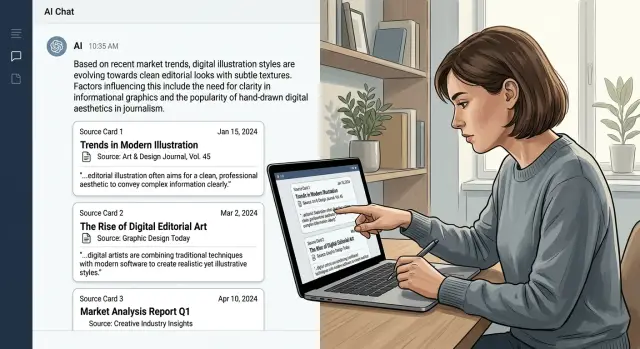
Table of Contents
Why people doubt AI answers
People lose trust in AI faster than they lose trust in search. The problem is not only accuracy. It is confidence without visible proof.
An AI answer can sound polished even when the source is weak, old, or only partly related. Readers then have no easy way to tell what came from a document and what the model filled in. A precise sentence is not the same as evidence.
Time makes this worse. Pricing, policy, security rules, and product behavior change often. An answer can read as correct and still be wrong because the source is six months old. If no date appears beside the claim, readers have to guess whether the information is current.
Quotes matter for the same reason. If a model says, "The contract allows early termination with 30 days notice," but shows no exact line, the reader cannot know whether the source really says that or whether the model softened or simplified it. A small wording change can change the meaning.
Picture a startup team asking, "Can enterprise customers export audit logs?" If the assistant answers yes, the team still does not know which document supports that answer, whether the document describes the current product, or whether the source says "available now" or "planned." That is why citations matter. People do not only want an answer. They want a way to check it in seconds.
Once readers can see the source, the date, and a short snippet beside the claim, doubt drops quickly. Without that, even correct answers feel risky. Risky answers do not get used.
What a useful citation looks like
A good citation feels less like a footnote and more like a receipt. The reader should see where the claim came from, which words support it, and whether the source is still current.
Use the source name in plain language. "Q2 support report" is better than an internal file ID. "Product pricing page, version 3.2" is better than a random document hash. People trust citations faster when they recognize the source without decoding it.
Be specific about location. If the claim came from page 14, say page 14. If it came from a meeting transcript, show the timestamp, such as 12:43. If it came from a policy document, name the section. Vague notes like "company docs" force people to guess, and guessing kills trust.
Most citations need only four parts:
- a clear source name
- an exact location, such as page, section, row, or timestamp
- a short snippet with the matching wording
- the date, time, or version when the content can change
The snippet does most of the work because most people will not open the full document unless something feels off. Keep it short. One or two lines is usually enough. Show the sentence that proves the claim, not a larger chunk that makes the reader hunt for it.
If an answer says a refund takes 5 business days, the citation should not dump the whole return policy. It should show something like "Refunds are processed within 5 business days after inspection," along with the policy name, the section title, and the last updated date.
Dates and versions matter more than many teams think. A pricing page from March and one from July can disagree. A video tutorial recorded last year may describe an old interface. If time can change the meaning, put that detail next to the citation, not somewhere else.
A reader should be able to open the source and compare the wording in a few seconds. If the answer says "cancel anytime," but the snippet says "cancel before the next billing cycle," the mismatch should be obvious at a glance. That is what makes evidence feel honest instead of decorative.
Keep evidence next to the claim
People trust an answer more when they can check a fact where it appears. If a sentence says sales dropped 12% in Q3, the proof should sit beside that sentence, not in a separate tab or buried at the bottom of the page.
Distance creates doubt. When readers have to hunt for the source, many assume the model filled in the gap. Keep the evidence close enough that a person can scan the claim, scan the snippet, and decide in a few seconds whether the answer holds up.
This matters even more when one paragraph mixes facts with interpretation. The cleanest fix is to separate them on purpose. State the sourced fact first and attach the citation. Then add the model's summary in a clearly separate sentence.
A simple example makes the difference clear. "Support tickets rose from 840 to 1,120 in April" is a factual claim, so it needs a source beside it. "The new checkout flow likely confused customers" is an interpretation. If no document says that directly, the answer should admit it: "This is an inference based on ticket volume and complaint themes. No source here confirms the cause."
That kind of line builds more trust than a vague citation ever will. Readers do not expect a model to know everything. They do expect it to say where the documents stop.
Quoted facts also need a visual boundary. Use quotation marks, a snippet box, or a short excerpt label so readers can tell what came from the document and what came from the model. If the model paraphrases, say it is a paraphrase. If it quotes, quote exactly.
When proof sits next to each claim, readers stop guessing which parts are grounded and which parts are judgment. Friction drops. So does the chance that a neat summary hides a weak source.
Make time visible
Time tells readers whether an answer is fresh, stable, or already stale. If that detail is hidden in a footnote or metadata panel, people have to guess. Most will either trust the answer too much or dismiss it too quickly.
For fixed documents, show the publication date beside the citation. A law, report, handbook, or product spec usually has one date that matters most. Readers can judge the claim in a second when they see something like "Published: 10 Apr 2026" next to the source title.
Live data needs a different label. Weather, prices, stock levels, incident status, and traffic can change in minutes. In those cases, show the retrieval time, not just the source name. "Retrieved: 10 Apr 2026, 14:35 UTC" is far more useful than a bare citation because it shows exactly when the system checked.
Internal documents create their own problem because teams often update them without changing the title. If your AI pulls from a handbook, runbook, or policy that changes every week, include the version too. A short note such as "Version 3.2, updated 10 Apr 2026" helps readers confirm they are looking at the same text.
Old sources are not always wrong, but they need a warning. If the answer cites a security guide from 2021 or a pricing page captured six months ago, say so plainly. A note like "This source is older and may not reflect current policy" prevents false confidence.
Consistency matters more than fancy formatting. Pick one date style and use it everywhere. Mixing "04/10/26," "10-04-2026," and "April 10" slows people down and creates avoidable mistakes. If readers can scan the date in two seconds, they can judge the answer without guessing.
Choose snippets that prove the point
A citation helps only if someone can verify the claim quickly. Long excerpts slow people down. Tiny excerpts create a different problem: readers cannot tell whether you clipped away the part that changes the meaning.
Use only the lines that directly support the sentence beside them. Most of the time, one to three lines are enough. That is short enough to scan quickly and long enough to keep the point clear.
Keep the wording exactly as it appears in the source. Do not rewrite the quote to make it cleaner or shorter. Even a small edit can make people doubt the evidence.
Context matters as much as the quote itself. Add a page number, heading, or section label next to the snippet. A short label like "Page 12, Security limits" or "FAQ, Data retention" gives readers a direct path back to the original text.
Clipping is where many systems go wrong. If a document says, "This method works for internal testing, but it is not approved for customer records," you cannot quote only "This method works" and treat that as proof. The missing words change the meaning.
A quick internal check helps before you show any snippet. Ask whether the quote supports the exact claim, whether the meaning stays the same if someone reads one line before and after it, and whether a reader can find it again without searching through the whole document.
The best snippets feel almost boring. They are exact, easy to scan, and easy to verify. That is why people believe them.
Build answers claim by claim
Most trust problems start before the answer appears. They start when the model mixes facts, guesses, and old details into one smooth sentence. A cited answer works better when you build it claim by claim, not paragraph by paragraph.
Pull out every statement a reader could question. If the answer says a contract ends on a certain date, a policy changed last month, and a fee applies only in one case, those are three separate claims. Treat each one as something the reader should be able to verify in seconds.
A simple workflow works well. Draft the answer first, then mark the factual claims. Match each claim to the source that supports it best. Save the exact snippet, the date, and the location, such as page 4, section 2.1, or 01:42 in a recording. Put the citation right next to the claim instead of burying it at the end.
One extra step is worth the time: ask someone else to verify the answer using the citations alone. If they cannot confirm it without asking where to look, the citations are too weak or too far from the text.
Formatting does a lot of work here. Put the claim first, then add a short source note in brackets or a small footnote marker that opens the exact proof. People should see the evidence while they read, not after they finish.
The snippet should be short but complete enough to prove the point. One sentence is often enough. Two can help when the first line uses vague words like "this" or "the above policy." Add the date when time matters, and always include a precise location. "Company handbook" is weak. "Handbook, leave policy, page 12, updated March 2025" is easy to check.
A useful test is simple: hand the answer to a coworker who knows nothing about the task. If they can confirm every claim from the citations alone in a minute or two, you built it well.
A realistic example
A customer types: "Can I get a refund if I bought this 17 days ago?" A weak AI answer says, "No, refunds are only available for 14 days." That may be correct, but the customer still has to guess whether the bot read the current policy, an old draft, or nothing at all.
A better answer puts the evidence right next to the claim.
Answer: Usually no. The standard refund window ends after 14 days from the purchase date.

Source: "Refunds and cancellations"
Quoted policy: "You can request a full refund within 14 calendar days of the purchase date."
Last updated: March 4, 2026

Note: This policy changed last month. An older version used a different refund window. If your order was placed before the update, support should check the prior policy version.
That short format does a lot of work. The customer sees the policy section name, the exact sentence that sets the limit, and the update date. They do not need to open the full policy unless their case looks unusual.
The quoted line matters most. If the answer only cites a page title, people still have to hunt for the rule. A tight quote removes that extra step.
The update note matters too. Policy pages change, and users notice when an answer feels stale. A one line note such as "Changed last month" tells the customer that the system checked version timing instead of pulling a random sentence from memory.
That is what good citations look like in practice: a clear claim, visible evidence, a readable date, and a short warning when timing could change the result.
The customer can now make a simple call. If the purchase happened 17 days ago under the current policy, the answer is probably no. If the order happened before last month's policy change, they also know why a human should review it.
Mistakes that break trust
Bad citations usually fail in ordinary ways. People do not expect perfect answers every time. They do expect a clear path to check what the answer says.
One common mistake is using one citation for several different claims. If a sentence mentions a price change, a policy rule, and an effective date, each part may come from a different place. When one footnote sits at the end of the whole sentence, readers cannot tell which claim it supports.
Another trust killer is citing a home page instead of the exact document. A home page tells people almost nothing. They still have to search, guess, and hope they found the same page the system used. If the answer came from a policy PDF, meeting transcript, or release note, cite that exact source.
Fresh wording can also hide stale evidence. This happens when the answer sounds current, but the source is months or years old. The wording feels new, so readers assume the evidence is new too. Put the source date where people can see it, especially when time changes the meaning.
Snippets can mislead even when the source is technically correct. A bad snippet cuts out the limiting sentence right before or after the quoted line. A document may say a feature is available only on enterprise plans, but the snippet shows only "feature is available." That feels misleading, even if the reader could eventually find the full file.
Style matters too. If one answer uses page numbers, the next uses vague labels, and a third shows no timestamp at all, readers start to wonder what changed behind the scenes. A stable citation format teaches people where to look every time.
If a reader has to do detective work, trust drops fast. Good citations do the opposite. They let someone verify the answer in a few seconds and move on.
A final check before you publish
Good citations feel almost boring. A reader should see where the claim came from, what part of the source supports it, and how old that source is without hunting around.
Begin with the first glance. If the source name is buried under an icon, hidden behind a hover state, or shortened so much that people cannot recognize it, the citation is already weaker than it should be. Put the source name where the eye lands quickly.
Then read the answer sentence by sentence. Every factual claim needs support. If one paragraph makes three claims but shows one vague citation at the end, readers have to guess which source backs which line. Most people will not do that. They will just stop trusting the answer.
Before you publish, check a few simple things:
- each claim points to a specific source, not a general source list
- the snippet says the same thing as the answer in plain reading
- the date, version, or timestamp is visible right away
- the citation opens to the exact place a reader needs
- a new reader can verify it alone
The snippet often tells you whether the whole answer is working. If the answer says "revenue fell 12%" but the snippet only mentions "market pressure," the citation is decoration, not evidence. Snippets should remove doubt, not add more work.
Dates deserve the same treatment. People read faster when you show a human friendly date or timestamp beside the citation instead of hiding it in metadata. For moving sources like product docs, policy pages, or live dashboards, version labels help just as much as calendar dates.
One simple test works well: give the answer to someone cold. Do not explain it. Do not point at the interface. If they can verify the answer in under a minute, you are close. If they ask where to click, what the snippet means, or whether the source is current, keep editing.
Where to start
Start where wrong answers waste the most time or money. That is usually support replies, internal search, policy lookups, pricing answers, and any workflow where someone has to verify a claim before acting on it. If a bad answer can cause a refund, a missed handoff, or a compliance problem, fix citations there first.
Then choose one citation format and keep it consistent across support, search, and internal tools. If every answer shows the source name, date, exact location, and a short snippet in the same place, people spend less time guessing. In practice, consistency builds more trust than a flashy interface.
A good starting format is small and clear: the document name or page title, a readable date or timestamp, one short snippet with the exact supporting text, and a location marker such as a section name, page number, or minute mark.
After that, test the format with real users. Do not stop with the team that built the tool. Give a few people real tasks and ask them to check whether an answer is true, outdated, or incomplete. Watch where they hesitate. If they cannot tell what the evidence means in a few seconds, the citation format still needs work.
This matters even more with AI because fluent writing makes weak answers sound stronger than they are. A citation should slow that down just enough for someone to verify the claim. If users still ask, "Where did this come from?" the answer needs better evidence, not better wording.
If your team needs help designing that kind of workflow, Oleg Sotnikov at oleg.is advises startups and smaller companies on practical AI systems, product architecture, and fractional CTO work. He focuses on setups that make answers easier to verify instead of harder to trust.


