Shipping every week with a small team without burnout
A simple weekly cadence for shipping every week with a small team: plan less, review faster, deploy on schedule, and keep support from taking over.
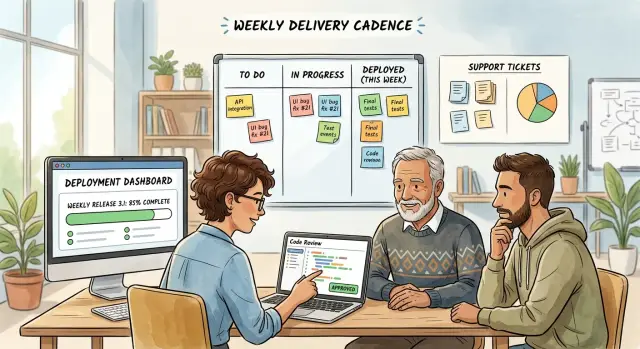
Table of Contents
Why weekly shipping breaks in tiny teams
Weekly releases often fail for a simple reason: a small team carries too many jobs at once. Two or three engineers do product work, code review, testing, deploys, and support. The plan looks fine on Monday, then the week gets chopped into tiny pieces.
Review is usually the first bottleneck. If one person acts as the main reviewer, everyone waits on that person. A single meeting, bug report, or urgent customer question can leave pull requests sitting for hours, and then coding spills into the next day.
Support makes this worse. In a tiny team, the same people who build new work also answer messages, investigate bugs, and calm down nervous users after a release. Even small interruptions hurt. A 15 minute fix rarely stays 15 minutes once someone has to read logs, reproduce the issue, and check that nothing else broke.
Bad weekly planning starts earlier than most teams admit. Work gets pulled into the sprint before anyone agrees on scope, edge cases, or what "done" means. Then the team spends Tuesday and Wednesday discovering hidden steps instead of finishing. That is one reason shipping every week with a small team feels harder than it should.
Deploys also slip because tiny teams wait for a feeling, not a standard. Someone wants one more test. Someone else wants to clean up a small detail. Another person worries that support will get noisy on Friday. The release keeps moving because nobody wants to own the risk.
Small bugs add another drag. None of them look serious on their own, so they stay open. After a few weeks, they start stealing attention every day. Engineers switch from planned work to chasing rough edges, and the week loses its shape.
A common example looks like this: two engineers plan three tasks on Monday. By Wednesday, one is buried in review and customer support. The other finishes code but waits for feedback. On Thursday they find a minor production issue, push the deploy to Friday, then push it again because everyone feels tired. Nothing dramatic happened. The rhythm just broke in five small places at once.
Tiny teams rarely fail because they lack effort. They fail because the week has no protection from review queues, support noise, fuzzy tickets, deploy nerves, and bug debt.
Build the cadence in five steps
Tiny teams do better with fixed timing than with heroic effort. If you want shipping every week with a small team, set a simple rhythm and protect it.
-
Start the week with one short planning slot. Twenty to thirty minutes is enough for most teams. Pick one release goal for the week, one small backup task, and any must-do fix. When the week looks full, stop planning.
-
Cut work into pieces that fit inside one or two days. Each task should end with something real you can test, such as a form, a bug fix, a settings page, or a small backend change. If a task needs a long explanation, split it again.
-
Review code at two set times each day instead of reacting all day. Late morning and late afternoon work well for many teams. This keeps pull requests moving, but it also protects focus. Constant review pings can waste more time than the review itself.
-
Deploy on the same day and at the same time every week. A fixed release window makes shipping feel routine. Everyone knows when to finish, when to test, and when to stay available in case something breaks.
-
Save a small support block each day. Twenty minutes can be enough for customer issues, small production checks, and urgent bug triage. Outside that block, only real incidents should interrupt planned work.
Put these times on the calendar so nobody has to guess. Keep the current week visible in one board or one doc, and resist the urge to keep adding work after Monday. If a new request shows up midweek, trade it for something already planned.
This rhythm looks almost boring, and that is the point. Small teams ship more when the week feels calm, predictable, and easy to repeat.
Plan work that fits the week
Most teams lose the week before they write a line of code. They pack in too much, split attention across too many tasks, and hope nothing goes wrong. That hope is usually where the schedule breaks.
For shipping every week with a small team, pick one outcome that would make the week feel done. Not five. One. It might be "users can invite a teammate" or "billing errors stop showing up in support." If you cannot say the result in one plain sentence, the work is still too fuzzy.
Then keep active work very small. A two or three person team usually does better with two or three tasks in progress total, not per person. When everyone opens too many threads, review slows down, testing drifts, and half-finished work piles up.
Each task needs a finish line that nobody argues about on Thursday. "Improve dashboard" is vague. "Add last-30-days filter, show totals, and track one error in logs" is clear. A good finish line tells the team when to stop.
A simple planning check helps:
- What is the one outcome for this week?
- Which few tasks directly move that outcome?
- How will we know each task is done?
- What can wait until next week?
- Where is the spare time for one surprise issue?
That last question matters more than most teams admit. Leave some room for one bug, one customer problem, or one deployment fix. If your plan fills 100 percent of the week, the plan is already broken.
Cut nice-to-have work early, while it still feels painless. The small extra polish item, the side refactor, the second admin screen - those are often the things that turn Friday into spillover. Keep a parking list and move them there fast.
Oleg often pushes teams toward this kind of narrow weekly scope for a simple reason: small teams move faster when they finish more than they start. That sounds obvious, but many teams still plan as if they had twice the people they actually have.
Keep review and testing moving
If you're shipping every week with a small team, review delays can quietly wreck the plan. The fix is simple: make each change small enough that another engineer can read it in one sitting and understand the risk fast.
Large pull requests invite slow reviews, vague comments, and missed bugs. Small ones move. A good target is a change that takes 15 to 30 minutes to review, not half a day.
When you ask for review, add a short summary. Say what changed, why it changed, what the reviewer should test, and where you feel unsure. Five clear lines save more time than a long thread later.
Keep the merge checks the same every time. People work faster when they know the bar. For most startup teams, that means the same unit tests, the same lint checks, one smoke test for the main user flow, and a quick manual check for anything a customer will notice.
- Keep pull requests small enough to review quickly
- Add a brief summary with test steps and risk notes
- Run the standard checks before asking for review
- Escalate a blocked review on the same day
AI can help with the first draft of the boring parts. It can suggest test cases, write a rough test file, or draft release notes from commits. That works well when someone still reads the output, checks the logic, and fixes the weak spots. AI saves time here, but a human still decides what ships.
Blocked reviews need a fast response. If one engineer waits all afternoon, the whole week starts to slip. Do not let review requests sit in silence. Send a follow-up message, grab ten minutes for a live review, or pair on the tricky part and close the gap.
A simple team rule works well: no review request waits overnight without a response. The response does not need to be a full review. Even a quick note like "I can check this at 3 pm" keeps work moving and stops small delays from turning into missed releases.
Deploy on the same day each week
A fixed release day cuts noise fast. People stop arguing about timing and start shaping work to fit a shared rhythm. For teams shipping every week with a small team, that routine does more than any fancy process.
Pick one day and protect it. Tuesday or Thursday often works well because Monday is messy and Friday leaves little room to react. A few hours before the release, freeze new merges. That pause gives the team time to finish checks, read the final change list, and catch surprises before users hit them.
Small batches are easier to trust. If you hold work for a giant release, review slows down, risk climbs, and support gets rough right after deploy. A weekly release should feel boring. Ship a handful of modest changes together, then do it again next week.
A simple rhythm helps:
- Freeze merges 2 to 4 hours before release
- Run final checks on the exact build you plan to ship
- Let one person deploy and one person stay free for questions
- Ask one person to watch errors, logs, and user reports for the next hour
- Write down what changed before the day moves on
That watcher role matters more than people think. Someone needs to sit with the deploy and look for spikes in errors, slow pages, broken forms, or support messages. If you already use tools like Sentry or Grafana, this is when they earn their keep. Do not make both engineers split attention. One deploys. One watches.
Rollback steps should read like plain instructions, not like a puzzle. "Restore the previous version, check login, check payments, confirm the main dashboard loads" is far more useful than a note that only says "run rollback script." When stress hits, plain language wins.
Before the day ends, write a short release note while the details are still fresh. List what changed, what you skipped, and what needs a quick follow-up next week. That habit saves time during support, planning, and the next release.
Handle support without losing the week
Support work breaks a weekly rhythm when everyone treats every message like a fire. If you want shipping every week with a small team, support needs a lane of its own.
A simple rule helps a lot: one person owns interruptions for a set time, and the other keeps building. You can rotate by day if issues come in often, or by week if support is lighter. The point is not the schedule itself. The point is that only one person gets pulled off track at a time.
When someone is on support, cut their build work on purpose. Do not give them a full feature and then act surprised when it slips. Give them smaller tasks, cleanup work, or bugs they can drop and resume without much cost.
Triage fast and move on
Most teams lose the week because they do not sort requests clearly. Use three buckets:
- Now: production bugs, blocked customers, broken payments, failed deploys
- Later: annoying issues with a workaround, small UX fixes, non-urgent requests
- Not worth it: rare requests, low-impact tweaks, anything that costs more than it gives back
That last bucket matters. Tiny teams do not have the spare time to polish every corner.
Repeat problems deserve attention before rare odd cases. If the same setup question appears three times in a week, fix the docs, the UI copy, or the default behavior. One hour spent there can save five more next week.
Save answers where the team can reuse them
Common questions should become short internal notes. Keep them plain: what happened, how you checked it, how you fixed it, and what to say if it comes up again. A note like that saves time during support and makes handoffs much easier.
This is one place where experienced operators tend to be strict. Oleg Sotnikov often talks about lean teams winning through clear systems, not heroics. Support works the same way. Protect the builder, limit interruptions, and turn repeated noise into a fix.
A simple two-person team example
Most two person teams miss a weekly release because they try to finish a whole roadmap in five days. A better rhythm looks smaller and a little boring, and that is exactly why it works.
Picture Sam and Nina running a small SaaS product. Sam handles backend work and deployment. Nina handles frontend work, QA, and first line support. They want a weekly release cadence they can keep for months, not one good week followed by a crash.
On Monday, they spend about 30 minutes on planning. They pick one change users will notice this week, such as a clearer billing page, and one cleanup task, such as removing a flaky test or fixing a noisy alert. If either item feels too big, they cut scope right away.
Tuesday and Wednesday are for building and merging in small pieces. Sam does not disappear for two days and come back with one giant pull request. Nina does not wait until the end to test everything. They merge small changes as they go, keep notes on edge cases, and leave comments while the code is still fresh.
By Thursday morning, they stop starting new work. They clear the review queue, run through the test cases, and write short release notes in plain language. This pause matters. It keeps Thursday afternoon from turning into a rushed deploy with guesswork.
They deploy on Thursday afternoon, not at night. Then they stay close to the product for a while and watch logs, errors, and customer messages. If something odd appears, they fix it the same day while the change is still easy to reason about.
Friday is lighter on coding. They handle support, clean up loose ends from the release, and write down what blocked them during the week. Then they sketch next Monday's plan. That might be one feature request from users and one maintenance task they kept postponing.
This is what shipping every week with a small team usually looks like in real life: less ambition per week, more finished work, and fewer messy Fridays. By the time the next week starts, they already know what deserves attention first.
Mistakes that ruin the cadence
Teams usually do not lose a weekly release cadence because they lack effort. They lose it because the week gets packed with work that never had a chance to fit. If you want shipping every week with a small team, start by cutting the number of promises you make on Monday.
Too many goals break the whole rhythm. A tiny team should finish one or two meaningful pieces of work, not chase five half-done tasks. When everything feels like a priority, review slips, testing gets rushed, and Friday turns into cleanup instead of release day.
Saving reviews for the end of the day causes a quieter kind of damage. One engineer finishes a change at noon, but the other waits until late afternoon to look at it. That delay sounds small, yet it often pushes fixes into the next morning. After a few days, the team has a stack of pending reviews and no clear picture of what is actually ready.
Support can wreck the week even faster. Tiny teams often treat every message like a fire alarm. Most of those messages are not urgent. If someone stops planned work every time a customer asks a question, the team never gets a clean block of time to finish anything.
A simple rule helps: sort support into three buckets.
- Production issue affecting active users
- Small question that can wait for a scheduled reply window
- Nice-to-have request for the backlog
Bundling risky work into one deploy is another common mistake. A database change, a new payment flow, and a refactor might each be reasonable on their own. Pushing all three at once on Friday is asking for a long night. Small weekly releases work because each release stays boring enough to understand.
A two-person startup team can fall into this pattern fast. On Monday they plan a feature, a refactor, and two customer fixes. By Thursday, one person still waits on reviews, the other is buried in support, and both decide to ship everything together because the week already feels messy. That is how a simple cadence turns into stress.
The last mistake is skipping notes after a bad week. Messy weeks happen. What hurts is forgetting why they went wrong. Write down three things: what got interrupted, what sat too long in review, and what should not have gone into the deploy. Ten minutes of honest notes can save the next four weeks.
A quick weekly checklist
A weekly rhythm breaks faster from small gaps than from big failures. Ten minutes with a short checklist can save a whole week of drift, rework, and late deploys. For a two or three person team, that habit matters more than another project board.
- Pick one outcome that must be true by the end of the week. Keep it concrete. "Improve onboarding" is fuzzy. "A new user can sign up and reach the dashboard without help" gives the team a clear target.
- Give each task one owner and one finish line. Small teams lose time when work sits in the last 10 percent because nobody owns the final test, copy change, or deploy step. Every task needs a person and a plain definition of done.
- Check whether the team can deploy without waiting for one specific person. If only one engineer knows the release steps, has the right access, or feels safe touching production, the cadence will slip. Write the steps down, keep access current, and let someone else run the release now and then.
- Leave room for support and bug fixes before the week starts. If the plan fills 100 percent of engineering time, support will eat the release. A small buffer keeps urgent fixes from wrecking the whole schedule.
- Review what slipped after the release and name the reason. Be blunt. Was the scope too big? Did support interrupt the week? Did review stall? Did testing take longer than expected? One honest sentence per slip is enough.
This checklist works because it forces simple choices. One outcome. One owner. One release path. One small review at the end. Teams that keep those four things clear usually ship more often and argue less about why work did not move.
Next steps if your team feels stuck
When a small team slows down, the usual reaction is to add a new ritual, a new board, or one more approval step. That often makes the week heavier, not clearer. Cut one meeting before you add a new process.
Then spend two weeks watching the work instead of debating it. Track three numbers: cycle time, review wait time, and support load. If a task takes five days but sits in review for two of them, the problem is not planning. If support interrupts the team ten times a day, the release plan is not the first thing to fix.
A simple reset looks like this:
- remove one recurring meeting that does not change decisions
- track the three numbers for two weeks in the same place
- pick one repetitive task for AI help
AI is most useful on the boring, repeated work. A small team can use it to draft test cases, suggest review comments, summarize bug reports, or turn code changes into release notes and internal docs. That saves real time, often 20 to 30 minutes a day per person, and it keeps engineers focused on shipping instead of admin.
If you try that and the team still stalls, bring in an outside eye. A good Fractional CTO can spot where your cadence breaks: too much work in progress, slow reviews, risky deploys, or support that never gets contained. The fix is usually smaller than people expect.
Oleg Sotnikov works with startups and small companies on this exact problem. His background includes running lean, AI-augmented engineering operations and simplifying planning, releases, and support without adding extra overhead. Sometimes one short review of the cadence is enough to cut the noise and get the team shipping every week again.


