Single-tenant support model before you price hardware
Use a single-tenant support model to price upgrades, data fixes, and exception requests before you quote isolated hardware.
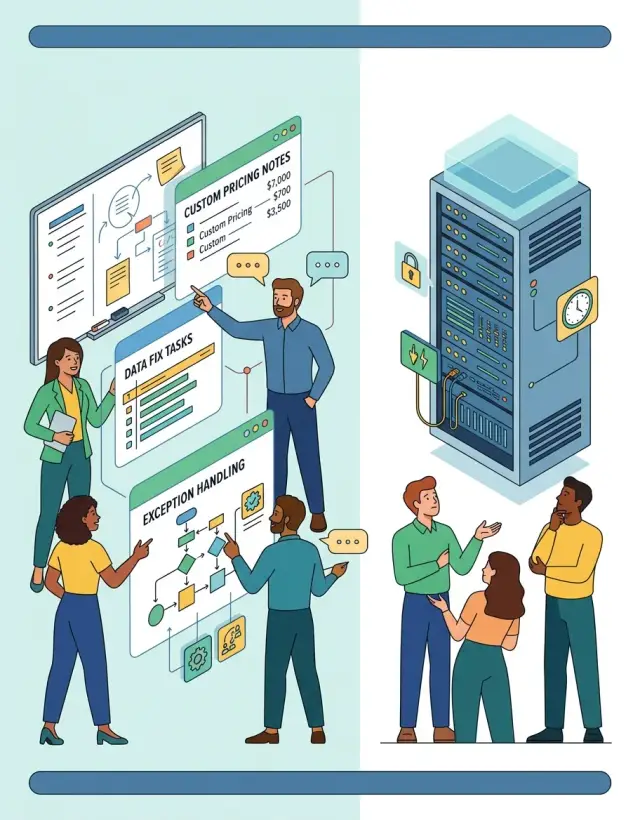
Table of Contents
Why these requests get messy fast
A "single-tenant" request sounds simple. One customer wants their own setup, you price the extra servers, and the deal moves forward.
That shortcut causes problems because customers use the same phrase for very different needs. One buyer wants strict data separation for compliance. Another wants delayed upgrades, faster help when data breaks, or approval for exceptions that regular customers don't get. Those are different jobs with different costs.
Most teams hear "single-tenant" and think about infrastructure first. In practice, support work usually creates more pain than the hardware. Before you estimate servers, you need to know what the customer is actually asking for:
- a separate database or environment
- off-cycle upgrades and release windows
- manual data fixes
- custom billing, access, or integration rules
- named people for urgent exceptions
Only the first item is mostly an infrastructure question. The rest need owners, limits, and a clear process.
This is where margins disappear. A dedicated server adds a clean monthly cost. Manual work doesn't. A customer asks for a pricing change outside the standard plan, then wants a historical data correction, then needs a hotfix on their own schedule. The hardware invoice stays tidy. The labor bill spreads across support, finance, operations, and engineering.
So the order matters. Build the single-tenant support model before you quote isolated hardware pricing. Count the requests that break the normal path. Decide who approves them, who does the work, how fast the team responds, and when the customer pays extra.
If you skip that step, you quote a server number for a service problem. The customer thinks they bought isolation. Your team learns later that they also bought custom operations.
What a single-tenant request usually means
A single-tenant request rarely starts with servers. It starts when one customer wants the product to work a little differently, and your team says yes often enough that the extra work becomes normal.
One customer asks for a pricing change that doesn't match any public plan. Another imports bad data and wants your staff to correct thousands of rows. A contract adds special approval rules, so refunds, exports, or access changes need extra checks. None of that points to isolated hardware first. It points to support work.
That work often lands outside the product itself. Finance approves one-off billing changes. Support runs manual corrections. Operations handles contract exceptions. Engineering writes scripts or repairs records in production. The hidden cost sits in Slack threads, admin panels, spreadsheets, and after-hours approvals.
Patterns matter more than one noisy request. If custom upgrades keep showing up, you need an upgrade request policy. If the same import mistakes happen every week, you need a data fix process and probably a better import flow. If contract terms keep forcing side paths, you need clear exception handling with named owners and response limits.
A small example makes this obvious. Say a customer pays for a private setup and then asks for special pricing on extra seats, monthly cleanup of import errors, and approval from their compliance manager before every export. The server bill looks simple. The real cost comes from repeated manual work that your product still can't do on its own.
Hosting isolation starts to matter after these requests become steady and predictable. When the same customer needs the same exceptions month after month, you can estimate effort, document the rules, and decide whether separate infrastructure makes sense. Before that, the safer move is to map the work, count who touches it, and charge for the process you actually run.
Sort the work before you quote
A single-tenant request often looks like a hosting question. Most of the time, it's a support question first.
Start with real requests from the last quarter, not guesses. Support inboxes, internal chats, and engineering tickets tell you what this customer type actually asks for. That history is more useful than a rough estimate for hardware alone.
Use a simple review:
- gather every custom request from the past 90 days
- note who handled it each time
- count how often it came up
- mark which requests pulled in engineers
- separate one-off fixes from work that repeats
This does two things quickly. First, it shows whether the customer mainly needs privacy and isolation or a custom operating model. Second, it gives you a cost base tied to labor, not just servers.
The split between quick fixes and ongoing custom work matters a lot. A one-time data correction might take 30 minutes and never come back. A customer-specific upgrade window creates work every release. Manual exception handling sounds small in a sales call, but it can come back every week.
Watch for requests that cross team lines. If support can solve an issue alone, the cost usually stays contained. If support needs product, engineering, and operations every time, that request belongs in your support model and needs a clear price or a hard limit.
Teams that skip this step usually underquote. They price a box, then end up running a special service lane for one account. Once you can see the request pattern, the hardware quote gets easier and much more honest.
Build the support model first
Most teams jump to servers too early. The real work starts with support rules, because that's where cost, delays, and customer tension show up first.
Start by naming the request types you'll accept. Keep the list narrow and plain: pricing changes, billing corrections, data fixes, access changes, and one-off product exceptions. If a request doesn't fit one of those buckets, stop and decide whether it belongs in product, support, or custom engineering.
Then give each request type one owner. Don't assign a committee. Billing issues might go to finance, data fixes to engineering, contract exceptions to a founder or CTO, and access requests to support. One owner doesn't mean one person does all the work. It means one person decides what happens next and closes the loop.
Set response times your team can actually keep. Promise less than your best day. If data fixes usually take two business days, say two business days. If approvals happen in a weekly review, say that too. Clear timing beats vague promises every time.
Write approval rules before the first urgent call. Keep them short:
- what support can approve on its own
- what needs finance or product input
- what needs CTO sign-off
- what manual work costs
- what you won't do
This is where exception handling often breaks down. Teams say yes once, then carry that promise forever. Every exception needs a reason, an approver, and an end date. If the customer wants the same special treatment every month, it isn't an exception anymore. It's a custom service.
Only move the conversation to infrastructure when the customer truly needs isolation. That usually means legal separation, strict security controls, customer-specific deployment windows, or data residency rules your shared setup can't meet. Faster support, custom pricing, or occasional manual fixes don't justify isolated hardware pricing on their own.
If you run a lean team, this order matters even more. Clear ownership and approval rules save hours every week, and they stop small requests from turning into expensive architecture decisions.
A simple SaaS example
A B2B SaaS company sells team subscriptions. One customer changes plans twice in a month, and billing goes sideways. The invoice shows the wrong seat count, a manual discount stays on the account, and an automatic renewal fires on the old plan.
The customer gets upset and asks for a private instance so "billing problems stop happening." That sounds like a hosting request. Usually it isn't.
When the team traces the issue, they find an ownership gap. Support can add credits, but finance has to approve reversals. Engineering has to repair a broken subscription record. Someone also needs to clean up duplicate workspace data created during the plan change. One angry ticket becomes a chain of small jobs.
A week later, the time log tells the real story:
- 40 minutes for support to verify charges and answer emails
- 25 minutes for finance to approve a partial reversal
- 90 minutes for engineering to repair account data
- 30 minutes to test the account before reopening access
- 20 minutes for internal handoffs and updates
The server cost is easy to see. The messy part sits in credits, reversals, approvals, and data repairs that cut across teams.
So the company pauses the hosting quote. First, they tighten the request flow. Support gets a rule for when it can issue credits. Finance gets a short path for reversals. Engineering gets a checklist for account repair and data cleanup. One person owns the case from start to finish.
Only after that do they price custom hosting. The first rough quote looked cheap because it counted servers and setup. The final quote is higher, but it's honest. It includes support time, finance review, engineering cleanup, and the extra work created by one-off exceptions.
That changes the decision. Sometimes the customer still wants a private instance. Sometimes they just want fewer billing errors and faster fixes. Those are different problems, and they need different prices.
What to price besides servers
A single-tenant request rarely stays limited to compute, storage, and backups. The server bill is the easy part. The real cost shows up when the customer wants changes outside your normal plan and your team has to handle them by hand.
Start with staff time around plan changes. Someone has to upgrade accounts, reverse billing mistakes, undo an early move, or switch features on and off when the customer changes scope. Each task looks small on its own. Together, they add up quickly.
Production data work is another line item teams often miss. If a customer asks for an import fix, record cleanup, or a manual correction after a failed sync, an engineer has to touch live systems carefully. That work is slow for a good reason. People need to review the request, make the change, verify the result, and document what happened.
You also need to price approval time. Once a request falls outside standard policy, a manager usually steps in to decide whether the team should do it, how much risk it adds, and who signs off. Even a 15-minute review becomes real cost if it happens every week.
On-call support changes too. A custom environment often brings custom alerts, custom deployment timing, and custom expectations when something fails at night or on a weekend. If your team carries that burden, the quote should show it.
A simple pricing structure usually includes:
- admin time for upgrades, downgrades, and reversals
- engineering time for production data fixes
- manager time for exceptions and approvals
- on-call coverage for the custom setup
- a budget for ongoing change requests
That last item matters more than many teams expect. Once a customer pays for isolation, they often start asking for extra reports, custom rules, and special rollout timing. That's not a server cost. It's operating overhead and roadmap pressure.
This is often an operating model problem before it's an infrastructure problem. Oleg Sotnikov makes that point often in his advisory work: if you price the machines and ignore the people around them, you'll almost always undercharge.
Mistakes that lead to bad deals
Bad single-tenant deals often start with one wrong assumption: the customer asked for private infrastructure, so the problem must be infrastructure. Usually it isn't. The harder part is the human work around it - custom upgrades, one-off data fixes, urgent exceptions, and the small requests that land in support every week.
Teams get into trouble when they quote isolated hardware pricing before they define who handles those requests, how fast, and under what limits. A private deployment without clear rules turns into a standing promise to do extra work on demand.
Small manual tasks cause more damage than people expect. One data export, one billing correction, one import script, one delayed upgrade on a custom branch - each task looks cheap alone. Put them together over six months and someone on the team now spends hours every week on work nobody priced.
The pattern is common:
- sales says yes to exceptions to close the deal
- product keeps normal releases moving
- support handles special cases by hand
- engineering gets pulled into fixes that don't help other customers
- finance wonders why the account feels busy but not profitable
This gets worse when nobody writes an upgrade request policy or a clear data fix process. Then every request becomes a debate. The customer thinks the team promised flexibility. The team thinks the request is outside scope. The contract stays vague enough for the same argument to happen again.
Another expensive mistake is skipping exit rules. If the custom setup stops making sense, you need a path back to the standard product, a higher fee, or a clean offboarding plan. Without that, a temporary exception becomes permanent.
A better start is boring, and that's fine. Define support hours, response times, upgrade windows, data change limits, and exception approvals. Quote hardware after that. If the support model already looks messy on paper, the deal will look worse in real life.
Quick checks before you say yes
Before you approve a single-tenant request, test whether the problem is really infrastructure. Many customers ask for a private setup when what they actually need is faster answers, a defined data fix process, or a written rule for unusual cases.
Use a short check before you send a quote:
- Can your current product meet the need with stricter service rules, better response times, or a dedicated support lane?
- Who approves upgrades, hotfixes, data repairs, and one-off requests, and who does the work?
- How many hours will this account need in a normal month and in a messy one?
- Does the customer need isolation for compliance or risk, or are they asking for reassurance?
- If you say yes once, will three more customers ask for the same deal next quarter?
The fourth question matters more than most teams expect. A customer may ask for isolated hardware because they fear bad imports, delayed fixes, or surprise changes. In that case, a private environment doesn't remove the real risk. A clear policy often does.
Take a simple case. A customer wants their own instance after one painful import. If your team already has an import review step, a rollback plan, and a named person who can approve fixes, that may solve the problem for a fraction of the cost. If nobody owns those actions, a separate server only hides the gap for a while.
Price the monthly support load before you price hardware. Include routine work, after-hours interruptions, upgrade coordination, and the time spent saying no to requests outside policy. Lean teams learn this quickly: one "special" customer can quietly consume more time than ten standard accounts.
One final test helps. Ask whether this request should become a repeatable service tier. If the answer is yes, write the rules now. If the answer is no, charge enough for the exception or decline it. That's usually cheaper than cleaning up a bad promise six months later.
What to do next
Start with your last ten custom requests. Don't treat them as sales wins or annoying edge cases. Treat them as support work that already showed you where the product bends.
Group each request by type. A pricing change is different from a data fix. A one-off import is different from an exception in business rules. Write down who handled it, how long it took, whether it touched production data, and whether the same request came up again.
Most teams end up with a short list:
- plan or pricing changes
- data repair or migration work
- custom workflow exceptions
- urgent support outside normal hours
- tenant-specific infrastructure requests
Once the pattern is visible, turn repeat work into policy. Keep it plain. Say what you do, what you don't do, what response time applies, and what each request type costs. If a customer asks for a manual data repair twice in six months, that isn't a surprise anymore. It's a service line.
Only quote isolated infrastructure after you can map the support work around it. If you can't explain who handles upgrades, who approves exceptions, who fixes broken data, and what happens on a weekend, you don't have a full offer yet. You have a partial number.
A short pricing table usually works better than a long proposal. Keep one row for setup, one for recurring infrastructure, and one for support items outside standard service. Customers usually accept clear boundaries faster than fuzzy promises.
If the request mix still feels messy, get a second opinion before you commit. Oleg Sotnikov writes about these tradeoffs on oleg.is and advises startups as a Fractional CTO. A short review before you promise single-tenant support is often cheaper than carrying an underpriced custom service for the next year.
Frequently Asked Questions
What does a single-tenant request usually include?
Usually it includes more than a separate server. Most teams also end up handling custom billing, data fixes, off-cycle releases, access exceptions, or named approvals for unusual cases.
Should I price the hardware first?
No. Quote the support model first, then price the hardware.
If you start with servers, you miss the labor that usually eats the margin.
When does a private instance actually make sense?
A private instance makes sense when the customer needs real isolation for legal, security, data residency, or deployment control reasons.
If they mainly want fewer mistakes, faster replies, or special handling, process changes often solve the problem better.
Why do these deals become unprofitable so fast?
Margins shrink because manual work spreads across support, finance, operations, and engineering. The server bill stays clear, but approvals, corrections, and exceptions keep coming back.
How do I estimate the real cost of this deal?
Start with real requests from the last 90 days. Check what the customer asked for, who handled it, how often it repeated, and where engineers got pulled in.
That gives you a cost based on actual work instead of guesses.
What needs an approval rule before I say yes?
You need rules for anything that breaks the normal path. That usually means pricing changes, billing corrections, data repairs, access changes, hotfix timing, and contract exceptions.
Give each request one owner so someone can make a decision and close the case.
Can better support rules solve this without separate infrastructure?
Yes, often it can. If the real problem is import mistakes, billing confusion, or slow exception handling, a clear policy and a named owner may fix it without isolated infrastructure.
A separate environment does not remove messy internal handoffs.
What should I include in the price besides servers?
Price the people around the environment, not just the machines. Include admin time for account changes, engineering time for production fixes, manager time for approvals, and after-hours support if the customer expects it.
Leave room for ongoing custom requests too.
What are the biggest red flags before approving a single-tenant deal?
A big red flag is a vague promise like "we'll handle exceptions as needed." Another one is a deal with no owner, no response times, and no limit on manual work.
If you cannot explain who approves what and when, the quote is too thin.
What should my team do next if these requests keep coming up?
Review your last ten custom requests and group them by type. Turn repeat work into written policy, set response times, assign owners, and only then quote isolated infrastructure.
If the work still looks messy on paper, charge more for the exception or decline it.


