Simpler service boundaries for better uptime and less sprawl
Simpler service boundaries cut failure paths, reduce noisy dependencies, and make outages easier to find, contain, and fix before users feel them.
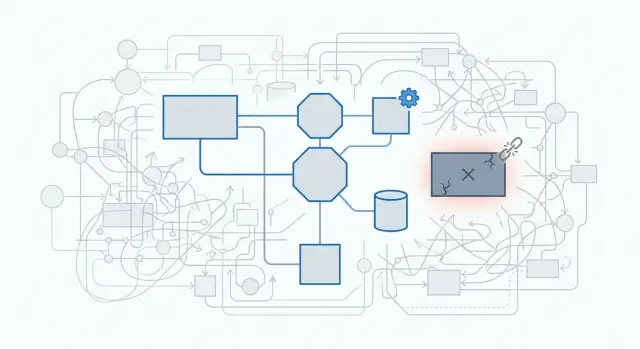
Table of Contents
Why more services often mean more downtime
Every extra service call gives your system one more chance to fail. A request that once stayed inside one app now depends on a network hop, another process, another timeout, another deploy, and another set of logs. If any one part slows down or breaks, users see the same result: your product stopped working.
That is why simple service boundaries usually help uptime. A small split can make sense when it isolates one clear job. A messy split does the opposite. One bug turns into retries, queue backups, stale caches, and alerts firing all over the place.
The hardest part often is not the first failure. It is the time your team burns trying to find it. One dashboard shows high latency, another shows healthy containers, and a third shows a spike in background jobs. Support keeps getting messages from users who do not care whether auth is healthy while billing is down. They only know checkout failed.
Platform sprawl makes incident response slower too. When five teams own five services, the first 20 minutes of an outage often go to figuring out who should even look at it. That delay matters. Small problems stay small when one person can trace the path quickly and fix it.
A common failure chain is simple: service A times out on service B, service A retries and adds more load, queues fill up, alerts fire in several places, and users start hitting errors across the product. It is a boring pattern, but it happens all the time.
Fewer moving parts do more than cut cost. They make failure areas clearer, debugging faster, and incidents shorter. More services can help when the boundaries are real and stable. Many teams split too early, then spend months babysitting the seams. Users pay for that choice every time a small fault spreads across the whole app.
What a boring service boundary looks like
A good boundary feels almost plain. One service does one user-facing job, and most of the code and data it needs live in the same place. If users update a subscription, one service should handle the request, write the new state, and return a clear result.
Teams get into trouble when they split that flow too early. They add one service for validation, another for writes, another for events, and another for notifications. Now a simple change depends on several calls, several timeouts, and several new places to fail.
A boring boundary keeps the write path short. The code that changes a record sits close to the table or document it changes. When something breaks, the team can trace the problem fast instead of jumping between tools and guessing which hop went bad.
You should be able to answer a few basic questions in under a minute: what request comes in, what response goes out, how long the service waits before timing out, and who owns it when it breaks. If those answers are fuzzy, the boundary is fuzzy too.
Ownership matters more than naming. One team, or even one person in a small company, should own the service day to day. Shared ownership sounds safe, but it often leads to slow fixes, vague on-call work, and bugs bouncing around until users complain loudly enough.
A boring service also makes failure easy to spot. Logs should show the request, the decision, and the result. Metrics should tell you when errors rise, response time gets worse, or a dependency stops answering. You should not have to rebuild one user action from three queues and a pile of IDs.
Clear limits help even more. A service should accept a small set of inputs, return a small set of outputs, and fail in ways the team already expects. If the email provider is down, the welcome email can wait while account creation still works. Users see a delay, not a full outage.
That kind of setup is not flashy. It is easy to run, easy to debug, and much easier to trust.
Where platform sprawl usually starts
Platform sprawl rarely begins with a messy plan. It usually starts with a reasonable choice that gets copied a few more times until the stack is much wider than the product needs.
A common trigger is imitation. A startup sees how a large company splits auth, users, billing, notifications, search, and reporting into separate services, then copies the pattern on day one. The diagram looks clean, but the team does not have the same traffic, staff, or operational needs.
Every extra boundary creates work. One user action can turn into five network calls, several deploy pipelines, more secrets, more logs, and more places for a timeout to hide. Teams drift away from simple service boundaries without really noticing.
Sprawl also grows from small defensive choices. A rare incident leads to a permanent new tool. One team adds a shared platform layer, but no one owns its uptime or cost. A vendor setup enables extra components by default, and nobody removes them. Engineers split a service early because they think it might need scale later.
The edge-case problem shows up fast. A payment retry fails once, so the team adds a queue, a workflow tool, and a worker service. Months later, the original bug is gone, but the queue still needs monitoring and the worker can still fail on its own.
Shared platforms create another trap. Teams build a common gateway, internal package, job runner, or event bus for everyone to use. Soon many products depend on it, but nobody has clear authority to simplify it, retire old parts, or say no to one more feature.
Vendors make this easy to miss. Cloud dashboards keep suggesting another proxy, another storage layer, another monitoring agent, another managed service. Each one sounds harmless. Together they widen the failure area.
Teams that cut back later usually find that uptime improves when ownership gets tighter and the request path gets shorter. That matches the lean approach Oleg Sotnikov has used in production systems: fewer layers, clear responsibility, and only the parts that earn their place.
If a team cannot explain who owns a layer, why it exists, and what breaks when it fails, that layer is often where sprawl began.
How simpler parts raise uptime
Uptime usually drops at the edges. A request leaves one service, crosses the network, waits on another service, and picks up new ways to fail at every hop. Simple boundaries cut down those weak points. If one app can finish a task with one database call and one background job, you remove a lot of random breakage before it starts.
Fewer network calls matter more than many teams expect. One extra hop can fail because of DNS, a timeout, a bad certificate, a retry loop, or stale service discovery. None of those problems care whether the business logic is correct. They break the path anyway.
Rollbacks get much easier when a change stays inside one clear boundary. If a release touches one service and one schema, the person on call can test it, revert it, and move on. If the same release spreads across an API gateway, a queue, two workers, and a policy change, rollback stops being a quick fix and becomes a small incident of its own.
That speed matters at 2 a.m. The best setup is often the one where an engineer can run the whole user path on one machine, click through it, and see the same failure the user sees. Local testing is not glamorous, but it cuts guesswork. You spend less time asking which service lied and more time fixing the bug.
Clear boundaries also stop failures from spreading. If the email sender breaks, account creation should still work and the system should queue the email for later. If analytics goes down, checkout should not care. A boring boundary makes that choice obvious because each part has one job and a small failure area.
Deployment gets calmer too. Fewer services usually means fewer environment variables, fewer secrets, fewer version mismatches, and fewer places where staging drifts away from production. A lot of outages start with config drift, not bad code.
Oleg Sotnikov has pointed to this tradeoff in his own work. Near-perfect uptime does not usually come from heroics. It comes from architecture discipline. When the stack has fewer moving parts, people spend less time babysitting it and more time improving it.
How to simplify a busy stack step by step
Start with one user journey that breaks often and annoys real people. Good choices are signup, checkout, password reset, or the first dashboard load after login. If support keeps hearing about one path, start there. It gives you a clear place to cut sprawl without guessing.
Map that journey from click to result. Put every hop on one page: browser, frontend, main API, auth check, database call, queue, worker, email send, analytics event. A lot of stacks look fine in architecture diagrams and messy in real life. When one button press crosses nine services, uptime depends on all nine behaving at once.
Then sort the hops by purpose. Keep the parts that enforce security, apply business rules, or store data. Question the parts that only reshape a payload or pass it to the next service. Thin services that mostly forward data often add more alerts than value.
As you simplify, keep one owner on every boundary that stays. One team should decide changes, watch errors, and fix breakage. If nobody owns a boundary, outages last longer because everyone waits for someone else to move first.
Do the cleanup one dependency at a time, then measure what changed. Watch how often that path fails, how long recovery takes, and whether support tickets drop. This is slower than a rewrite, and that is a good thing. Small removals are easier to test and easier to roll back.
Teams that push toward simpler boundaries usually get the same payoff: fewer moving parts, cleaner failure areas, and calmer on-call shifts.
Example: a startup signup flow with too many hops
A common startup mistake is making signup do too much before the user even gets an account. The team wants every new user to land in a fully prepared workspace, so the form triggers a long chain of calls the moment someone clicks "Create account."
First the app creates credentials in auth. Then it opens a profile record, sends a welcome email, logs an analytics event, and tries to attach a billing customer. Only after every call returns does the screen show success.
That looks neat on a diagram. In production, it is fragile.
If billing slows down for three seconds, signup feels broken even though auth works fine. If the email provider times out, the whole request can fail. If analytics has a bad deploy, new users may never reach the product. One weak dependency becomes a gate for the whole flow.
The fix is usually less dramatic than teams expect. They do not need five services to agree before a person can start using the app.
Keep one hard requirement: create the account. Fold profile setup into the main app, where it is just a database write next to user creation. That removes a network hop and one more place for partial failure.
Move email and analytics after account creation. The app can send those tasks in the background, retry them later, or even drop an analytics event if needed. None of that should block someone who just wants to sign up.
Billing often belongs later too. If the product has a trial, the app can create the billing customer when the user reaches the paywall instead of during signup. That keeps the first step short and easier to trust.
The result is boring in the best way. Signup succeeds more often because it depends on fewer moving parts. When email or analytics breaks, the team gets a smaller problem to fix and new accounts still work.
That is what simple service boundaries look like in practice: one path for account creation, and separate paths for everything else.
Mistakes that make outages harder to contain
Outages spread when a small request crosses too many hands. A bug that should affect one screen ends up touching five services, two message systems, and a shared database. Then nobody knows where to stop the blast radius.
One common mistake is splitting services by org chart instead of user flow. Team A owns accounts, Team B owns profiles, Team C owns notifications, so one simple action gets chopped into pieces because the company is chopped into pieces. Users do not care about those lines. If signup is one task from the user's point of view, keep as much of it together as you can.
Another mistake is pushing simple request work into async messages. If a user clicks "Create account" and expects a result now, a direct request is usually easier to reason about. Queues help when work can wait, retry, or run in the background. They make basic request-response flows harder to trace, slower to debug, and easier to lose in the middle.
Things get worse when teams add both a queue and an event bus for the same job. That often starts as "future proofing" and ends with duplicate paths, duplicate failures, and duplicate confusion. One path is usually enough.
Sharing one database across many separate services is another trap. The services look separate on a diagram, but they are still tied together at the data layer. A schema change, slow query, or bad migration can hit all of them at once. Simpler boundaries work better when each service has clear control over its own data.
Ownership matters just as much as architecture. When a central internal team controls the plumbing but nobody on that team carries a pager for the business outcome, issues linger. The product team thinks "infra owns it." The infra team thinks "the app team changed something." Meanwhile the outage keeps growing.
A few warning signs usually show up early. One user action depends on more than two or three synchronous hops. Different teams can deploy parts of the same flow without talking. More than one team can break the same database. Alerts fire, but no single team owns the fix.
The boring setup is often the safer one. Fewer moving parts make failure isolation real instead of something that only looks good on an architecture slide.
Quick checks before you add another service
Most teams do not add a service because they truly need one. They add it because the diagram looks cleaner. Production does not care about diagrams. If one process still handles the traffic, prove that it cannot keep up before you split it.
Start with load. Measure what the current process does on a normal day, during a spike, and after a bad deploy. If it still has room, a new service may only give you another place to time out, queue up, or fail.
Then ask about ownership. When the new thing breaks at 2 a.m., who gets paged, and will that person know how to fix it quickly? If the answer is "the team will sort it out," that is not ownership. That is a future outage.
Next, look at dependency failure. Ask a blunt question: if this service or vendor goes down, what stops working right away? A good boundary keeps the damage narrow. A bad one turns one fault into login problems, checkout problems, and a long support day.
Local development is a quiet test that catches bad ideas early. A developer should be able to run the service on a laptop in a few minutes, with test data if needed. If setup needs five containers, three secrets, and unwritten steps, the service already costs too much to maintain.
Rollback should feel boring too. You should know which version to restore, which config to revert, and how to do it without touching six other systems. If a rollback needs a long runbook and perfect timing, the design is too tangled.
A simple review before adding anything new usually comes down to five answers. The current process is near its real limit, not an imagined one. One team owns failures and fixes them. The blast radius stays narrow when a dependency dies. A developer can run and test the service quickly. Reverting a bad release takes minutes, not an evening.
That bias toward fewer moving parts is one reason Oleg Sotnikov favors lean systems when helping teams keep uptime high and costs under control.
What to do next
Pick one real customer path this week and trace it end to end. Do not choose a rare admin task. Choose something people use every day, like signup to first payment or login to first saved action, and count every hop, queue, API call, and background job on that path.
That count tells you where to act first. If one dependency causes most of the alerts, timeouts, or retries, cut that one before you touch anything fancy. Teams often waste weeks debating architecture while the same noisy service keeps breaking the path people actually use.
Keep the review short. Write the path on one page in order. Mark who owns each service. Note where a failure stays local and where it spreads. Circle the dependency that creates the most noise. Then decide whether you can remove it, merge it, or simplify it this month.
This works because uptime usually improves through fewer moving parts, not through more tooling. Simple service boundaries make failures easier to spot and easier to contain. When one service has a clear job, one owner, and one small failure area, on-call work gets calmer fast.
Also write down the failure boundary for each service in plain language. If this service slows down, who feels it first? If it goes down, which part of the product should still work? If nobody can answer in one sentence, the boundary is probably too fuzzy.
If your stack feels busy and nobody trusts the diagram anymore, an outside review can save time. A fractional CTO can look at the architecture, call out the uptime risks, and tell you which parts add real safety and which parts only add hops. Oleg Sotnikov does this kind of work through oleg.is, with a focus on simpler systems, lower cloud spend, and practical AI-first operations for small teams.
By the end of the week, aim for three concrete things: one path mapped, one noisy dependency chosen, and one change scheduled.
Frequently Asked Questions
Should I split a service just because the codebase is getting bigger?
Usually no. A bigger codebase alone does not justify a new service. Split only when one part has a stable job, a real reason to scale or deploy on its own, and one team that will own it every day.
How many synchronous service calls are too many for one user action?
Treat more than two or three synchronous hops as a warning sign. Each extra call adds another timeout, retry, and failure point. Keep the write path short, especially for signup, login, and checkout.
What should stay inside the main request for signup or checkout?
Keep only the work the user needs right now. Create the account, save the order, or confirm the payment first. Move email, analytics, and other side work to the background or to a later step.
Are queues always better for reliability?
No. Queues help when work can wait or retry later. If the user expects an immediate result, a direct request is often easier to trace, test, and fix.
What does a good service boundary look like?
One service does one user-facing job, keeps its write path short, and owns its own data and logic. The team should know the input, output, timeout, and owner without digging through docs.
Why do outages last longer in a sprawling system?
Because teams lose time before they even start fixing the bug. They jump between dashboards, argue over ownership, and trace too many hops. A shorter request path and one owner cut that delay fast.
Should separate services share one database?
Usually no, not if you want real isolation. A shared database ties those services together, so one slow query, migration, or schema change can hit all of them. If they share the same data store deeply, treat them as one boundary.
What is the first step to simplify a busy stack?
Start with one customer path that breaks often, like signup or first payment. Map every hop on one page, mark who owns each part, and question the services that mostly forward data without adding business value.
How can I tell if a new service is actually worth adding?
Check the boring stuff first. Can one team own failures at 2 a.m., can a developer run it on a laptop quickly, and can you roll it back in minutes? If not, the new service will likely add more pain than value.
Can simpler architecture lower costs and improve uptime at the same time?
Yes, often it can. Fewer services usually mean fewer proxies, secrets, deploy steps, and monitoring gaps. You spend less on cloud and less time chasing small failures, as long as you do not merge unrelated work into one messy app.


