Why senior employees quit after AI rollout at work
Learn why senior employees quit after AI rollout and how to fix unclear ownership, shifting goals, and weak review loops before teams burn out.
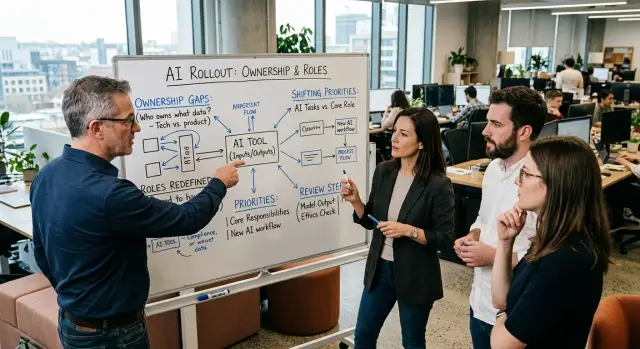
Table of Contents
What changes after the rollout
The first shift usually is not technical. It is social.
A senior engineer, designer, or manager can go from owning a decision to watching it get split across a prompt library, a new approval layer, and three people who now "review AI output." That loss of control lands hard. Most senior staff can handle change when they still make the final call. They pull back when they still carry the risk but no longer have the authority.
If a model drafts code, specs, or customer replies, someone still decides what ships. When that line is blurry, trust drops fast.
Work also gets heavier in a way many managers miss. Teams add prompt checks, AI experiments, tool training, and extra review steps on top of the old job. The old meetings stay. The old reports stay. The old deadlines stay. People are not rejecting the tool as much as they are rejecting two jobs squeezed into one.
Review queues often grow faster than output. AI can produce ten drafts in the time one person used to make one. That sounds efficient until one senior person has to check all ten. Their day turns into screening, correcting, and explaining. The deeper work disappears, and their role starts to feel wasted.
That is why senior people often leave after an AI rollout for reasons that have little to do with the tool itself. The team changed decision rights, added noise, and built a weak review process.
A simple example shows it. A product lead used to approve scope with one engineering manager. After AI adoption, marketing asks for AI-generated variants, engineering wants prompt review, legal adds another check, and leadership expects faster output because "the tool is helping." Nothing got simpler. The team just covered old process problems with new software.
When people blame the tool, they are often reacting to confusion.
Where authority breaks
When senior employees quit after AI rollout, leaders often blame the tool first. In many teams, the real problem is simpler: leaders take away judgment and keep the responsibility attached to it. Senior people still answer for quality, delivery, and risk, but they no longer control the choices that shape those results.
The break usually starts when nobody states which decisions still belong to experienced staff. A senior engineer may still need to own release risk, coding standards, and exceptions to the usual process. A product lead may still need to own scope, trade-offs, and what reaches customers. If those calls drift upward to one manager or sideways to a new AI working group, senior people stop acting like owners because they are no longer allowed to.
A few questions expose the problem quickly. Who decides whether AI-generated work is good enough to ship? Who can reject a tool even after leadership has paid for it? Who sets the review bar for risky changes? Who makes the final call when speed and quality conflict?
Teams also mix up tool choices and product choices. They are different. Choosing an AI assistant, model, or code review setup is an operating decision. Choosing what customers see, what gets delayed, or what level of risk is acceptable is a product decision. When one person tries to approve both, the team slows down and senior staff lose room to think.
The worst version is the single-manager funnel. Every prompt library, test plan, release note, and automation rule goes through one department head. That person becomes the bottleneck, and everyone else learns to wait. Good people hate that setup. They did not stay for years just to ask permission for routine calls.
Fixing this does not require a thick AI policy document. It requires visible ownership in each workflow. For code, name the reviewer with final sign-off. For support automation, name the person who owns customer impact. For internal process changes, name the manager who approves routine changes and name the cases that need escalation. A one-page chart often clears more tension than another meeting.
Why noisy priorities push people out
Senior people usually do not leave because a new AI tool is hard to learn. They leave when the work stops making sense.
After an AI rollout, the number of possible tasks rises fast. Teams suddenly have prompt tweaks, review questions, policy debates, automation ideas, data cleanup, and one-off requests from every department. If leadership still talks about weekly goals while the team spends each day reacting to interrupts, the job starts to feel fake.
That gap matters. A senior engineer, designer, or product lead wants to finish work that moves the company forward. If they keep dropping one task to pick up another, they stop feeling useful.
A common pattern looks like this. The team starts the week with a clear plan to improve one customer support workflow. By Tuesday, sales wants a custom AI demo. On Wednesday, someone asks for an internal assistant for HR. On Thursday, leadership wants a new evaluation sheet for generated content. None of those requests sounds crazy on its own. Together, they destroy momentum.
The problem is not extra work. It is constant restart.
Every restart has a cost. People lose context and need time to get back into the problem. Reviews happen on half-finished work. Bugs slip in because nobody stays with one task long enough. Sprint plans stop meaning much because everyone expects them to change.
Teams can fix a lot of this with tighter priority rules. Compare the weekly goal with the actual daily interrupts. If side requests keep jumping the queue, cut them, batch them, or make a leader swap them directly with planned work. Do not let new requests stack on top of old ones.
Hold one clear target for a full sprint unless something truly urgent changes the plan. If leadership must change direction, say it plainly and name what gets dropped.
It also helps to track restart rate. Count how often someone begins work, gets pulled away, and later has to resume from the middle. If that happens three or four times in one sprint, the team does not have a motivation problem. It has a noise problem.
Someone has to own that queue. In a small company, that may be the founder. In a growing one, it may be a CTO or a Fractional CTO for AI transition work. If nobody owns it, your best people end up doing traffic control instead of their real job.
How weak review design creates more work
A bad review loop can turn a 10-minute draft into an afternoon of cleanup. That is one of the main AI rollout team problems.
Many teams review only the final output. That misses the part that usually causes the mess: the prompt, the source material, and the rules the model received. If the input is vague, outdated, or missing a clear limit, the result can look polished and still be wrong. A senior reviewer then has to trace the error backward, fix the logic, and redo the work.
Review also needs clear owners. One person rarely catches everything. The workflow owner should check whether the answer fits the task. The person closest to customer, legal, or security risk should check exposure. The team member who knows common failure patterns should check edge cases. That does not require a committee. It requires a simple rule: every type of risk has a name next to it.
Clear limits for auto-approved work matter just as much. Teams can often auto-approve low-impact tasks such as summaries, formatting fixes, or first drafts for internal notes. They should stop and require human review for anything that changes pricing, policy, customer promises, production systems, or access rights. If every task goes through full review, people drown. If almost nothing gets reviewed, senior staff inherit the fallout.
Track rework hours next to speed. Speed on its own can hide the truth. If AI writes a test plan in 15 minutes but a senior engineer spends 70 minutes fixing missing cases, the team did not save time. It just moved the time to a more expensive person. After a few months, that person feels like a filter, not a leader.
Teams that use AI well in software, support, or operations usually keep a simple scorecard: draft time, review time, and rework time. That shows whether the AI review process at work is actually reducing effort or just hiding it. If rework stays high, fix the review design before asking people to move faster.
A simple team example
Take a 10-person SaaS team with one founder, one product manager, four engineers, one designer, and support and sales staff who stay close to customers. The founder wants faster shipping and tells the team to use AI for specs, code drafts, tests, and support replies. On paper, that sounds sensible. In practice, nobody changes who owns decisions.
The most senior engineer, Maya, becomes the safety net. AI now writes parts of pull requests, updates old tests, and suggests schema changes. That saves junior engineers time at first, but every risky change lands on Maya's desk. She reviews generated code, explains why half of it should not ship, and rewrites the messy parts. Her calendar fills up while everyone else thinks the team is moving faster.
By Wednesday, the plan usually breaks. Sales promises a prospect one more workflow. Support reports two urgent customer issues. The founder drops both into the sprint because "AI should help us absorb more work." The team stops finishing what it started. Engineers switch tabs all day. Maya loses whole afternoons rechecking code that changed twice since morning.
A few months later, the dashboard still looks busy. More tickets move. More drafts appear. But the experienced people feel the cost first. They carry the hidden work: review, cleanup, rollback plans, and customer calls after bugs. They also get blamed when release quality drops, because they were the last people to touch the work.
Then Maya takes a recruiter call. A few weeks later, the product manager leaves too. They did not quit because AI exists. They quit because the team used AI without clear ownership, review limits, or a rule for interrupting planned work.
That is the pattern many companies miss. When a business adds faster output but keeps weak decision rules, senior staff become human filters for machine noise. People can do that for a sprint or two. Very few want to do it for a year.
How to fix it step by step
Fix the workflow before you talk about morale. Senior people usually leave when the team keeps arguing about who decides, what needs review, and which requests matter today.
Start small. Do not try to clean up every process at once. Pick one workflow that breaks often, such as shipping a customer-facing feature, writing support replies with AI, or reviewing AI-generated code. One messy workflow is enough to expose the real problem.
Then write down five things for that workflow: the decisions people make, the person who owns each one, the review points before work moves forward, the cases where a human must approve, and the metric you will check each week.
Keep it on one page. If it takes a long document to explain, the process is still too fuzzy.
Human approval rules matter more than most teams expect. If AI drafts customer emails, a person should approve anything that changes pricing, contract terms, or promised deadlines. If AI writes code, a person should approve security-sensitive changes, database migrations, and anything that touches billing. The team should not guess. Guessing creates rework, and rework burns out your strongest people first.
Next, pause low-value requests for two weeks. That sounds harsh, but it works. Teams often blame AI when the real issue is noise: side tasks, experiments, and a dozen "quick" asks that interrupt the main work. Put those requests in a backlog. If nobody misses them in two weeks, they were never urgent.
After that, check three signals every week: rework, cycle time, and team feedback. Rework shows whether review rules are too loose. Cycle time shows whether handoffs are too slow. Team feedback shows whether people feel boxed in or ignored.
If nobody inside the company can own this cleanup, an experienced technical lead or Fractional CTO can set the rules, test them for a few weeks, and hand the process back to the team.
Mistakes that make exits more likely
When senior employees quit after AI rollout, leaders often call it fear of change. That is usually the easy answer, not the right one. Most senior people do not leave because a new tool showed up. They leave because work gets sloppier, authority gets murky, and nobody fixes it.
One bad move is treating every concern as resistance. A staff engineer says AI output creates hidden bugs, or a product lead says the new workflow adds review time. If the response is "you just need to adapt," people stop raising problems. After that, they either disengage or leave.
Another mistake is measuring activity instead of finished work. Some teams count prompts, AI sessions, or draft volume as proof that the rollout is working. Senior people see the gap right away. If ten fast drafts still need two hours of repair, the team did not gain much. When leaders reward noise, experienced people lose trust in the scorecard.
Cleanup duty drives people out too. Many companies keep senior staff in a loop of fixing AI output, rewriting weak drafts, and checking work that junior staff no longer understand. A little of that is normal. All day, every day is not. Senior people want to solve hard problems, make trade-offs, and guide direction. If they spend weeks doing repair work, they start looking elsewhere.
Tool switching makes this worse. Teams often jump from one model or assistant to the next, hoping the next change will fix the frustration. It rarely does. If nobody owns the workflow, the review rules, and the final call, a better tool only changes the shape of the mess.
The most harmful mistake is hidden decision power. People can handle disagreement. They struggle when nobody knows who approves a release, who rejects weak output, or who decides when human work should beat AI speed. In that setup, senior employees carry risk without real authority. They might tolerate that for a while. They rarely stay in it.
Quick checks for the next two weeks
You can spot most problems quickly if you watch decisions, review queues, and work that keeps drifting. Skip the big survey for now. Look at what people can approve, what gets stuck, and what nobody wants to touch.
For the next ten business days, ask each senior person one direct question: "What can you still decide without asking again?" If people at the same level give different answers, ownership is already blurry.
Count how many AI-related changes wait for review at the end of each day. A short queue is normal. A queue that grows all week means the team added new output but never changed the approval path.
Write down every time priorities change after Monday. One change can happen. Three or four in the same week usually means nobody is protecting the plan.
Look for places where one person reviews almost everything. That creates a silent bottleneck, even if that reviewer works fast. Also mark work people keep avoiding in planning or handing off late. If nobody wants to own evaluation, prompt updates, model choice, or production checks, the role is undefined.
You are not looking for perfect metrics. You are looking for mismatches. If a senior engineer owns delivery but cannot approve an AI workflow change, that person carries blame without control. People do not stay in that setup for long.
Keep the results on one page. If the same problem shows up in three checks, fix that first.
What to do next
Start with a short audit, not a bigger rollout. Map three things on one page: who decides, who reviews, and which AI tasks sit between those steps. When two people think they own the same decision, or nobody owns it, fix that first.
Then pick one team and reset the workflow there before touching the rest of the company. A small test will show whether the tool helps or whether the process is creating drag. If a lead engineer spends 90 minutes a day checking AI output from three people, the team did not gain speed. It just pushed work uphill.
A useful reset is usually simple. Give one person clear ownership for each recurring AI-assisted task. Write plain review rules: what needs human review, who approves it, and what can move forward without extra checks. Remove AI steps that create more edits, more meetings, or more waiting. Then track two signals for two weeks: time to finish work and how often people need to redo it.
Keep the scope tight. Do not try to fix product, hiring, planning, and tooling in the same week. If you reduce review noise and clarify ownership in one team, senior people notice quickly. They usually do not need a pep talk. They need a workday that makes sense again.
Founders often miss the problem because they see the plan, not the daily friction. An outside operator can help when managers disagree, reviews keep looping, or nobody can explain why a task now takes longer. Oleg Sotnikov at oleg.is works as a Fractional CTO and startup advisor, and this kind of cleanup - ownership, review paths, and practical AI adoption - is exactly where an external view can help.
If senior employees quit after AI rollout, treat it as a team design problem first. Fix one team, measure the change, and only then expand.
Frequently Asked Questions
Why do senior employees leave after an AI rollout?
Most senior people do not leave because they hate AI. They leave because the team adds more drafts, more checks, and more noise while taking away clear decision rights. They still carry delivery, quality, and risk, but they no longer control the work that shapes those results.
Is the AI tool usually the real problem?
Usually no. The tool often exposes weak process that already existed. If nobody names who decides, who reviews, and what work can move without a human check, the team blames AI for confusion that came from poor workflow design.
What tends to break first after AI adoption?
Authority often breaks first. A senior engineer or product lead may still own the outcome, but a manager, committee, or new approval step starts making the calls. That gap kills trust fast because people keep the risk and lose the control.
How can I tell if authority got blurry?
Ask each senior person one direct question: what can you still decide on your own? If people at the same level give different answers, your ownership rules are blurry. You should also watch for one manager approving almost everything, because that turns into a bottleneck fast.
Why do review queues grow after teams add AI?
AI can produce far more drafts than one senior person can check. The team feels faster at the front, but review time grows in the back. Then your experienced people spend their day screening, fixing, and explaining instead of doing deeper work.
What work should always keep human approval?
Keep a human on anything that changes pricing, policy, customer promises, production systems, access rights, billing, or database structure. Let AI help with low-impact drafts and formatting, but make a named person approve risky changes before they move forward.
How do we stop AI-related side requests from taking over the week?
Set one clear sprint target and protect it. When a new request arrives, a leader should either reject it, batch it for later, or swap it with planned work right away. If you let side requests stack on top of the plan, the team spends the week restarting instead of finishing.
What metrics show whether AI is actually helping?
Track draft time, review time, and rework time together. If AI creates a draft in 15 minutes and a senior person spends an hour fixing it, you did not save time. You just moved the work to a more expensive person.
What can a manager fix in the next two weeks?
Run a short audit on one workflow, not the whole company. Write down who decides, who reviews, what cases need human approval, and where work gets stuck. Then pause low-value requests for two weeks and watch rework, cycle time, and how often priorities change midweek.
When should a company bring in a Fractional CTO?
Bring in outside help when managers disagree on ownership, review loops keep growing, or nobody can explain why work takes longer after AI adoption. A good Fractional CTO can clean up decision rules, review paths, and daily workflow without turning it into a long policy project.


