SaaS encryption key ownership: when vendor keys work
SaaS encryption key ownership affects sales, security, and support. Learn when vendor keys work fine and when customer-held keys merit the extra work.
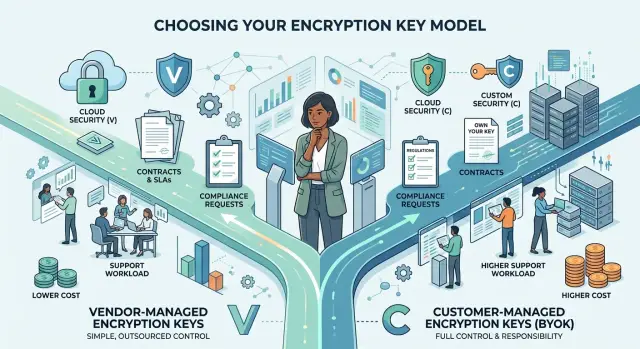
Table of Contents
Why this question comes up
Most founders don't think about encryption key ownership when they're planning the product. It usually appears later, during a security review. A prospect sends a long questionnaire, someone on the buyer's side scans for risk, and one question jumps out: who controls the encryption keys?
That question often comes from policy, not panic. Large companies ask for customer-managed keys or BYOK because an internal checklist tells them to ask. The person asking may not know whether they truly need it. They just know the deal can slow down if the answer sounds weak.
That is why one buyer request can turn into a roadmap fight overnight. Sales sees a contract that might close. Engineering sees design work, cloud changes, testing, support overhead, and a new class of outages. Founders sit in the middle and wonder whether this is a small checkbox or a real product shift.
It helps to say the quiet part out loud: this is not only a security choice. It affects onboarding, pricing, documentation, support, incident response, and offboarding. If each customer can bring their own keys, your team has more moving parts whenever something breaks or a customer rotates access.
The debate is real because both sides have a fair point. Customers want more control, clearer separation, and a cleaner answer for auditors. Your team wants a product that stays simple, reliable, and affordable.
That is the tradeoff. More control can open doors with bigger buyers. It also adds complexity your team will carry long after the contract is signed.
What vendor-managed keys mean
With vendor-managed keys, your SaaS company handles the encryption keys inside its own stack. Your cloud provider or security tools may store those keys, but your team decides how the system works and customers do not bring their own keys.
In plain English, you lock the data and you keep the ring of keys. Customers use the product without handling them day to day.
Your team creates the keys, stores them in a proper KMS or HSM-backed setup, rotates them on a schedule or after an incident, and retires old ones when needed. You also control which data gets encrypted, where encryption happens, who on your team can use the KMS, how access is logged, and what happens if something goes wrong.
For many products, that is enough. You get strong security without turning the roadmap into a compliance exercise. If you're early, vendor-managed keys usually make more sense than building BYOK before any real customer demands it.
Some buyers will still push back. Their concern is rarely that vendor-managed keys are weak. They care about control. If you hold the keys, they may worry that your staff could decrypt data, that a legal request to your company could expose their records, or that they cannot revoke access on their own if they leave.
Large buyers may also want stricter tenant separation, proof of rotation, region-specific storage, or a setup that fits their internal rules. That is when encryption key ownership stops being a technical detail and becomes a sales issue.
If your customers are mostly startups and mid-market teams, vendor-managed keys usually pass review. In enterprise deals, they can become the first real objection.
What customer-managed keys change
With vendor-managed encryption, your SaaS creates and holds the main keys. Your team decides how they rotate, who can use them, and what logs you keep. Customer-managed keys move that control point.
In a BYOK setup, the customer creates or imports a key in its own cloud account and allows your service to use it under narrow rules. Your app still runs the product, but the customer holds the switch. If they disable that key, parts of your service can stop reading or writing their data.
That changes the operating model in a few direct ways. Access control moves closer to the customer's security team. Rotation may follow the customer's schedule, not yours. Offboarding gets sharper because the customer can revoke access directly. Audit trails may improve because more events appear in the customer's own logs.
It sounds simple. It isn't.
Now your team has to deal with cross-account setup, permissions, failed requests, and edge cases when a customer rotates a key at the wrong moment or locks it by mistake. You also need good alerts, clear fallback behavior, and support playbooks. A normal outage is stressful enough. An outage caused by a customer's key policy is worse because your support team cannot fix it alone.
Offboarding changes in a meaningful way too. With vendor-managed keys, customers trust you to remove access when the contract ends. With customer-managed keys, they can cut access themselves. Some buyers care a lot about that, especially in regulated companies and long procurement cycles.
Still, many requests come from policy rather than a real gap in protection. A buyer may have a checklist that says the customer must control encryption keys even when vendor-managed keys would protect the data just fine for that use case. That does not make the request silly. It just means the driver is often compliance, internal rules, or procurement language rather than a measured difference in risk.
That distinction matters. You are not only adding a security option. You are adding product surface area, operating work, and a new class of support tickets.
When the extra complexity makes sense
Extra work makes sense when a deal truly depends on it, not when a form happens to mention it. Most founders should treat customer-held keys as a commercial feature first and a security upgrade second.
The strongest signal is repeated demand from the same kind of buyer. One vague request tells you almost nothing. Three similar requests from enterprise prospects in the same segment usually tell you where the market is going.
The details matter. A copied questionnaire is different from a real blocker. Many enterprise forms ask about BYOK, dedicated hosting, on-prem installs, and a dozen other controls by default. Buyers send those forms before they know what they actually need. If nobody follows up after you answer "no," the request probably was not decisive.
A real blocker looks more concrete. The buyer's security team joins the call. They ask how rotation works, who can access decrypted data, what happens if they disable a key, and whether they can revoke access on their own timeline. Legal adds the requirement to contract redlines. The deal depends on your answer.
The revenue also has to justify the burden. A large contract in healthcare, finance, insurance, or government may support the added build and support cost. A smaller deal often will not. If the feature does not unlock a segment or enough revenue to pay for itself, it is hard to defend.
Most early startups gain more by tightening vendor-managed controls: access restrictions, audit logs, backup policy, incident response, and clear answers during security review. Customer-managed keys add more than code. They add support work, edge cases, documentation, tests, and promises your team has to keep.
How to decide step by step
Start with the customer segment you want next, not with the loudest request in your inbox. If your next ten targets are small or midsize teams that care more about speed and price, vendor-managed keys are usually enough. If you're moving upmarket into buyers with strict procurement rules, the answer can change quickly.
This becomes a real product choice only when it changes who can buy from you. Until then, it is often an expensive promise with little return.
Write down the exact customers you want to win over the next 6 to 12 months. Be specific. "Enterprise" is too vague. A 200-person fintech company and a global bank do not ask for the same controls.
Then review closed-lost deals and active security reviews. Look for proof, not guesses. Did a buyer actually walk because they needed customer-managed keys, or did they only ask whether you had them?
After that, price the full engineering cost. The build is only the start. You also need failure testing, safe rotation, more deployment paths, documentation, monitoring, and more on-call load when something breaks at 2 a.m.
Walk through support and recovery with real incidents in mind. If a customer disables or misconfigures its key, can your team still debug login issues, restore backups, or inspect affected records? Some recovery steps stop working when the customer owns the key. Your runbooks need to match that reality.
Last, set a written trigger. It could be something as plain as: "We will build BYOK after three lost deals above a certain revenue threshold," or "We will build it when two customers in our target segment make it a contract requirement." A written rule keeps one noisy prospect from steering the roadmap.
Founders often skip the cost step and regret it later. The sales upside looks clean on paper. The support burden is where the pain shows up.
A realistic sales scenario
Picture a five-person startup selling a workflow tool to small marketing teams. Its first customers are agencies, SaaS companies, and internal teams with 10 to 80 users. During sales calls, nobody asks who owns the encryption keys. Buyers care about backups, permissions, SSO, and whether data is encrypted at rest.
The startup uses vendor-managed keys through its cloud setup. Access is logged, storage is encrypted, and the team can rotate secrets on its side. For those customers, that is enough. They want a product that works, a clean security answer, and a fast rollout.
A year later, the company starts selling to larger accounts. One prospect is a global enterprise with a serious budget and a long security review. The questions get sharper. Can the customer control its own keys? Can it revoke access without waiting for the vendor? Can the vendor separate that customer from every other tenant at the cryptographic level?
Now the founder has a real decision to make. Adding customer-managed keys is not one checkbox. It may require changes to tenant setup, support procedures, disaster recovery, logging, rotation, and on-call work. Sales will also start promising something the product must support for years.
The deal looks attractive. It could bring $180,000 a year. But the founder does the math. Two engineers may spend six to eight weeks building the first version, and the team will keep paying for that choice through every audit, bug, and edge case later.
So the founder takes the middle path. The company keeps vendor-managed keys for the standard product and does not rush into full BYOK after one enterprise request. Instead, it tracks how many serious prospects ask for the same control, what revenue is attached, and whether those buyers fit the long-term market.
That means losing some deals. It also stops one large prospect from setting the roadmap for everyone else. For this startup, that is the right call.
Costs your team will feel later
The first version is usually the cheap part. The real cost starts after launch, when your team has to keep customer-managed keys working through routine updates, urgent incidents, and messy onboarding.
Most founders count the build and stop there. They miss the engineering work that keeps showing up month after month.
You will likely need tenant setup flows that collect the right details and catch bad configuration early. You will need rotation logic with retries, version checks, and rollback paths. You will need logs that show which tenant key failed and why. You will need failure handling for expired grants, deleted keys, changed policies, and quota limits.
None of that looks dramatic in a roadmap. It still consumes time.
Support gets harder too. With vendor-managed keys, your team controls the whole path. With customer-managed keys, outages often begin in systems your team cannot see or change. A customer may revoke access by mistake, rotate a key without warning, or apply a policy that blocks decrypt requests. Now your team has to figure out whether the bug lives in your app, the customer's cloud account, or both.
That changes the shape of support tickets. They take longer. They need better logs. They often need an engineer, not a support rep. A ticket that once took 15 minutes can turn into half a day.
Onboarding slows down as well. Sales may close the deal, but the tenant cannot go live until security teams, cloud admins, and your implementation team finish setup. One missing permission can delay launch for days.
Your own team needs training. Support needs a playbook. Engineers need to understand IAM policies, rotation edge cases, and what to do when a customer locks you out of the key. Product and customer success teams need to explain the tradeoff clearly. That is why this is not just a security decision. It becomes an operating cost.
Mistakes founders make
The most common mistake is simple: a founder hears one prospect ask for customer-managed keys and treats it like a market signal. Often, it isn't.
This happens because security requests sound urgent. Founders assume that if a buyer mentions security, they need the most complex option. In practice, many customers are fine with vendor-managed keys if you can explain your controls clearly, answer the review well, and show that your team knows how data is protected.
Another common mistake is treating a compliance checkbox as proof of customer value. A question on a procurement form can matter, but some questions are just leftovers from old templates. If you build a hard feature for a line item nobody will enforce, you can spend months on work that does nothing for close rate.
The technical mistakes appear later. Teams add customer-held keys and forget to design for ugly cases. What happens if a customer disables a key on Friday night? What happens if they delete it by accident, rotate it incorrectly, or lose access during an internal admin change? Your app needs a clear and tested response before any of that happens.
Backups, exports, and emergency access often get ignored too. Founders promise strong isolation, then realize their restore process no longer works without special handling. Or they export data in plain form during a migration and undercut the promise they made in sales. Emergency access is another trap. If a customer says, "our users are locked out," your team needs rules before that call begins.
A smaller but expensive mistake is selling the feature before the support model exists. Customer-managed keys change onboarding, docs, incident response, and who gets paged when something fails. If you sell it first and design it later, your engineers become the support plan.
The better habit is plain and a little boring. Ask how many deals need it, what exact problem it solves, and what failure cases your team can support without panic. If those answers are thin, vendor-managed keys are usually the safer choice.
A short checklist before you commit
Pause before you promise customer-managed keys. The expensive mistake is building for a requirement that only sounds important in calls.
Start with buyers, not architecture. One vague questionnaire note about BYOK does not mean the market needs it. A signed requirement from a real prospect is different.
Ask a few direct questions:
- Which buyers truly need to hold their own keys, and why?
- How many deals could this change in the next 12 months?
- Can your team operate it daily without drama?
- Do you have written rules for rotation, outages, emergency access, and offboarding?
- If you delay it, do you lose real revenue or only a hypothetical future deal?
A simple test helps. If several target accounts have already asked for customer-held keys and your team can support the model cleanly, the extra work may pay off. If no live deal depends on it, vendor-managed keys are usually the better choice for now.
This is where founders often get too optimistic. They treat a future sales argument as if it were a current customer need. Build the feature when the revenue case is clear, the operating model is written down, and your team can support it on a boring Tuesday night, not just in a polished demo.
What to do next
Start with a default: if buyers do not have a clear legal, contractual, or policy reason to control encryption keys, keep vendor-managed keys. For most SaaS companies, that is still the sensible path. It keeps the product easier to run, lowers support load, and leaves more room for features customers use every day.
Before anyone in sales promises BYOK or customer-managed keys, write a short decision memo and have both sales and engineering sign off on it. Keep it specific. Note which customer asked for it, how much revenue is actually tied to the request, the exact wording in the contract or review, what your team would need to build and support, and what changes in onboarding, incident response, and offboarding if you add it.
That memo does two useful things. It stops vague security requests from turning into permanent product work, and it gives sales a clear answer they can reuse. If the request is real, the memo will make that obvious. If it is just a checkbox nobody can explain, that usually becomes obvious too.
It also helps to get a second opinion before you add complexity you may carry for years. A short review from an experienced startup architect or Fractional CTO can be cheaper than building the wrong thing and backing out later. If you need that kind of practical review, Oleg Sotnikov at oleg.is works with startups and small businesses on architecture, infrastructure, and AI-driven engineering operations. For this kind of decision, the useful part is simple: pressure-test the revenue case, the operating burden, and the failure modes before your team commits.
Frequently Asked Questions
What do vendor-managed keys actually mean?
It means your company creates, stores, rotates, and retires the encryption keys that protect customer data. Customers do not bring their own keys, and your team runs the KMS rules, access controls, and audit logs.
Does BYOK make my SaaS much safer?
Not by default. BYOK gives the customer more control over access and revocation, but it does not fix weak app design, broad staff access, or poor ops. If you already use a good KMS setup, tight permissions, and clear logs, the risk gap may be small.
When are vendor-managed keys enough?
They usually work fine for startups and mid-market buyers that want encryption at rest, audit logs, backups, SSO, and clear access rules. If your deals close without deep questions about revocation or customer-held keys, keep the simpler model.
How can I tell if a BYOK request is real or just a checkbox?
Ask the buyer what happens if you answer no. If security or legal joins the call, asks about rotation and revocation, or adds the requirement to contract redlines, treat it as real. If nobody follows up after a questionnaire, the request often came from template language.
How many deals should ask for BYOK before I build it?
Set a written rule before the next loud prospect appears. For example, build it only after several lost deals in the same segment or when a couple of target customers make it a contract term. That keeps one noisy prospect from steering your roadmap.
What hidden costs show up after launch?
The code is only the start. You also pay for longer onboarding, rotation testing, better logs, support playbooks, on-call load, and more incident work when a customer's cloud policy blocks access. Those costs stay with you long after launch.
What happens if a customer disables or misconfigures its encryption key?
Parts of your app may stop reading or writing data for that tenant. Your team needs alerts, safe error messages, and a runbook that shows support what to check and what the customer must fix in their own cloud account.
Do customer-managed keys help with offboarding?
Yes, and that is one reason some buyers ask for it. If the customer controls the encryption key, they can revoke your service's access on their own timeline. That gives them a cleaner exit, but accidental lockouts become your support problem.
Should an early-stage startup build BYOK now?
Usually no. Early teams get more value from tightening vendor-managed controls, answering security reviews clearly, and shipping product work customers use every day. Build BYOK when real revenue and target buyers justify the extra operating burden.
What should I document before sales promises customer-managed keys?
Write a short memo with the buyer name, expected revenue, exact contract language, build work, support plan, failure cases, and offboarding changes. Make sales and engineering agree before anyone promises it. That document saves a lot of churn later.


