System ownership after contractor growth: how to rebuild it
System ownership breaks when contractors add parts without clear lines. Learn how to use maps, release rights, and business boundaries to fix it.
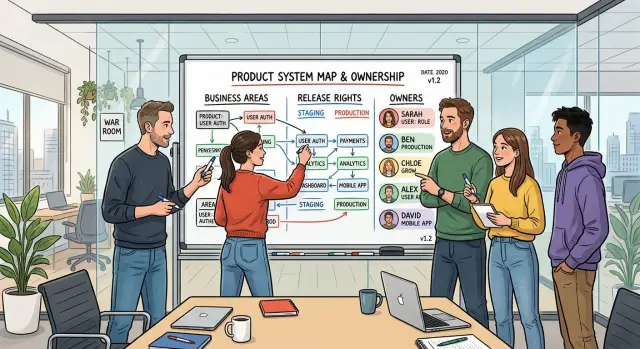
Table of Contents
What breaks when nobody owns the whole system
A company can keep shipping for a while without clear system ownership. Then the cracks show up all at once. A signup flow fails on one payment path, support can't explain why, and each contractor says their part still works.
That's the real problem. People fix what sits in front of them. They patch the app, the CRM, the billing script, or the analytics tag, but nobody checks the full business flow from "customer clicked buy" to "money arrived and access was granted." Cross-tool failures stay alive for weeks because each person sees only one slice.
Releases get messy fast. A small change sounds simple until someone asks who can approve it. One contractor owns the frontend repo, another touches the API, an employee updates pricing, and nobody knows who has the final call. Releases slow down, not because the work is hard, but because permission is fuzzy.
Customer issues usually follow the same pattern. Support sends the case to engineering. Engineering says the bug starts in a third-party tool. The contractor for that tool says the app sent bad data. The employee who knows the process is on vacation. The customer waits while everyone protects their own piece.
Managers often miss this because the dashboards still look active. Tickets move. Bugs get closed. Sprints finish on time. But the company loses sight of complete business paths like lead to demo, order to activation, or invoice to cash. When one step breaks, nobody feels fully responsible for the outcome.
That's why growth through contractors can feel strangely fragile. You may have capable people, decent code, and steady delivery, yet the system behaves like disconnected islands. A good fractional CTO often sees it in one meeting: everyone can describe their tool, but nobody can draw how the business runs end to end.
When that happens, the risk is concrete. Revenue leaks, releases stall, and the same customer problem comes back under a different ticket number.
Start with business boundaries
When contractors build in parallel, the code gets split by repos, tickets, and handoffs. The business doesn't work that way. Customers move through one flow, and money follows that flow.
Start by listing the journeys that bring in money, protect revenue, or cause damage when they break. A good fractional CTO will ask about renewals and refunds before asking for repo access, because those flows show where system ownership should sit.
A short list is enough: first purchase, upgrade or renewal, refund or failed payment, a support issue that blocks a paying customer, and the monthly reporting finance depends on.
Then trace each journey across the tools people actually use. Don't stop at the app. Follow the order through billing, email, support, reporting, and any spreadsheet someone updates by hand. If support needs to open three tools to answer one simple question, that's one boundary problem, not three separate software problems.
Write one business outcome next to each boundary. Keep it plain and measurable. "Paid order appears in billing and reporting on the same day" is clear. "Customer can get a refund without finance fixing data by hand" is clear too. These outcomes give the team something real to own.
Many teams get this backward. They start with repo names like "checkout-service" or "reporting-api" and assume ownership should follow that shape. Repo names reflect old decisions, personal habits, or contractor scopes. They rarely match the real work. The customer doesn't care which repo failed. They care that the order, invoice, and confirmation all line up.
A startup might think it has separate systems for orders, billing, support, and reports. After a simple review, it often turns out one customer purchase crosses all four. That means the first boundary is the full revenue flow, not a single app or database.
If you want system ownership to stick, draw the lines around business results first. The code can move later. The boundary should match the work that matters when something goes right or wrong.
Draw a system map people can read
A good system map fits on one page. If people need to zoom, scroll, or open five files to follow a customer action, the map is too big to help. Any person on the team should be able to understand how the product works in a few minutes.
Start with the parts that change customer outcomes. Show the main services, the databases they depend on, any queues or background jobs, and the outside vendors that can stop your product if they fail. Payment providers, email tools, identity services, analytics, and cloud storage belong on the page if the business depends on them.
Don't chase perfect detail. A box called "billing" is better than six tiny boxes nobody can explain. If one area needs deeper detail later, give it its own page.
Each box should answer four plain questions: what it's called now, what it does for the business, who owns it today, and what it depends on.
That third question matters more than most teams expect. Write the owner on every box, even if the answer is awkward. If two groups share it, mark both. Shared ownership is still useful data. It tells you where system ownership is blurry and where releases will stall.
Add the messy parts people usually skip. Mark failure paths. Show what breaks when a queue backs up, a vendor rate-limits you, or a database lock slows writes. Mark handoffs too. If engineering waits on a contractor to deploy, or support needs data from two teams to solve one issue, put that on the map.
Names matter. Rename boxes that no longer match reality. "Temporary importer" that has run for 18 months isn't temporary. "Core API" might actually hide three separate business areas under one old label. Bad names keep bad ownership alive.
This is why many fractional CTO reviews start with the map. Once the page is honest, release rights, team boundaries, and escalation paths get much easier to fix.
If one person can read the map and point to who owns checkout, customer data, and deployment without guessing, you have something useful.
Set release rights before changing team structure
Teams often redraw org charts too early. That feels like progress, but it doesn't fix releases. First decide who can ship what, who must review shared parts, and who can roll a change back quickly.
Release rights make system ownership real. If a team needs three approvals for a small fix, nobody owns that area in practice. If one person can ship a normal change inside a clear boundary, the team starts acting like an owner instead of a ticket handler.
A normal change should move without extra approval. That usually means bug fixes, copy updates, small UI changes, and safe backend edits that stay inside one boundary. The person closest to that area should ship it.
Shared components need a different rule. Login, billing, permissions, event tracking, and deployment pipelines often affect more than one team. Put these on a short joint review list before the next release. Keep the list small or every change gets stuck again.
Each boundary needs one named person who makes the final release call. Pick the person who understands the risk and can answer for outcomes. Don't tie that right to title alone. A staff engineer shouldn't approve every release by default, and a founder shouldn't become the fallback for routine work.
Risk matters more than rank. A low-risk change in email templates may need one reviewer. A pricing update, payment flow change, or auth change may need joint review and a scheduled release window. Teams usually trust that rule because it matches business impact.
Rollback rights need the same clarity. During an incident, teams lose time when nobody knows who can revert a release, disable a feature flag, or pause a job. Write down who can roll back code, who can disable risky features, who can stop background jobs, and who must be informed after the rollback.
A growing startup might give the onboarding team full release rights for onboarding screens and emails, while billing changes need review from both the billing owner and the finance owner. That's simple, and simple rules hold up under stress.
Rebuild ownership in small steps
Trying to redraw the whole org chart at once usually makes things worse. Start with one boundary that already hurts: a checkout flow that slips every release, a billing job that fails twice a month, or an internal tool that nobody wants to touch. Pain makes the choice clear, and it gives you a clean way to measure change.
Put one person in charge of that boundary. Name one backup at the same time. The owner sets priorities for that area and answers for its health. The backup joins reviews, knows the moving parts, and can step in during leave or outages. If five people "sort of" own it, system ownership is still missing.
Ownership isn't real if the work stays scattered across chats, folders, and boards. Move the practical parts into the same workspace: the runbook for normal changes and incidents, the alerts and dashboards for that boundary, and the backlog with bugs, small fixes, and cleanup.
Then give that team control over release timing for its own area. They shouldn't need three other groups to approve a small, safe change inside the boundary. Keep a few guardrails. If a change affects a shared API, security rules, or customer pricing, bring in the right people. For routine work, release rights should sit with the team that owns the boundary.
Wait two sprints, then review the result. Check whether incidents move faster, fewer tickets bounce between teams, and the backup can explain how the area works without hunting for answers. If the boundary feels too wide, split it. If it's too thin to own properly, expand it.
This is where an outside CTO can help without becoming the owner. Oleg often works this way with growing companies: pick one messy area, put simple rules around it, and let the team prove it can own, run, and release that part before changing anything else.
A simple startup example
A SaaS startup grew quickly and hired contractors wherever the pressure showed up first. One team handled checkout, another handled billing, and a third shipped changes in the mobile app. On paper, it looked fine. Each group moved quickly and pushed code every week.
The trouble showed up when customers asked for refunds after duplicate charges. Support opened one ticket, but the fix touched three repos. Checkout created the payment session, billing processed the webhook, and mobile showed the wrong purchase state. Each contractor could explain their own part. Nobody could explain the whole path.
So small bugs turned into long threads. Support passed the same issue from one team to the next. Engineers argued over where the bug started. Releases stalled because no one had release rights across the full flow.
The company fixed this by redrawing the work around the business flow, not around old contracts. Instead of separate buckets for checkout, billing, and mobile, they created one boundary for checkout and payment recovery, then a second boundary for post-purchase support.
They also made a system map simple enough for non-engineers to read. It showed where a payment starts, which service confirms it, how refunds move through the system, and where support steps in.
Then they picked one product engineer to own releases across the checkout boundary. Contractors still wrote code. That didn't change. What changed was decision-making. One person now approved release timing, checked cross-repo changes, and made sure refund fixes shipped as one update instead of three separate guesses.
The result wasn't flashy. It was practical. Support stopped chasing the same bug through different teams. Refund issues closed faster because one owner could see the full path and push a coordinated fix.
That's what system ownership looks like in a growing company. It's less about titles and more about giving one person a clear boundary, a readable map, and the release rights to act on both.
Mistakes that keep ownership blurry
Ownership gets fuzzy when the org chart follows vendors, old projects, or team history instead of the customer flow. A user signs up, pays, gets onboarded, and asks for support through one experience. If that flow is split across five teams, each team guards its own piece and nobody can answer a simple question: "Can we change this safely this week?"
The problem gets worse when contractors leave the code but keep the real power. The handoff looks finished on paper, yet someone still waits for the old contractor to approve a release, review a schema change, or bless a rollback. The company thinks it owns the system, but release rights still sit outside the company. During an incident, that gap hurts quickly.
Another common mistake is naming owners for repositories and calling it done. Code ownership is only one part of system ownership. Someone also needs to own on-call, rollback calls, production access, and the first answer when sales or support asks, "What broke, who fixes it, and when will it be back?" If those jobs belong to different people with no clear lead, nobody owns the whole thing.
System maps also decay faster than teams expect. One rushed integration, two temporary workarounds, and a renamed service can make the map useless. Then people stop trusting it and go back to asking around in chat. A map that's six months old is often worse than no map because it creates false confidence.
A quieter mistake is turning every shared library into a central platform. Teams do this with good intent, then end up with a small internal gatekeeper group that must approve every minor change. Most shared code isn't a platform. If two teams use a package, one team can own it and publish changes with clear version rules.
When a fractional CTO steps into this kind of setup, these are often the first cracks that show. The fix is rarely dramatic. Give one team a full boundary, a current map, and real release rights. Then test whether it can ship and recover without asking three other groups for permission.
A quick check for each boundary
Pick one boundary at a time. Good boundaries feel boring in the best way: one team knows the flow, ships normal changes, sees failures quickly, and can undo a bad release without calling three other teams.
Use a real flow, not a diagram from months ago. Signup, invoice payment, password reset, and refund handling work well because support sees them every week.
Ask one team to explain the whole user journey in plain words. They should describe what the customer does, what the system does next, and where the data ends up. If they stop at handoffs like "then another team handles it," the boundary is still split.
Then ask whether that same team can ship a routine change on its own. A small text edit, a field rename, or a retry rule is enough. If they need approvals, code changes, or deployment help from two other teams, ownership is still fuzzy.
Check whether one dashboard shows the full flow. You want one place where the team can see errors, slow steps, and failed jobs across that boundary. If half the story lives in app logs and the rest sits in another tool nobody checks, people will argue instead of fix.
Give support a simple test case. If a customer says, "I paid but didn't get access," support should know exactly where that issue goes. If they need to guess between billing, backend, and ops, the boundary isn't clear enough.
Finally, ask the owner how they would roll back a bad release. They should have a direct answer and a short path to act. If rollback starts with a meeting, a Slack thread, and a search for who still has deploy access, you found a weak spot.
This check works because it tests behavior, not org charts. Teams often look tidy on paper and still fail these questions.
What to do in the next 30 days
Don't start with a reorg. Spend the next 30 days making system ownership visible, then fix the release path where the pain is worst.
A month is enough to stop guessing. It isn't enough to redesign the whole company, so keep the scope tight and pick the flows that touch money, customer pain, and production changes.
In week 1, map the top three flows that bring in revenue or create the most support work. Put each flow on one page with the people, services, databases, and handoffs involved. These system maps should show where work stalls and where nobody can name an owner.
In week 2, pick the messiest business boundary and set release rights there first. Decide who can ship changes, who must review them, and which changes don't need another team to approve them.
In week 3, delete approval steps that survived from an older org chart. If a sign-off doesn't lower risk, cut it. Old approvals often exist because nobody trusted ownership before, and they keep that problem alive.
In week 4, ask an outside CTO to review the gaps in ownership, maps, and release rules. An outside review helps because insiders often accept messy handoffs as normal.
Keep the map simple. One page beats a giant diagram nobody reads. If a team can't use it during a release or an incident, the map is too big.
A small example helps. Say sales promises custom invoicing, support gets the complaints, and contractors still push billing changes. Treat that as one flow, not three separate problems. Put the same flow on the map, name one owner for the boundary, and cut the approvals that bounce between teams.
Don't try to fix every weak spot this month. Fix one boundary well, prove that the new release rights work, and use that result to clean up the next one.
If you need an outside view, Oleg at oleg.is does this kind of Fractional CTO work with startups and small teams. His background in architecture, infrastructure, and AI-first development makes that review useful when the problem crosses products, processes, and release ownership.
By day 30, you should have three maps, one repaired boundary, fewer useless approvals, and named owners who can actually ship.