RAG content operations keep answers useful over time
RAG content operations give teams clear owners, source reviews, and version history so answer quality does not fall apart after launch.
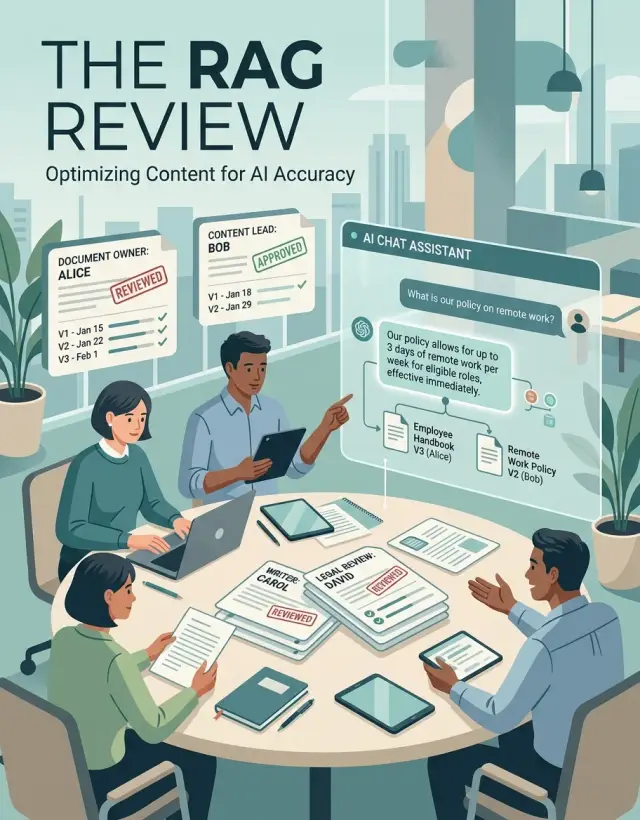
Table of Contents
Why answers slip after the demo
A first demo usually looks better than day-to-day use. Someone picks a small set of clean documents, removes the obvious junk, and asks friendly questions the system can answer. It works because the test set is tidy.
Production content is not tidy.
After launch, teams upload drafts, copy the same policy into several folders, keep old PDFs because nobody wants to delete them, and leave half-finished notes next to approved material. The index does not know which file feels official to a human. It only sees text.
That is where answer quality starts to drift. If two documents disagree, retrieval can bring back either one. If an old troubleshooting guide matches the wording of a question better than the current guide, the assistant may quote the old guide. The answer still sounds confident. The source is the problem.
This gets worse as more people add content. A normal knowledge base slowly fills with draft procedures that never got approved, duplicate files with minor edits, old pricing sheets, copied ticket notes, and policy pages nobody remembers creating. None of that ruins a demo on day one. It ruins trust over time.
Ownership is usually the second weak spot. When every source belongs to "the team," it usually belongs to nobody. Support assumes product will fix the article. Product assumes operations owns the folder. Operations assumes the AI team will filter the bad files out. The file stays live, and the system keeps pulling from it.
A simple support example shows the pattern. During testing, the bot answers refund questions well because it only sees one approved policy page. A month later, someone adds an outdated refund checklist and a draft exception note from an internal meeting. Now the bot gives mixed answers, even though the model itself did not get worse.
That is why content governance for RAG matters. The issue usually is not the embedding model. The issue is messy, unowned content that keeps entering the system and never leaves.
What content operations adds
Embeddings help a model find text. They do not manage that text.
If a policy changed last month, an old FAQ can still win retrieval and push a wrong answer. Content operations closes that gap by treating source material like something that needs care, history, and rules. Not a dump folder.
Each source needs a clear owner. One person or one team should know why the file exists, where it came from, and when it needs review. Without that, stale documents stay in the index for months because everyone assumes someone else will clean them up.
Teams should also track content changes the same way they track code changes. In many cases, a Git repo with simple commit messages is enough. You get a clear edit history, an easy rollback path, and a way to see whether answer quality dropped right after a source changed.
A small review step matters more than most teams expect. Before new content enters the index, someone should check a few plain things: is it current, does it conflict with another source, does it answer a real user question, and does it have an owner with a review date?
Retirement matters too. Old release notes, expired pricing sheets, and replaced SOPs should leave the index when they stop applying. If you keep everything forever, retrieval starts surfacing documents that were once correct and are now harmful.
This work sounds ordinary, and that is exactly the point. Most answer quality problems do not start with weak embeddings. They start because nobody owns the content, nobody tracks edits, and nobody removes dead files. A lean team can avoid a lot of that with one shared repo, a short review checklist, and a monthly cleanup pass.
Give every source an owner
A RAG system does not fail only because retrieval misses the right chunk. It also fails when nobody owns the source behind that chunk. If a refund policy, API guide, or pricing note sits in the index without a clear owner, old text stays there until users catch it.
Give each source to one person or one team. Not five people. Shared ownership sounds safe, but it often means nobody fixes the file when the product changes on Friday and the bot keeps answering from Tuesday's rules on Monday.
The owner does not need to write every word. They need to do a few simple jobs. They decide what counts as approved content for that source. They confirm which drafts, notes, or exports must stay out of the index. They set a review date that matches how often the content changes. And they handle urgent fixes, or they name the person who will.
This is where the idea becomes practical. The model can only answer from what you feed it. If the source is wrong, unpublished, or half finished, better embeddings will not rescue the answer.
A support team makes this easy to picture. Product docs may belong to product. Billing articles may belong to finance or support operations. Incident runbooks may belong to engineering. When a customer asks about plan limits, the system should pull from the page the billing owner approved last week, not from a slide deck someone shared six months ago.
Write the owner down next to every source. A simple table is enough: source name, owner, what they approve, next review date, and urgent contact. That removes a lot of the "Who updates this?" confusion.
Review dates matter because different sources age at different speeds. A security policy may need a monthly check. Office hours may need a same-day update. One fixed schedule for all content sounds neat, but it either misses fast-changing documents or wastes time on stable ones.
Urgent fixes also need a clear path. When the team changes a cancellation rule, someone must know who updates the source before the next user asks the bot. If nobody owns that step, answer quality drops fast.
Use version control for content
Source documents change more often than teams think. A pricing note changes. A policy page gets rewritten. A product spec loses one sentence that used to matter. When those edits happen without history, the assistant starts mixing old and new facts. That is one of the fastest ways to lose trust.
Put source files in a system that keeps every revision. Git works well, but any document system with real history can do the job. You need to see what changed, who changed it, and when it happened.
Knowledge base version control is really about trust. If a customer asks why the assistant gave a different answer yesterday, your team should be able to trace that shift to one document update instead of guessing.
Use version names people can read at a glance. "refund-policy-2026-04-11" says more than "final_v7_latest." Dates matter because they help you match a bad answer to the revision that likely caused it.
Each edit should also include a short reason. One sentence is enough. "Updated trial terms after legal review" or "Removed old storage limit from retired plan" gives the next person context the file itself may not show.
The routine can stay simple:
- Save each approved document in one shared repository.
- Include a date in the version name or commit.
- Add one short note on why the edit happened.
- Reindex only reviewed files.
Rollback matters too. If someone uploads the wrong FAQ or deletes an important section, the team should be able to restore the last clean version in minutes. You do not want a support bot repeating a wrong refund rule for half a day because nobody can find the previous file.
This is where the problem stops feeling abstract. A team can spot a bad answer, trace it to a specific document revision, restore the earlier version, and then fix the source properly. Most of the time, the model is not the problem. Missing history is.
Review sources before they reach the index
A RAG system will answer from whatever you feed it. If a source is weak, old, or repeated five times with slight wording changes, the model still treats it as evidence. That is why source review for AI answers needs to happen before indexing, not after users start reporting mistakes.
Start with authorship. Every page should show who wrote it or who approved it. If nobody owns a document, it drifts. Old process notes stay online, product details change, and no one fixes them because no one feels responsible.
Duplicates cause a quieter problem. The model may retrieve two or three copies of the same claim and treat that repetition like stronger proof. Near duplicates are just as bad. One FAQ says refunds take seven days, another says ten, and now the system has no single source it can trust.
Dates need to stay visible. A page without a publish date or review date is hard to judge later, especially when policies change. Supporting references help for the same reason. If a page makes a factual claim that needs backing, reviewers should be able to check the source quickly instead of guessing.
Status labels matter too. Drafts, working notes, launch plans, and expired pages should not slip into the same index as approved material. If a team wants to keep old pages for record keeping, it can archive them outside the retrieval set or mark them so clearly that they do not compete with current guidance.
A simple test helps: can the page answer one clear question? If it tries to cover five topics at once, retrieval gets messy. A page called "Shipping options" works better than a long memo that mixes shipping, returns, packaging, and holiday exceptions.
A source is ready for indexing when a real owner confirms it is current, one approved version exists, the page has a clear date and any needed reference, and the content answers a specific question without mixing unrelated topics.
That small gate saves a lot of cleanup later. Users notice it in the simplest possible way: they get fewer weird answers.
Build a simple update workflow
Most teams make this harder than it needs to be. Do not start with every document, every FAQ, and every policy file. Start with the 20 sources that answer most user questions.
That smaller set gives you enough material to build a routine without drowning in cleanup. It also makes the work feel practical instead of heavy.
A simple workflow is enough. Pick the top 20 sources people rely on most. Clean each one and remove old, duplicate, or vague content. Assign one owner to every source. Store the files in version control so changes stay visible. Review updates before reindexing, then test with real questions.
Cleaning matters more than teams expect. If one page says "refunds take 5 days" and another says "refunds take 10 days," the model may return either answer. Fix the source before it reaches the index.
Ownership keeps this from becoming nobody's job. A support lead can own help articles. A product manager can own feature docs. Someone in operations can own policy text. One person does not need to write everything. They just need to decide what is current.
Version control gives you memory. When RAG answer quality drops, you can check what changed instead of guessing. Even a basic repo with clear file names and short commit notes is enough.
The review step should stay light. When someone updates a source, another person checks two things: is the content correct, and will a normal user understand it? After approval, reindex only the changed content if your setup allows it.
Then ask real questions. Use the same questions customers ask in tickets, chat, or sales calls. If a few common questions start failing after an update, roll back the content and fix it before the problem spreads.
That is the routine: small scope, clear owners, visible changes, and quick testing after each edit.
A simple example from a support team
A support team updates its pricing policy in April. One billing fee changes, and the new number goes live on the approved help page the same day. The change looks small, so nobody thinks much about the older files still sitting in shared storage.
One of those files is a PDF from last month. It still has the old fee. The RAG system pulls that PDF into the index, so when customers ask, "What fee do you charge for this change?" the bot gives the old number and cites the PDF with confidence. The answer looks polished. It is still wrong.
That kind of mistake is common because the model did not fail on language. The content failed. Fixing it means making someone responsible for the source, not just for the bot.
In a healthy setup, the billing lead owns pricing documents. When the team spots the bad answer, the owner checks the source list, archives the old PDF, and marks it as unapproved for retrieval. Then the owner updates the current billing page so it becomes the clear source for that fee.
The team should not stop there. It should rerun a few real billing questions customers often ask: What is the current fee? When did the fee change? Which source should support agents trust? Does the bot still cite the archived PDF?
This takes a few minutes, but it tells the team whether the fix actually worked. If the bot still pulls the old file, the problem sits in indexing or source rules, not in the wording of the page.
That simple case explains why answer quality fades after a good demo. Content keeps changing. Old files linger. Shared folders get messy fast. Clear ownership, quick source review, and a short retest loop keep the bot useful when policy changes again next month.
Mistakes that break answer quality
A RAG system can look sharp in a demo and still fail a month later. The usual reason is not the model. It is the content behind it and the habits around that content.
One common mistake is indexing every file the team can find. Old slide decks, copied notes, half-finished docs, and exported chats all end up in the same pile. The retriever does not know which source deserves trust. It only knows which text looks similar. That is how you get answers that sound right while pulling details from stale or accidental sources.
Drafts mixed with approved material cause the same problem. If a pricing page says one thing and an internal draft says another, the model may blend both. Users then get a clean answer with the wrong number, process, or policy. Approved content and work in progress should not live in the same searchable layer.
Teams also skip dates and source labels more often than they think. A page without an owner, last review date, or status tag becomes hard to trust. When an answer cites that page, nobody knows whether the content is current, retired, or still waiting for review. Even a basic label such as "approved," "draft," or "archived" helps a lot.
Another quiet failure appears when three teams can edit the same page with no clear owner. One team updates feature steps, another changes terms, and a third adds a special-case note. The page turns into a patchwork. Some parts are current. Some are old. The model treats all of it as one source.
Then there is the demo trap. A team tests ten friendly questions, gets good answers, and assumes the system is ready. Real users ask messy questions. They use old product names, partial facts, and odd wording. If you judge the system from one polished chat, you will miss the gaps that show up in daily use.
Most bad answers start long before retrieval. They start when nobody owns the source, nobody marks its status, and nobody checks what enters the index.
Quick checks you can run every week
Weekly checks catch slow content decay before users feel it. Most teams can do this in 20 to 30 minutes, and that small habit often does more than another round of prompt tweaking.
Start with real questions, not random tests. Pull five common questions from support tickets, chat logs, or search history. If people ask them every week, they are the best pressure test for the system.
Then run the same routine each time:
- Ask those five questions and save the answers.
- Open the source behind each answer and confirm it still says the same thing.
- Check the last review date on each source.
- Remove one stale file from the index.
- Assign any missing or unclear content to one owner.
That last step matters more than it looks. A gap without an owner usually stays open for weeks. A gap with a name and due date often gets fixed the same day.
Look closely at review dates. If a document has no date, treat that as a problem. If the date is old and the topic changes often, flag it even if the answer still sounds fine. Models can give smooth answers from stale material, and that is exactly why weak content slips through.
Removing one stale file each week is a good rule because it forces cleanup without turning it into a large project. Old PDFs, copied FAQs, and draft notes often stay in the index long after the team has stopped trusting them. Less content, kept cleaner, usually works better.
This is what the work looks like in practice. You check a few common answers, trace them to sources, and fix the broken ownership around them.
A simple example: a support team asks about refund timing, and the answer points to a policy file reviewed nine months ago. Finance changed the process last quarter. Remove that file, assign the updated policy to the right person, and the system stops repeating an outdated promise.
Do this every week, and the knowledge base stays alive instead of turning into demo material.
What to do next
Pick one area where wrong answers already waste real time. Support is often the best place to start because the team sees bad replies quickly and knows which documents go stale first. Sales can work too, especially when people often ask about pricing, plans, or policy details.
Keep the first pass small. You do not need a giant cleanup across every file in the company. Start with one bounded set of sources, one owner for each source, and a review rule people can follow every week.
At the start, a basic setup is enough. Choose one domain. Name one owner for every source you index. Require review before new or changed content enters the index. Add a last-reviewed date to each source. Remove files nobody wants to own.
That alone fixes a lot. Teams often discover the model was never the main problem. Old PDFs, duplicate docs, and unclear ownership were.
Measure the mess before you clean it up, then measure it again after two or three weeks. Count how many answers were wrong, stale, or missing. Track how often a human had to step in and how much time the team spent correcting replies. Even a small drop in bad answers can save hours every month.
Keep the review rule plain. If a product manager changes a refund policy, someone should check the source before that change reaches the index. If a help article has no owner, it should not stay in the system for long. Clear rules beat clever tooling.
Some teams can set this up on their own. Others need an experienced technical lead to define ownership, review flow, and version control without turning it into a slow process. Oleg Sotnikov, through oleg.is, does that kind of Fractional CTO and startup advisory work, especially for teams building AI-driven products and internal automation. If your assistant keeps slipping after the demo, the fix is often simpler than it looks: clean sources, clear owners, visible history, and regular review.
Frequently Asked Questions
Why does a RAG assistant look good in a demo and get worse later?
Because the demo usually uses clean, approved files. After launch, teams add drafts, duplicates, old PDFs, and stray notes, and retrieval starts pulling from them. The model often sounds just as confident, but the source behind the answer gets worse.
What should I fix first when answers start drifting?
Start with the content, not the model. Check which files the system cites for wrong answers, remove stale or duplicate sources, and name one owner for each approved document. Most teams fix more by cleaning the index than by changing prompts or embeddings.
Will better embeddings solve stale or conflicting answers?
No. Embeddings help the system find similar text, but they do not decide which document is current or approved. If an old policy matches the wording better than the new one, retrieval may still pull the old policy.
Who should own a source in a RAG knowledge base?
Give each source to one person or one team that can approve changes and handle urgent fixes. Shared ownership often turns into no ownership, so keep it simple. If billing owns pricing and support owns help articles, people know who updates what.
How often should we review source documents?
Review fast-changing content on a tighter schedule and stable content less often. Pricing, office hours, and policy exceptions may need frequent checks, while a stable SOP may not. The useful rule is simple: match the review date to how fast the topic changes.
Should we store RAG content in Git or another versioned system?
Yes, if your team can use it without friction. Git gives you edit history, clear rollback, and a way to trace a bad answer to a document change. Even a small repo with clear file names and short commit notes helps a lot.
What should we review before a document enters the index?
Check four things before you index it: someone owns it, it is current, it does not conflict with another approved source, and it answers a clear user question. If the page mixes several topics or has no date, clean it first.
What content should stay out of the index?
Keep drafts, meeting notes, expired pricing sheets, old release notes, copied ticket text, and duplicate files out of the retrieval set. If a document exists only for record keeping, archive it outside the index. The bot should search approved material, not every file the company has ever saved.
How do we test updates without building a huge QA process?
Use a small test set from real support tickets, chats, or sales calls. Ask the same few questions after each content change, inspect the cited source, and roll back fast if the answer slips. That routine catches problems early without turning testing into a big project.
What is the smallest content workflow that actually works for RAG?
Begin with one area where wrong answers already waste time, usually support or pricing. Pick the top sources people use most, assign owners, add review dates, store changes in version control, and reindex only reviewed updates. That small workflow keeps answers useful without slowing the team down.


