Pull request review process that stops blocking delivery
A simple guide to a pull request review process with response time rules, reviewer rotation, and AI help that cuts wait time without rubber stamping.
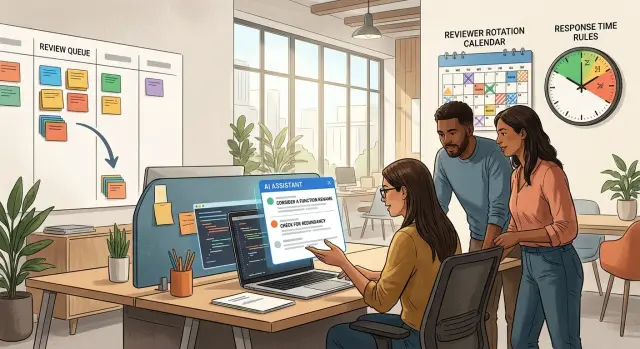
Table of Contents
Why reviews slow delivery
Most delays do not come from Git. They come from silence.
A developer opens a pull request, tags a reviewer, and waits. The reviewer is in meetings, fixing production issues, or buried in another task. Nobody says, "I can take this in two hours" or "please reassign it," so the work sits there.
Teams often make this worse by sending hard changes to the same senior engineers every time. That feels safe, but it creates a bottleneck fast. The people with the most context are usually the busiest, so the queue grows around them.
Large pull requests slow things down even more. A reviewer can scan 80 lines between tasks. A 1,500-line change needs focus, more context, and more confidence that nothing got missed. Most people put that off until they have a clear block of time. Often, that block never comes.
Comment quality matters too. Many teams mix style notes with real blockers in the same review. If one comment says "this variable name feels odd" and the next says "this can break billing," the author has to guess what actually stops the merge. That creates long back-and-forth threads, extra commits, and another round of waiting.
In most cases, slow reviews come from four problems: unclear ownership, overloaded reviewers, oversized changes, and no shared rule for what counts as blocking. Fix those, and review becomes a safety check instead of a traffic jam.
Small teams feel this more than anyone. They usually have enough skill. What they lack is a review flow that fits a real workday.
What reviewers should look for
A good review finds risk fast and leaves style debates for another day. If every pull request turns into a design debate, delivery slows and nobody feels finished.
Start with risk
Review the parts that can hurt users, expose data, or create hard-to-fix errors. A renamed variable rarely matters today. A change to login rules, billing logic, permissions, or a database migration can matter a lot.
Start with a few plain questions:
- Can this break a user task or change the result they see?
- Does it touch auth, secrets, permissions, payments, or input validation?
- Does it change stored data, schema, migrations, or API responses?
- Will this be hard to roll back if production acts up?
That order matters. If a PR updates button spacing and also changes how invoices are saved, the invoice logic deserves most of the attention.
Reviewers also need to separate bugs from preference. "This can fail when the field is empty" is a blocker. "I prefer another function name" usually is not. Teams get stuck when taste gets treated like risk.
Comment so the author can act
Short comments work better than essays. The author should know what to change after one read.
Good comments name the problem and suggest a fix. "Handle null here before calling parseDate()" is clear. "This feels off" is not. If a larger refactor would help, say so without blocking the merge: "Ship this fix now. We can split the payment logic into its own service in a follow-up PR."
That keeps momentum. Small fixes happen now. Bigger ideas go into a ticket, a follow-up PR, or a short team discussion.
A useful rule is simple: block only when the code can cause harm, confuse users, weaken security, or make later work risky. Everything else can wait.
Set response time rules people can follow
Most review delays start with silence. A developer opens a PR, nobody answers for half a day, and the work stops even if the change is small.
A better process uses time windows people can remember. Set one first-response window for normal work. For many teams, 4 work hours is realistic. Smaller teams can aim for 2. First response does not mean full approval. It means the reviewer opened the PR and left a clear next step.
Set a second window for re-review after the author makes changes. Keep it shorter than the first pass, often 2 work hours or less. Re-review should move faster because the reviewer already knows the code and the open questions.
You also need a backup rule. If the assigned reviewer is in meetings, out sick, or deep in another task, someone else steps in. Write that down before the queue builds up.
Urgent fixes need their own path. A production issue should not wait behind normal feature work. Give urgent PRs a faster response window during work hours, and name the small group who can review them right away.
A simple setup works well:
- Normal PR: first response within 4 work hours
- Updated PR: re-review within 2 work hours
- Urgent fix: first response within 1 work hour
- Missed window: backup reviewer takes over
Track missed windows for a few weeks. Do not use that data to shame people. Use it to find the actual problem. One reviewer may own too much, large PRs may need to be split sooner, or AI code review may need to catch style issues before a human spends time on them.
Lean teams often get more from clear response rules than from extra meetings or extra approval layers. If people know who reviews, by when, and what happens when that person is busy, the queue stops feeling random.
Build a reviewer rotation that spreads the load
If the same two people review most pull requests, work piles up fast. They get pulled into meetings, they take time off, or they simply hit their limit for the day. A rotation makes review ownership predictable and shared.
A simple weekly schedule is usually enough. Pick a primary reviewer for each area, then switch that person every week. The goal is not perfect fairness. The goal is to stop one senior engineer from becoming the default gatekeeper for everything.
Keep the rules plain:
- Assign a primary reviewer each week.
- Assign a backup reviewer for leave, meetings, or urgent work.
- Ask service owners to review risky changes, not routine updates.
- Cap open reviews per person so nobody owns too many at once.
That last rule matters more than teams expect. If one person already has four open reviews, the next PR should go elsewhere. Otherwise the queue looks balanced on paper but still stalls in practice.
Service owners need protection too. Teams often tag them on every change because they know the system best. That feels safe, but it turns experts into bottlenecks. Bring them in for database changes, security-sensitive code, billing logic, or anything that can break a shared service. Leave normal UI fixes, tests, and small refactors to the weekly reviewer.
A small team can start with something basic. Five engineers might rotate one primary and one backup each week. If the primary is in planning meetings all Tuesday, the backup picks up new PRs that day. Nobody waits for one person to come back online.
Check the rotation once a month. Look at who handled the most reviews, who still gets interrupted the most, and where PRs wait longest. Then adjust. One team may need two primaries for a busy codebase. Another may need a separate rotation for mobile or infrastructure.
Use AI for the first pass
AI works best before a person opens the pull request. It can catch naming problems, obvious bugs, missing tests, dead code, and copy-paste mistakes in seconds. That cuts the pile of low-value comments that slow reviews down.
A short summary helps even more. Ask AI to explain what changed, which files matter, and where the risk is. When the human reviewer starts with that summary, they spend less time decoding the diff and more time checking whether the change makes sense.
Keep the split clear. Let AI scan for patterns. Let people judge product logic, user impact, edge cases, and trade-offs. If a change affects billing rules, onboarding flow, or a customer promise, a human should make the final call even if the code looks clean.
A few saved prompts cover most of the first pass:
- "Summarize this PR in plain English. List touched areas and likely risks."
- "Check for missing tests, weak assertions, and changed code paths without test updates."
- "Review for security problems such as unsafe input handling, secrets, auth gaps, or permission mistakes."
- "Check database migrations for rollback risk, locking risk, and data loss risk."
- "Check API changes for breaking responses, renamed fields, and versioning issues."
The bad version of AI review is noisy. If the bot posts twenty comments about style, developers stop reading all of them. Set a threshold: the AI should comment only when it can point to a real line, a likely failure, or a clear missing test. Put style rules in the formatter and linter, not in review comments.
Teams that use AI well treat it like a fast junior reviewer with perfect patience and uneven judgment. It never gets tired, but it should not decide whether the team chose the right approach.
That matches how Oleg Sotnikov approaches AI-assisted engineering at oleg.is: automate the first sweep, then use experienced human review where judgment matters most.
Roll out the new flow step by step
Big changes usually fail when a team pushes them across every repo at once. Start with one team and one repository. A small trial gives you real numbers without turning the whole week into an experiment.
Keep the rules on one short page. If people need a meeting and three documents to understand review flow, the setup is already too heavy. Write down who reviews, how fast they should respond, when someone can reassign a PR, and what needs human attention before merge.
That page usually needs four things:
- the first response target
- the rotation schedule for reviewers
- the cases where the author can ask for a backup reviewer
- the few checks that must happen before approval
Run the new rotation for two weeks. That is long enough to catch busy days, slow mornings, and the usual end-of-sprint rush. Do not judge it by mood alone. Look at three numbers: time to first response, total time from opening to approval, and bugs found after merge.
Small teams often learn something awkward in week one. One reviewer still gets most of the hard PRs. Another responds fast but misses obvious issues. That is normal. Do not throw out the whole plan after three rough days.
Change one rule at a time. If first response time improves but total review time stays high, the problem may be follow-up rounds, not the rotation. If bugs after merge go up, tighten the review checklist before you add more reviewers.
A careful rollout beats a dramatic one. When one team can show that reviews dropped from 14 hours to 5 without more bugs in production, other teams usually copy the flow without much pushing.
A simple team example
A five-person product team had a familiar problem. Most pull requests sat for about a day before anyone touched them, even when the change was small. A typo fix, a test update, and a real bug fix all waited in the same line.
Their bottleneck was obvious. One senior developer reviewed almost every change because everyone trusted that person to catch problems. That felt safe, but it slowed the whole team down.
The team changed two rules. First, a reviewer had to give a first response within four working hours. That response did not need to be a full review. It could be a quick approval, one or two blocking comments, or a short note that said, "I can review this after lunch."
Second, they added a backup reviewer for every pull request. If the first reviewer did not respond in time, the backup stepped in. That removed the silent waiting that usually eats half a day.
They also stopped sending every change to the same senior engineer. Each week, two people handled most incoming reviews, and the senior developer joined only when a change touched risky code or architecture. The load spread out fast, and people started reviewing smaller changes with more confidence.
AI helped with the first pass. Before a human opened the pull request, an AI tool checked test coverage, style issues, and simple mistakes like unclear naming or missing edge-case tests. Because the AI handled the repetitive notes, reviewers could spend their time on behavior, product impact, and whether the change made sense.
After two sprints, the shift was clear. Small fixes often merged the same day. Reviewers still asked real questions, so quality did not drop. They just stopped spending senior attention on every minor change.
The team did not need a fancy workflow. They needed a response rule, a backup plan, and a simple reviewer rotation.
Mistakes that create more waiting
Most review delays come from team habits, not from the code itself. A slow process usually grows out of rules that sound careful but create a queue.
One common mistake is asking three reviewers to approve every small change. That might make sense for risky database work or auth changes. It does not make sense for a copy fix, a small test update, or a one-line config change. When every PR needs the same level of attention, small work waits behind big work.
Big PRs sent late on Friday cause the same problem in a different way. Reviewers are wrapping up their week, context is already gone, and nobody wants to spend Monday morning untangling 1,200 lines of mixed changes.
Another delay comes from treating every comment as a blocker. Some comments should stop a merge. A broken test, a security issue, or a confusing API change needs a fix. A preference about naming or a different way to structure a helper function usually does not. If reviewers do not label comments clearly, authors waste time guessing what must change now and what can wait.
AI can help, but it can also make the line longer. If AI posts a long report full of style notes, repeated warnings, and low-risk suggestions, people stop reading it. Then humans still do the full first pass themselves. AI should cut noise, not add another wall of text.
Sprint planning causes review delays too. If every engineer gets booked at 100 percent, nobody has time to review anyone else's work. Reviews are work. Teams need to plan for them.
A few fixes help fast:
- Match reviewer count to risk, not habit.
- Split work into smaller PRs before the end of the week.
- Mark comments as must-fix or optional.
- Keep AI review short and limited to checks people trust.
- Leave room for reviews in sprint capacity.
If a team ignores those basics, the queue keeps growing even when everyone thinks they are moving fast.
A quick checklist before you change anything
Before changing the review process, spend a week looking at what actually happens. Most teams guess wrong. They blame slow reviewers, but the delay often starts with uneven workload, unclear escalation, or comments that reopen the same argument every few days.
A short audit gives you a cleaner starting point:
- Track the time from PR open to first human review. Do not use averages alone. A team with a 4-hour average can still have many PRs waiting two days, and that is the number people feel.
- Write down who reviews most of the code. You will usually find the same few names on every risky change.
- Look at the comments that delay releases, not every comment. Missing tests, unclear rollback plans, migration risk, and security concerns matter more than naming or formatting debates.
- Mark the kinds of changes that need senior review every time. Database migrations, auth flows, billing logic, and infra changes usually belong in that group. Small UI text fixes or low-risk refactors usually do not.
- Decide where AI can save time without acting like a reviewer with authority. AI works well for style issues, obvious bug patterns, missing test cases, and change summaries. It should not decide whether complex business logic is safe to ship.
This checklist sounds basic, but it prevents a common mistake: redesigning the workflow before you know where the waiting starts. In practice, one metric and one simple map of reviewer load tell you more than a month of opinions.
Teams Oleg Sotnikov works with often find the same pattern. They do not need more review steps. They need faster first responses, fewer avoidable comments, and a clear rule for which changes need senior attention.
What to do next
Pick one rule and test it next week. If review requests often sit untouched for a day, set a simple target such as "first response within 4 working hours." That first response can be a real review, a quick note about when the review will happen, or a handoff to the backup reviewer.
Keep the first change small. Teams usually get more from one rule people follow than from five rules nobody remembers.
A simple setup works well:
- Assign one primary reviewer for each day or half-day.
- Name one backup reviewer in case that person is busy.
- Use AI for the first pass on repeated checks like formatting, test gaps, and obvious risk areas.
- Leave final approval to a person who understands the feature and its trade-offs.
Give the new flow two sprints before you judge it. Then check a few numbers: how long the first response takes, how long PRs stay open, how many review rounds happen, and whether bugs increase after merge. If first response time improved but review quality dropped, tighten the AI checks or narrow who can approve certain changes.
A short team habit helps too. Spend 15 minutes at the end of the second sprint and ask three plain questions: What moved faster? Where did work still pile up? Which rule felt annoying or unclear?
If your team needs help setting up review rules, AI-assisted workflows, or a lean engineering process, Oleg Sotnikov at oleg.is works with startups and small businesses as a Fractional CTO and advisor. His background spans software engineering, infrastructure, and AI-assisted development, so the guidance stays practical.
A good pull request review process should feel boring in the best way. Work moves, reviewers know when they are on point, and nobody waits three days for a small fix.
Frequently Asked Questions
How fast should someone respond to a pull request?
Set a first response target of 4 work hours for normal PRs. Small teams with fewer meetings can aim for 2 hours, and urgent production fixes need a 1 hour path.
What counts as a first response?
A first response means the reviewer opened the PR and gave the author a next step. That can be an approval, one or two blocking comments, or a note with a review time and a handoff to the backup reviewer.
What should block a merge?
Block a merge only for real risk such as user breakage, security gaps, bad migrations, data loss, broken tests, or changes that are hard to roll back. Leave naming, style, and small refactor ideas for follow up work unless they hide a bug.
How big should a pull request be?
Keep most PRs small enough to review between other tasks. If one change mixes UI tweaks, refactors, and billing logic, split it so the risky part gets focused attention and the simple parts move faster.
Do small fixes need the same approval path as risky code?
No. Match the review path to the risk. A copy fix or test update rarely needs three approvals, while auth, payments, schema changes, and shared infra deserve more eyes.
How do we stop one senior engineer from reviewing everything?
Use a weekly rotation with one primary reviewer and one backup. Bring service owners into risky changes, not routine work, and cap how many open reviews one person can own at once.
When should the backup reviewer step in?
Write a simple rule before the queue grows. If the assigned reviewer misses the response window, hits their review cap, or gets pulled into meetings or leave, the backup takes the PR right away.
What should AI review before a human looks at the PR?
Let AI check for missing tests, obvious bug patterns, unsafe input handling, weak assertions, dead code, and risky migration or API changes. Ask it for a short summary too, so the human reviewer starts with context instead of decoding the whole diff first.
How do we keep AI review from turning into noise?
Set a high bar for comments. The bot should speak up only when it can point to a likely failure, a risky line, or a missing test, and your formatter and linter should handle style.
What should we measure after we change the review process?
Track time to first human response, total time from open to approval, re review time, and post merge bugs. Check patterns by reviewer and PR size, then change one rule at a time instead of rewriting the whole process.