Prompt-only teams and the hidden costs they create
Prompt-only teams move fast, but speed alone can raise rework, missed tests, and risky releases. Clear repo rules and rollback habits keep work stable.
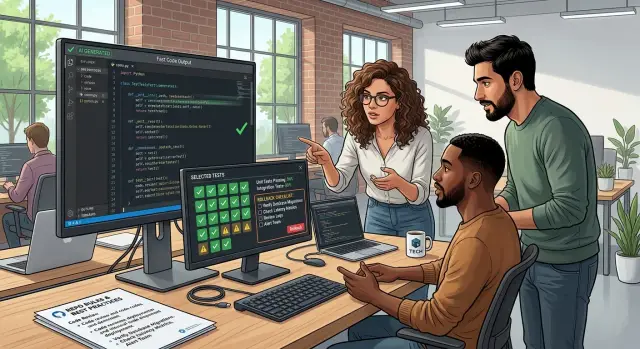
Table of Contents
Why fast code can still slow a team down
Fast code generation does not remove work. It moves the bottleneck.
Writing code can take minutes. Review, testing, and repair still take real time. A team can produce five pull requests before lunch, but someone still has to read the diff, check the assumptions, and decide whether the change is safe to ship.
That gap gets expensive fast. AI can create more code than a team can properly verify, so the queue shifts from "build it" to "what did this change actually do?" People end up spending more time on cleanup than on delivery.
Small mistakes also spread farther than most teams expect. A prompt like "add role-based access" can touch middleware, database models, API handlers, UI states, tests, and deployment settings. If one assumption is wrong, the bug does not stay in one file. It shows up in six or seven places, and the fix turns into a trace through the whole stack.
This is where prompt-only teams often stall. They move fast at generation time, but nobody clearly owns release safety. One person prompts the code, another skims it, and a third merges it because the diff looks reasonable. When production breaks, the team loses hours on basic questions: who approved the change, which tests should have caught it, what the fastest rollback is, and whether the merge changed data, config, or both.
One bad merge can erase a week of apparent speed. A rushed update to billing, auth, or permissions can trigger hotfixes, support work, customer confusion, and late night database checks. The code may have taken 20 minutes to generate. The repair can take two days.
Teams that keep uptime high while using AI do not rely on prompts alone. They treat generated code like any other risky change. They keep clear repo rules, choose tests before merge, and make rollback simple. It is less exciting than "ship faster," but it saves far more time once real users are involved.
What prompt-only work leaves out
A prompt can ask for a feature. It cannot replace the quiet rules that keep a codebase readable six months later.
If one developer asks for a billing endpoint and another asks for payment API logic, the model may put files in different folders, pick different names, and handle errors in different ways. The code may run. The repo still gets messier.
Many team rules never make it into the prompt. They live in old pull requests, in someone's memory, or in a chat thread from last month. Models cannot guess those rules well. If your team wants service files in one place, tests near the feature, and logs in one format, you need to write that down where both people and tools can see it.
Chat is a weak place for rules. It scrolls away, it gets paraphrased, and different people remember it differently. When prompt-only teams rely on chat as team memory, they get uneven output even from good models.
Generated code also tends to skip dull but necessary work. It often covers the happy path and misses the edges: empty input, retries, cleanup after failure, old code that should be removed, or a small config change that keeps the feature consistent with the rest of the repo. Those gaps become support work later.
The larger cost shows up in repetition. One person accepts a helper in the wrong layer. The next prompt copies that pattern because it now exists in the codebase. Soon the same mistake keeps coming back, and every fix feels new even though the team has already paid for it.
A short written standard breaks that loop. It should define folder structure and file naming, say where tests belong, explain error handling and logging, and list cleanup work expected in every change.
Teams can generate code fast and still work carefully. Those habits fit together. If nobody writes the rules into the repo, each new prompt starts from fuzzy memory instead of a shared standard.
What repo rules should cover
When code gets cheap to produce, the repo needs clearer boundaries, not fewer. Prompt-only teams usually learn this after a bad merge: files land in the wrong place, a migration runs twice, and nobody knows who should approve the fix.
Start with structure. Folder names should tell people and agents where code belongs, where shared logic lives, and what nobody should touch without review. Ownership should be plain. If billing files change, the right engineer and the payments owner should review them. If auth code changes, the security owner should review it. That may sound strict, but it saves hours of guesswork.
Most teams do well when repo rules cover four things: what belongs in each directory, who owns sensitive parts of the codebase, which approval path applies to database, auth, billing, and infrastructure changes, and how large commits should be.
Commit size matters even more with AI written code. A 600 line "cleanup" commit hides real risk. A 40 line commit with a note like "rename cache key in checkout flow" gives reviewers a fair shot. It also makes rollback much easier.
Some files need extra care. Repo rules should say whether agents may edit migrations, environment config, deployment files, or anything related to secrets. In many teams, the safest default is simple. Agents can draft migration code, but a human reviews it before merge. Agents never commit secrets. Config changes need explicit approval because one wrong value can break a working release.
Keep the rules and a few short examples in one place inside the repo. If people have to search through chat logs, old tickets, and half finished docs, they will guess. A single rules file with examples of good commits, allowed folders, and protected files is much easier to follow.
Treat those rules as living documents. When a real incident happens, update them. If a generated script dropped a column too early, add a rule for staged migrations. If an agent changed production config by mistake, lock that path down. The best repo rules come from scars, not theory.
How to choose tests before you merge
When code generation gets cheap, the slow part moves to proof. The team has to decide what needs to be true before a merge.
If you run every test for every tiny change, people wait too long. If you run almost nothing, bugs slip into production. The answer is not "always run the full suite." The answer is to match tests to the risk.
Start with the diff. Look at the files that changed, the service they belong to, and the shared code they touch. A small edit to a UI label does not need the same test plan as a change in billing logic or a database write path.
Run the fastest tests that cover those paths first. Unit tests and narrow integration tests usually catch the obvious break in a few minutes. That fast signal matters because teams actually use it. A 40 minute suite that people skip is worse than a 4 minute suite they trust.
A checkout example makes this obvious. If someone changes invoice formatting in one service, run tests for that service, the invoice parser, and one checkout smoke test. If the same change also touches payment retries or tax calculation, widen the net right away.
Broader tests make sense when a change touches shared risk areas like auth and permissions, billing and refunds, data writes or schema changes, or code imported across many services.
When a test fails, do not keep rerunning it and hope for green. Check whether the failure is noisy, flaky, or clearly tied to the change. Look at the error, the last green run, and whether that test has a history of random failure. Blind reruns teach teams to ignore red builds.
One rule should stay strict. If someone skips tests, they should say which ones, why they skipped them, what risk remains, and how they would roll the change back. If nobody can answer those questions, the merge is early. Prompt-only teams often trust clean looking output too soon. Good test selection is what turns fast code into safe code.
How rollback habits reduce damage
Fast code generation shortens the trip from idea to deploy. It also shortens the trip from small mistake to customer problem.
When teams can ship ten changes in a day, they need a clean way to undo one bad change in minutes. That only works when deploys stay small. If one release bundles a database change, a billing fix, three UI updates, and a new background job, nobody knows what to undo first. Smaller deploys make the decision much simpler: keep it or revert it.
Prompt-only teams often trust the latest output because it looks finished. That is where damage spreads. A clear rollback habit limits the blast radius before people start guessing, patching production live, or making the problem worse.
A rollback plan should answer a few plain questions. What was the last stable build? Which config version matched it? Who makes the rollback call? Who handles the app, database, and monitoring steps? How long does rollback usually take?
Config is where many teams stumble. Reverting code is often easy compared with restoring the right feature flags, secrets, environment values, and deployment settings. If you save the last stable build but forget the matching config, you can roll back into a different outage.
Write the order down. Do not rely on memory in the middle of an incident. A short note in internal docs is enough if it names the person in charge, the rollback steps, and the checks after rollback. A plan that lives only in chat is not a plan.
Practice before you need it. Pick a quiet window, roll back a harmless change, and time the process. You will usually find one missing permission, one unclear step, or one person who assumed someone else owned the call.
Teams that keep uptime high do not treat rollback as failure. They treat it as normal operations. That mindset matters even more when AI helps a team ship faster.
Track rollback time after each drill or incident. If it takes 25 minutes now, try to get it under 10. That number says more about release safety than any confident prompt.
A simple example from a small product team
A small product team of four asked a model to update checkout copy before a regional launch. The prompt looked harmless: change a few labels, add new tax handling for one market, and keep the existing checkout flow untouched.
The model did all of it in one pass. It changed the button text, updated the order summary, touched the receipt template, and adjusted the tax calculation branch for digital add ons. The diff looked clean. File names made sense. The style matched the repo. So the team reviewed it quickly and shipped the same day.
For most buyers, nothing looked wrong. Orders went through, receipts arrived, and the new wording read better than the old copy. Then support got a message from one region where totals looked off by a small amount. A customer used a discount code, bought a digital add on, and hit an edge case in the new tax path. The checkout showed one total, the receipt showed another, and the payment processor charged the higher number.
Now the team had a bigger problem than a copy fix. Support had to issue refunds. Finance had to check which orders were wrong. Engineers had to read a generated diff that mixed text edits with business logic. That is the hidden cost. The code arrives fast, but the cleanup lands on people later.
Three habits would have reduced the damage. First, the repo should block pricing or tax changes from shipping in the same pull request as text only edits. Second, the team should run a targeted test for the changed region, including one discount case and one receipt check. Third, the team should have a rollback plan that lets them revert the checkout change in minutes.
With those guardrails, the same bug would still be annoying, but much smaller. The pull request would get extra review. The test would likely catch the mismatch before release. And if it still slipped through, the team could roll back the tax change first, keep the safer text update for later, and stop bad totals before support tickets piled up.
That is the pattern. Fast generation is not the risky part. Shipping mixed changes without repo rules, test selection, and rollback habits is.
Mistakes teams make when AI output looks good
Readable code can fool a team. Prompt-only teams often trust a change because the naming is clean, the comments sound calm, and the diff feels organized. None of that proves the change is safe.
One common mistake is merging a large diff because it reads well. AI can rewrite five files, add tests, update a migration, and refactor a helper in one pass. Reviewers skim instead of checking behavior, and the team misses the one line that changes auth, billing, or data handling.
Another trap is trusting green unit tests when nobody checks the user path. Unit tests are easy for a model to write because they stay close to the code it just produced. Real breakage often lives between steps: a user logs in, changes a setting, uploads a file, and then hits a page that fails because one API field changed.
Teams also get too relaxed when an agent edits config. App code gets most of the attention, but config files decide how the app starts, deploys, caches, retries, and talks to other services. A small edit to an environment variable, feature flag, CI job, or rate limit can cause more damage than a broken button label or a bad helper function.
Late week shipping makes this worse. If someone merges on Thursday night or Friday afternoon without a named rollback owner, the team creates a slow mess for itself. When alerts start firing, people ask basic questions under pressure: who reverts, which migration must roll back, and which flag turns the feature off?
A quieter mistake shows up after the incident. The team solves the same problem in chat again and again instead of adding repo rules. If the agent keeps touching protected files, writing broad permissions, or skipping test selection, the answer is not another clever prompt. The answer is to lock the lesson into the repo with review rules, CI checks, templates, and clear merge habits.
That is how teams keep speed without paying for the same mistake twice.
A quick check before every merge
Fast code invites lazy merges. That is where teams pay later.
Before anyone ships AI written code, they should answer five plain questions. If even one answer is fuzzy, the merge is probably early.
- What user flow changed?
- Which tests cover that exact flow?
- How do we undo this quickly if it goes wrong?
- Is the diff small enough to review honestly?
- Did this change expose a new rule that belongs in the repo?
The list is simple. The hard part is discipline.
A small diff is underrated. Reviewers catch more when a change touches one flow, one file group, and one reason for change. Once a diff spreads across ten files with mixed intent, review turns into skimming. Skimming is how bugs reach production.
Test choice matters just as much. If a change affects signup emails, run the tests around signup, email sending, and the job queue that triggers delivery. Broad tests are fine, but they do not replace targeted ones.
Rollback habits also need muscle memory. "We can always revert it" means very little if the last clean deploy is unclear, the migration cannot roll back, or the fix depends on one person being awake.
One more habit pays off quickly: keep a short log of prompt failures and the repo rules that fixed them. After a few weeks, the team stops repeating the same mistakes. That saves more time than another clever prompt.
Next steps
Start small and make the changes real. Most prompt-only teams do not need a giant process rewrite. They need a few plain rules that people follow every week.
Pick one part of the repo that changes often, such as billing, auth, or onboarding. Write three simple rules for that area and keep them easy to check in review. For example, ban direct database queries in handlers, require a migration for every schema change, and ask for one updated test whenever an API changes.
Then make a small test matrix for the changes your team makes most. Keep it short enough that people will use it. A UI text or layout change might only need smoke tests and one visual check. An API logic change usually needs unit tests, contract tests, and one end to end path. A database change should include migration checks, seed data checks, and a rollback test. Auth or billing changes deserve the full critical path, even if they take longer.
This does not need a perfect spreadsheet. A one page note in the repo is enough if the team trusts it and updates it.
Next, run one rollback drill this month. Pick a small release, pretend it failed, and time how long it takes the team to undo it. You will learn very quickly whether the rollback steps are clear, whether data changes are reversible, and whether one person holds too much release knowledge.
If nobody on the team has handled this in production before, an outside review can help. Oleg Sotnikov at oleg.is does this kind of Fractional CTO work with startups and small teams, including AI focused development practices, infrastructure, and release process cleanup. A few hours of review is often cheaper than one bad deploy.
Fast code is useful. Safe delivery is what makes it worth anything.
Frequently Asked Questions
Why is fast code generation not enough on its own?
Because speed does not remove review, testing, or repair. It just moves the bottleneck from writing code to proving the change is safe.
A team can generate a lot of code in hours, but one bad merge in billing, auth, or data handling can wipe out that time with hotfixes, refunds, and support work.
What usually goes wrong in a prompt-only team?
They usually move quickly at generation time and slow down at release time. People skim large diffs, nobody owns release safety, and the team finds out too late that a clean-looking change also touched config, data, or shared logic.
That pattern creates hidden cleanup work that never shows up in the prompt.
Do small AI changes still need careful review?
Yes, if the change touches a real user flow. A small prompt can spread across middleware, models, handlers, UI states, tests, and deployment settings.
Review should match the risk, not the wording of the prompt. "Just a small update" often hides a wider change.
Which repo rules should we set up first?
Start with structure, ownership, protected files, and merge size. People should know where code belongs, who reviews sensitive areas, which paths need extra approval, and how small a pull request should stay.
Write those rules in the repo so both people and tools can follow them without guessing.
How big should an AI-generated pull request be?
Keep them focused on one user flow or one reason for change. If a pull request mixes text edits, refactors, config updates, and business logic, reviewers start skimming.
A smaller diff gives people a fair shot to catch the one risky line and makes rollback much easier.
How do we choose the right tests before merge?
Match the tests to the files and behavior that changed. A label change may need only a narrow check, while billing logic or a database write path needs unit tests, integration tests, and at least one real flow test.
Run the fastest useful tests first so the team actually uses the signal.
When should we run broader tests instead of the fast ones?
Go wider when a change touches shared code or risky areas like auth, permissions, billing, refunds, writes, schema changes, or code imported by many services.
You should also widen testing when one prompt changed more layers than expected, even if the original request looked small.
What makes a rollback plan actually useful?
A good rollback plan says what the last stable build was, which config matched it, who makes the call, and how the team checks the system after the revert.
Keep it written down and practice it. If rollback depends on memory or one person being online, it is too fragile.
Should we let AI change migrations and config files?
Let AI draft them if you want, but keep a human in charge before merge. Migrations, environment settings, deployment files, and secrets can break a healthy release faster than most app code changes.
The safest default is simple: review those paths by hand and require explicit approval.
What is the fastest way to improve a team that relies too much on prompts?
Pick one risky area, write a few short repo rules for it, and add a small test matrix the team will really use. Then run one rollback drill on a harmless release and see where the process breaks.
That gives you better release safety without turning the team into a slow approval machine.


