Product operating model for steadier team delivery
A practical look at the product operating model: who decides, who owns what, and how a clear release rhythm helps teams ship without daily churn.
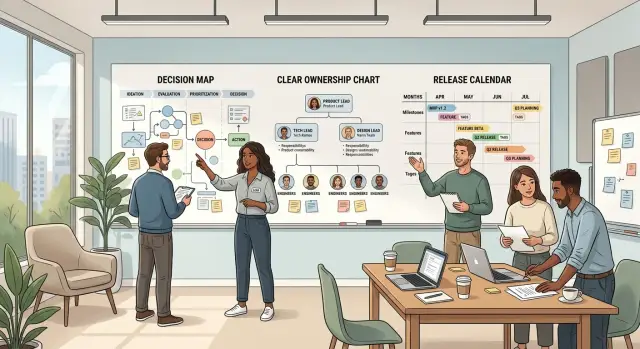
Table of Contents
When meetings grow but delivery slips
Delivery rarely slows because a team forgot one more meeting. It usually slows because people are not sure who decides, who owns the work, and when the work actually has to ship.
A slipping roadmap often triggers the same response. Someone adds a planning session. Bugs create a weekly triage call. Cross-team confusion brings another sync. Calendars fill up, but the hard questions stay open. Should product make the tradeoff, or engineering? Who can cut scope? Who says a release is ready?
That is when an operating model starts to matter. It gives the team a clear way to make calls instead of turning every disagreement into another meeting. Without that structure, rituals hide uncertainty.
You can see it in small moments. A designer wants more polish. An engineer wants less risk. A product manager wants the feature out this week. All three goals make sense. Trouble starts when all three think they have the final vote. Work pauses, people wait for approval, and a two-day task slides into the next sprint.
Release dates slip for the same reason. Teams often blame testing, dependencies, or last-minute changes. Sometimes that is true. Often the issue is simpler: nobody owns the final call. If no one can say ship this now or cut this part and release anyway, the date becomes a suggestion.
A growing SaaS team can spend ten hours a week in meetings and still feel surprised on release day. That usually means the team does not need more ceremonies. It needs clear decision rights, real ownership, and a release rhythm people trust. Once those are in place, many meetings shrink on their own because fewer questions need a room full of people.
What the operating model needs to answer
A team does not need more meetings to steady delivery. It needs a few plain answers that stop the same arguments from coming back every week.
First, someone must set direction for the next cycle. That does not mean one person invents the whole plan alone. It means the team knows who turns company goals, customer feedback, and current constraints into a short set of priorities people can work from.
If that owner is unclear, every planning session turns into a debate. Sales pushes one request, support pushes another, engineering pushes cleanup, and nothing feels settled. One named owner should make the final call on what the team is trying to achieve before work starts.
The model also needs a rule for scope changes after planning. Teams get into trouble when anyone can drop in new work halfway through the cycle. A simple rule works better: define which changes can enter, who approves them, and what gets pushed out when new work comes in.
Release readiness needs the same clarity. Shipping should not depend on a vague feeling that things look fine. Decide who approves the release from a product view, who approves it from an engineering view, and what checks they use. If one person can stop a release because of a real risk, write that down too.
Conflict handling matters more than most teams admit. People will disagree on tradeoffs, especially when speed, quality, and scope pull in different directions. The model should name a tie-breaker for each type of decision so the team can settle disputes in hours, not drag them through three meetings.
Write these rules in one short document people will actually read: who sets priorities for the next cycle, who can approve scope changes, who approves releases, who breaks ties when roles disagree, and when the team revisits the rules.
That page sounds small, but it removes a lot of churn. When people know who decides what, they spend less time protecting turf and more time finishing work.
Decide who makes which calls
An operating model becomes real when it names who decides what. Teams slow down when the same question circles through product, design, engineering, sales, and leadership with no final owner.
Start with the decisions that stall work most often: release scope, bug priority, launch readiness, and requests that arrive after work has already started.
Put one role on each decision. That person can ask others for input, but one person must make the call. If three people share final approval, nobody really has it.
Clear decision rights do not mean people work alone. Design should shape usability calls. Engineering should speak plainly about risk and effort. Sales and support should bring customer context. Input helps before the decision. It blocks progress when people treat input like veto power.
Hard calls need a tie-breaker before the conflict starts. In many teams, the simplest split is this: the product manager decides customer and scope tradeoffs, the engineering lead decides technical safety, and a founder or CTO steps in only when the choice affects budget, timing, or company direction.
Write this map in plain language and keep it short. A one-page note works better than a dense chart. For example: the product manager decides release scope after input from design and engineering. The engineering lead decides if the release is safe to ship. Sales can request changes, but sales does not approve releases.
When people can read that in two minutes, meetings get shorter. Work moves with less debate, and delivery stops wobbling every time pressure goes up.
Give each area a real owner
Teams slow down when a screen, workflow, or metric belongs to everyone. Bugs sit. Tradeoffs drag on. Small release decisions turn into group debates because nobody feels allowed to say yes or no.
Split the product into areas that make sense to users and to the team. That might be onboarding, billing, reporting, and admin. Or it might be buyer flow, seller flow, and internal tools. The exact map matters less than one rule: each area needs one owner with one clear goal.
A goal should point to a result, not a task list. Improve trial-to-paid conversion in onboarding is clear. Coordinate onboarding work is not. When one name sits next to one goal, people know who sets priorities, who breaks ties, and who answers for the outcome.
Other functions still matter. Engineers shape scope and timing. Designers test ideas. Support and sales bring real customer pain into the room. Data helps the owner see what changed after a release. That support helps, but it is not ownership.
The handoffs matter too. Work often stalls between discovery and design, design and engineering, build and release, and release and support. If nobody carries the work across those moments, gaps open fast. Teams start saying they thought someone else had it, and the same issue circles for days.
Shared ownership sounds fair, but it often hides conflict. Two owners usually means two priority lists, two versions of success, and one waiting team. If an area feels too big for one person, split it into smaller parts. Do not solve that problem by giving it two drivers.
This matters even more in a growing SaaS team. A single owner for billing can decide whether to fix invoice confusion before adding a new discount feature. Without that owner, finance, support, and product may all care, but nobody will move first.
An operating model works only when every product area has one person who can make the call and carry the result.
Pick a release cadence people can trust
A good release cadence feels a little boring, and that is usually a good sign. People know when code freezes, when checks happen, and when users get changes. If your team keeps missing a weekly release, stop promising weekly releases. A calm every-two-weeks rhythm beats a weekly scramble that falls apart.
Trust starts when the team picks a pace it can hold for months, not just one sprint. Release cadence should reduce drama. It should not create more of it.
Keep planning and shipping separate. Teams make a mess when they decide scope on the same day they release. Plan early in the cycle, lock scope before release, and ship on a fixed day. That gives engineers time to test and product people time to spot risky changes before they reach customers.
Most steady cadences share four rules: ship on fixed dates even if the release is small, plan before the release date, route urgent fixes through a separate fast path, and require one explicit approval for late changes.
That fast path matters. Production issues, broken payments, and security bugs cannot wait for the next train. Most other requests can. If every sales request or executive idea becomes urgent, the schedule stops meaning anything.
Late changes need a high bar. If someone wants to add work a day before release, they should explain the risk of shipping it now and the risk of waiting. In many teams, the right default is no. One last-minute change can pull in three more and ruin the release.
Review missed releases while the details are still fresh. Keep it short. Ask what actually caused the slip: unclear scope, a dependency that moved, weak tests, or a decision that came too late. After a few cycles, patterns appear. Then the team can fix the cause instead of adding another meeting.
A growing SaaS team often gets steadier when it moves from ship when ready to ship every second Thursday, except for severe issues. Users learn the rhythm. Internal teams do too. That predictability is what people trust.
Build the model step by step
Start small. If you try to redesign the whole product organization at once, the team will spend more time debating the model than using it.
Pick one product area with clear boundaries. A customer onboarding flow, billing, or reporting works better than the whole app. One area gives you enough real work to test the model without dragging every team into the change.
Put the model on one page. Keep it plain enough that anyone can read it in two minutes. For that one area, write down which decisions the team can make on its own, which decisions need a wider call, who owns outcomes instead of just tasks, how often the team plans, reviews, and releases, and what counts as a normal release versus an urgent fix.
That page does not need a fancy diagram. A simple table often works better because people actually update it.
Run the model for one month. That is usually long enough to see where it breaks. You will notice patterns fast: the same approval gets stuck, one owner keeps getting bypassed, or the release rhythm looks good on paper but slips in practice.
Fix one pain point at a time. If you change ownership, planning, release timing, and team structure in the same week, nobody will know what helped. Pick the sharpest problem first. If work stalls because design and engineering both think the other side makes the call, settle that single decision and test it again.
A practical approach is to treat the first area like a pilot. Keep notes on missed handoffs, slow approvals, and surprise work. Then adjust the model with small edits, not a full rewrite.
Expand only when the first area feels stable. Stable does not mean perfect. It means people know who decides, who owns the result, and when work ships. When those answers stop changing every week, copy the model to the next area.
A simple example from a growing SaaS team
A 12-person SaaS team had enough talent to ship fast, but they still missed dates. They planned work every Monday and aimed to release twice a week. Then sales brought in a custom request on Wednesday, support raised a customer issue on Thursday, and the week broke apart.
Nothing was wrong with the team itself. Too many people could change the plan at any time. They had rituals, but they did not have an operating model that set clear decision rights.
They fixed it with two simple rules. First, the product manager owned scope for the current cycle. If sales wanted custom work for a large prospect, the product manager could move it to the next review instead of rewriting the week. Second, the engineering lead owned release readiness. That stopped last-hour arguments about whether a build was probably fine to ship.
The release cadence stayed simple. The team shipped every Tuesday and Friday unless a real production issue forced a change. That gave sales and support something they could trust. It also pushed better habits: smaller tickets, earlier testing, and fewer half-finished features sitting in limbo.
Emergency work got a tighter definition. A signed prospect asking for a special field was not an emergency. A billing bug affecting live customers was. Once the team drew that line, the number of urgent interruptions dropped fast.
After a few cycles, the change was easy to see. Engineers finished what they started. The product manager spent less time renegotiating work. Sales still made requests, but they no longer rewrote the week every few days.
The team did not become slower. They became steadier. For most growing SaaS companies, that is the point. Predictable delivery beats constant motion that never quite turns into shipped product.
Common traps that bring back churn
Churn usually returns in ordinary ways, not dramatic ones. A team adds planning sessions, status calls, and check-ins, but delivery still feels shaky because the same few problems keep breaking the flow.
One of the worst is shared final approval. If two people both think they make the last call, nobody really owns it. A product manager says a feature is ready for release, an engineering lead wants one more change, and the team burns three days waiting for a tie-break. That delay spreads fast.
Priority changes in the middle of a cycle cause the same mess. Leaders often do this for understandable reasons, but the effect is still expensive. Engineers stop current work, carry half-finished tasks into the next cycle, and lose time getting back into context. If a change truly cannot wait, someone should say what gets dropped right now. Teams get into trouble when new work arrives and old work quietly stays on the list.
Urgency inflation is another common habit. Sales asks for one thing, support asks for another, a customer sends a heated email, and suddenly everything is urgent. If every request can jump the line, the team stops trusting the plan and starts waiting for the next interruption.
Exceptions also pile up quietly. One founder request skips the normal process. One late change goes into the release because it seems small. One team keeps its own side list of work nobody else sees. Each exception feels harmless on its own. Together they bring back the same chaos the model was supposed to stop.
Another trap is writing the rules once and never checking them again. Teams change. Products change. The model needs light maintenance. If the same conflict keeps repeating, update the rule instead of arguing about it every week.
A short checklist before you add another ritual
If a team keeps adding standups, reviews, and planning sessions, the usual problem is not a lack of meetings. It is fuzzy ownership. A good operating model makes work feel boring in the best way: people know who decides, what ships next, and how to raise a problem before it turns into a delay.
Run a quick test. Ask these questions in the same room, or in one shared doc:
- Can everyone name the person who makes the final call when product, design, and engineering disagree?
- Does each product area have one owner, not a group that shares the title and avoids hard calls?
- Can the team say the next three release dates without checking three different tools?
- Does everyone know how to raise a risk fast, who sees it first, and how long it should wait?
- Can someone explain the whole model on one page that a new hire can read in five minutes?
Listen for hesitation. If five people give five different answers, the team does not need another ritual. It needs clearer rules. If the final decision-maker changes by topic but nobody can say when, that also slows delivery.
This test works because it checks daily behavior, not theory. When ownership is clear, fewer meetings turn into status theater. When release dates stay visible, planning gets calmer. When risk escalation is simple, problems reach the right person before they block a sprint or force a late-night patch.
Keep the fix small. One page is often enough. Write down decision rights, owners for each area, the release rhythm, and the path for urgent issues. Then use it for two weeks. If people still ask who decides this or when this ships, tighten the model before you add one more recurring meeting.
Next steps for steadier delivery
An operating model helps only if people can use it on a normal Tuesday, under normal pressure. The next move is usually small, not dramatic. Teams get steadier when they remove a few daily points of friction and keep the fix in place long enough to see if it works.
If delivery keeps slipping, write down the decisions that keep getting stuck. Be plain about it. Maybe pricing changes wait on the founder, scope changes bounce between product and engineering, or releases pause because nobody knows who can say go. A short list like that often shows the real problem faster than another meeting.
Then fix one ownership problem this week. Pick the gap that hurts most, name one owner, and make that visible to everyone involved. Do not redesign the whole org chart. One clear owner for one messy area is enough to change the tone of a team.
Keep the next month simple. Track the three to five decisions that create the most delay. Assign one person to each area where work stalls. Set one release cadence for the next four weeks and keep it stable. At the end of each release, review what slipped and why.
The cadence matters because trust grows when people know when changes will ship. Weekly is often better than whenever it is ready for a growing SaaS team. It forces smaller batches, clearer tradeoffs, and fewer last-minute arguments.
Some teams still go in circles even after they write roles down. If the same debate returns every week, an outside review can help. Oleg Sotnikov at oleg.is works with startups as a fractional CTO and can help map decision rights, product ownership, and release rules when a team feels busy but stuck.
After 30 days, look for a few simple signs. Decisions should move faster. Owners should step in earlier. Releases should feel boring in the best way. If one of those is still missing, change one rule and test it again next month.
Frequently Asked Questions
How do I know my team needs an operating model?
If meetings keep growing while dates still slip, you likely have an ownership problem, not a meeting problem. You need an operating model when people cannot name who sets priorities, who can change scope, and who can say a release is ready.
What should the first version include?
Start with one page. Write down who sets priorities for the next cycle, who approves scope changes, who approves releases, who breaks ties, and when the team ships.
Who should make the final scope decision?
Give final scope calls to one product owner, often the product manager for that area. They should take input from design, engineering, sales, and support, but one person needs the last word.
How should we handle late requests after planning?
Set a default rule: new work does not enter the current cycle unless someone approves it and removes something else. That stops the team from quietly carrying old work and new work at the same time.
Can two people share ownership of one product area?
One owner works best. If two people share final ownership, the team usually gets two priority lists and one long debate.
What release cadence usually works for a growing SaaS team?
Pick a pace the team can hold for months, not one sprint. For many growing SaaS teams, a fixed weekly or every-two-weeks release works well because people can plan around it and trust it.
What counts as a real emergency?
A real emergency affects live customers, money, security, or uptime right now. A sales request, a founder idea, or a nice-to-have change usually belongs in the next normal cycle.
How do we try this without changing the whole company at once?
Run it in one product area for a month. Choose something with clear boundaries, name one owner, set the release rhythm, and watch where approvals or handoffs still stall.
What usually brings the churn back?
Chaos usually returns through exceptions. One late change, one side list, or one founder request that skips the rules can pull the team back into constant interruption.
When should we ask for outside help?
Bring in outside help when the same conflict repeats every week even after you wrote roles down. A fractional CTO can spot fuzzy decision rights, reset ownership, and give the team a simpler release process without a full reorg.


