Engineering problems after product-market fit get worse
Engineering problems after product-market fit often start with fuzzy ownership, loose specs, and risky deploys. Learn what to fix first.
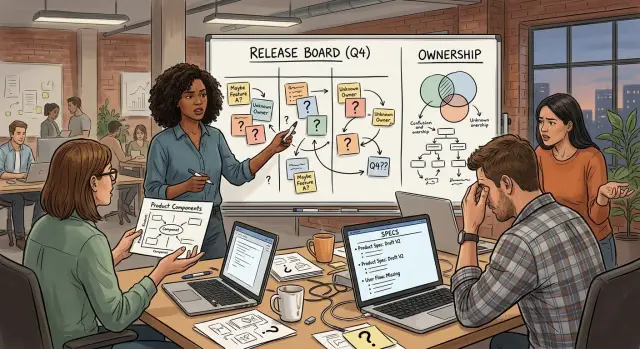
Table of Contents
Demand exposes the cracks
More users do not calm a codebase down. They expose everything the team has been getting away with.
Early on, a small team can cover gaps with memory and speed. One engineer knows which background job can fail without causing damage. The founder remembers why an odd feature flag exists. Support messages the developer who built the feature, and the issue is gone by lunch.
That works when only a few customers use the product. Once demand grows, the same habits start draining time every day. Support asks for fixes each morning. Sales promises a use case that almost works. Product asks for a "small change" that touches billing, logins, and reporting at the same time.
The problems can look sudden, but they usually are not new. Demand does not create most of them. It makes them visible, frequent, and expensive.
More customers also bring more edge cases. One account has old data that no longer matches the current database structure. Another uses the API in a way nobody expected. A third needs permissions split across teams, and the simple role model stops working.
Each case looks minor on its own. Together they expose the gaps the team used to work around by instinct. Some parts of the product have no clear owner. Specs live in chat threads and people's heads. Releases depend on one careful person being awake and available.
A five-person startup can survive like this for a while. At 50 paying customers, the cracks start pulling engineers away from planned work. At 500, the team can spend half the week reacting instead of building.
Revenue can keep rising while engineering stress rises even faster. That mismatch is where the real mess starts.
Ownership breaks first
Growth changes one thing before anything else: more people now touch the same work.
A feature request no longer moves from one founder to one engineer. Now it pulls in product, support, sales, and engineering all at once. That sounds normal, but it creates confusion fast. Product wants a cleaner flow. Support wants fewer tickets. Engineering wants something that will still hold up next week. If nobody has the right to make the final call, the team keeps moving without actually deciding.
The result is messy work, not necessarily slow work. People stay busy. Messages fly. Tickets move. But scope, edge cases, and release rules stay fuzzy until the last minute.
A common sequence is easy to spot. A customer asks for a change that seems small. Support promises a quick fix because the account matters. Product adds extra behavior during the discussion. Engineers build from chat messages instead of a real spec. A manager asks for updates every few hours, but nobody answers the harder question: who decides what "done" means?
That last gap causes most of the damage. Status checks feel productive, but they do not settle disagreements. Teams need a decider, not more comments.
Take a billing change at a growing startup. One customer wants invoices grouped a new way. Support wants the format changed today. Product wants the same logic added to the dashboard. Engineering sees follow-up risks in tax handling and exports. If one person owns the full outcome, the team can cut scope and ship a safe version. If nobody owns it, each group makes a partial decision and the final result lands on engineering.
Urgent work makes this worse because handoffs disappear first. People skip the normal path, send a few messages, and call it alignment. Later, when something confuses users or breaks an internal process, nobody can point to the actual decision.
Growing teams do not need more approval layers. They need clear names next to decisions, clear limits on scope, and one person who can say yes, no, or not now.
Specs get fuzzy under pressure
When demand rises, teams stop describing features clearly and start talking in broad outcomes. Sales hears a customer say, "We need better reporting" or "We need approvals," then turns that into a promise with a date.
That promise is usually much wider than the work anyone actually defined. The customer imagines edge cases, permissions, exports, alerts, and admin controls. The ticket often says two lines and leaves the hard parts blank.
Product feels the pressure next. Instead of writing a complete spec, they write short tickets with open questions and hope the team can sort them out while building. A tiny team can survive that once or twice. It breaks quickly when more people touch the same feature.
Engineers do what they always do when the spec is thin: they guess. Usually they guess in good faith. One developer assumes the feature only applies to new customers. Another assumes it must work for old accounts too. Both choices sound reasonable. Either one can still be wrong.
QA usually gets the worst version of this. They see the feature late, after code already exists and people feel committed to the current approach. At that point, QA is not checking a shared definition. They are trying to reverse-engineer the original intent from scraps.
A small example
A startup starts closing larger deals. Sales promises "custom approval flows" because buyers keep asking for them. Product creates a few tickets: add approval steps, add admin settings, send notifications.
Nobody writes down who can edit a flow, what happens when a step fails, or whether old requests must follow the new rules. Engineering fills in the blanks. QA tests the tickets as written. Then the customer demo happens, and everyone realizes they built a partial version of three different ideas.
Good product specs for a growing team do not need to be long. They need to answer a few basic questions: who will use the feature, what exact problem it solves, what counts as done, what is out of scope, and which edge cases matter now.
Without that, ordinary ambiguity turns into expensive rework. The team ships code, but nobody shares the same picture of what they shipped.
Deploys stop being routine
A lot of post-fit engineering pain first shows up in releases.
A team that used to ship three times a day now needs a shared checklist, a database change, a config update, and one person who still remembers the exact order. That is where mistakes start.
Manual release steps feel manageable when traffic is low and only two people touch production. After demand grows, those same steps become traps. Someone forgets an environment variable. Someone runs a migration before the app code is live. Someone skips a cache clear because the last deploy worked without it.
Small database changes cause more pain than teams expect. Adding one column, changing a default value, or tightening validation can break old requests, slow down a busy table, or confuse users in places nobody checked. The change looks tiny in a pull request. In production, it can lock part of the app for ten minutes and create a support queue for the rest of the day.
Rollback speed matters more than release speed. If a bad deploy takes forty minutes to unwind, people stop treating releases as routine work. They wait for a quieter hour. Then they avoid Friday. Then they bundle five or six changes into one release because nobody wants to go through the process twice.
That pileup makes every deploy harder to trust. When front-end updates, back-end changes, migrations, and billing tweaks all land together, the team loses the ability to spot what broke. Fixing the issue takes longer because too many things changed at once.
You can usually tell this problem is real when one senior engineer has to babysit every release, harmless fixes get delayed until a larger batch is ready, release notes get written in chat from memory, and rollback feels like a rescue mission instead of a normal action.
A good deploy process feels boring. One change goes out. Monitoring shows whether it worked. If it fails, the team backs it out fast and tries again. If deploys feel tense, slow, or personal, the process is already too fragile for the stage the company has reached.
A simple growth scenario
A SaaS team closes three new accounts in one month. That feels like proof the product works. It also creates a quiet trap when all three customers ask for almost the same workflow, with slightly different approval rules, field names, and reporting steps.
The clean move would be to stop and shape one shared workflow model. Most teams do not do that. Sales already promised dates. Customer success wants each account live fast. Engineers copy the existing logic three times, add a few flags, and move on.
At first, this looks faster. One customer needs two approvers instead of one, so the team adds a condition. Another wants a custom status label, so they hardcode that too. The third wants one extra step before completion, so they fork the logic again instead of asking whether the original model still makes sense.
Two weeks later, support starts seeing the same bug under different names. One ticket says approvals freeze after edit. Another says status does not update after reassignment. A third says the workflow finishes, but the report still shows it as pending. These look like separate issues, so support logs them in three places. They are really one bug hiding inside three versions of the same flow.
Now the cost shows up everywhere. Product cannot tell which behavior is correct. Engineering has to patch three paths for one fix. Support cannot give a clear answer to customers. QA has to retest each account by hand.
This is how the mess usually spreads. Demand gives the team more chances to copy old shortcuts into more places.
Once that happens, every new customer request feels heavier than the last one. A small change that should take half a day now touches several code paths, three test cases, and a risky deploy window. The team thinks it has a feature problem. It actually has a system problem, and growth made it visible.
That is why fast growth can make a decent product feel oddly fragile. The product found buyers. The engineering system never caught up.
Fix the system in order
Most of this does not call for a rewrite. It calls for order.
If you try to fix everything at once, the team will just ship chaos faster.
Start with ownership. Write down every product area and put one name next to each one. Signup, billing, onboarding, mobile, admin, support tools - each area needs a clear owner. That person can ask for help, but one person makes the call. If five people own checkout, nobody really owns it.
Then fix how work enters the team. For growing teams, better product specs beat more meetings almost every time. Change the ticket template so every task states the user action, the awkward cases around it, and the exact done state. When a ticket says, "User uploads a PDF, gets a confirmation, and sees an error if the file is too large," engineers do less guessing and QA finds fewer surprises.
Next, change the deployment process in one simple way: make releases smaller. Teams under pressure often bundle ten changes into one deploy because it feels faster. It usually creates slow debugging and long nights. Ship small batches every day instead. Small releases are easier to review, easier to test, and easier to undo.
A deploy also needs a way back. Pick the release types you use most and give each one a rollback path. Keep the previous front-end build ready. Let the old API version stay live for a short time when you can. Avoid one-way database changes unless you truly need them. You do not need a perfect rollback system. You need one that works when people are stressed.
Last, review one incident every week. Keep it short and plain. Find one cause you can remove now, then remove it. Maybe the alert came too late. Maybe the spec missed an edge case. Maybe nobody knew who could approve the fix.
The order matters. Ownership calms product decisions. Clear specs calm delivery. Smaller deploys calm operations.
Mistakes that make the mess worse
Once demand shows up, teams often make a few rushed decisions that feel sensible in the moment. They want relief, so they add people, tools, exceptions, and extra effort. That usually makes the situation harder to untangle.
The first mistake is hiring before roles are clear. A bigger team does not fix fuzzy ownership. It spreads the confusion wider. Two engineers edit the same area, nobody knows who approves changes, and small bugs sit untouched because each person assumes somebody else owns them.
The next mistake is buying process tools before the team agrees on a basic way of working. A new ticket system, a new doc tool, and a new CI setup can look like progress. If the team still disagrees on when work is ready, who reviews it, and how code reaches production, the tools just give the mess nicer labels.
A lot of startups also keep one engineer as the release hero. That person knows the hidden steps, the odd server behavior, and the order of commands that makes deploys work. It feels efficient right up to the day they are sick, asleep, or simply tired of carrying the whole release on their back.
Treating every customer request as custom work causes slower damage. Sales closes one deal with a special rule. Support asks for another exception. Engineering adds flags, manual steps, and one-off logic until the product starts acting like five products taped together.
You can see the pattern when new hires ask the same ownership questions every week, release dates depend on one person being online, the team adds tools but handoffs still break, customer requests skip product review and go straight to code, and old edge cases keep showing up in new work.
The fix is not glamorous. Name owners before hiring. Agree on one path from idea to deploy before adding more tools. Make releases normal enough that any trained engineer can handle them. Push repeated customer requests back into the product instead of hiding them in custom code.
Teams get better when they remove mystery first.
A quick team check
Growth gets messy when the team cannot answer basic questions quickly. You do not need a big audit to spot the problem. Fifteen minutes in one team meeting is often enough.
Ask these four questions:
- If a bug lands in checkout, billing, or onboarding, can everyone name the person who decides what happens next?
- When someone picks up a ticket, does it explain the change and the reason behind it in one or two clear lines?
- If you need to ship a small fix right now, can the team deploy in minutes, or does the release turn into a long handoff?
- Can support see what shipped today without asking engineers in chat?
These questions sound almost too simple. That is the point. Most growing teams do not break on dramatic failures. They break on hesitation around simple things. People pause, look around, and ask who owns it. A ticket exists, but nobody knows the goal. A release works, but only after three people approve it, one person watches logs, and someone else updates customers by hand.
One fuzzy answer is a warning. Two means the system is already slowing the team down. Four means demand is running ahead of your operating habits.
Small teams can hide this for a while because people remember everything. Growing teams cannot. The moment you add more customers, more tickets, and more engineers, memory stops working as a process.
The same pattern shows up in Oleg Sotnikov's Fractional CTO work at oleg.is. Teams hold up better under load when ownership is obvious, specs are short and clear, and releases leave a visible trail that product and support can read.
If you run this check and hear long explanations instead of direct answers, do not debate it for a month. Pick the first weak area and tighten it this week. Clean ownership first, clearer tickets second, faster deploys third, and daily release visibility right after that.
What to do next
Do not try to clean up the whole company at once. Pick one product line, one customer journey, or one team that ships often. A narrow slice gives you real signal fast, and it keeps the work small enough to finish.
Start with ownership. One person should decide what gets built, who approves changes, and who answers when something breaks in that area. Shared ownership sounds polite, but in growing teams it usually means nobody closes the loop.
Then fix specs. They do not need to be long. They need to say what problem you are solving, what "done" means, what should not change, and who signs off. If engineers and product people read the same page and come away with different plans, the spec failed.
After that, fix deploys. Write down the release steps, cut manual handoffs, and make rollback boring. A startup does not need a giant release process, but it does need one that works at 5 pm on a Friday and during a bad week in October.
A simple first pass looks like this:
- Choose one product line with frequent changes and real revenue impact.
- Name a single owner for product calls and a single owner for delivery.
- Use a short spec template for every change for the next 30 days.
- Track every deploy: who shipped, what changed, what broke, and how long recovery took.
This is usually where the problem becomes impossible to ignore. Demand did not create the mess. It made it impossible to hide.
If the team keeps arguing about symptoms, an outside review can help. The useful questions are plain: who owns this, where does the spec fail, and why is shipping risky?
That is the kind of work Oleg Sotnikov focuses on for startups and small teams. If you need a direct read on what to fix first, a practical Fractional CTO review can save a lot of wasted motion.
Frequently Asked Questions
Why do engineering problems get worse after product-market fit?
More demand puts real traffic, real customers, and real edge cases on top of habits that only worked when the team could rely on memory. Problems that felt small suddenly show up every day, cost more to fix, and pull engineers away from planned work.
What usually breaks first when a startup starts growing?
Ownership usually breaks first. More people touch the same feature, but nobody has the final say on scope, tradeoffs, or what counts as done. The team stays busy, yet decisions stay fuzzy until the last minute.
How can I tell if ownership is unclear?
Watch for long Slack threads, repeated status checks, and tickets that move forward without a clear decision. If support, product, and engineering all make partial calls on the same issue, you have an ownership problem.
How detailed should a product spec be?
A good spec can stay short. It should say who the feature is for, what exact problem it solves, what done looks like, what stays out of scope, and which edge cases matter now. If engineers have to guess, the spec is too thin.
Why do small customer requests turn into big engineering work?
Because teams often copy the old logic, add flags, and patch around each customer's variation instead of shaping one clean model. That feels fast for a week, then one bug spreads across several code paths and every fix gets heavier.
What makes deploys start feeling risky?
Deploys feel risky when they depend on manual steps, hidden knowledge, and one careful person remembering the right order. Slow rollbacks make it worse, because the team starts batching changes and each release becomes harder to debug.
Do we need a rewrite once growth starts hurting the team?
Usually no. Most teams need order before they need a rewrite. Clear owners, better specs, smaller releases, and a simple rollback path fix a lot of the pain without burning months on a rebuild.
What should we fix first?
Start with ownership, then fix how work enters the team, then make releases smaller and easier to undo. That order works because better decisions calm product work first, and calmer product work makes delivery and operations easier to fix.
Will hiring more engineers solve the problem?
Not by itself. If roles stay fuzzy, a bigger team spreads the confusion wider. New people need clear ownership, a simple path from request to deploy, and release steps they can follow without chasing tribal knowledge.
When should we bring in a Fractional CTO or outside review?
Bring in outside help when the same arguments keep repeating, releases depend on one person, or the team cannot answer basic questions about ownership and shipping. A good Fractional CTO should find the weak spots fast and help you fix the first few in the right order.


