PHP API validation packages for thin controllers and DTOs
Compare PHP API validation packages, request mappers, and serializers for cleaner controllers, clearer DTOs, and API errors clients can fix fast.
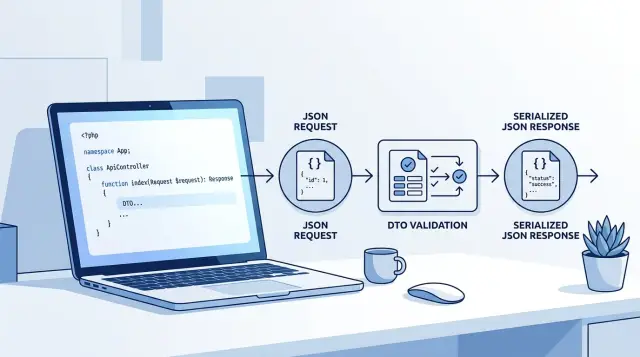
Table of Contents
Why this problem shows up in PHP APIs
PHP makes it very easy to start an endpoint with raw request data and a few quick checks. That speed is nice on day one. A month later, the controller often turns into a pile of isset() calls, manual casts, default values, and custom error arrays.
A simple "create user" action can end up doing five jobs at once. It reads query or JSON input, converts strings into ints or booleans, checks required fields, formats validation errors, calls business logic, and then reshapes the response for the client. The controller stops being a thin entry point and becomes a place where every small rule gets dropped.
That mix causes testing problems fast. If parsing, validation, business rules, and response formatting all live in one method, each test has to cover too many branches. A small change in error text or type casting can break tests that were meant to verify business behavior, not request handling.
Loose input handling makes the problem worse because it hides contract errors. A controller may accept "42" as an integer in one endpoint, reject it in another, and quietly ignore unknown fields in a third. Everything looks fine in local testing, then production traffic finds the gaps. A mobile app sends null where an array was expected, or a partner system sends an extra field with a typo, and now the endpoint fails in a way that is hard to trace.
This is why PHP API validation packages, request mappers, and serialization tools matter. They move repetitive work into code that has one clear job. The controller can go back to doing very little: accept the request, hand it to a mapper or validator, call the application service, and return a shaped response.
That split makes contract errors obvious early. It also makes the code easier to read. When a controller fits on one screen, teams usually spot mistakes before users do.
What to compare before you choose
Most packages look similar on the feature list, but they fail in different places once real payloads hit your API. When you compare PHP API validation packages, focus less on marketing claims and more on what happens when the client sends bad data.
Start with error messages. A good tool tells you exactly which field failed, why it failed, and what type it expected. If email is missing or age arrives as a string instead of an integer, the package should point to that field without making you dig through a generic exception.
Nested payloads matter just as much. Many APIs accept JSON like an order with customer data, items, and shipping details. If a package handles flat input well but gets awkward with nested arrays and typed objects, your controllers will fill up with manual mapping code again.
Look closely at the awkward values before you commit. Dates often break first. Enums come next. Then nulls create confusion, especially when null means "empty on purpose" in one field and "missing" in another. A package that makes those rules explicit will save you hours of debugging.
Framework fit matters, but it should not trap you. Some tools feel natural in Symfony because they plug into the request lifecycle. Others work better in Laravel with casts, form requests, or container binding. If you run plain PHP, check whether the package still feels clean without a pile of custom glue.
A quick test helps more than a long comparison table:
- Map a nested JSON payload into DTOs
- Send a missing required field
- Send a wrong type inside a child object
- Parse one date field and one enum field
- Allow
nullin one property and reject it in another
Setup time is the last check, not the first. A package that takes 30 extra minutes to wire up can still be the better choice if it removes 200 lines of controller code and makes contract errors obvious on day one. Thin controllers are not about having fewer files. They are about moving parsing, validation, and response shaping into places where mistakes are easy to spot.
Packages that validate input cleanly
Good validation makes bad input fail early, before your controller touches business logic. That matters more than most teams admit. Once raw request data leaks deeper into the app, contract errors get harder to trace and much harder to explain to clients.
Among PHP API validation packages, Symfony Validator is the safest default when you want clear rules and clear error messages. It gives you strong constraints for strings, numbers, dates, arrays, nested objects, and custom rules. It also reports field-level errors well, so an API can return useful messages like "email is not valid" or "age must be at least 18" instead of a vague 400 response.
Respect/Validation fits plain PHP projects that do not want a full framework dependency. Its rules read simply, and you can add them almost anywhere. That makes it easy to adopt in older codebases or small services, though you usually have to build more of the surrounding error format yourself.
Laravel Validator and Form Requests work fast if your API already lives inside Laravel. You get request validation, authorization checks, and readable error responses with little setup. The tradeoff is portability. If you move logic into a shared package or a non-Laravel service later, that validation layer does not travel as cleanly.
Where each tool fits
Symfony Validator works best when your payloads have nested data and you want consistent error reporting across many endpoints. Respect/Validation is better when you need a lightweight library and you control the request flow yourself. Laravel Form Requests are the fastest choice when the whole team already builds the Laravel way.
Validation alone solves enough when the input is simple and the endpoint only needs to reject malformed data.
- Required fields must exist
- Types must match
- String lengths or ranges must stay within limits
- A small set of fields needs format checks like email, UUID, or date
The gaps show up once the request needs more than rule checking. Validation does not map arrays into DTOs, pick safe defaults, normalize types across the app, or express business rules cleanly. A rule can say a field is present. It usually should not decide how an order object, command, or internal model gets built.
A good pattern is simple: validate raw input first, stop bad requests early, then pass clean data into a mapper or DTO factory. That keeps controllers short and makes contract errors obvious without stuffing every decision into validation rules.
Tools that map requests into DTOs
A mapper turns loose request arrays into typed objects before controller logic runs. That sounds small, but it changes the whole flow. The controller stops pulling values from $request one by one, and bad input fails near the edge of the app.
Valinor is the strict option. It maps arrays into plain PHP objects and gives very exact type errors when input does not match. If a field should be an int and the client sends "abc", Valinor tells you which path failed, even in nested data like items[2].price. That makes contract bugs easy to spot.
Spatie Laravel Data feels smoother in Laravel projects. It fits request classes, validation, casts, and DTO creation in a way Laravel teams usually pick up fast. Defaults are easy to express in the data object, and nested input works well for common cases like an order with line items.
Symfony request payload mapping makes sense if you already build on Symfony. You can map request payloads straight into typed objects and let the framework handle much of the plumbing. That keeps controllers short and consistent with the rest of the app.
Where the differences show up
Extra fields are where these tools start to feel different. Some teams ignore unknown input to stay forgiving, but that often hides client bugs for weeks. Valinor leans strict, which I prefer for public APIs. Symfony and Spatie give you more room to shape how unknown fields behave, depending on your setup.
Defaults matter too. If you want a missing page value to become 1, Spatie Laravel Data makes that easy. If you want missing data to fail unless you declared it with care, Valinor is a better fit. Symfony sits in the middle and depends more on how you define the DTO and validation rules.
Nested input is the real test. A flat login request is easy for any PHP request mapping tool. A checkout payload with customer data, addresses, discounts, and item arrays is where weak setups start to creak. Pick the one that points to the exact bad field, not just a vague "invalid payload" error.
For most teams, the split is pretty simple:
- Pick Valinor when strict types and precise errors matter most.
- Pick Spatie Laravel Data when you build in Laravel and want a fast DTO flow.
- Pick Symfony mapping when your app already follows Symfony patterns.
Tools that shape API responses
A good response layer does one job well: it turns internal data into the exact JSON your API promises. When that layer is clear, controllers stop doing little formatting tricks like renaming fields, trimming nested data, or hand-building date strings.
Symfony Serializer fits teams that want a lot of control without writing the same mapping code over and over. It handles field name changes, serialization groups, dates, and enums well. If one endpoint needs created_at and another needs createdAt, you can keep that rule in the serializer instead of scattering it across controllers.
JMS Serializer still makes sense in older Symfony projects, especially when the codebase already relies on annotations on models and DTOs. It can feel heavy in a new build, but replacing it just for style is often a waste of time. If the team already understands its rules and the output is predictable, keeping it may be the safer choice.
Laravel API Resources are often the easiest option for Laravel teams. They make response shaping readable, and they keep presentation rules close to the output. That works well when you need to expose only part of a model, add small computed fields, or wrap collections in a consistent format.
Plain json_encode with response DTOs is still a good choice more often than people admit. If your API has a small number of response shapes, a plain DTO plus explicit mapping can be easier to read than a serializer with many hidden rules. This also makes contract changes obvious in code review, because every field sits in one place.
A quick rule helps:
- Use Symfony Serializer when output rules vary by endpoint.
- Keep JMS Serializer in older Symfony apps that already depend on it.
- Use Laravel API Resources when you are already deep in Laravel.
- Use DTOs plus
json_encodewhen you want the leanest stack.
Teams that care about thin controllers usually do better when they pick one response pattern and stick to it. Mixing resources, serializers, arrays, and ad hoc JSON in the same API gets messy fast. If you want contract errors to stay visible, boring and explicit often beats clever.
How to build a thin controller flow
A thin controller should do very little. It should accept the HTTP request, hand data to a mapper, call one service, and return a response DTO. If type checks, validation rules, and response shaping all sit inside the controller, the endpoint gets messy fast.
Start with one endpoint, not the whole API. A single POST endpoint is enough to prove the pattern. Create a request DTO with the exact fields you accept, and a response DTO with the exact fields you return.
Put mapping and validation before business logic
Most PHP API validation packages work better when bad input fails early. Map raw request data into the request DTO before the controller calls your service. Then validate that DTO, with rules close to each field through attributes, metadata, or the package's normal style.
That order keeps the controller calm. If "age" arrives as "twenty" or "email" is missing, the service never runs. The controller only needs one simple branch: valid input goes forward, invalid input returns a contract error.
A small flow often looks like this:
- Decode the request body
- Map it into a request DTO
- Validate the DTO
- Pass the DTO to an application service
- Map the result into a response DTO and serialize it
Use one error format for every contract failure. Do not return one JSON shape for missing fields and another for wrong types. Clients should always know where to look. Field, code, and message are usually enough.
{
  "errors": [
    { "field": "email", "code": "required", "message": "email is required" }
  ]
}
Use that same format for wrong types, missing fields, and extra fields. Extra fields need a clear rule. I prefer rejecting them in public APIs because silent ignores hide bugs and make client code harder to trust.
Tests keep this flow honest. Write a few request-level tests that send bad payloads on purpose. One with a string where an integer should be, one without a required field, and one with an unexpected field will catch most contract drift early.
When this pattern clicks, controllers shrink to a few lines. That makes reviews faster, errors clearer, and DTO mapping much easier to reason about.
A realistic example of the refactor
A signup endpoint is a good place to see the mess clearly. It often starts small, then grows into a controller that reads raw input, checks fields, hashes passwords, creates a user, sends a welcome email, and builds the response by hand.
Before
The first version usually pulls values straight from the request array and mixes transport rules with business logic.
public function signup(Request $request): JsonResponse
{
    $data = $request->request->all();

    if (empty($data['email']) || !filter_var($data['email'], FILTER_VALIDATE_EMAIL)) {
        return new JsonResponse(['error' => 'Email is invalid'], 422);
    }

    if (empty($data['password']) || strlen($data['password']) < 8) {
        return new JsonResponse(['error' => 'Password must be at least 8 characters'], 422);
    }

    if (!isset($data['consent']) || $data['consent'] !== true) {
        return new JsonResponse(['error' => 'Consent is required'], 422);
    }

    $user = $this->userService->create(
        $data['email'],
        password_hash($data['password'], PASSWORD_BCRYPT),
        $data['consent']
    );

    return new JsonResponse([
        'id' => $user->id,
        'email' => $user->email,
        'created_at' => $user->createdAt->format(DATE_ATOM),
    ], 201);
}
This works, but contract errors hide in small details. One controller might expect consent === true, another accepts 1, and a third trims email while the others do not. Error messages also drift fast because each action writes its own strings.
After
A cleaner version maps the request into a DTO, validates it, hands it to a service, and serializes the response. A common stack in PHP is Valinor for mapping, Symfony Validator for input rules, and Symfony Serializer for output.
public function signup(Request $request): JsonResponse
{
    $command = $this->mapper->map(SignupRequest::class, $request->toArray());
    $this->validator->validate($command);

    $user = $this->signupService->handle($command);

    return new JsonResponse(
        $this->serializer->normalize(UserResponse::fromUser($user)),
        201
    );
}
Now the failures happen early. If email is missing or malformed, mapping or validation stops the request before the service runs. If password is too short, the validator returns a field error tied to password, not a generic message. If consent is false or missing, the DTO never reaches account creation.
That changes the controller from a decision tree into a thin entry point. It accepts input, passes a typed object to the service, and returns a shaped response. The signup rules live in one place, so tests get smaller and contract mistakes stop spreading across endpoints.
Mistakes that hide contract errors
A lot of PHP APIs look fine until clients send messy input. Then the same endpoint starts failing in three different ways, and nobody can tell whether the problem is the request, the business rule, or the code path. That usually happens when teams blur the line between contract checks and domain logic.
A common mistake is to mix simple input validation with business rules. Checking that "email" is a string and that "quantity" is an integer belongs at the edge of the app. Checking whether a user can place an order belongs deeper in the flow. When both happen in one place, clients get vague errors like "invalid request" for problems that have very different causes.
Another problem starts after you already mapped the request into a DTO. If a controller or service drops back to loose arrays, you lose the safety you just created. A DTO says, "this field exists and has this type." An array says almost nothing. One helper reads "userId", another expects "user_id", and the contract gets fuzzy again.
Mutating DTOs halfway through the request also causes trouble. If the incoming DTO says age is null, but some later step quietly sets it to 0, debugging gets ugly fast. The client sent one thing. Your app processed another. Keep request DTOs stable and create a new object when you need derived data.
Error shape matters too. If one endpoint returns:
{"error":"Invalid email"}
and another returns:
{"errors":{"email":["Required"]}}
clients need endpoint-specific error handling. That wastes time and hides patterns in bad requests. Pick one error format and use it everywhere.
Silent type coercion is the sneakiest bug of the lot. A client sends "false", 0, or "123abc", and PHP turns it into something usable enough to slip through. Then the API behaves in a way the client never asked for. Good PHP API validation packages help only if you keep strict types, reject bad values early, and avoid "close enough" casting.
If a controller stays thin, contract errors stay obvious. Parse once, validate once, map once, and pass clean data forward.
Quick checks before you commit
A package can look neat in a demo and still make daily API work worse. Before you add it to your stack, test the boring parts. That is where thin controllers either stay thin or slowly fill up with glue code.
If you compare PHP API validation packages, start with the error messages. A good tool should point to the exact field path, not just say that the payload is wrong. If the client sends customer.address.postcode and the response only says address is invalid, someone will spend extra time guessing.
Use this short checklist when you try a package on a real request:
- It reports the exact path for bad input, including nested arrays and objects.
- It maps nested input into DTOs without hand-written array plumbing.
- It lets you run the same rules in HTTP requests, tests, and queue jobs.
- It works with your framework's request lifecycle instead of forcing odd workarounds.
- It leaves you with a DTO that another developer can read in 30 seconds.
Nested mapping matters more than most teams expect. Flat examples look easy, but real payloads usually contain items, options, and child objects. If the package breaks down as soon as you add items[2].price or billing.contact.email, your controller will end up fixing structure problems that the mapper should handle.
Rule reuse is another fast test. Try the same DTO and validation rules in a console command or background job. If they only work inside a controller, you do not have a clean contract. You have request-bound logic.
Framework fit also saves time. In Laravel, Symfony, or another stack, the tool should feel native enough that your team stops thinking about it after a day or two. If every request needs adapters, converters, and custom hooks, the package is fighting your app.
One last check is simple: open the DTO file cold. Can a teammate tell what the API accepts, what is optional, and what fails validation? If not, the contract is still hidden. That usually means more bugs, slower reviews, and controllers that grow again.
Next steps for your team
Pick one endpoint that causes regular friction. A signup form, checkout request, or partner webhook is enough. Refactor only that flow, then measure what changed: lines removed from the controller, number of manual if checks deleted, and how many error responses now follow one clear format.
That small test tells you more than a long debate. If the controller shrinks, the DTO becomes easy to read, and bad input fails in one obvious place, you are on the right track. If the stack feels heavy after one endpoint, stop there and simplify.
A short team rule helps more than a long style guide. Keep it plain:
- Controllers accept the request and hand it off fast.
- DTOs hold typed input, not business logic.
- Validation runs before service code starts.
- Response mapping happens in one place, not inside each controller.
Write those rules where the team already works. Two or three sentences in your project docs is enough if everyone follows them.
Keep the first stack boring. One validator, one way to map requests into DTOs, and one serializer is usually plenty. Mixing several PHP API validation packages, custom mappers, and multiple PHP serialization libraries at the start often creates the same mess in a new shape. Thin controllers come from clear boundaries, not from adding more tools.
A good checkpoint after the first refactor is simple: can a new developer open the endpoint and understand the request shape, validation rules, and response format in a few minutes? If not, trim more.
If your startup needs an outside view, Oleg Sotnikov offers Fractional CTO advice on architecture, infrastructure, and AI-assisted development workflows. That kind of review is most useful when you want a lean PHP request mapping and DTO setup without turning a small API into a framework project.
Do one endpoint well, copy the pattern, and make the next endpoint easier than the last.


