Outside CTO vs engineering manager: which hire fits?
Outside CTO vs engineering manager: use team size, release pain, and system risk to choose the hire that fixes your bottleneck first.
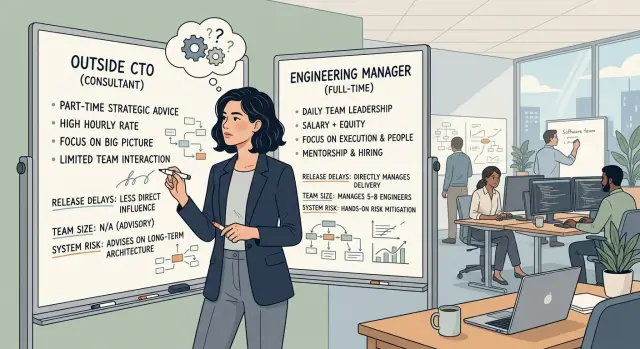
Table of Contents
Why this choice feels confusing
Founders rarely start with a title. They start with pain. Releases slip, engineers argue about priorities, the same bugs come back, and nobody seems fully responsible for the outcome.
That is where the confusion starts. An outside CTO and an engineering manager can both help, but they fix different problems.
Founders often combine strategy, delivery, and people management into one vague role and hope one hire will solve all three. Sometimes that works. More often, it hides the real bottleneck.
The problem gets worse when the company reacts to the loudest issue. If sprint planning feels messy, an engineering manager can look like the obvious answer. If the product has risky architecture or unstable infrastructure, an outside CTO is often the better fit. The wrong hire can make things look better on the surface while the real problem stays in place.
Three signals usually tell the story better than job titles: team size, release pain, and system risk.
A small team with weak technical direction usually needs someone to set standards, make architecture calls, and lower risk. A bigger team with decent technical direction but poor execution usually needs someone to run delivery, hiring, and daily management.
That is why the outside CTO vs engineering manager decision feels harder than it should. Both roles can touch process, people, and product. The real difference is where they start and what they own first.
You also do not need a perfect org chart before you decide. Early stage companies rarely have one. You need an honest read on what hurts most: unclear technical decisions, painful releases, or a team that lacks daily management. That answer usually gets you to the right hire faster than any debate about titles.
What an outside CTO fixes first
An outside CTO starts with technical direction. When founders keep hearing different answers from senior engineers, or nobody wants to own a hard tradeoff, this person steps in and makes the call.
The first pass usually looks at architecture, security, infrastructure cost, and whether the hiring plan matches the product stage. This role is less about task tracking and more about judgment.
If the team argues about stack choices, roadmap scope, or whether to build something in house or buy it, an outside CTO breaks the tie and explains the reason clearly.
A simple example helps. Imagine a startup with eight engineers, a product that mostly works, and founders who get stuck every time the team debates a rewrite, a new vendor, or a rushed feature request. An engineering manager can keep work moving, but that does not solve the deeper problem if nobody owns technical direction.
That is where a fractional CTO often earns their keep. They review the current system, find the weak points, cut ideas that waste time, and set a plan the team can follow over the next few months.
This also matters when senior engineers are capable but spread too thin. Good engineers can build a lot. They still need one clear owner for decisions that affect security, reliability, hiring, and cost.
If the business needs calm technical judgment more than daily people management, an outside CTO is usually the better first hire.
What an engineering manager fixes first
An engineering manager usually starts with the team's daily operating rhythm. When the product direction is mostly clear and the architecture is not falling apart, the bigger problem is often execution.
Work stalls. Handoffs get messy. Good engineers spend too much time guessing who owns what.
This role brings order to the week. A strong engineering manager runs planning, keeps one on ones consistent, and pays close attention to team health. If one engineer feels lost, another keeps missing estimates, and a third avoids code review, that pattern needs management more than it needs a new system design.
They also remove the blockers that quietly slow everything down. A task waits for product input. A pull request sits untouched for two days. Backend work lands, but frontend never picks it up because nobody agreed on the handoff. An engineering manager sees those gaps and closes them.
You usually want this hire when engineers work hard but releases still slip, scope grows during the sprint and nobody pushes back, ownership feels fuzzy, or some engineers need regular feedback and structure to do their best work.
Coaching matters more than many founders expect. A manager can help a solid developer break large tasks into smaller ones, ask for help sooner, and explain tradeoffs clearly. That kind of support can change output within a few weeks.
This role fits best when the company does not need a reset on system design or product direction. If the roadmap makes sense and the stack is mostly fine, an engineering manager can turn a scattered team into one that ships on time with less stress.
Start with team size
Headcount is a rough filter, but it works well. The smaller the team, the less you need another layer of management and the more you need clear technical judgment.
With three to six engineers, most startups need direction first. Someone has to decide what to build now, what to delay, which shortcuts are safe, and where the system might break later. If founders still approve every technical call, an outside CTO usually helps more than an engineering manager.
That changes once the team reaches seven to fifteen people. At that size, either hire can make sense. The better question is what hurts every week.
If nobody owns architecture, priorities, or technical tradeoffs, bring in an outside CTO. If the plan is clear but work slips because of weak planning, uneven feedback, or messy handoffs, hire an engineering manager. If both problems exist, pick the one that costs you more time right now.
Several squads with team leads often need management consistency first. When leads already make sound technical decisions, an engineering manager can help more by setting a steady cadence for planning, reviews, hiring, and one on ones. That usually reduces friction faster than adding another senior technical voice.
A simple test helps. Ask who owns the hard calls today. If the answer is "the founder, mostly," you probably still need CTO level help. If the answer is "our leads already handle architecture," then an engineering manager may be enough.
That is why this decision has less to do with titles and more to do with who carries the decision load. Small teams break when nobody sets direction. Bigger teams slow down when nobody manages execution.
Oleg Sotnikov often works with companies in that first situation: founders carry too many technical decisions, releases depend on a few people, and the team needs senior guidance before it needs more management structure. Later, once leads own the system, an engineering manager can take over the daily rhythm.
Use release pain as a signal
The handoff from "done" to "live" tells you more than status reports do. When a team says code is finished but the release still slips, something in the path to production is weak.
Start by asking what breaks after coding ends. The answer usually points to the hire you need.
If QA finds serious issues only at the end, scope changes after engineers think the work is done, or deploys depend on manual steps and last minute fixes, look at execution first. Frequent slips often come from planning problems, fuzzy ownership, or a QA flow that starts too late. In that case, an engineering manager can help more than a senior architect.
If nobody trusts estimates, check management habits before anything else. Teams miss dates when work enters the sprint half defined, priorities move every few days, or no one closes the loop.
Repeated rework points somewhere else. If engineers keep rebuilding the same feature, or cut scope late because the system cannot support the original plan cleanly, the issue is technical direction. That is where an outside CTO makes more sense. The job is not to manage the sprint. The job is to set standards early, review risk before work starts, and stop bad bets before they turn into expensive rewrites.
Fire drills after every release are another strong signal. Hotfixes, rollback fear, and surprise outages usually mean the team lacks release standards and risk review. If the team can build but cannot release calmly, check process first. If each release exposes deeper flaws in the system, check technical leadership first.
Check system risk before you decide
Org charts can wait for a day. System risk usually cannot.
If one bad technical call could stop revenue, expose customer data, or break a promise to paying users, you may need senior technical leadership now. This is often the fastest way to choose between an outside CTO and an engineering manager.
Look at the systems that carry the most weight. A small startup can have only one risky service, and that alone can justify a more senior hire.
Think about a few direct questions. Do outages hit sales or support right away? Are there known security gaps or recent near misses? Do you store sensitive customer, health, or financial data? Would one vendor outage or price change cause real trouble? Do billing, payouts, or subscription rules depend on fragile code?
An engineering manager helps teams work better. That matters. But if founders are losing sleep because a payment bug could leak money for two days, or a security scare could trigger legal trouble, they need someone who can judge architecture, risk, and tradeoffs at a higher level.
Legacy code by itself does not prove you need a CTO. Plenty of old code is messy but stable. If customers rarely notice issues, data risk is low, and the business can tolerate slow cleanup, an engineering manager may be enough.
The picture changes when customer promises, compliance duties, or cash movement sit on top of shaky systems. Then the cost of a wrong technical decision rises fast. A senior operator can decide what to fix first, what to leave alone, and where a cheap shortcut will cost you later.
A simple test helps here too: if a founder cannot explain the worst technical failure in one sentence, start with the person who can find that answer and reduce the risk.
A simple way to choose in one week
You do not need a long hiring debate. One week of honest review usually shows where the damage starts.
Pull the last five incidents that hurt the team, the product, or the business. Use real events, not vague feelings: a release slipped by 10 days, a bug hit production, two engineers built the same thing, or a founder changed direction and the team threw away work.
Write each incident in one sentence. Mark it as people, process, architecture, or business direction. Note the cost in hours, money, customer trust, or missed sales. Then count where the damage actually came from and ignore who complained the loudest.
This works because teams often hire for the noisiest pain, not the most expensive one. If most of the damage came from missed follow through, weak planning, unclear ownership, or poor coordination, the engineering manager role is probably the better fit.
If the pattern points to risky architecture, unclear technical direction, security worries, or product decisions that nobody translated into sound engineering choices, you likely need an outside CTO. That role fixes the decisions behind the chaos, not just the daily flow of work.
Then write one sentence about what success looks like in 90 days. Keep it concrete. "Ship releases on schedule and reduce blocked work" points to an engineering manager. "Cut system risk, set technical direction, and stop expensive rebuilds" points to an outside CTO.
If your 90 day outcome tries to cover both jobs, stop and rewrite it. One role can help a lot. It cannot fix every problem you avoided naming.
A simple example from a 12 person startup
A SaaS company with 12 people keeps missing ship dates. Every Friday ends the same way: the team pushes a release late, finds a problem in production, and spends the evening patching it. The founder looks at the stress and thinks, "We need another manager."
That guess is understandable, but it misses the real issue. The team does not mainly lack supervision. It lacks technical direction.
A closer look shows the pattern. Engineers change scope during the week because the original design was thin. Nobody owns release quality from start to finish. One person merges code, another deploys, and nobody checks rollback steps until something breaks. The team moves fast in short bursts, then pays for it on Friday.
This is the moment to slow down and diagnose. An engineering manager can improve meetings, follow up, and team habits. That helps only a little if the architecture keeps creating surprise work.
An outside CTO usually fixes the mess closer to the source. In this case, that person would set clear release rules, trim scope so the team ships fewer risky changes at once, assign one owner for each service and each production issue, and clean up the worst shortcuts that keep causing rework.
After a few weeks, the team often looks very different. Friday patches drop. Releases get smaller. Engineers stop guessing who should make the call when something fails.
Then the founder can ask a cleaner question: do we still need an engineering manager? If the system is calmer but people management still suffers, then yes, hiring one makes sense. If the real pain was system risk and rushed technical decisions, the outside CTO fixed the part that hurt most first.
Mistakes that waste time and budget
Many teams lose months because they hire for the title they recognize, not the job that hurts today. This choice gets messy when nobody writes down who makes technical decisions, who manages people, and who owns delivery.
A common mistake is hiring an engineering manager while the founder still approves every major technical call. If the founder still picks the stack, steps into incidents, and rewrites architecture decisions, the new manager cannot do much. They end up tracking tickets and running standups while the real bottleneck stays in place.
The opposite mistake is just as expensive. Some teams hire a CTO because releases feel chaotic, but the deeper problem is plain management. Priorities change every few days, follow through is weak, and work sits half done because nobody pushes decisions to closure. A CTO will not fix that by title alone. A good manager usually will.
Job posts often make this worse. They ask one person to own product input, incident response, hiring, architecture, sprint admin, vendor choices, and team coaching. That is not one clear role. It is a pile of unresolved problems.
Another budget drain is expecting one hire to repair culture, architecture, and delivery in a month. People habits take time. System problems need diagnosis. Release speed improves only after the team stops changing direction every week.
Teams also copy titles from much larger companies. A 200 person company can separate CTO, VP Engineering, and engineering managers. A 10 person startup usually cannot. If you borrow big company titles, you also borrow assumptions that do not fit a small team.
A better test is simple. Ask three questions: who makes the hard technical tradeoffs, who keeps people accountable every week, and who steps in when releases start to slip? If one role description tries to answer all three, rewrite it before you hire.
Quick checks before you open the role
Before you write a job post, find the work that already falls through the cracks. Teams often say a tech lead or founder owns it, but vague ownership usually means no one owns it.
Start with architecture. If nobody can explain why the system looks the way it does, what debt is acceptable, and what failure would hurt the business first, you likely need outside CTO help. If the architecture is mostly settled and the pain shows up in daily execution, an engineering manager usually fits better.
Then look at people management. Someone needs to run planning, hold one on ones, give clear feedback, and deal with weak follow through. When senior engineers try to do that work between coding tasks, team quality gets uneven fast.
Ask a few direct questions before this turns into a bad hire. Who makes the final architecture call when engineers disagree? Who runs planning, hiring feedback, and performance conversations each week? How often do releases slip, and what caused the last few delays? Which failure would hurt most: downtime, lost data, security trouble, or broken billing? What should be true after 90 days so you can say the hire worked?
That last question matters more than most founders expect. A good 90 day outcome for an engineering manager might be predictable sprints, cleaner handoffs, and fewer release surprises. A good 90 day outcome for an outside CTO might be a clear architecture plan, a risk map, and fewer expensive technical bets made on guesswork.
If your answers stay fuzzy, pause the hiring process and spend one week writing them down. That small step often saves months of hiring the wrong person.
What to do next
Start with the first problem you want this person to remove. Do you need someone to stop release chaos, reduce system risk, or manage a growing team day to day? If you skip that step, the outside CTO vs engineering manager choice turns into a title debate, and title debates waste months.
Write a narrow scorecard before you write a job post. Tie it to outcomes you can see in 30 to 90 days. Cut release delays from weekly to occasional. Map the top three system risks and assign owners. Set a clear engineering cadence for planning and reviews. Define who owns architecture, delivery, and people management.
This also makes interviews easier. It shows whether you need strategic technical judgment, hands on delivery structure, or both for a short period.
If you are still unsure, start with a short advisory review before making a full time hire. On oleg.is, Oleg Sotnikov works with founders on team structure, release flow, infrastructure, and system risk, which can help clarify whether the next hire should own direction or execution. That kind of review is often cheaper than hiring the wrong full time leader and rebuilding the org chart three months later.
One pattern keeps showing up: founders hire an engineering manager when the real problem is architecture drift, or they bring in a CTO when the team mostly needs better planning and execution. The fix is the same each time. Look at the evidence, not the title you hear most often from investors, recruiters, or peers.
Pick the role that solves the next painful bottleneck. Then give that person a clear scorecard and enough room to do the job.
Frequently Asked Questions
What is the real difference between an outside CTO and an engineering manager?
An outside CTO starts with technical direction. They make architecture calls, reduce system risk, and decide what the team should build, delay, or stop.
An engineering manager starts with execution. They run planning, improve handoffs, give feedback, and keep work moving week to week.
Which hire usually fits a small startup team first?
If you have three to six engineers, hire for direction first in most cases. Small teams usually feel more pain from fuzzy technical decisions than from missing management layers.
Pick an outside CTO if the founder still carries architecture calls, stack choices, or release risk alone.
What changes when the team grows to around 7 to 15 engineers?
At that size, either role can make sense. Look at what hurts every week, not the title.
If leads already make sound technical calls but delivery feels messy, hire an engineering manager. If nobody owns architecture, risk, or hard tradeoffs, bring in an outside CTO.
Do missed releases always mean I need an engineering manager?
No. Missed releases often come from weak planning, fuzzy ownership, or poor handoffs, and a manager can fix that.
But if the team keeps reworking features because the design was wrong from the start, you have a technical direction problem. That points to an outside CTO.
What signs point to hiring an outside CTO?
Look at the damage a bad technical call could cause. If one outage could stop revenue, expose customer data, or break billing, get senior technical leadership first.
You should also lean toward an outside CTO when engineers keep arguing about stack choices, rewrites, or vendor decisions and no one owns the final call.
What signs point to hiring an engineering manager?
Choose an engineering manager when the roadmap makes sense but the team still struggles to ship cleanly. This role helps when scope grows mid sprint, pull requests sit too long, and engineers need regular feedback and structure.
They make the weekly rhythm calmer and more predictable.
Can one person cover both jobs?
Sometimes, but that usually works only for a short stretch. Most companies get better results when they name the first bottleneck and hire for that job.
If you ask one person to own architecture, incidents, hiring, coaching, and sprint admin at once, you will probably blur the role and miss the real problem.
How can I decide in one week without a long hiring debate?
Take the last five painful incidents and write each one in one sentence. Tag each one as people, process, architecture, or business direction, then note the cost in time, money, or customer trust.
The pattern usually tells you what to do. If most damage comes from execution gaps, hire an engineering manager. If it comes from risky decisions or shaky systems, hire an outside CTO.
What if the founder still makes most technical decisions?
If you still approve major technical calls, you probably need CTO level help first. A new manager cannot fix the bottleneck if every hard decision still climbs back to the founder.
Shift technical ownership before you expect smoother execution.
What should success look like in the first 90 days, and should I start with an advisory review?
Write one clear 90 day outcome before you open the role. For an engineering manager, that might mean fewer blocked tasks and more predictable releases. For an outside CTO, that might mean a clear architecture plan, lower system risk, and fewer expensive rebuilds.
If you still feel unsure, a short advisory review can save time and hiring budget before you commit to a full time role.


