Off-roadmap asks keep breaking product team focus
Off-roadmap asks look small, but they pile up into support debt, unowned code, and missed roadmap work. Learn how to stop the drift.
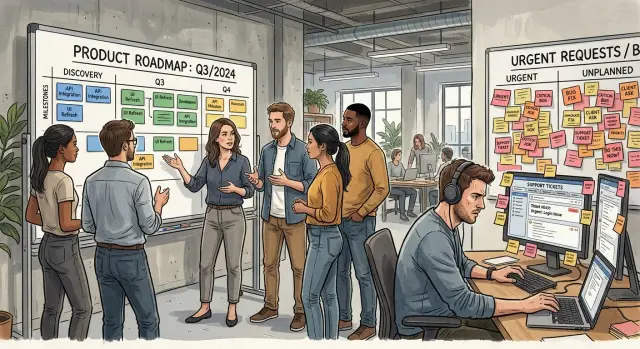
Table of Contents
Why side work keeps sneaking in
Off-roadmap requests rarely arrive as a major decision. They show up as a small favor.
A founder wants a custom export for one prospect. A sales lead asks for a one-off setting before a demo. Someone says it will take "just a few hours," so the team treats it like a harmless detour.
That is usually when priorities start to blur. The request feels urgent to one person, even if it does nothing for the broader plan. Because the ask sounds small, nobody asks the harder question: what slips if we do this now?
Teams also skip the normal planning discussion when the request comes from someone senior. Nobody wants to be the person who slows things down. Saying yes feels polite. Saying no feels political.
So the work slips in through side doors. A developer picks it up between tasks. A designer makes a quick tweak in Slack. QA hears about it after the fact. The team ships it, but nobody records what got bumped, shortened, or rushed.
That missing record matters. If the team delays a bug fix, pushes onboarding work, or cuts test time to make room for the extra request, the tradeoff should be visible. When it is not visible, the request looks free. It never is.
There is also a basic human reason this keeps happening: short-term relief beats clean process. The founder feels heard. Sales gets something to show. The team avoids an awkward debate. Everyone gets a small win today, and the real cost lands next week.
Teams often call this flexibility. Sometimes it is. More often, it creates a habit where the roadmap is optional and the loudest request wins.
That habit grows fast. Once people learn they can get work done outside the usual planning path, they stop using the usual path. Then every new request feels like an exception, even when exceptions have become the rule.
What one small request really costs
A request can sound tiny: "add one export button," "show this extra field," or "make a quick admin toggle." The code change might take two hours. The full job rarely does.
Once the team says yes, the work spreads. A designer checks layout and edge cases. QA tests old flows and the new one. Someone updates help text, internal docs, or release notes. The release takes time too, because one small change can still delay a deploy if it causes trouble elsewhere.
That cost lands on top of work users are already waiting for. When a team pauses planned work for off-roadmap asks, delivery slows in ways people notice quickly. The feature due next week slips. A bug fix stays open longer. Priorities stop looking like priorities because the schedule now belongs to whoever asked last.
The cost keeps going after launch. Every extra branch in the product creates another path the team must test later. A new permission rule, an odd settings toggle, a custom report filter - each one adds more cases to regression testing. Six months later, nobody remembers why it exists, but the team still has to keep it working.
One quick request also teaches a habit. If leaders keep approving work outside the plan, roadmap discipline starts to crack. Sales asks for a custom tweak. Support wants a shortcut for one customer. An executive wants a pet feature before a meeting. People stop discussing tradeoffs because they expect exceptions.
A small request is rarely "just engineering time." It usually pulls in design review, QA now and later, docs, support updates, delay on planned work, and one more piece of code that somebody has to own for years.
That does not mean every surprise request is wrong. Some deserve to move ahead. But the team should name the cost in plain language before anyone says yes. That one habit protects focus, keeps support debt down, and makes the roadmap real instead of decorative.
How support debt grows after launch
Support debt usually starts on day two, not launch day. The request looked simple, so the team shipped it fast. Then real users touched it and asked for the parts nobody wrote down.
A one-off feature almost never stays one-off. Someone wants a different permission rule. Another customer expects it to work on mobile. A third asks why the export includes one field but not another. The original request did not cover any of that, so every question turns into follow-up work.
Support feels this first. Support teams need clear rules, but off-roadmap asks often ship without proper guidance, help text, or a list of edge cases. That leaves people guessing. One person says, "Yes, it should do that." Another says, "No, that is not supported." Users get different answers, and trust drops fast.
Engineering feels it next. Instead of fixing the design, developers patch the odd cases one by one. They add a condition for one customer, then another for a legacy account, then a silent fallback because support needs an answer today. None of these patches look huge on their own. Together they make the feature harder to understand and harder to change.
Take a simple example. A team adds a custom CSV export for one sales account because the deal feels urgent. Two weeks later, support gets tickets about column order, timezone mismatches, and missing rows. Engineering adds switches to keep that account happy. Three months later, a broader reporting update has to preserve all those strange rules, even though they make no sense for everyone else.
That is the trap. The feature did not only cost build time. It created a promise, even if nobody meant to make one.
After that, every release carries extra risk. Test cases grow. QA has more hidden behavior to remember. Priorities bend around old exceptions. A request that skipped roadmap discipline now taxes every future change.
That is how off-roadmap asks become support debt: first a favor, then a patch, then a rule the team carries forever.
Why unowned code turns into team debt
Unowned code often starts the same way. One person adds a custom report, a hidden admin switch, or a special workflow for one customer, then moves on to the next sprint. The code ships, but ownership never does.
That is where the debt starts. If nobody clearly owns the feature after launch, bugs bounce between teams, small fixes wait too long, and routine updates feel risky. The team still pays for the code, even when nobody wants to admit it belongs to them.
This happens a lot with off-roadmap asks because the work feels temporary. People skip the parts that make code safe to live with: tests, docs, cleanup tasks, and a note about who maintains it. The feature may work on day one. Day thirty is another story.
A simple example makes the problem obvious. A developer adds a custom export for one account manager. It solves the request quickly, so everyone moves on. Three months later, the export fails after a schema change. Support reports it, engineering tries to figure out who wrote it, and the original developer is busy or gone. What looked like a two-hour job now takes half a day just to understand.
New hires feel this debt early. When they see code with thin tests, no context, and strange edge cases, they avoid touching it. That is a sensible choice. Nobody wants their first week to end with a production bug caused by a feature nobody can explain.
The cost is not only technical. Unowned code slows planning because every future change comes with a hidden question: what weird thing might this break? Over time, roadmap priorities stop reflecting the plan and start reflecting old exceptions.
Teams do better when every shipped change has a named owner, even if the ownership is temporary. If nobody is ready to own the code after release, that is usually a sign the work should not ship yet.
A realistic example
A sales rep is close to closing a customer. The customer wants a custom export so they can load data into an older finance system. Sales frames it as a tiny ask: one CSV, one customer, one quick win.
The request is not on the roadmap, but nobody wants to hold up the deal. An engineer adds the export behind a hidden admin switch. There is no product review, no written scope, and no clear owner after launch. The customer gets the file, the deal moves forward, and the team returns to planned work.
For a few weeks, it looks harmless.
Then another customer hears about the export and wants the same format with two extra columns. A third asks for the same file in a different column order. Support starts getting tickets because customers treat it like a normal feature. Support cannot answer much because nothing was documented. Product gets dragged in because nobody decided who this export is really for. Engineering gets pulled back because only one person knows how the code works.
Now the team owns a feature nobody planned to own. It needs tests, permissions, bug fixes, release notes, and basic rules about who can use it. When the original engineer is busy, changes slow down. If that engineer leaves, the export becomes unowned code overnight.
The cost keeps spreading. Support now manages a feature with no clear policy. Sales keeps promising slight variations because the first version already exists. Product managers spend time sorting exceptions instead of moving roadmap work forward. Engineers patch edge cases between larger tasks, which is exactly how planned work quietly slips.
A team might lose only a few hours each week at first. That still adds up fast. Five hours here, eight hours there, and suddenly a planned release moves by two weeks because people keep stopping to fix a hidden switch.
That is how off-roadmap asks create support debt. The first request looks cheap. The next five are where the real bill appears.
How to handle a new off-roadmap request
When a new request lands, do not start with effort. Start with the problem. Write it in one sentence that a customer or support person would understand. If nobody can explain what pain it fixes, the request is still a preference, not a product decision.
That one sentence does two useful things. It strips away vague language, and it makes weak requests easier to reject. "Sales wants this" is not a user problem. "New trial users cannot export the report they just created" is.
Next, ask who will own the code after launch. This question saves teams from a lot of quiet damage. A small feature is never just a pull request. Someone will answer support tickets, fix edge cases, update docs, and touch the code again when the product changes.
If the answer is "the team" or "we'll figure it out later," treat that as no owner. Unowned code becomes support debt fast.
A short intake filter helps. Before anyone writes code, answer four questions:
- What user problem does this solve?
- Who owns it after launch?
- What does it cost to build, support, and clean up later?
- Which planned item moves if we say yes?
That last question matters more than most teams admit. New work does not appear out of nowhere. If you say yes to one request, you are also saying no, or "later," to something already on the roadmap. Make that trade explicit. Name the item that slips, and name the person who accepts that trade.
It also helps to estimate three kinds of time instead of one. Build time is obvious. Support time is the part teams forget. Cleanup time matters too, because many side requests need rework, removal, or extra testing once real users touch them.
A tiny admin shortcut might take half a day to build, then steal 20 minutes a week in questions, fixes, and follow-up changes. After three months, it is no longer a tiny ask.
If a request cannot pass the intake filter, cannot get an owner, or cannot justify what it displaces, park it. That is roadmap discipline, not stubbornness.
Mistakes that make the mess worse
The mess usually starts with one bad label. Someone calls side work a "quick win," so the team skips the normal questions: who owns it, who supports it, and what gets delayed to make room for it? That label hides the real cost. A two-day request can easily turn into weeks of follow-up once users depend on it.
Another common mistake is hiding custom code behind a flag and treating that as safety. A flag does not remove ownership. It only makes the code easier to forget. Three months later, somebody changes a shared flow, the hidden branch breaks, and the team has to debug logic that no one remembers writing.
Shipping with no docs, no tests, and no support notes makes the problem worse quickly. Support has to guess how the feature works. New engineers read the code and still miss the reason it exists. The original requester often moves on, but the product team keeps the burden.
Letting people bypass product review is where off-roadmap asks start to pile up. A founder sends a message. Sales promises a prospect a small tweak. Customer success asks an engineer directly because it feels faster. Each request looks harmless on its own. Together they break priorities because nobody compares them against planned work.
The accounting gets distorted too. Teams often treat ad hoc work as free because nobody tracks it. They log roadmap items, but they do not log the extra planning, testing, support replies, bug fixes, and context switching that side work creates.
A simple scorecard can expose that hidden cost. Track build time, test and release time, support questions after launch, bugs tied to the change, and roadmap work pushed back. If a team refuses to track those five things, it will keep lying to itself about effort.
The worst version of this problem is quiet. Nothing explodes on launch day. The team just gets slower every month. More code has no clear owner. More requests arrive through side doors. Planned work slips, and people blame execution when the real problem is weak roadmap discipline.
A quick check before you ship anything
Teams rarely regret the slow "no." They often regret the fast "yes" that turns into a permanent chore.
A small gate before release saves a lot of cleanup later. If an off-roadmap ask cannot pass a few basic checks, it should wait.
Check the pattern, not the volume. One angry customer, one pushy sales call, or one executive message is not enough. Ship it when the same pain shows up again and again across real users or internal teams.
Name an owner before code ships. One person or one team needs to carry bugs, questions, and follow-up changes. Shared ownership usually means no ownership.
Write down the trade. Every extra request pushes something else back. Put the slipped work in writing so nobody can pretend the new task was free.
Test the support explanation. If support cannot explain what it does, who it is for, and when to use it in two or three plain sentences, the request is still half-baked.
Plan the exit. Some add-ons are fine if you can remove them later without breaking the main product flow. If you cannot undo it safely, treat it like a real product decision.
A custom export for one customer is a good example. It may take a day to build, but that is not the full cost. Support now has a new edge case to explain. QA has one more thing to test. Future refactors need to preserve it. If nobody owns it, the whole team owns it by default.
This check is boring on purpose. Boring rules protect priorities better than good intentions.
If two answers are weak, stop. If three are weak, the request is not urgent - it is unclear. That is usually the moment to push it into discovery, bundle it with a broader problem, or say no and move on.
What to do next
Start with the last 90 days. Pull every ad hoc request that slipped past the roadmap, even the ones that looked harmless at the time. Include the full list: small client tweaks, internal tools, one-off reports, and "quick" fixes that became permanent.
Then sort each item by what happened after release. Did someone own it? Did anyone write docs? Did the team leave cleanup for later and never return? This is where support debt and unowned code show up clearly.
A short review usually tells you enough. Mark items with no clear owner, no docs or tests, ongoing support questions, and any case where planned work got pushed into the next sprint or quarter.
Patterns matter more than individual mistakes. If three small requests delayed a larger product goal by two weeks, that is a planning problem, not bad luck. If a request shipped in March and still confuses the team in June, it was never really finished.
Next, make one rule for intake and one rule for follow-up. Keep both short. For example, no off-roadmap ask ships unless a named owner, expected support load, and cleanup plan exist before work starts. After release, that same owner closes the loop with docs and a quick review two to four weeks later.
Bring this review into every planning cycle. Do not ask only what the team will build next. Ask what side work changed the plan last cycle, how much time it took, and whether it was worth the delay. That keeps priorities visible when people argue that a request is "too small to matter."
If this pattern keeps repeating, outside help can fix it faster than another internal debate. Oleg Sotnikov at oleg.is works as a Fractional CTO and advises startups and smaller teams on product architecture, ownership, infrastructure, and practical AI adoption. This kind of outside review is often enough to tighten intake, reduce side work, and get the roadmap back under control.
Frequently Asked Questions
What counts as an off-roadmap request?
An off-roadmap request is work that skips the normal planning path. It often shows up as a custom export, a hidden admin switch, a sales tweak before a demo, or an internal shortcut that no one planned for this sprint.
Why do small favors turn into bigger problems?
Because the code change is only part of the job. Design review, QA, docs, release work, support questions, and future fixes all add time, and something already planned usually slips to make room.
Should we always say no to side requests?
No. Some surprise requests deserve a fast yes, but the team should name the user problem, the owner, the support load, and the roadmap item that moves first. If nobody can answer those, park the request.
How do we decide if a surprise request should ship?
Start with one sentence in plain language: what pain does this solve for a real user or team? Then ask who owns it after launch and what planned work gets delayed if you ship it now.
Who should own a one-off feature after launch?
Give it to one person or one team before release. If everyone owns it, no one owns it, and bugs, support tickets, and follow-up changes will bounce around until the code turns into team debt.
Why does support debt show up after release instead of before?
Launch day only proves the feature works once. Real users then ask for edge cases, different rules, mobile behavior, missing fields, and odd data cases. That follow-up work is where support debt starts.
What hidden costs should we name before saying yes?
Name build time, test and release time, support time, cleanup time, and the roadmap item that slips. That gives the team a real cost instead of the usual "just a few hours" guess.
Is a feature flag enough to make a custom request safe?
No. A flag can hide the feature from most users, but it does not remove the code, the owner, the test cases, or the support questions. Hidden code often breaks because teams forget it exists.
What should support have before we release side work?
Support should know what it does, who it is for, and where the limits are. If support cannot explain it in two or three plain sentences, the request is not ready to ship.
When should we ask for outside help?
Bring in outside help when side requests keep slipping past planning, nobody tracks the tradeoffs, or old exceptions keep slowing new work. A Fractional CTO can review intake, ownership, and product rules and help the team clean this up fast.


