Workshop topics for nontechnical founders before demo day
Workshop topics for nontechnical founders help turn demo day prep into clear sessions on architecture, delivery risk, and honest AI claims.
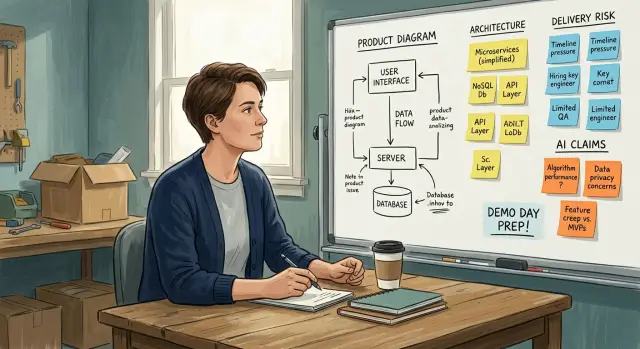
Table of Contents
Why founders lose the room
Founders usually lose attention early for a simple reason: they start in the wrong place. Instead of naming the problem, who feels it, and why it matters now, they open with features, architecture, or a tour of what the team built.
That rarely works. Investors, partners, and judges want the basic story first. What hurts, who pays for that pain, and why this team can solve it better than the alternatives.
Language is the next problem. Inside a startup, teams shorten everything. They say "agent," "pipeline," "orchestrator," or "MVP" as if everyone in the room uses those words every day. Most people do not. Once listeners have to translate team slang while following the pitch, attention drops fast.
Risk is another place where trust slips. Some founders try to sound certain, so they skip delays, technical limits, messy data, or dependence on one hard-to-hire engineer. Then one direct question exposes the gap, and the whole pitch feels weaker than it is.
AI claims make this worse. A founder says the product is "AI-powered," "autonomous," or "fully automated," but the real system still needs manual review, prompt tuning, or narrow use cases. That does not make the product bad. It means the claim is too big. People forgive limits much more easily than hype.
A short practice exercise often fixes this. Ask the founder to explain the product to someone outside tech in 60 seconds, then cut every word only the team would use. If the pitch still makes sense, the room is more likely to stay with them.
An experienced Fractional CTO can help here. The job is not to make the pitch sound more technical. It is to make it honest, plain, and easy to trust.
What people need to understand
Most demo audiences only need four facts. If they leave with those, they can follow the product story and judge it fairly.
First, they need one plain sentence about what the product does. Skip the big vision. Skip the stack. "We help sales teams answer RFPs in minutes instead of days" is enough. If the sentence needs a whiteboard, it is still too messy.
Second, they need to know where the hard part sits. Every product has one place where the work gets tricky: syncing data across tools, keeping a workflow reliable, handling edge cases, or making an AI step consistent enough for daily use. Say that part out loud. Founders sound more credible when they name the real challenge instead of pointing vaguely at "the backend."
Third, they need a clear sense of delivery risk. A demo can look finished while launch still depends on one missing integration, one slow approval, or two weeks of bug fixing. A strong founder says what could slip, why it could slip, and what users still get if that happens.
Fourth, they need honest AI claims. Say what the model does, where it helps, and where people still check the result. For example, an assistant might draft replies or sort support tickets while a person still approves sensitive messages. That one line tells investors and customers you understand the limits.
A short practice session with a seasoned CTO or startup advisor often pays off here. Someone who has shipped real products can catch fuzzy claims quickly and turn them into plain language before demo day.
Which session format fits which topic
One long rehearsal usually fails. Different topics need different workshop formats. A founder can explain the product well and still lose people when the talk shifts to architecture, delivery risk, or AI.
A better plan is a few short sessions, each with one clear job. Keep them under 45 minutes. That forces plain language and stops the room from drifting into side debates.
For architecture, use a whiteboard walkthrough. Start with the user action, then show what the product does next, and where people still make decisions. Boxes and arrows are enough. If someone adds technical terms, stop and replace them with plain words like "stores data," "checks the file," or "sends the result back."
For delivery risk, a red-amber-green review works well. Red means a real blocker or missing dependency. Amber means the team can ship, but timing or scope may move. Green means the work is understood and under control. It is simple, and that is the point. The format helps founders talk about risk without sounding vague or defensive.
AI claims need a stricter exercise. Use claim-and-proof cards. Put one claim on a card, then force the evidence onto that same card: a test result, a user outcome, a known limit, or a human review step. If the claim is "our AI reads contracts," the proof might be: "it extracts vendor name, date, amount, and renewal term from standard PDFs, but a person checks unusual files."
At the end of each session, write down the exact wording that worked. Those lines should go straight into pitch practice. Founders often improve fastest when they stop improvising the hard parts.
Explaining architecture without jargon
Investors do not need a tour of your stack. They need to grasp what happens after a user clicks, where the hard part sits, and why the result shows up fast enough to feel real.
Start with one user action and trace it to one visible outcome. For example: "A customer uploads an invoice, our app reads the text, checks it against purchase records, and gives a draft approval in about 10 seconds." That explains the flow better than naming APIs, queues, or databases.
Only mention the parts that change what the audience sees in the demo. If live data matters, say that. If a human review step keeps results safe, say that too. Skip the rest.
Plain language usually works better than system terms. "Stores the file" is clearer than "writes to object storage." "Routes the request" is clearer than "orchestrates the workflow." "Checks past records" is clearer than "queries the database." And "uses an AI model to draft a reply" is better than "runs inference through a model pipeline."
This does not mean you hide complexity. You translate it. A founder who says "we have three services and a retrieval layer" often loses the room. A founder who says "we pull the customer record, find similar past cases, and draft the answer" usually keeps people with them.
Keep one backup answer ready for deeper questions. You only need one layer down. If someone asks, "What happens if the AI gets it wrong?" a clear answer is enough: "We keep the original source, show the draft to the user, and send edge cases to a person."
That level of detail is usually enough for demo day. It shows the product is thought through without turning the pitch into an engineering meeting.
Talking about delivery risk clearly
Investors do not expect certainty. They expect a plan that sounds real.
A founder loses trust when every date sounds fixed, every dependency sounds easy, and every feature sounds done. Start with the next three things that must ship. Keep them concrete. "Finish onboarding email flow, connect billing, and test the admin export" is much better than "improve the product."
Then name the outside dependencies. If a feature depends on a payment vendor, an AI provider, or customer data that still needs cleanup, say so. That shows where delay can happen. It also shows that you know the difference between work your team controls and work it does not.
A simple way to explain delivery risk is to cover four points in order: what ships next, what you already tested with real users or real data, what depends on a vendor or partner, and what you will do if something slips.
Small details help. If one workflow already works end to end, say that. If the AI feature performs well on sample data but struggles with messy customer files, say that too. Honest limits sound stronger than broad promises.
A short example works well: "We can demo document classification today. Next we add human review rules. After that we connect the customer's storage. The only part outside our control is access to their old files. If that takes longer, we will launch with manual upload first."
That kind of answer is calm, specific, and easy to trust.
Making AI claims honest and clear
Founders lose trust fast when they describe automation as if it were judgment. If the product classifies invoices, drafts replies, or summarizes calls, say that plainly. Do not claim the model "thinks like an analyst" or "runs on its own" unless it really makes decisions without people checking the result.
One simple way to explain it is to split the system into three parts: what the model does, what rules or people still do, and where it can fail.
The model might draft, sort, extract, rank, or suggest. People or rules might approve, reject, edit, or send. Failure points might include weak inputs, edge cases, missing context, or high-risk decisions. That sounds less flashy, but it works better because it is clear.
Use one concrete example instead of a broad claim. "The model reads an inbound support email, suggests a reply, and a team member approves it in about 30 seconds" is easy to picture. "Our AI handles support end to end" creates the wrong image. People hear full autonomy, perfect accuracy, and no review.
Say where the model can fail before someone else asks. It may miss sarcasm, pull the wrong detail from a messy document, or sound confident when it is wrong. Saying this out loud shows control, not weakness.
Also name what a human still reviews. A person may check every output, only flagged cases, or a small sample. Be specific. "A manager approves refund decisions" says more than "human in the loop."
Avoid vague lines like "almost fully automatic." If people cannot tell what the machine does and what your team does, the claim is too fuzzy.
How to run these workshops
Run one topic per session. If you mix architecture, delivery risk, and AI claims in the same hour, people start fixing words instead of fixing the message.
Keep the room small. The founder should be there, along with the product lead and the tech lead. If one person covers two of those roles, that is fine. If you work with a Fractional CTO, include them too, but do not let the session turn into a panel.
Start with a cold pitch. Give the founder five minutes to explain the topic exactly as they would on demo day. No slides. No rescue. No interruptions until the timer ends.
Then replay it line by line. Every time someone says something vague or technical, stop and rewrite it in plain English. "Microservices" might become "we split the product into small parts so one problem does not break everything." "Fine-tuned model" might become "we trained the system on our own examples so the answers fit our work better."
A simple flow works well: five minutes for the first attempt, 15 to 20 minutes to question and rewrite, 10 minutes to try the new version, and two minutes to cut it down for demo day.
The founder should do most of the talking. The product lead should push for customer language. The tech lead should check that the simpler version is still true. That balance matters. Founders often sound clearer after one rewrite, but they also tend to promise too much unless someone in the room pushes back.
Keep a shared document open during the workshop. Write down the terms that caused confusion and the plain versions that replaced them. After two or three sessions, patterns appear. The same words usually cause trouble every time.
End every workshop with a two-minute version. That is the one the founder should practice before demo day. Two minutes forces hard choices. If a point does not fit, it probably does not belong in the live pitch.
A simple example before demo day
A founder walks into a practice session with a pitch for an AI support tool for clinics. The first version sounds polished, but too broad. She says the product "uses AI to handle patient communication and cut admin work," and the room goes quiet.
Then someone asks a plain question: where does patient data go? Another asks who can see it, where it sits, and what happens if the model gives a wrong answer. Those questions matter because they expose the part many founders skip. People do not need a deep technical diagram. They need a clear flow they can trust.
So the team stops the pitch and redraws the product in plain words. A patient sends a message. The clinic system pulls only the details needed for that request. The tool drafts a reply for common admin questions such as appointment changes or office hours. A staff member checks the draft before it goes out. The message and action log stay inside the clinic's system.
That rewrite fixes two problems at once. It explains architecture simply, and it lowers delivery risk. The founder no longer sounds like she is promising full automation on day one.
The team also cuts the biggest AI claim. Instead of saying "our AI manages patient support," she says, "the product drafts replies for routine clinic messages, and staff approve them before sending." That promise is smaller, but much easier to believe.
The final pitch feels calmer. Investors hear a product with limits, safeguards, and a rollout path. Customers hear less magic and more control. That usually lands better than a big claim with no clear data flow behind it.
Mistakes that trip founders up
Even strong workshop topics for nontechnical founders can fall flat when the story gets crowded. A founder puts the whole stack on one slide, names every tool, and hopes detail will create trust. It usually does the opposite.
A better slide does less. It shows what the product does, where the hard part lives, and why the team can ship it.
When risk sounds vague
Founders often talk about risk like a legal disclaimer. They say things like "there are always technical challenges" or "we are aware of possible delays." That tells the audience almost nothing. Plain language works better: "The mobile app is ready, but the billing migration may add two weeks because we still need live payment testing."
AI claims cause trouble just as quickly. If a founder says the product "uses AI to automate support" but never explains limits, people assume the team is hiding something. Say what the model can do, where it fails, and what a human still checks.
Q and A can make things worse. Some founders answer the first question in 20 seconds, the next in a minute, and the third in two. Long answers look like confusion, even when the team knows the work.
Another common problem appears when the founder and tech lead use different words for the same thing. If one says "workflow engine" and the other says "AI agent," the audience starts sorting out terms instead of listening.
A short practice round should catch most of this. Cut any slide that explains every layer at once. Replace vague risk language with one specific delay or dependency. Add one sentence on AI limits and human review. Keep answers short enough to say out loud without rushing. And make sure the founder and tech lead use the same names for the same parts.
That kind of cleanup can change the whole room.
Quick checks on the morning of the demo
A demo can lose people fast when the team gives different answers to the same basic question. Before you rehearse slides again, check whether everyone can tell the same simple story out loud.
Use a short pass with every speaker, even if only one founder will present. Ten focused minutes usually catches more trouble than another full run.
Ask each speaker to explain the product in 30 seconds. They should say what it does, who it helps, and what happens behind the scenes in plain words. If someone needs a diagram to get through it, the explanation is still too heavy.
Ask one hard question about risk. A good answer sounds calm and specific: "We still need manual review for unusual cases, so we limit rollout and watch errors closely." That is much better than pretending nothing can go wrong.
Test every AI claim with one real example. If you say the product "summarizes support tickets," show a messy ticket and the actual summary it produces. If you cannot show a simple before-and-after example, trim the claim.
Listen for shared language. Everyone should use the same words for the same parts of the system. "Model," "assistant," and "engine" may sound like small differences, but mixed terms make the product feel fuzzy.
One small rule helps a lot: ban filler words that hide weak thinking. "Smart," "advanced," and "powered by AI" do not explain anything on their own. Replace them with what the system actually does.
That is where demo day prep sessions often earn their keep. Founders who practiced clear language earlier do not scramble in the final hour. They know the short version, they can admit one risk without panic, and they can back up each claim with something concrete.
If the room asks a surprise question, simple language holds up better than buzzwords. That is often the difference between sounding prepared and sounding rehearsed.
What to do after the practice round
Right after the session, capture the exact lines that worked. Founders often leave practice with three versions of the same answer, and that creates drift by demo day. Put the final wording for the product, architecture, delivery plan, and AI claims in one shared note so everyone tells the same story.
Then bring in one outsider. Pick someone smart who does not know the product well and ask them to interrupt you. If they stop you with questions like "What does that mean?" or "Why will this ship on time?" keep those questions. They show where the pitch still feels vague.
Fix the product story before you polish slides. A nicer deck cannot rescue a weak explanation. If people still do not understand what the product does, who it helps, or why the team can deliver it, rewrite the talk first.
A short cleanup pass is usually enough. Remove terms your customer would never say. Replace broad claims with one concrete example. Cut any AI claim you cannot explain in a single sentence. Make sure risk sounds managed, not ignored.
Small wording changes matter. "We use AI across the workflow" sounds slippery. "We use one model to sort support tickets, and staff review edge cases" sounds real.
If the architecture or delivery plan still feels shaky, get a technical review before the event. Oleg Sotnikov at oleg.is does this kind of work as a Fractional CTO and startup advisor. A good review is usually less about adding detail and more about removing confusion, so the room understands the product after one clear explanation.
Frequently Asked Questions
What should I practice first before demo day?
Start with a 60-second explanation of the problem, who feels it, and what your product does. If you can say that in plain English, the rest of the pitch gets easier. Leave features and stack details for follow-up questions.
How do I explain my product in one sentence?
Use a sentence that starts with the user and the result. "We help clinic staff answer routine patient messages faster" works better than naming tools, models, or internal terms.
Do investors need my full architecture?
No. Walk people through one user action and one visible result. Then say where the hard part sits and where a person still checks the output if that matters.
How can I talk about delivery risk without sounding weak?
Name the next work, the outside dependency, and your fallback plan. People trust a calm, specific answer more than a promise that nothing will slip.
How should I describe AI without sounding vague?
Say what the model does, what people or rules still do, and where it can fail. A smaller claim that you can prove lands better than broad automation talk.
Is one long rehearsal enough?
Usually not. Run a few short sessions, each with one job, such as product story, architecture, or risk. Short sessions keep the language simple and stop side debates.
Who should join the workshop?
Keep the room small: founder, product lead, tech lead, and a CTO or advisor if you have one. Too many voices turn practice into debate instead of cleanup.
How do I catch jargon before the demo?
Do a cold pitch with no slides, then stop on every team word that an outsider would not know. Replace terms like "orchestrator" with plain actions like "finds past cases" or "sends the reply back."
What should I check on the morning of the demo?
Ask every speaker for the same 30-second story, one honest risk answer, and one real example for each AI claim. If people use different words for the same thing, fix that before you touch the slides again.
When should I ask a Fractional CTO to review the pitch?
Bring one in when the story sounds too technical, the risk answer feels fuzzy, or your AI claim sounds bigger than the product. A good CTO review cuts confusion and keeps the pitch true to what you can ship.


