Move billing logic out of code before releases slip
Move billing logic out of code when rate tables, exceptions, and contract terms change faster than your release cycle can safely handle.
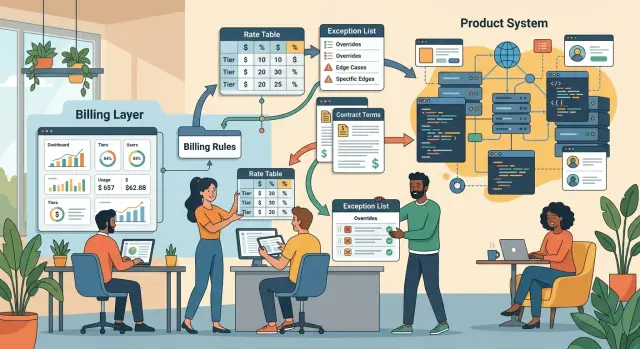
Table of Contents
Why this becomes a release problem
When pricing rules live in product code, a finance update turns into a software release. A new rate, a one-time discount, a contract exception, or a changed renewal term now needs a developer, testing, and a safe deploy window.
That feels manageable at first. Then the requests pile up. Finance wants one customer plan updated before invoices go out. Sales promises special terms to close a deal. Support spots a strange charge and cannot explain it without asking engineering to trace the logic.
The hard part is not the code change itself. It is everything around it. Even a small contract edit can create a ticket, pull a developer off product work, trigger QA, and add risk to the next release. If your team ships carefully, billing changes wait behind other work. If your team ships fast, rushed billing fixes can slip through and create invoice mistakes.
Picture a startup with monthly plans hardcoded in the app. One customer negotiates custom overage rates and a billing cap for three months. Finance asks for the change on Friday so Monday invoices look right. Engineering patches the logic, QA checks the subscription flow, and the team delays a planned product release because nobody wants billing risk mixed with feature work.
Support feels the pain too. When invoice behavior depends on scattered rules in the product, support cannot answer customers with confidence. They need an engineer to explain why a charge happened. Replies slow down, and the company looks disorganized even when the invoice is technically correct.
Most teams decide to move billing logic out of code after one ugly quarter-end or one delayed launch. By then the pattern is obvious: pricing changes block releases, and releases block pricing changes.
Signs you've outgrown code-based billing
Billing rules stop feeling simple long before the team admits it. The first clue is frequency. If you change prices every few weeks for plans, regions, partners, or older customer groups, hardcoded rules turn routine updates into release work.
Sales usually exposes the next problem. Once contracts start adding custom minimums, temporary discounts, usage caps, or one-off renewal terms, one pricing model no longer fits everyone. Product code expects a clean pattern. Real contracts stop being clean pretty quickly.
Finance often sees the issue before engineering does. When the app cannot store exceptions, finance starts keeping side spreadsheets to track who pays what, when discounts end, or which customer still follows an older agreement. That sheet becomes the real source of truth, even though invoices still depend on the code.
You have likely outgrown code-based billing if rates differ by customer group and each change needs an engineer, if sales keeps closing deals with terms the product cannot express, if finance checks a spreadsheet before trusting an invoice, or if even small billing edits make engineers nervous because an older customer might break.
That last point matters more than most teams expect. Billing code ages badly because old rules rarely disappear. A startup may have three active plans, but it may also have five years of legacy logic still affecting renewals and credits. One developer changes a condition for a new offer, and a customer on a 2022 contract suddenly gets the wrong invoice.
At that stage, pricing complexity is not the only problem. Ownership is. Finance owns the numbers, sales owns the promises, and engineering owns the code path that turns both into invoices. If those rules live only in the product, every billing change becomes a risky software change.
That is usually the point where the team needs a billing layer the business can own, with clear structure, history, and review. If engineers look relieved when they hear that idea, the team is probably late, not early.
What belongs in the billing layer
The billing layer should hold business rules in plain records that finance, ops, and engineering can all read. Start by pulling out anything that changes because of pricing, contracts, or one-off promises.
Keep rules as records, not code
Rate tables belong here first. Store every price with an effective start date, and add an end date when you replace it. Give each version a clear human name, such as "2025 standard SaaS rates" or "enterprise rates - Jan 2026." That sounds basic, but it prevents a lot of invoice disputes because people can see which rates applied on a given day.
Contract terms should sit next to those rates, tied to a customer or account. That includes minimum commits, volume discounts, free usage blocks, billing frequency, payment terms, and negotiated caps. If sales promised custom overage pricing, the billing layer should hold that promise directly. Engineers should not have to search old tickets or read custom conditions buried in product code.
Exceptions need one home too. A temporary discount, a waived fee, a custom invoice rule, or a grace period should all live in the same place with a short reason. Add an owner and, when it makes sense, an expiry date. Otherwise temporary exceptions stay around for years and quietly change revenue.
Make every change traceable
Every rule needs a simple history. Record who changed it, when they changed it, and what changed. Keep the old value, the new value, and a short note that explains why.
A small startup can get by with a basic admin table and an audit log at first. That is often enough. But the records need to answer simple questions quickly: which rate applied last month, why this customer paid less, and who approved the change.
When that information lives in one owned layer, finance can update billing rules without waiting for a release. Engineering stops carrying contract details inside application logic, and billing layer design stays readable instead of turning into another pile of exceptions.
What should stay in the product
The product should keep the facts that only the product can see when they happen. That includes usage events, seat changes, feature access, account status, and the raw record of each billable action. If a customer uploaded 12 files, ran 480 API calls, or added two team members, the product should capture that at the source.
Those records should describe what happened, not what it costs. The app should send clean inputs such as account ID, event type, quantity, timestamp, and the plan or access level tied to that action. Once the product starts attaching prices, discounts, or contract exceptions to those events, releases get tangled with billing changes.
Access rules should also stay in the product, because they shape the user experience right away. If a workspace is over its seat limit, the app may block new invites. If a customer is on a read-only plan, the app should hide editing. Those are product decisions.
Invoice math is different. A blocked invite is one thing. A grace period, an overage fee, a minimum spend clause, or a custom enterprise exception is money logic. That belongs in the billing layer, not mixed into feature checks.
A clean split looks like this:
- The product records facts.
- The product enforces access.
- The billing layer decides charges.
- Finance updates pricing rules without asking for a code release.
Both teams need to use that boundary in the same way. A practical rule helps: if the answer changes what the user can do right now, keep it in the product. If the answer changes what appears on the invoice, move it out.
That split feels strict, but it saves a lot of arguments later. Engineering can focus on event quality and access behavior. Finance can manage rate tables and contract terms in a place they own. When both sides follow one boundary, routine pricing changes stop colliding with product releases.
How to move rules without breaking invoices
Start by finding every billing rule already hiding in the product code. Teams usually know the obvious ones, like plan prices, but miss the messy parts: one-customer discounts, country tax checks, minimum fees, renewal dates, grace periods, or contract terms buried in admin scripts.
Start with a map
Write each rule down in plain English before you move anything. Then group the rules by job. Most teams end up with four buckets: rates, exceptions, terms, and calculations.
That grouping matters because each bucket changes for a different reason. Finance may update rate tables every month. Sales may add a contract exception for one account. Legal may change terms. Engineering should change the calculation engine only when the math itself changes.
Put names on the process early. One person should own rule changes. One person should own releases. In a small startup, that might be the same person, but the role still needs a clear name. If nobody owns the rule set, people will keep sneaking changes back into code.
A short checklist helps:
- List every rule now running in code, scripts, or spreadsheets.
- Mark the source for each rule: finance, sales, legal, or engineering.
- Define the input and output for every calculation.
- Note which customers or plans each rule affects.
- Flag anything that can change without a product release.
Cut over in small steps
Do not switch everything at once. Pick one plan, one region, or one customer segment and move only that slice first. That keeps the blast radius small and gives the team real invoice data to compare.
Run the old path and the new path side by side for at least one full billing cycle. Compare line items, taxes, discounts, credits, and rounding. Small mismatches matter. A five-cent difference repeated across thousands of invoices turns into support tickets and lost trust.
A simple example makes this concrete. A SaaS company moves annual plans first. The old code still creates live invoices. The new billing layer creates shadow invoices in parallel. Finance checks both outputs every day for two weeks. When totals match and exceptions behave the same way, the team cuts over that segment and then expands.
Keep the rollback simple. If the new layer produces a wrong total, switch that segment back, fix the rule, and rerun the comparison. If one invoice differs by 37 cents and nobody can explain why, stop there and find the rule before you expand.
A simple startup example
A small SaaS company starts with one plan: $49 per seat each month. Early on, the team hardcodes that price in checkout, copies it into invoice logic, and adds a small usage fee in product code. It feels fine because every customer pays the same way.
Six months later, sales closes two enterprise deals. One customer gets cheaper seats after 100 users. Another signs a contract with a custom base rate, a yearly minimum, and a special overage price for API calls. Finance then changes the overage rate twice in one quarter because the first number was too low and the second still did not match the contract margin.
That is when the mess starts.
Engineers patch one condition in checkout so new buyers see the latest rate. Then they patch invoice generation so finance can bill existing accounts correctly. Then they patch the renewal flow because one enterprise customer keeps last year's terms until the contract end date. Each change looks small on its own, but the rules now live in several places.
Soon the team starts seeing the same kind of errors. Checkout shows the new overage price, but invoices still use the old one. One enterprise customer gets the right total with the wrong line items. A product release waits for billing edits that have nothing to do with the feature itself.
The fix is not another patch. The team moves billing logic out of code and into one owned layer. That layer holds rate tables, contract terms, effective dates, usage thresholds, and account-level exceptions. Checkout, subscription changes, and invoicing all read the same rules from the same place.
After that change, finance can update a rate table without asking engineers to touch three services. Engineers still control how the system calculates charges, but they stop bundling routine pricing edits with feature releases. When finance changes overage rates again, the team updates one source, tests the invoice output, and ships the product on time.
That is the real win. Billing rules stop acting like hidden product behavior and start acting like business data the company owns.
Mistakes that make the split harder
Teams usually make this harder by moving too fast and carrying old confusion into the new billing layer. If you move billing logic out of code but keep the same vague names, hidden exceptions, and one-off patches, nothing really improves. You just move the mess somewhere else.
One mistake shows up on day one: people copy old rules exactly as they are. Names like "special_price_v2_final" or "enterprise_override" may feel fine when one engineer knows the backstory. A few months later, finance reads the same rule and guesses. Support guesses too. Clear rule names matter because billing rules are business records, not private notes inside product code.
Another problem appears when one field tries to do too much. Access rights say what a customer can use. Discounts change the price. Contract promises describe special terms that may not fit either of those. If you push all three into one "plan" field or one "override" field, every edit gets risky. A feature change can alter billing by accident. A discount can look like product access. Nobody knows which promise actually drove the invoice.
Versioning is the next trap. Billing does not live only in the present. Finance will ask what rate applied last month, when a contract changed, or why one customer paid a different minimum in March. If your system stores only the latest rule, you lose that trail. Then the team starts digging through old code, chat messages, and spreadsheet exports to rebuild facts that should already be stored with the rule.
The most painful mistake is a full cutover for every customer at once. It sounds clean. It usually is not. One forgotten exception for a legacy account can break invoices on the first run. Start with a small customer group instead. Run the old and new calculations side by side, compare totals, and keep an easy rollback path.
That last part matters more than teams expect. Small, reversible production changes are usually safer than big cleanups, and billing needs that discipline more than most parts of the product. This is the kind of approach Oleg Sotnikov often brings to Fractional CTO work: separate the rules clearly, keep changes traceable, and make rollback easy.
A quick check before each billing change
A billing change should feel boring. If it still feels risky, your team probably has pricing rules, exceptions, or contract terms sitting in the wrong place.
Four simple tests can catch that early.
Four tests that catch trouble early
If finance wants to change a rate, they should not need a product bug, an app release, and a developer on standby. They should update the rule in the billing layer, with review and versioning, while the product keeps running.
Every invoice line should be easy to trace. A support person, engineer, or finance lead should be able to explain where one number came from: the usage record, the rate table, the contract rule, any exception, and the final total. If nobody can do that in a few minutes, disputes will drag on.
Teams also need a safe way to test unusual cases before customers see them. A contract exception, custom discount, minimum commit, or one-time credit should produce a draft result in a test run. If the first real test happens on a live invoice, the process is too fragile.
Rollback matters as much as rollout. If one rule goes wrong, your team should revert that rule by version or effective date without rolling back the whole app. If the only recovery plan is a full deploy reversal, the billing layer is still too tangled with product code.
A simple rule helps: if one answer is no, pause the change.
For a small startup, that can be the difference between a ten-minute update and a late-night fix. Imagine finance changes enterprise overage pricing on Tuesday, support spots a mistake on Wednesday, and engineering rolls back one rule before Thursday invoices go out. That is the standard you want.
When these checks pass, finance moves faster, engineering stays out of routine pricing edits, and customers get cleaner invoices with fewer surprises.
Start with the rules that change most
If you want to move billing logic out of code, do not begin with a rewrite. Start with the rules that change often and keep hurting releases. That is usually rate tables, one-off exceptions, renewal terms, or customer-specific contract rules that finance needs to adjust faster than engineering can ship.
Write down ownership before you move anything. Someone should own pricing data, someone should approve changes, and someone should decide release timing. In many teams, engineering owns the code that reads and checks the rules, while finance or ops owns the numbers and contract terms. If nobody can answer "who changed this and when does it go live?" the split will stay messy.
A short review habit works better than scattered messages. Put finance, ops, and engineering in one 20-minute meeting each week, or before any billing change if changes are rare. Keep the agenda plain:
- Confirm which rules changed.
- Check who approved them.
- Verify the effective date.
- Test one real invoice example.
- Note whether the change needs code or only data.
That catches release problems early. It also stops a common mismatch: finance sees a pricing change as a simple number update, while engineering knows the rule also touches usage, limits, or plan logic.
Keep the first version boring. A spreadsheet, a simple admin table, or a versioned config file can be enough if ownership is clear and invoice tests exist. You do not need a large billing system on day one. You need one place where rules live, a record of approvals, and a way to test what changed.
If your team needs help drawing that boundary, Oleg Sotnikov works on this kind of systems and process design through Fractional CTO advisory at oleg.is. The result should be easy to spot after a couple of billing cycles: pricing changes stop blocking product releases, and common billing updates no longer require changes in product code.


