Model federation for coding assistants: when to split work
Model federation for coding assistants works when each model handles a job that clearly saves time, lowers risk, or cuts review effort.
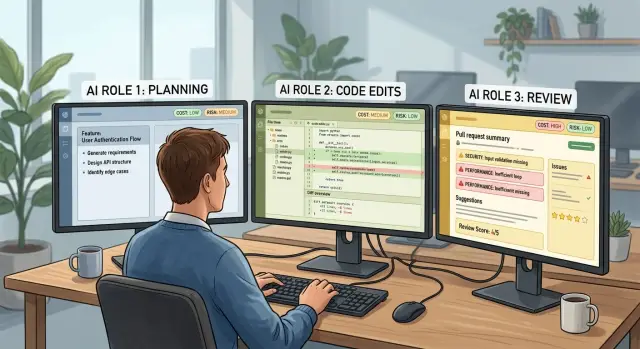
Table of Contents
What problem this solves
One model can write code, explain its choices, read logs, and review a pull request. That sounds efficient until you ask the same chat to do all of it in one thread. The prompt keeps growing, the model loses focus, and the bill rises faster than most teams expect.
It usually starts small. Someone asks for a fix, then adds the ticket, a repo summary, framework rules, old messages, test output, and a long diff. After that, they ask for a review in the same conversation. Every step drags the full context along again. You pay for repeated tokens, longer waits, and more reruns when the answer misses something obvious.
Cost is only part of the issue. Mixed jobs often lead to weaker judgment. Planning needs broad thinking. Editing code needs precision. Review needs distance and some skepticism. When one model handles all three jobs in one flow, those boundaries blur.
You can see it in small but expensive mistakes. The model explains its own patch instead of questioning it. It remembers why it took a shortcut, then fails to challenge that shortcut later. It spends time on style comments and misses a broken edge case. Review quality drops because the task itself is muddy.
This gets worse in teams that use AI every day across many files, tests, and prompts. A cheap model with a huge prompt can cost more than a stronger model with a narrow job. A strong model used for every tiny task wastes money too. The goal is not to use more models because it sounds advanced. The goal is better output for the money you spend.
That is where splitting work starts to make sense. A small model can sketch a plan, a stronger one can handle the risky edit, and a separate reviewer can check only the diff. Think of it as a control problem. If each split reduces cost, delay, or mistakes, keep it. If it does not, keep one model in charge.
Teams that treat models like specialists often spend less, wait less, and catch more issues before code reaches production. That matters for startups, lean product teams, and any company trying to move fast without letting model spend drift.
When one model is enough
Teams often add a second or third model too early. For a lot of coding work, one good model is faster, cheaper, and easier to trust than a chain of specialists.
Keep it simple when the job is small and the context is short. A typo fix, a form label change, a small refactor inside one file, or a missing test case does not need separate planning, editing, and review models. One model can read the prompt, make the change, explain what it touched, and stop.
Extra handoffs have a cost. Each new model needs context, repeats part of the work, and can drift from the original goal. On low risk tasks, that overhead is usually bigger than the benefit. If a developer can scan the diff in under a minute, a multi model setup is probably too much.
A single model usually works well when the change is small, the goal is clear, the edit is easy to roll back, and the code does not touch security, billing, or tricky concurrent behavior. It also helps when a human reviewer can judge the result quickly.
This is the right starting point for any team that wants to split work later. Measure one model first. If it handles most routine edits at an acceptable quality level, that gives you a real baseline for speed, cost, and errors. Without that baseline, extra models are just guesswork.
A plain workflow can be boring, and that is fine. Ask one model to propose the change, make the edit, and summarize what it touched. Then let a person review the diff. Small teams usually get more from that than from a fancy chain that burns tokens moving a simple task across three models.
If the task does not carry much risk, do not build ceremony around it. Save model splitting for work that is hard to reason about, expensive to get wrong, or too large for one clean pass.
Choose jobs that deserve a different model
Different models make sense only when the task changes enough to justify the extra step. If the same model can plan, edit, and check the result in one pass, keep it simple.
The cleanest split is often between planning and coding. Planning is cheap when you keep it short. Ask one model to read the ticket, name the files that matter, spot the main risks, and suggest a small edit plan. Then let the coding model do the actual work. That split works because planning needs breadth and editing needs precision.
Risk changes the math. A UI label does not need a specialist review model. A change in billing, authentication, database migrations, or permission checks often does. Those parts of the code can break more than one screen or feature, so paying for a stronger second opinion makes sense.
You do not need a clever routing system to do this. A few plain rules handle most cases. Use a cheaper model to plan changes that touch several files or have vague requirements. Use a stronger coding model when the logic is tricky, tests are thin, or the repo is large. Use a review model only for risky files, public APIs, migrations, security rules, or performance sensitive code. Skip specialist models for tiny jobs like copy edits, obvious refactors, or one line fixes.
Job size matters as much as job type. If a task changes one function and one test, a single model usually wins. If it changes six files, updates a schema, and needs careful rollback thinking, splitting the work starts to pay for itself.
Take a startup adding a "resend invite" button. Planning can stay cheap. The planner only needs to identify the UI file, the API handler, rate limit rules, and the tests. The coding step may need a stronger model if the invite flow already has edge cases. Review deserves another model only if the change touches authentication, abuse prevention, or email limits.
That is the pattern worth following. Split work only where a different model lowers risk or saves enough rework to cover its own cost.
A simple workflow
A split workflow works only when each handoff removes work instead of adding it. Keep the brief short, keep the edit scope narrow, and review only the code that changed.
A practical loop looks like this:
- Start with a planner. Give it the ticket, the goal, and any limits. Ask for a short task note that names what should change, which files probably matter, what to avoid, and how to test the result.
- Pass that note to a coding model. Keep the request tight. A small feature or bug fix should not turn into a repo wide rewrite.
- Send only the diff, or only the changed files, to a review model. Ask it to look for regressions, missing tests, unsafe assumptions, and style issues that actually matter.
- If the planner, coder, and reviewer keep talking past each other, stop splitting the job. Run the same task with one model and compare the result.
- After each run, log three numbers: time spent, tokens used, and human rework.
The first step matters more than many teams think. A good brief can be five or six lines long. It should name the user facing change, the likely files, and one or two risks. If the planner writes a page of notes, the handoff is already getting expensive.
The coding model does not need the whole product story every time. Give it the brief, the acceptance check, and the local code context it needs. That keeps edits smaller and makes review easier.
For review, less context is often better. A reviewer that checks only the diff usually gives sharper feedback than one that reads half the repo and starts inventing cleanup work. This is one of the most common ways teams waste money with coding assistants.
One rule keeps the process honest: if a second model does not cut review time, reduce rework, or catch bugs you missed, remove it. In many teams, two models are enough for routine work. A third earns its place only on risky changes.
Set cost rules before you add models
Before a team adds a planner, an editor, and a reviewer, it should decide what each task is allowed to cost. If bug triage gets a small budget and feature work gets a larger one, people stop sending every tiny change through three models "just in case." Budgets work best by task type: small refactor, bug fix, new feature, or risky migration.
Then look at the price of one more handoff. A handoff is never free. You pay for another prompt, more context, and usually more waiting. If one review pass adds 20 percent to the bill, that review should catch enough real problems to justify the spend. If it mostly repeats style rules, cut it.
Track outcomes, not activity. Count how often the review step finds a bug, a missed test, a security issue, or a broken assumption that the editing step missed. After a few dozen tasks, the pattern gets pretty clear. Some steps prevent rollbacks. Others rarely change the result.
A simple scorecard helps:
- Set a token cap for each job type.
- Write down why an extra model is there.
- Log whether that step changed code, tests, or release risk.
- Remove any step that fails to earn its cost for a full sprint.
Cheap models can still waste money if they create noise. A low cost reviewer that sends developers chasing false alarms burns more time than it saves. Time is part of the bill, even when it never shows up on the API invoice.
This comes up often in small teams with tight budgets. A founder may think a three model workflow looks safer, but one stronger model often does the same job for less. The practical rule is simple: keep the steps that improve release quality, and drop the ones that only make the process longer.
If a step rarely changes the code, the tests, or the decision to ship, remove it first.
A realistic example from a small feature
Imagine a small SaaS team adding one endpoint: POST /api/projects/{id}/invite. It should let an admin invite a teammate by email, block duplicate invites, write an audit log, and return a clear error if the caller lacks permission. This is a good case for splitting work because the feature is small, but one part is riskier than the rest.
The team starts with a short brief sent to a planning model. The brief names the route, request body, response shape, permission rule, and edge cases. In about three minutes, the planner returns a compact plan: files to change, test cases to cover, and one warning that the permission check and audit log need extra care.
Next, a faster and cheaper model writes the boilerplate. It creates the handler stub, request validation, a service method, and the first pass of unit tests. That part is mostly routine. A stronger model can do it too, but it often costs more without giving much better code.
The team does not send the whole diff to a strict reviewer. It sends only the sensitive parts: permission checks, invite token handling, audit log fields, and error messages. The reviewer finds two problems within minutes. The handler logs the invite token on failure, and the permission check sits too low in the call chain, where another path could bypass it later.
That is where the extra model earns its keep. The boilerplate was fine. The risky part was not.
In one run, a single strong model handled planning, coding, tests, and review in about 26 minutes and cost roughly $2.40 in API usage. In the split run, the whole task took 17 minutes. Planning cost about $0.20, the writing and test pass cost $0.45, and the stricter review cost $0.60. Total cost: about $1.25.
The savings are nice, but the bigger win is avoiding a quiet security bug. Fixing that after release would cost more than the whole run. That is the real point of multi model review: pay extra only where failure gets expensive.
Mistakes that waste money
Most teams do not lose money because splitting work is hard. They lose money because they make every step bigger than it needs to be.
The first leak is simple: sending the full repo to every model. That feels safe, but it usually buys noise instead of better answers. If a model only needs one handler, one test file, and a schema, give it that slice. A focused patch with a few related files often works better than a dump of the whole codebase.
Teams also waste money when they ask two models the same fuzzy question and hope one will sound smarter. If the prompt is vague, both models wander. You pay twice and still get a blurry answer. Split the job instead. Ask one model to plan the change. Ask another to check the risks in the diff. Give each model a clear task and a clear boundary.
Cheap edits do not need premium review. If a developer changes a label, fixes a typo, or renames one variable inside a test, an expensive review model will not save you. Save the costly pass for work that can break behavior: authentication rules, billing logic, migrations, concurrent code, or changes that touch many files.
A small team can keep this under control with a few habits. Send only the files a model needs. Write prompts that ask for one output instead of a broad opinion. Route low risk edits to a fast, cheap model, or skip model review entirely. Track cost, delay, and defect catches every week.
The last mistake is the one people ignore most: keeping a setup that nobody measures. If you do not track what each step costs, how long it takes, and what bugs it catches, you are guessing. After a month, you should know which model earns its place and which one just adds delay.
Extra steps can feel clever. Clever does not matter. A workflow earns its keep when it cuts review time, catches real bugs, or lowers spend. If it does none of those, remove it.
Quick checks before you run it
Before you start, do one quick review of the setup itself. That usually tells you whether the flow is doing real work or just adding ceremony.
Give each model one job. One model plans, one edits, one reviews. If two models both read the same task and both try to reason through the whole change, you are paying twice for overlap.
Cut the context hard. Most tasks need the ticket, the files you expect to change, and maybe one test or schema file. Sending half the repo to every model makes answers slower and less clear.
State the reason for every handoff in one plain sentence. "The planner picks the touched files." "The coding model handles the refactor." "The reviewer checks for missed edge cases." If you cannot explain why the next model exists, drop it.
Look closely at the review output. A good review catches a broken test path, a bad query, a missing null check, or a wrong assumption about existing code. If it only suggests style tweaks, that step may not earn its cost.
Test the cheap baseline too. Run a few similar tasks with one lower cost model and compare the result. If quality stays close, keep the simpler path.
A small feature makes this easy to judge. Say you add a new billing field to a settings page. The planner should identify the UI file, the API handler, and a test. The coding model should edit only those files. The reviewer should find something concrete, like a missing validation rule. If that last step adds nothing, skip it next time.
Teams often overbuild the workflow before they measure it. Start with the cheapest setup that works, then add a second or third model only when you can point to the bug, delay, or missed detail it prevents.
Next steps for your team
Start with one repeated task, not a full team rollout. Pick something easy to compare against your current process, such as fixing small bugs, adding simple CRUD screens, or reviewing pull requests under a certain size. A narrow pilot makes it obvious whether splitting work saves time or just adds another step.
Write the handoff rules on one page and keep them plain. Use a planning model only for work that is large, vague, or risky. Let one coding model own the edits so the patch stays consistent. Ask a review model to check only changes with real downside, such as authentication, billing, database migrations, or public APIs. Skip any step that does not catch mistakes or reduce review time.
Those rules matter more than clever routing. Most teams do not need a different model for every task. They need a small set of rules that says when a second or third model earns its cost.
After two weeks, review the pilot with real numbers. Look at cost per task, defects found in review, bugs that reached production, and time spent fixing rework. If a review model rarely finds anything useful, cut it. If planning reduces confusion on larger changes, keep it for those jobs only.
A small feature is enough to test this. If your team ships the same admin form every week, one model can draft the plan, another can write the code, and a stricter reviewer can check schema changes before merge. You do not need a bigger experiment than that.
If you want outside help, Oleg Sotnikov works with startups and small businesses on AI first development workflows, lean infrastructure, and Fractional CTO support. More details are available on oleg.is. Keep the goal simple: use extra models only when they improve the result enough to justify the cost.
A short pilot, clear handoff rules, and a two week review are usually enough to tell you whether to expand the workflow or keep one model in charge.