Live debugging vs roadmap clinic at founder events
live debugging vs roadmap clinic helps founders compare three event formats, including architecture teardowns, and pick one people remember.
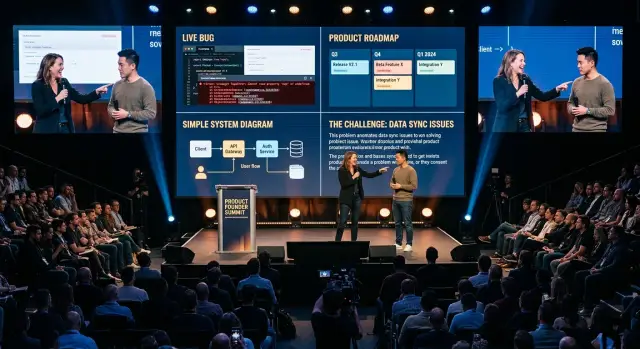
Table of Contents
Why founders forget most event talks
Founders sit through plenty of talks that sound useful for an hour and vanish by dinner. The slides look clean, the advice sounds reasonable, and a few lines get written down. By the third session on product, hiring, or AI, it all starts to blur.
The reason is simple. Most founders are tired, distracted, and carrying a live problem in their head while they listen. If a speaker stays in theory, the audience files it under "maybe later" and moves on.
Abstract advice rarely sticks. Visible change does.
People remember the speaker who took a messy onboarding flow, a bloated roadmap, or an expensive system and made one fix the room could see. That creates a scene, not just a note. The audience can replay it later and repeat it in one line: "He found the bottleneck in five minutes," or "She cut the roadmap in half and the plan finally made sense."
Forgettable talks usually fail in the same ways. The problem is fuzzy, the advice could fit almost any startup, the speaker never lands on a clear result, and the audience leaves with notes instead of a story.
One visible fix changes that. It gives the room a before and after. Maybe users keep dropping at step three and the speaker spots why. Maybe one roadmap item disappears and the next quarter suddenly looks sane. Maybe a system sketch makes an obvious cost leak visible.
Founders do not remember polished advice on its own. They remember the moment something changed.
What makes a live fix stick
A live fix works because everyone in the room has one target to follow. If the problem is "people leave after the pricing page," nobody has to guess what matters. The audience watches one thread from start to finish.
That changes how people listen. They are not collecting tips anymore. They are watching decisions. Why check analytics first? Why ignore one bug and chase another? Why cut a feature instead of adding one more? That chain of judgment is what makes a session feel real.
Small wins usually land better than big strategy. A founder may forget a broad talk about growth before lunch. They often remember seven minutes spent fixing a broken onboarding email, a slow form, or a call to action that confused users. It feels close to daily work, so it keeps echoing after the event.
The strongest sessions also produce a clear before and after. Before, the team is stuck, people have theories, and nothing moves. After, the cause is visible, the next step is obvious, and the fix looks doable. Even when the exact problem is different from their own, the shape of the win stays in memory.
A live session does not need drama. It needs a problem small enough to solve in public and important enough to matter. That is why founders often get more from one honest teardown or one live problem solving session than from half an hour of general advice.
When live debugging works
Live debugging works when the audience can understand the problem in under 30 seconds. A broken signup form, a payment error, or an onboarding step that traps users gives people something concrete to watch. Founders stay with you because they can connect the bug to lost sales, support tickets, or churn right away.
This format wins when the issue is visible and the fix has a short path. If a page loads blank because of one bad config value, or an API call fails because of a clear auth mistake, people can track each move. If the demo needs ten minutes of setup before the bug appears, attention starts to drift.
The bug also has to be simple enough for non engineers to grasp. A founder does not need to read code line by line to understand "users click buy, then nothing happens." That is enough. Familiar tools help too. Browser dev tools, a short log with one obvious error, or a test that flips from red to green works better than a wall of terminal output.
Set a time limit before you start. Fifteen minutes is usually enough. That forces better choices and tells the room you respect their attention. Either you fix it or you stop before the session turns into private engineering therapy.
A good live debugging session usually follows a plain sequence:
- Show the broken flow.
- Say what you think is causing it.
- Test that idea in public.
- Confirm the fix with the same user action.
Mixed rooms need more discipline. Skip deep code detail, framework trivia, and clever refactors. Most founders care about how you narrow the problem, what you ignore, and how fast you get back to a working product.
A small example works well. A SaaS signup button fails after a form change. You inspect the request, spot a missing field, patch the mapping, and run signup again. Everyone sees the before and after. That sticks.
When a roadmap clinic works
A roadmap clinic works when the room is stuck on sequence rather than code. Founders rarely lack ideas. They usually lack a clear way to choose the next move that gives the fastest proof, the clearest signal, or the shortest path to revenue.
This format is stronger than live debugging when the bottleneck is judgment. If the team does not need help fixing a broken system today, but does need help deciding what to build, cut, or delay, a clinic is the better fit. It also beats a teardown when the product is still moving and technical design is not the first thing holding the company back.
The session gets sharper when the founder brings one product goal and one hard constraint. A goal might be "increase trial to paid conversion." A constraint might be "two engineers, one designer, six weeks." Without both, the discussion drifts into wishful thinking.
Early teams usually get a lot from this format because every wrong turn hurts. A small startup can lose a month by keeping five "maybe later" ideas alive. A roadmap clinic forces tradeoffs in public, and that is exactly why people remember it.
The most useful moment often comes when the speaker cuts work. Adding ideas is easy. Saying "do not build that yet" is harder and usually more helpful. If a founder wants a new dashboard, a partner portal, and a mobile app, but the real problem is weak onboarding, the clinic should say so plainly.
A strong ending is concrete. The room should leave with the next moves in order:
- Fix the first run onboarding step with the biggest drop off.
- Pause the partner portal until more users finish the core workflow.
- Talk to ten recent signups before planning the next sprint.
If people walk out knowing what to do on Monday, the session worked.
When an architecture teardown works
An architecture teardown works when the problem sits above the code. The room does not need to watch someone hunt a bug live. It needs to see why the system costs too much, breaks under load, or slows the team down.
This format lands best when founders and technical leads are in the same room. Founders hear the business impact in plain language. Technical leads can test whether the reasoning holds up.
Start with a simple sketch: app, database, background jobs, outside services, and anything that costs real money or fails often. If the sketch needs ten minutes of setup, it is already too detailed.
Then stay on one issue. A teardown gets stronger fast when it answers one sharp question. Why does the cloud bill keep rising? Why do deploys cause outages? Why does one slow service delay the whole product? Why does the team use three tools when one would do?
Plain language matters more than a perfect diagram. Say "this part is expensive because it runs all day even when traffic is low" instead of turning the talk into an infrastructure lesson. Say "if this service fails, signup stops" instead of naming every internal dependency.
A simple example helps. Someone with Oleg Sotnikov's background in infrastructure and product architecture might sketch a stack, circle an oversized cluster, two duplicate services, and a noisy deployment path. The point is not to impress the room with tools. It is to show how one architecture choice can waste money every month, and how a simpler setup can cut spend without hurting reliability.
Stop before the session turns into an internal engineering review. Once the audience understands the tradeoff and the next move, you are done. If two senior developers start arguing about queue depth, retry timing, or Kubernetes settings, most of the room is gone.
How to choose the right format
Start with the room, not with your favorite style. New founders usually need a roadmap clinic more than live debugging. They are still deciding what to build, what to cut, and what to ship first. A room full of technical founders or product teams may get more from a live fix they can watch step by step.
Keep the problem small. If you cannot explain it, inspect it, and fix it in 15 minutes, it is too big for the stage. One blocked signup flow, one messy launch plan, or one slow API path works. A full product strategy or a complete system review does not.
Choose the format that makes the fix easiest to see:
- Use live debugging when the audience can watch cause and effect on screen.
- Use a roadmap clinic when bad prioritization is the pain.
- Use an architecture teardown when one sketch can explain cost, reliability, or team speed problems.
Visibility matters more than complexity. A simple problem with a clear before and after beats a smart problem nobody can follow. If the audience needs ten minutes of setup before they care, choose a different case.
Always bring a backup. Live sessions fail for boring reasons: bad wifi, broken demo data, a founder who freezes, a laptop that will not mirror to the projector. A prepared backup keeps the session calm and protects your point.
Rehearse the first minute and the last minute. The opening should tell people what problem they are about to see and why it matters now. The ending should name the fix in one sentence and explain what they can copy next week.
If you are torn between formats, pick the one that makes people say, "I can use that tomorrow."
A simple event example
A SaaS founder redesigns the product site and expects more trial signups. The opposite happens. Traffic stays flat, demo interest stays flat, but trial starts fall hard after the release.
Put that same problem on stage three different ways and the room learns three different things.
In a live debugging session, the speaker opens the signup flow and tests it like a real user. A broken onboarding step shows up on screen: the form submits, but the account setup page fails because a hidden field does not load in some browsers. The room sees something useful right away. Small break, big damage. Just as important, they watch an experienced operator check the path, make a quick guess, test it, and confirm the cause instead of thinking out loud for 20 minutes.
A roadmap clinic uses the same case but asks a different question: what should the founder do next week? The team had planned five follow up features to "fix conversion" - a new pricing page, a referral prompt, extra onboarding emails, a dashboard tour, and a shorter form. The clinic cuts four of them. It keeps one test: repair the broken step, then measure completion rate before building anything else. That version teaches discipline. Founders see how often teams try to solve a leak by adding more product.
An architecture teardown goes one layer deeper. The speaker maps the signup request flow and spots why pages got slower after the redesign. Too many scripts load before the form becomes usable. One API call blocks the next step. The room learns that speed problems and conversion problems often share the same cause. The page does not just "feel slower." It gives users more chances to leave.
Each format leaves a different memory. Live debugging shows how to find one real fault under time pressure. A roadmap clinic shows what to stop doing. An architecture teardown shows why the same problem keeps coming back.
That is why this is not really a fight between formats. If you want the room to remember one sharp moment, live debugging usually wins. If you want founders to change how they choose work, the clinic often lands better. If the product keeps breaking in the same area, a teardown usually leaves the deepest mark.
Mistakes that make the room tune out
The same mistakes hurt live debugging, a roadmap clinic, and an architecture teardown. They make the room work too hard.
The first mistake is choosing a problem only experts understand. If the whole session depends on deep knowledge of a niche stack, most people check out. A flaky signup flow, a release process that slips every week, or cloud costs that doubled in six months lands with a much wider room.
Backstory is the next thing that drains attention. A volunteer starts with company history, then the first product version, then the team change, then the last investor update. The audience still does not know what needs fixing. Cut straight to the current pain. "Users quit at step three" is enough to start.
Another common mistake is letting the volunteer ramble. Some speakers think the founder should fully explain the situation before they step in. On stage, that rarely works. Guide the person. Ask short questions. Stop side tracks early. If you do not control the frame, the session turns into a vague chat.
Trying to solve three problems in one slot is usually fatal. A 20 minute session can hold one strong problem and maybe one follow up decision. If you mix hiring, roadmap, and architecture, nobody remembers the answer. People remember a single sharp fix.
Jargon finishes the job. When speakers hide tradeoffs behind phrases like "event driven rewrite" or "multi agent orchestration," the room hears noise. Plain language is better. Say what the team gains, what it gives up, and what it should do on Monday.
A simple example shows the difference. A founder says releases are late, bugs pile up, and customers want new features. Do not chase all three. Pick one thread, like why code review takes four days, work through that live, and show the next step. That feels real. People remember real.
Quick checks before you go on stage
A live session falls apart when people need too much context. If a stranger can understand the problem in under a minute, you are in good shape. If not, trim the setup until the room can answer one simple question: what is broken, slow, blocked, or unclear?
Decide what success looks like before you open your laptop. Maybe the page loads in two seconds instead of eight. Maybe the founder leaves with a clear 30 day roadmap. Maybe the team spots one system choice that will cause pain later. Pick one finish line and say it early.
Screen size matters more than most speakers expect. Tiny text loses the back row first, then everyone else. Test the exact view you plan to show and check it from the back of the room if you can. If code, dashboards, or diagrams look cramped, zoom in and show less.
Live setups fail all the time. Wifi drops. Permissions break. The right branch is missing. Keep backup screenshots for every step that matters, especially the starting point and the result. That way a broken demo does not turn into five minutes of dead air.
A short pre stage check helps:
- Say the problem in one plain sentence.
- Say what success looks like in one plain sentence.
- Check whether people in the back can read the screen.
- Save screenshots in the order you may need them.
- Write one sentence people can repeat after the session.
That last line matters. Most attendees will forget the detail but remember the story. Give them something clean and specific, like "They fixed one real bottleneck in 15 minutes" or "They found the next three product bets in public."
If people can repeat that sentence over coffee ten minutes later, the talk worked.
What to do next
A good founder session leaves people with one sentence they can repeat later. If they cannot explain the win in ten seconds, the session was too broad. Pick the sharpest moment from your talk and turn it into that sentence.
For live debugging, that line might be "we found the bug in seven minutes and cut signup drop off." For a roadmap clinic, it might be "they dropped three features and shipped the one that moved revenue." A teardown works best when the room can retell a clear before and after, not a pile of diagrams.
After the event, ask attendees one plain question: which format helped you most, and why? A one question poll, a quick reply prompt, or three short conversations near the exit will tell you more than polite applause.
If you are still choosing between formats, test the idea on five people before you go on stage. Ask what they would remember tomorrow. Ask what they would tell a cofounder. Their answers usually make the choice obvious.
Your follow up note should use the strongest moment, not a summary of everything you said. Lead with the exact problem, the decision, and the result. If one founder in the room saw their own situation in that example, they will reply.
Keep the note simple. Name the problem you fixed, name the decision that changed the outcome, and name the result people cared about.
If you want an outside read before the event, Oleg at oleg.is can review a clinic or teardown through his Fractional CTO advisory work. The useful part is not polish for its own sake. It is choosing a case the room will follow, cutting weak setup, and making sure the audience leaves with one point worth repeating.


