Lean stack for founder led products beats trendy tech
A plain comparison of maintenance load, hiring risk, and outage patterns to help founders choose a lean stack for founder led products.
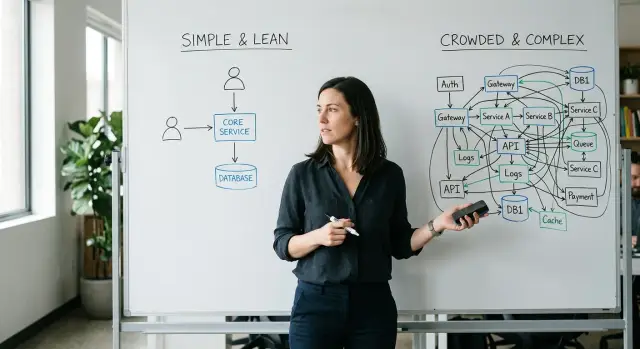
Table of Contents
Why stack choice becomes a daily cost
A stack rarely costs you most on launch day. It costs you on random Tuesdays, when a package update breaks the build, one service changes its API, and nobody remembers why a queue was added in the first place.
For founder teams, extra tools feel cheap at first. One handles auth, another sends events, a third runs search, and a fourth glues workflows together. Each solves a real problem. Together, they create a daily tax: more dashboards to check, more secrets to rotate, more invoices, more logs in different places, and more small failures that steal an hour at a time.
Small teams feel this first because they do not have spare people. The same person often writes code, talks to users, reviews analytics, and handles production issues. If that person has to understand three languages, two deployment paths, and five vendors, simple work stops being simple. A product change that should take one morning can turn into two days because every layer has its own rules.
That is why a lean stack usually wins for founder led products. Fewer moving parts mean less maintenance, lower hiring risk, and calmer incidents. When the system stays small, one solid generalist can trace a bug from the UI to the database, ship a fix, and move on.
Fashionable stacks often hide their price until traffic grows or the first engineer leaves. Then the team learns what it really bought: ongoing coordination work. Many stack choices look smart in a pitch deck and feel bad by month six. A stack is a daily operating cost, paid in time, focus, and mistakes.
What a lean stack looks like
A lean stack is a small set of tools your team can understand, run, and fix without drama. It has fewer moving parts, clear ownership, and as little duplication as possible.
A fashionable stack is different. Teams pick it because it is new, popular, or sounds impressive in a hiring post. That often adds extra layers before the product has enough users to justify them.
For most early products, a lean stack looks plain on purpose: one backend, one frontend, one database, one place for logs, and one way to deploy. If you can explain the whole system on a whiteboard in two minutes, you are probably close.
A common setup might be:
- a monolith instead of microservices
- PostgreSQL before extra data stores
- one cloud provider instead of two
- Docker and a basic CI pipeline instead of a custom platform
Simple defaults beat specialized services more often than founders expect. If your app needs search, PostgreSQL search can be enough for a long time. If you need background jobs, a database backed queue may work before you add a separate queue system. If one app server handles your traffic, splitting it into five services only creates more places for bugs and outages.
This is also why boring tools age better. They usually have better docs, more people who know them, and failure modes your team has seen before. PostgreSQL from five years ago is still easy to hire for today. A niche framework that looked smart last year can leave you stuck with one contractor and a messy upgrade path.
The same logic shows up in Oleg Sotnikov's work with small teams and AI first operations. Keeping the stack legible, cutting extra services, and automating repeatable work makes uptime easier to protect. That matters more than sounding current in a tech chat.
Founders do not need the most interesting stack. They need one that still feels manageable after six months of product changes, late night fixes, and one engineer going on vacation.
Where maintenance work really shows up
Maintenance work rarely comes from the app people see. It comes from the extra moving parts around it. A founder approves one new tool because it solves a real problem, then approves three more because they seem normal for a "modern" stack. A few months later, the team spends real time just keeping the system alive.
Start with upgrades and patches. Every database, framework, queue, SDK, hosting layer, and auth service adds its own release cycle. One upgrade sounds small. Ten separate upgrades create version conflicts, surprise breaking changes, and weekends lost to testing things that used to work.
A lean stack keeps this count low on purpose. Fewer parts mean fewer upgrade paths, fewer security patches to track, and fewer chances for one library to block the rest of the system.
The same pattern shows up in operations. Each extra service usually brings another dashboard, another alert rule, another secret to rotate, and another step in deployment. None of that helps a customer finish a task. It only gives the team more surface area to watch.
Custom glue code is another quiet cost. Teams write small scripts to sync users, push events, transform data, retry failed jobs, or bridge tools that were never meant to fit together. Each script looks harmless. Together, they become a second product that nobody planned to own.
A simple way to spot trouble is to ask four plain questions:
- What needs regular updates or patching?
- How many steps does one production deploy need?
- What code exists only to connect tools?
- Who fixes each piece at 2 a.m. when it fails?
That last question matters most. If the answer is "the one engineer who set it up," the stack already has a maintenance problem.
A small team can run a lot on one app, one database, one queue, and a short deploy path. Once the stack spreads across many vendors and custom connectors, every change gets slower. The product may look the same from the outside, but the team feels the weight every day.
How the stack changes hiring risk
A stack choice is also a hiring choice. If you build on tools that few people use, you cut your candidate pool before the job post even goes live. That does not just make hiring slower. It makes every departure more painful.
Common stacks give you more room to work with. If you use familiar tools like TypeScript, Node.js, Python, PostgreSQL, or React, you can usually find people who have seen the same patterns before. They may not know your codebase on day one, but they can get useful work done much faster.
A niche stack changes that math. You are hiring for a smaller mix of language knowledge, tooling habits, and hard to teach context. In a founder led product, that delay hurts. One open role can stall product work for weeks.
Resume fit matters less than ramp-up speed
Founders often overrate resume prestige and underrate ramp up time. A developer with a famous company on their resume still needs to learn your app, your release process, your bugs, and your tradeoffs. If the stack is familiar, that learning curve is shorter. If the stack is unusual, even strong engineers spend more time getting oriented.
This matters more than people expect. In a small team, you do not hire someone for abstract brilliance. You hire them to fix billing bugs on Tuesday, ship a small feature on Thursday, and handle an odd production issue without freezing.
Depending on one specialist is the worst version of this problem. If only one engineer understands the build system, the custom framework, or the unusual database setup, that person becomes a bottleneck. They do not need to quit for this to hurt you. Vacation, illness, or simple overload is enough.
Replacement cost also changes with the stack. Common tools usually mean a shorter search, less recruiter filtering, lower onboarding time, and fewer mistakes in the first months. With a niche stack, hiring often takes longer, salaries rise, and new hires need more hand holding.
That is why a lean stack is usually the safer bet. It keeps the team replaceable in the healthy sense of the word: no single person has to carry the whole system in their head.
How incidents break across different stacks
Lean systems fail in plainer ways. That sounds boring, but boring helps at 2 a.m. when login breaks, checkout hangs, or an API starts timing out.
Every new layer adds another place where requests can stall, data can drift, or logs can disappear. A simple app with one backend, one database, and one queue can still fail, but the blast radius stays easier to see. A more fashionable stack often adds edge workers, serverless functions, managed event buses, third party auth, separate search, separate analytics pipelines, and AI services from more than one vendor. Each part can work fine on its own and still break the whole flow.
Clear failures are faster to fix. If the database is down, you know where to look. If a bad deploy caused the error, you roll back and check the last change. Hard to trace failures waste hours because the symptom shows up in one place and the cause sits somewhere else.
Founders usually feel that difference in a few places. Recovery gets slower because the team has to check several dashboards before they can name the problem. Rollback gets messy when one release touches app code, cloud config, and vendor settings. Log access gets worse when each service stores events in a different format. On call stress goes up when nobody knows who owns the broken step.
Mixed vendors make diagnosis slower than most teams expect. One provider shows a timeout, another shows rate limits, and a third shows nothing useful at all. Now the team has to line up timestamps, request IDs, and partial logs across systems that do not talk to each other well. That delay often hurts more than the original bug.
Lean systems also make rollbacks more honest. If you deploy one app and one database migration, you can rehearse recovery and trust it. If your product depends on several managed tools, rollback often means hope rather than a plan.
This is one reason experienced operators keep observability close to the product. Oleg Sotnikov often works with self hosted CI/CD, Sentry, Grafana, Prometheus, and Loki for this reason: fast access to logs, metrics, and release history cuts incident time. Fewer moving parts do not stop outages, but they do help teams find the fault and recover before users give up.
A simple founder scenario
Maya runs a small SaaS with one engineer. They need user accounts, subscriptions, an admin area, email notifications, and a few background jobs. For a lean setup, they pick one web app framework, one PostgreSQL database, one queue, and one place to host it.
A friend pushes a more fashionable setup. That version uses edge functions, a serverless database, a separate auth service, a managed event bus, a search service, and a vector database they might need later. On day one, both versions look current. Only one stays easy to live with.
After six months, the product faces normal product work. Customers ask for billing fixes, CSV imports, better permissions, and audit logs. In the lean stack, most changes touch the app and the database. The engineer can trace a bug in one sitting, and Maya can still follow what broke.
In the heavier stack, the same feature spreads across several services. A permission bug might involve auth rules, event delivery, stale search data, and a background worker timeout. Nothing looks huge on its own, but the cost grows in the gaps between tools.
Hiring changes too. If Maya's engineer quits, she can usually find a decent full stack developer who knows the common tools. If the app depends on several niche services, hiring risk gets real fast. Candidates either lack one part of the stack or want a salary that hurts a small company.
Then Friday night arrives. Invoice emails stop, and some customers see unpaid accounts by mistake. In the lean stack, Maya's engineer checks one log stream, sees the job queue backed up after a bad retry loop, pauses the worker, clears the bad jobs, and replays the rest. It is a rough night, but the path is clear.
In the heavier stack, they first have to find where the failure started. Did the webhook fail, did the event bus delay delivery, did the auth service reject a token, or did one serverless function hit a limit? One stack gives you a short list of suspects. The other sends you on a scavenger hunt when you are already tired.
How to choose a stack
A lean stack starts with the next 12 months, not a five year fantasy. Most founders get into trouble when they pick tools for scale, complexity, or hiring plans that do not exist yet.
Use a short process and stay strict about it.
- Write down the product jobs you must support in year one. Think in plain terms: user accounts, payments, an admin area, reporting, maybe one AI feature. Split them into "must have now" and "can wait." If something can wait, it should not shape the stack.
- Pick the fewest moving parts that cover those jobs. One backend, one database, one frontend, and one deployment path is often enough.
- Choose tools your first hires already know. If your first engineer can ship in week one, you save real time. If they need a month to learn a niche setup, the stack is already costing you.
- Test failure before launch. Run a deploy, then roll it back. Break one part on purpose and see who gets the alert, how fast they see it, and whether they can recover without guessing.
- Add new tools only after a real bottleneck appears. That bottleneck should be easy to name: builds are slow every day, the database is close to its limit, or one feature truly needs a queue or search engine. "We might need it later" is not a good reason.
A small product can go a long way with one codebase, PostgreSQL, basic monitoring, and boring deployments. It may sound plain. Plain is often the right choice when the founder still needs to sell, hire, and talk to users instead of babysitting infrastructure.
Mistakes founders make
A small product team can drown in tool choices long before it hits real scale limits. The most common mistake is copying a stack from a famous company that solved a very different problem. A startup with two engineers does not need the same setup as a company with a platform team, a security team, and round the clock ops.
Another mistake starts in product demos. A tool looks slick, the sales pitch sounds smart, and the dashboard feels current, so it gets added to the stack. Then the team finds out nobody enjoys using it, local setup takes half a day, and debugging now crosses three services and two admin panels.
Data gets messy fast when founders split it across too many systems too early. Search in one service, auth in another, events in a third, analytics in a fourth, and business logic glued across all of them. Each choice looks small on its own. Together, they create slow queries, sync bugs, and awkward migrations.
The quiet work gets ignored most often:
- Can a new developer run the app locally in under an hour?
- Can the team roll back a bad deploy in minutes?
- Does someone know what to check at 2 a.m. when jobs stop running?
- Can one person inspect logs, metrics, and database state without jumping across five tools?
If those answers are weak, the stack is already too expensive.
One more pattern causes long term pain: letting one contractor choose everything alone. A smart contractor can build fast, but personal preference is not the same as team fit. If the stack depends on one person's habits, the company inherits hiring risk on day one.
A lean stack usually looks a bit boring, and that is often a good sign. Simple tools age better. They are easier to hire for, easier to run, and much easier to fix when production goes sideways.
Quick checks before you commit
A stack is probably too heavy if your team needs a meeting to explain how a single request moves through the product. One engineer should be able to trace it from browser or app, through the API, into the database, and back again. If that story gets fuzzy, bugs get expensive fast.
Speed matters just as much as clarity. A small team should be able to ship a change, spot a problem, and roll it back in the same afternoon. If deploys need three tools, four approvals, and one person who knows the "real" process, you do not have a problem later. You have one now.
Ask a few blunt questions before you commit:
- Can one person explain the full request path without opening five diagrams?
- Can the team deploy and undo a bad release before the day ends?
- Can support or ops find the right logs on their own when a customer reports a bug?
- If one vendor raises prices or breaks a feature, can you swap it out without touching half the product?
- If your most experienced engineer takes a week off, does work keep moving?
The support check gets ignored too often. When logs live in three places and only one engineer knows where errors show up, every incident turns into a scavenger hunt. Good stacks make boring work easy. Someone reports a payment issue, support finds the request, engineering sees the error, and the team fixes it without a chain of handoffs.
Vendor lock in deserves the same suspicion. Using a hosted search tool or auth service is fine. Building your whole product around one vendor's quirks is where trouble starts. Keep the edges clean so you can replace parts without a rewrite.
This is one reason experienced CTOs push for simpler systems early. The stack that looks slightly boring on day one is often the one that still feels manageable a year later.
What to do next
Buying one more tool feels easy. Living with it every week is the hard part.
Write a one page stack brief before you add anything new. Keep it plain. Note what you are building, how many engineers will touch it, who will handle deploys and alerts, and what must still work when one person is on vacation.
That brief should answer a few boring questions:
- What parts of the stack need daily or weekly care?
- How many people can debug each part without outside help?
- What breaks first during an incident?
- What will this cost in tools, cloud spend, and team time?
Then review the options in one meeting. Put cost, hiring risk, and incident behavior on the same page so nobody argues in the abstract. If one stack looks clever but needs rare skills, extra services, and more on call stress, that cost is real even if the demo looks great.
When two options seem close, pick the one with fewer moving parts. Most founder led products do not need five databases, three queues, and a custom platform layer. They need a stack the team can understand at 2 a.m. and change on a normal Tuesday.
If the team feels split, get a short outside review. A fresh pair of eyes can often spot tool overlap, hidden ownership gaps, and parts nobody really wants to maintain.
If you want that kind of review, Oleg Sotnikov at oleg.is works as a Fractional CTO for startups and small businesses. His approach is practical: cut stack sprawl, keep the system understandable, and add AI automation where it reduces real work instead of creating more overhead.
Frequently Asked Questions
What counts as a lean stack?
Usually it means one backend, one frontend, one database, one log stream, and one deploy path. If one engineer can explain the whole request path in a couple of minutes and fix most issues without jumping across vendors, you are close.
Why do trendy stacks cost more later?
The cost shows up in daily work, not the demo. Every extra service adds updates, secrets, dashboards, logs, and failure points, so small changes take longer and incidents drag on.
Should I start with microservices?
Most founder-led products should not. A monolith lets a small team ship faster, trace bugs in one place, and hire from a bigger pool. Split services only after one app truly blocks growth.
Is PostgreSQL enough for an early product?
Often yes. PostgreSQL handles normal app data, basic search, and even simple job queues for a long time. That saves you from adding more systems before you need them.
How do I know my stack is too heavy?
Watch how hard simple work feels. If deploys need several tools, one engineer holds the real setup in their head, or support cannot find logs without help, the stack already costs too much.
Does stack choice really affect hiring?
Yes, right away. Common tools let new hires ramp up faster, while niche tools shrink your candidate pool and turn every departure into a bigger problem.
Why are incidents worse in a complex stack?
Because the symptom and the cause often live in different places. Your team wastes time lining up logs, vendor status pages, and config changes instead of fixing the broken step.
When should I add another service or tool?
Add one only after you can name a real bottleneck in plain words, like slow builds every day or search that no longer meets user needs. "We might need it later" usually buys you maintenance before it buys you value.
How do I avoid vendor lock-in?
Keep the edges simple. Put vendor-specific code behind a thin layer, store your own source data in a system you control, and avoid building product rules around one provider's quirks.
Should I get an outside review of my stack?
If your team argues about tools, incidents feel murky, or one person owns too much hidden knowledge, a short review helps. An experienced CTO can spot overlap, hiring risk, and rollback gaps before they turn into weekly pain.


