Lean technical roadmap with a stop list for each quarter
A lean technical roadmap works better when every quarter includes a stop list. Learn what to delete, defer, or refuse so teams keep focus.
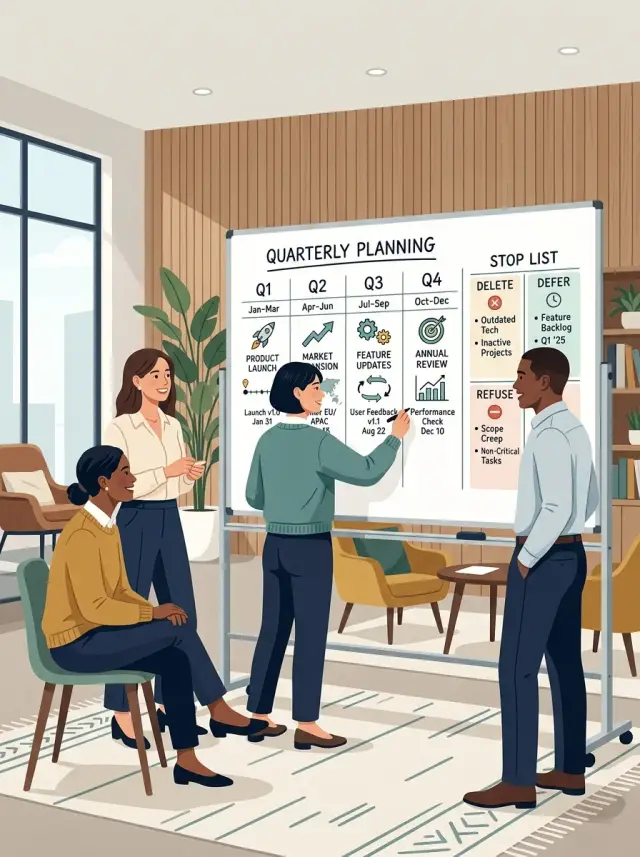
Table of Contents
Why roadmaps get crowded
Roadmaps usually get crowded for a simple reason: adding work feels easy, and removing work feels awkward. A new request can slip into the plan in ten minutes. Taking something out often starts a debate about promises, politics, or fear of disappointing someone.
That is how a focused roadmap turns into a wish list. Teams keep saying yes to the next feature, the next fix, the next internal idea. Very few people ask what should leave the plan to make room for it.
Old promises make this worse. A feature that mattered three months ago can lose its place after a pricing change, a customer shift, or a product update. Many teams still leave it on the roadmap because nobody wants to say it is deferred.
Planned work also competes with work that shows up uninvited. Support issues interrupt the week. Bugs pull engineers off scheduled tasks. Infrastructure chores are easy to ignore on paper, but they still take time. Server updates, backups, access problems, and release cleanup can quietly eat a large part of the quarter.
When quarterly goals ignore that reality, the roadmap stops being a plan. It becomes a polite fiction. Everything looks approved, but the team already knows some items will get little attention or none at all.
That is the most expensive part of a crowded roadmap. It hides what the team will ignore. Product, sales, and leadership may keep planning around items that will never ship because nobody marked them as out of scope.
A small SaaS team can hit this fast. They might schedule a new reporting page for Q2, keep an old mobile refresh on the list, and assume maintenance work will stay small. Then login bugs, billing tickets, and a server patch take ten days. The roadmap still looks full, but the team spent most of the month reacting.
A stop list fixes this. It forces the team to name what will not happen this quarter, not just what will.
What belongs on a stop list
A stop list is a short record of work the team will not do this quarter. It matters as much as the goals list because it shows where focus starts and where it ends.
Some items belong there because they no longer matter. Delete work when the problem is gone, the customer need never showed up, or a newer plan made the old one pointless. Old dashboard cleanup, a second admin panel nobody uses, or a rewrite idea that has been drifting around for months usually fit here.
Other items still matter, but the timing is wrong. Defer work when the idea is sound and the quarter is about something else. A team may want better internal analytics, a mobile app, or a bigger permissions model, but if the next 12 weeks are about cutting outages, those projects need to move out of the way.
A third group needs a clear no. Refuse work that breaks the quarter goal, even if the request sounds smart on its own. If the team chose faster onboarding, then a custom feature for one prospect, a design refresh, or a database switch can pull attention away fast.
The difference between defer and refuse is simple. Deferred work may come back next quarter. Refused work does not belong in the current plan because it fights the goal or burns time without enough payoff.
Write one short reason next to every item. That keeps the list honest and makes week-six debates much easier.
For example:
- Delete: old import tool, replaced by the new flow
- Defer: advanced audit log, wait until enterprise demand justifies it
- Refuse: framework migration, no user impact this quarter
Most teams already know what they want to start. They get sharper when they also name what they will delete, defer, or refuse, and why.
Build the list in one planning session
This works best when everything sits on one page.
Start with one sentence: the single result you want by the end of the quarter. Make it concrete. "Reduce onboarding drop-off by 20%" is usable. "Improve the product" is not.
Then pull every active request into the room. That means roadmap ideas, bug reports, sales promises, founder asks, infrastructure work, customer complaints, and old tickets nobody closed. If part of the work lives in chat, docs, and someone's head, the plan will look smaller than it really is.
Once the full pile is visible, label each item with one of four choices:
- Keep if it directly supports the quarter result
- Delete if nobody can explain why it still exists
- Defer if it matters, but not now
- Refuse if it is a bad fit for the quarter
The sorting is usually quick. The cutting is not.
You have to cut until the work fits the team you actually have, not the team you wish you had. If three engineers can finish about six meaningful tasks, do not plan twelve and call half of them "stretch." That is how quarterly goals turn into a stack of half-done work.
A small SaaS team can do this in one meeting if one person owns the board and keeps the group honest. Hidden work often changes the plan more than shiny new ideas do. Release chores, support load, migration cleanup, and monitoring fixes eat real time. Put them on the board before you promise anything new.
End the meeting by naming one owner for every kept item and for the stop list itself. If nobody owns a deferred request, it sneaks back in next week. If nobody owns a refusal, someone will reopen it after one loud customer call.
Pair every goal with real tradeoffs
A roadmap gets real when every goal has a price.
If you add one major item for the quarter, remove at least two others. That rule feels strict, but it forces honest planning instead of wishful planning.
The cuts should free the same kind of capacity the new work will use. If a billing project needs your backend engineer, QA time, and database changes, then the work you cut should free backend, QA, and database capacity too. Dropping a blog refresh does not help if the bottleneck sits with the same two engineers.
Shared teams need extra protection. Product groups often promise work without checking who else they pull in. A small feature can still hit design, DevOps, support, and finance. That is how a quarter gets crowded through side doors.
A simple rule helps: if a goal touches a shared team, write down which requests that team will ignore this quarter. That might mean no one-off customer reports, no internal dashboard cleanup, and no extra environment setup unless it supports a committed goal.
A tradeoff note can be blunt:
- Goal: improve onboarding conversion
- Cut: defer account settings redesign
- Cut: refuse custom signup flows for sales deals
- Cut: pause low-traffic admin polish work
This makes focus visible outside engineering too. Sales can see why a custom request got pushed out. Support can see why an internal tool update waits. Leaders stop treating the roadmap like spare capacity.
Say what will not ship in plain language. "No mobile app refresh this quarter" is much better than "mobile improvements under review." Soft wording invites the same debate every week.
If a goal has no matching cuts, it is not a goal yet. It is just another wish on a crowded list.
A simple example from a small SaaS team
A five-person SaaS team plans the next quarter around one clear goal: cut signup drop-off before a launch. They have enough traffic to know the problem is real. Too many people start the flow, hit friction, and leave.
Their roadmap stays short on purpose. One product manager, one designer, and three engineers can finish a lot in 12 weeks, but only if they stop pretending every good idea belongs in the same quarter.
They make four decisions. They delete a dashboard redesign that has been sitting in Figma for months. No customer asked for it, and it does nothing for signup. They defer a mobile app refresh to the next quarter. The app matters, but the launch depends more on getting new users through the front door. They refuse custom client features that would split the team into side work for two large accounts. And they keep one reliability task: fixing slow email verification and retry logic, because failed confirmation emails directly hurt conversion.
Now the quarter gets easier to manage. The designer works on signup steps, error messages, and pricing page clarity instead of polishing internal screens. Engineers spend time on form flow, analytics events, email delivery, and a few A/B tests. Support knows which requests will get a polite no.
This kind of tradeoff looks boring, and that is usually a good sign. Teams get into trouble when every plan is full of shiny work that feels exciting but does not move the number they care about.
It also protects morale. Nobody gets dragged into five half-finished tracks. The team can point to one outcome, one supporting reliability fix, and a short stop list that explains why other work is out.
If the launch goes well and signup conversion improves, they can reopen the mobile refresh later. If it does not, they still learned something useful without wasting a quarter on scattered work.
Mistakes that weaken the stop list
A stop list fails when it feels polite instead of firm. Teams write it to look disciplined, then keep every door half open. A few weeks later, the quarter is crowded again and nobody knows why.
The first mistake is vague wording. Items like "platform improvements" or "tech cleanup" sound harmless, but they hide too much. One person thinks that means fixing alerts. Another thinks it means a database rewrite. If the team cannot point to a clear item and say "not this quarter," the list will not protect any time.
Another mistake is hiding the cuts in a separate document. The roadmap sits in one deck, the stop list in a planning note, and status meetings only mention goals. People remember what they promised to ship and forget what they agreed to defer. The tradeoff needs to sit next to the goal or it disappears.
Leadership can break the list even faster. If leaders reopen closed items every week, the team learns that "deferred" really means "wait for the next loud meeting." That leads to constant debate, not focus. Revisit a closed item only when something in the business actually changed.
Stretch work creates a quieter problem. Planning ends, then extra projects slip in under labels like "nice to have" or "if we have time." Most teams do not have spare time. They have hidden work, support issues, and bugs. When stretch work enters after planning, it usually steals time from testing, cleanup, or the last 20 percent of the main goal.
You can usually spot a weak stop list quickly:
- People use broad labels instead of naming exact work
- The cuts are harder to find than the roadmap
- Anyone can reopen a deferred item in a weekly meeting
- New work enters without removing something else
If you want the list to hold, make every stopped item specific, visible, and hard to reopen.
Checks before the quarter starts
A quarter often goes off track before the work even begins. Teams start with a goal that sounds good in a meeting, then fill the calendar with side work, support requests, and old promises nobody wants to revisit.
Before day one, ask four plain questions:
- Can everyone say the goal in one sentence?
- Does every cut have one owner and one review date?
- Did you leave time for support and bug fixes?
- Will stakeholders see what you said no to?
If people describe the same goal three different ways, you do not have a goal yet. You have a theme. "Improve onboarding" is too loose. "Reduce signup drop-off by fixing the first-run flow" gives the team something they can repeat, check, and argue about if needed.
The stop list needs the same clarity. "Pause analytics cleanup" is weak. Name the person who owns that pause and the date when you will review it again. Without an owner, the work slips back in through chat, side tickets, or a loud sales request.
Most teams also plan as if support work will disappear for a quarter. It never does. Leave room for bug fixes, customer questions, small incidents, and the weird issue that only shows up on Friday afternoon. If your team usually spends 25 percent of its time on that work, plan for it.
Visibility matters just as much as discipline. Stakeholders should see the goals and the cuts. When they can read the no list, they stop assuming every idea still sits in the queue. That reduces last-minute pressure and makes tradeoffs feel real.
Keep the list alive during the quarter
A stop list only works if the team sees it every week. Put it next to the quarter goals in the same planning document and review both in the same meeting. If a goal gets attention but the stop list stays untouched, the roadmap will slowly turn back into a wish list.
Weekly planning is the best place to keep the list honest. When a new request shows up, do not ask only, "Should we do this?" Ask, "What are we dropping, delaying, or refusing to make room for it?" If nobody wants to cut anything, the answer is usually no.
Small teams feel this fast. One extra integration, one custom report, or one "quick" internal tool can eat a few days. That may not sound huge, but across a quarter it can break the work that actually moves the product forward.
Treat every new request as a trade, not an addition. Ask four things: what current goal loses time, what item moves to the stop list now, who agreed to the swap, and when that decision will be reviewed again.
This keeps changes visible instead of letting them sneak in through chat, side meetings, or founder requests.
Reopened items deserve special attention. If the same stopped task comes back again and again, tag it and count it. That is scope creep in plain view. Sometimes the request is real. More often, people feel uneasy saying no, so the same idea keeps returning with a new label.
Urgent work needs the same rules. Production issues, customer bugs, and security problems are real, but "urgent" should not give work a free pass. If the team pulls in an urgent item, they should still name what slips.
A short review every week is enough. Fifteen clear minutes beats one long rescue meeting at the end of the quarter.
What to do next
Put the next quarter on one page. If the page does not fit on one screen or a single sheet, the plan is still too wide.
Write one outcome that matters enough to protect. Keep it concrete. "Ship self-serve billing" or "cut failed imports by half" is easier to defend than "improve platform experience."
Then add the work that will not happen. Right under the quarter goal, write three lines: one thing you will delete, one thing you will defer, and one thing you will refuse even if someone asks for it mid-quarter.
A small SaaS team might choose "reduce onboarding drop-off" as the goal. Their stop list could be simple: delete a half-used internal report, defer a mobile app refresh, and refuse one-off sales requests that pull engineers away from signup fixes.
Make those tradeoffs public before people start making side promises. Product, sales, support, and founders do not need a long deck. They need to see the limits early, while there is still time to push back.
An outside review can help if your team keeps stuffing extra work into every quarter. Oleg Sotnikov at oleg.is works with startups and smaller businesses on roadmap focus, technical priorities, and Fractional CTO support, and that kind of second opinion is often enough to spot old promises and hidden capacity problems.
Do the draft this week, not at the end of the month. A rough stop list now is better than a polished roadmap nobody can protect later.
Frequently Asked Questions
What is a stop list in a roadmap?
A stop list names the work your team will not do this quarter. Put it next to the quarter goal so everyone can see the tradeoffs, not just the planned work.
It keeps the roadmap honest. Without it, old promises and random requests keep sliding back into the plan.
What is the difference between defer and refuse?
Defer means the work still makes sense, but not in this quarter. You may bring it back when the goal changes or capacity opens up.
Refuse means the work fights the quarter goal or eats too much time for too little return. It should stay out unless the business changes in a real way.
How many items should a small team put on a quarterly roadmap?
Start with one clear outcome for the quarter, then cut until the work fits the team you actually have. If three engineers can finish about six meaningful tasks, plan around that reality instead of filling the board with stretch work.
A shorter roadmap usually ships more.
Should bugs and support work count when we plan the quarter?
Yes. Bugs, support load, release chores, and infra work take real time, so treat them as part of the plan from day one.
If you ignore that work during planning, the roadmap turns into a promise your team cannot keep.
Who should own the stop list?
Give one person clear ownership of the stop list. That person keeps it visible, updates it when the team makes a trade, and stops closed items from sneaking back in.
Shared ownership often turns into no ownership.
When should we bring a deferred item back?
Reopen it only when something actually changed. A new customer segment, a broken assumption, or a serious production issue can justify a review.
Do not reopen work just because someone brought it up again in a meeting. That trains the team to treat every no as temporary.
How should we handle urgent new requests during the quarter?
Treat every new request as a swap, not an add-on. Ask what current work loses time, what moves to the stop list, who agreed to the change, and when you will review it again.
If nobody wants to cut anything, say no.
Where should the stop list live?
Keep it in the same document as the quarter goals and review both in the same weekly meeting. When the stop list lives in a separate note, people forget it and keep planning around work you already cut.
Visibility does a lot of the work here.
What makes a stop list clear and useful?
Use exact item names and one short reason next to each one. Write things like "defer mobile app refresh" or "refuse framework migration" instead of broad labels like "platform work."
Specific wording stops weekly debates because people can see what you meant.
What if leadership or sales keeps pushing work we already cut?
Show the tradeoffs early and in plain language. If sales, support, and leaders can read what will not ship, they stop assuming every request still sits in line.
When someone pushes an old promise, tie the answer back to the quarter goal and the capacity you already committed.


