Lack of technical strategy: signs hidden in repeated delays
A lack of technical strategy often shows up as roadmap churn, tool spread, and nonstop emergency work. Spot it early and fix the pattern.
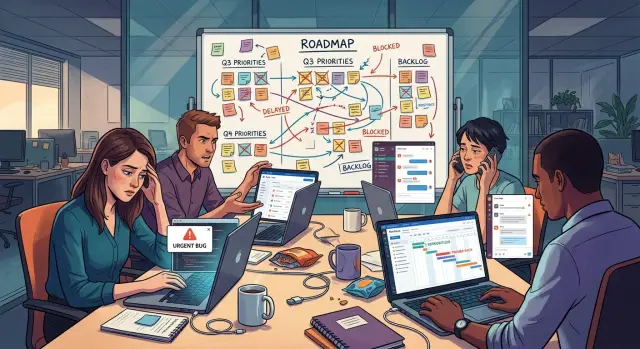
Table of Contents
What the problem looks like day to day
Poor technical direction rarely appears as one dramatic failure. It shows up in ordinary work.
A deadline moves from Friday to Tuesday, then to "early next week," and nobody even reacts. Managers stop trusting the plan, so they spend more time asking for updates than helping the team move. Standups get longer. Status meetings multiply. People fall back to chat threads as a tracking system because the official plan is already stale.
Engineers feel it in a more irritating way. They start one task, switch to an urgent fix, jump to a customer request, then return to the first task days later. Work stays unfinished across branches, tickets, and documents. Everyone stays busy all week, but it is hard to point to what actually shipped.
Sales and support feel the same drift from a different angle. They still need to answer customers, so they guess at delivery dates. Those guesses quietly become promises. Then engineering has to explain why the feature is late, why the integration needs more time, or why a bug that looked small blocked the release.
Inside the company, this can start to feel normal. People talk about speed, but most of the week goes to catching up. Simple requests take longer each month even though everyone is working hard. Teams blame communication, but the deeper problem is that nobody has set a shared technical direction.
A growing company can live with some chaos for a while. Early startups often do. But when the same scenes repeat every week, the issue is no longer "we are just busy." The company is making decisions one request at a time.
You can see it in small moments. A founder asks for a launch date and gets three different answers. A support lead checks with engineering before replying to a customer because last week's estimate was wrong. A developer keeps a private to do list because the board changes too often to trust. When enough of those moments pile up, the day to day work is already telling you that something is off.
Why the same delays keep coming back
A late release often gets explained away as bad luck. A vendor changed something. A bug took longer than expected. One engineer got pulled into support. All of that happens. The pattern matters when the same kind of delay returns every month with different details.
Teams often treat each delay as its own fire. They patch the issue, work a few late nights, move the date, and keep going. Almost nobody stops to ask why work keeps reaching the same blocked state. That is how missing technical direction hides in plain sight.
One common cause is unspoken tradeoffs. Leadership says it wants speed, low cost, and low risk at the same time, but nobody ranks those goals. The team has to guess. One manager pushes for a fast launch. Another wants more checks. Someone else wants to avoid changes to old systems to save money. Each choice makes sense by itself. Together, they pull the work apart.
The next problem starts earlier than most founders expect. Teams begin building before they agree on the technical plan. They know the feature idea, but they have not settled the system changes, dependencies, testing approach, or limits of the current setup. Work starts because the deadline feels urgent. The hard questions appear halfway through the sprint, when changing course is slow and expensive.
The pattern is easy to spot once you know where to look. Estimates change after coding starts. Priority calls depend on who spoke last. Engineers spend more time clarifying than building. Old shortcuts keep forcing rework.
A good fractional CTO looks past the latest missed date and checks the decision path behind it. Who set the priority? What tradeoff did they choose? What plan did the team agree on before coding started? Those answers tell you more than any status update.
Repeated delays rarely come from one bad week. They come from the same unresolved choices, made again and again, until the schedule starts to feel random.
Roadmap churn as an early warning
Roadmap churn looks harmless at first. A feature moves from this month to next month, then disappears, then comes back with a smaller scope. If nobody can clearly explain why it moved, you are not looking at healthy change. You are looking at weak planning.
The pattern gets clearer when work starts before the team breaks it into smaller pieces. A large project sits on the roadmap as one big promise. Halfway through, engineering finds hidden dependencies, extra integration work, or missing decisions. Estimates change after work has already started, and everyone acts surprised even though the work was never planned in enough detail.
Another warning sign is a split timeline. Product plans around launches, campaigns, or sales promises. Engineering plans around what the current system can support, what needs cleanup first, and how many people are free to do the work. When those two calendars rarely match, the roadmap keeps changing because there was never one shared plan.
You can usually see the damage in unfinished work. Items from one quarter drift into the next, then drift again. After a while, the roadmap fills up with postponed fixes, partial features, and renamed projects that are really the same old work.
Some teams explain this by saying they are "always adjusting to new information." Sometimes that is true. More often, they are reacting to weak scoping, unclear ownership, and decisions that should have happened earlier.
A simple review helps. Look at the last three roadmap changes and ask four plain questions: who asked for the change, what new fact caused it, why the team missed that fact earlier, and what work got delayed because of it. If those answers are vague, the problem is not speed. The roadmap is absorbing confusion that should have been handled upstream.
Tool spread that hides bigger issues
When each team picks its own tracker, chat tool, docs, or deploy flow, the mess usually starts with small local fixes. Design wants one tool. Engineering wants another. Support keeps notes in chat. Operations has its own release routine. None of that feels serious at first.
The tool itself is rarely the real issue. The issue starts when nobody can say, in one sentence, where the current truth lives.
A product manager updates plans in Notion. Developers track work in Jira. Support reports bugs in Slack. Release notes sit in GitLab comments or a spreadsheet. One feature can pass through four places before it ships. People ask the same questions again because they no longer trust what they see.
New tools also arrive faster than old ones leave. A team feels pain, buys something new, and moves on. Nobody owns cleanup, so the old tool stays half alive. A few months later, the company pays for overlap and still cannot get a clear view of status, blockers, or release risk.
That is when personal habits take over. One engineer writes careful handoff notes. Another explains everything in chat. A manager keeps private docs. Someone else remembers the real plan in their head. Work starts to depend on who is involved that week instead of shared rules.
Most teams do not need a complicated fix. They need one place for current priorities, one place for technical decisions, one release flow that everyone uses, and a regular review of tools to remove, not just tools to add.
Without those rules, leaders often misread the problem. They assume the company needs better software, more process, or another project manager. Often it is simpler than that. The spread of tools is just the visible symptom of weak technical leadership.
If five people give five different answers to "where do I check the latest status?" the company is already losing time every day.
Emergency work that takes over the week
A week full of urgent fixes is often the clearest sign that the team is running without enough technical direction. Planned work starts on Monday. Then a bug blocks a customer, an outage needs a patch, and a rushed sales promise pulls two developers into another quick change. By Friday, the team has worked hard and shipped almost nothing it planned.
This hurts more than the task list. Senior engineers and managers spend their time approving hotfixes, checking risky changes, and answering "can we patch this today?" They stop doing the slower work that prevents the next mess, like sorting priorities, reducing risk, and setting rules for how the team builds and releases.
The signs usually show up together. Sprint work rolls into the next week because urgent tickets jump the line. Senior people review tiny fixes all day and never get time for planning. Cleanup gets postponed because another urgent request is already waiting. On call work spills into evenings, and people start to sound tired or detached. Delivery dates turn into guesses because urgent work wins every time.
The hardest part is that emergency work can look productive from the outside. Chat is busy. People respond fast. Problems get patched. But the team is living one step behind the system. It is paying for old decisions every day.
Over time, morale drops. Good people get frustrated when they cannot finish anything properly. They stop trusting dates, and so does everyone else. Once that happens, even simple roadmap promises lose weight because nobody expects the plan to survive the next outage or rushed request.
Every team needs some urgent work. Production systems are messy, and customers do hit real problems. The problem starts when emergencies become the normal shape of the week. That usually means the company lacks guardrails, cleanup time, or one clear owner of technical direction.
A simple example from a growing company
A small SaaS company starts growing fast. New customers arrive, and several ask for custom features before they sign or renew. The founder says yes because each request looks close enough to the product they already have.
At first, the team feels fast. One developer adds a new automation service for a client workflow. Another plugs in a second reporting tool because the first one cannot handle a custom dashboard. A third sets up a separate notification system to ship alerts faster.
None of those choices looks dangerous by itself. Together, they create the kind of tool sprawl that quietly slows everything down.
Three months later, releases happen less often, not more. A feature that once took four days now takes two weeks because people need to check more systems, update more scripts, and test more edge cases. Small changes break things that used to feel stable.
Support feels it first. Tickets rise because rushed fixes create new problems. A customer export fails after a reporting change. Notifications send twice for some accounts. User permissions reset after a custom workflow update. The team patches one issue and creates another nearby.
The founder sees the delays but struggles to name the cause. On paper, the team is busy all week. In reality, much of that time goes to rework, manual checks, and urgent fixes that never make the roadmap smaller.
This is what missing technical direction often looks like in real life. The company does not slow down because one engineer picked the wrong tool. It slows down because nobody set rules for custom work, shared architecture, or the point where "one more system" stops being a shortcut and starts being a cost.
A fractional CTO usually spots this quickly. More customers brought more promises. More promises brought more tools. More tools brought more breakpoints. The founder sees repeated delays. The cause sits underneath them.
How to check the problem step by step
You do not need a long audit to see whether this is happening. One month of recent work is usually enough.
- Pull the last ten delayed items, whether they were features, fixes, releases, or internal projects. Write down the original target date, the actual date, and the plain reason each one slipped.
- Mark every item that changed scope after work started. If half the list grew mid build, the team did not start with a stable decision.
- Count how many tools the company uses for planning, code review, documentation, and incident handling. Tool sprawl often means people follow different rules without admitting it.
- Compare planned work with emergency work from the last four weeks. Include outages, urgent customer requests, hotfixes, and last minute executive asks.
- Ask three ownership questions: who decides architecture, who sets delivery rules, and who chooses when to pay down technical debt. If five people give three different answers, nobody really owns the system.
Then write down the tradeoffs leadership actually wants. Keep it blunt. Does the company want faster shipping, fewer incidents, lower cost, or a major product change first? Teams struggle when leaders ask for all of them at once and never rank them.
This check works because it turns vague frustration into evidence. Scope changes show roadmap churn. Too many overlapping systems show tool sprawl. Hours lost to urgent work show how much of the week is getting hijacked.
A small company might find that six of the last ten delays came from changed requirements, four different tools held the same project notes, and emergency work ate two days each week. That is not a scheduling problem. It is a strategy problem that shows up in the schedule.
If your notes fit on one page, you already have enough to start fixing the right thing.
Mistakes that make the gap worse
When delivery starts slipping, teams often respond with more activity. That usually makes the real problem harder to see.
Hiring is a common example. If leaders add engineers before they set direction, the team gets bigger but not clearer. New people need onboarding. More meetings appear. Different ideas about priorities start to clash. A team of five can move faster than a team of ten if everyone works from the same plan.
Buying another tool creates the same trap. One tool tracks tasks, another tracks bugs, a third stores docs, and a fourth handles roadmaps. Soon nobody knows which version is current, and work slips because people spend time checking systems instead of finishing work.
Rewrites create another false fix. If the current process feels messy, a full rebuild can feel clean and decisive. Most of the time, it only hides the original problem. The team still has weak priorities, unclear ownership, and too much urgent work. Now it also has an unfinished rewrite.
Private priority changes do damage faster than many founders expect. A sales call happens, a customer complains, a manager sends a message, and work changes in chat without any update to the shared plan. People spend the week pulling in different directions. That is when deadlines start moving and old tasks keep reopening.
Even measurement can push the team the wrong way. If managers reward ticket count, people learn to close small items instead of solving the right problem. Fifty closed tickets can still leave a broken onboarding flow, a slow checkout, or an unstable release process.
A better response is usually less dramatic. Keep one shared priority list. Remove overlapping tools before buying new ones. Fix process problems before adding headcount. Rewrite only when the team can name the exact payoff. Measure finished outcomes, not task volume.
That kind of advice can sound plain, but it works. Cut overlap, make priorities visible, and protect the team from random changes. That does more than another hiring sprint or another software subscription.
Quick checks for founders and managers
Five direct questions can expose the gap faster than a month of status meetings.
- Ask one person to explain why the roadmap changed last month. If the answer is "priorities shifted," ask again. You want the real reason: a customer promise, a system limit, a missed estimate, or a surprise bug.
- Ask engineering which systems block delivery most often. If every team names something different, the company is probably working around pain instead of fixing it.
- Ask product, engineering, and sales for the next release date. If you get three dates, you do not have one plan. You have three stories.
- Ask how many hours emergency work took last week. If nobody tracks it, urgent work can swallow half the week without anyone noticing.
- Ask who owns technical standards. One clear owner is enough. If ownership is split across three people, standards usually turn into opinions.
These checks work because they test shared understanding, not optimism. A healthy team can still have delays, but people usually agree on what changed, what hurts, and who decides.
Take a simple example. Sales promises a feature for the end of the month, product thinks it will ship next sprint, and engineering says a billing service keeps breaking deployments. None of those answers is crazy by itself. Together, they show a company running without one clear technical direction.
You do not need a big audit to spot this. One meeting and a few direct questions are often enough. Write the answers down. Look for gaps, not excuses.
If the answers clash, fix ownership before you buy another tool or add more people. This is often where a fractional CTO helps most. An outside technical lead can turn scattered opinions into one roadmap, one release story, and one set of tradeoffs.
What to do next
Start with one planning cycle, not a grand reset. Most teams do not need a dramatic rewrite on day one. They need one calm cycle where the team commits to a small set of work and stops changing direction every few days.
Freeze scope for that cycle and defend it. If a new request appears, move it to the next cycle unless it fixes a live incident, a security issue, or a legal problem. Some teams call this rigid. Usually, it is the first time they get to see what normal delivery actually looks like.
Then cut the number of tools. Pick one place for planning and one place for documentation. Remove tools that duplicate the same job. Move old work into the systems you keep. The goal is simple: when someone asks where the latest answer lives, everyone should give the same answer.
The week also needs space for work that never makes the roadmap. Reserve time for bug fixes, incident follow up, technical debt, flaky tests, and cleanup. Even a small buffer can stop urgent work from swallowing the whole week.
You also need one technical leader with clear authority over architecture choices. That does not mean one person does everything. It means everyone knows who decides when the codebase, tooling, or infrastructure starts drifting.
If this pattern has been going on for months, an outside review can help. Oleg Sotnikov at oleg.is works with startups and small companies as a Fractional CTO and advisor, helping teams tighten architecture, infrastructure, and AI adoption without hiring a full-time CTO right away.
A simple plan beats a clever one. If the team can follow it for one full cycle, the difference shows up quickly.
Frequently Asked Questions
How do I know if delays mean a strategy problem?
Look for the pattern, not one slip. If dates keep moving, scope changes after work starts, and urgent fixes eat the week, the problem usually sits in weak direction rather than bad luck.
What does roadmap churn actually look like?
Roadmap churn means planned work keeps moving, shrinking, disappearing, or coming back under a new name. Some change is normal, but repeated changes without a plain reason usually mean the team started too early or never agreed on tradeoffs.
How much emergency work is too much?
If urgent work takes a small slice of the week, teams can absorb it. When hotfixes, outages, and rush requests regularly push planned work into next week, emergencies have become the real roadmap.
Why do extra tools slow the team down?
Too many tools split the source of truth. People stop trusting the board, ask the same questions in chat, and waste time checking notes across several systems before they can ship anything.
Who should own technical direction?
One person needs authority to make architecture calls, set delivery rules, and decide when to pay down technical debt. Without that owner, teams fill the gap with private decisions and mixed priorities.
Should we hire more engineers before fixing the process?
Not usually. More engineers help only after you set one plan, one release flow, and one set of priorities. If direction stays fuzzy, a larger team often creates more meetings and more rework.
Do we need a rewrite if delivery feels messy?
Most teams should resist that urge. A rewrite feels clean, but it rarely fixes weak ownership, shifting priorities, or constant interruptions. You can end up with the same habits on top of a half-finished rebuild.
What should we review first to confirm the problem?
Start with the last month of delayed work. Compare the original dates with the actual dates, note scope changes after work began, and measure how many hours emergency work took from the team.
How can we stop mid-cycle scope changes?
Freeze scope for one planning cycle and defend it hard. Move new requests to the next cycle unless they cover a live incident, security issue, or legal need, and make sure everyone sees the same priority list.
When does it make sense to bring in a fractional CTO?
A fractional CTO fits when the company needs senior technical direction but does not need a full-time CTO yet. That usually happens when releases keep slipping, tools keep spreading, and nobody can give one answer on priorities, architecture, and delivery.


